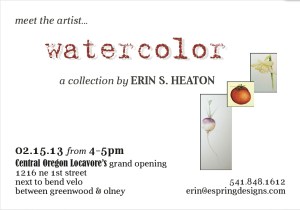
Tomorrow graphic designer and botanical artist,
Erin S. Heaton, will unveil watercolor, an exhibition showcasing a collection of her botanical paintings.
Meet the artist tomorrow at Central Oregon Locavore, Bend’s new grocery store from 4-5 pm.
Tomorrow graphic designer and botanical artist,
Erin S. Heaton, will unveil watercolor, an exhibition showcasing a collection of her botanical paintings.
Meet the artist tomorrow at Central Oregon Locavore, Bend’s new grocery store from 4-5 pm.
Posted in botanical art, Education, Learning Opportunities, Special Announcements, Special Events |
Artist residencies sound romantic. However a residency comes with expenses and logistical issues you may never have considered.
Featured guest Ruth Ava Lyons explains what is expected of artists during and after a residency.
Artists generally have to pay for their round-trip transportation to a residency. Housing and studio space is covered as well as meals. Sometimes there is a small stipend for materials. A residency can range from 2 weeks to one year, so you have to be contractually bound to a time frame. This is why it is good to do residencies when you are young and do not have to deal with the interruption in family life with children or occupation. The artist is expected to…
Posted in botanical art, Education, Learning Opportunities, Special Articles & Interviews, Special Events |
 ArtPlantae has received a Making A Mark Award by artist and writer Katherine Tyrrell, editor of Making A Mark, a blog about art for artists and art lovers. Katherine’s resource-rich blog is rated #3 out of the top 25 art blogs in the UK.
Katherine awarded ArtPlantae with The Going Greener Gong for 2012. This award is given to the art blog “most stimulating in relation to getting us in touch with nature and the environment.”
It is an honor to receive this award from Katherine and I appreciate her bringing attention to the site and the wonderful guests who have taught us so much.
View previous award winners of The Going Greener Gong, as well as winners in the plein air category and the sketchbook category at Making A Mark.
Posted in Blog News, botanical art, nature, Special Announcements | 4 Comments »
Last week Ruth shared some ways artists can learn about residency programs. Today Ruth answers the question:
Do residency programs accept up-and-coming artists or do they only want to deal with artists with extensive portfolios?
Ruth says…
The cost of being an artist is very high, with competition being a fact of the lifestyle. It isn’t enough to be productive and talented…you have to stay on top of a self-marketing plan 24/7. There is a great deal of rejection that accompanies the struggle, so you have to be very persistent and keep letting programs/institutions know of your existence. This approach applies to residency programs as well.
Posted in botanical art, Education, Learning Opportunities, Special Articles & Interviews, Special Events |
For the past fourteen years, the botanical gardens at the University of California Riverside has hosted Primavera in the Gardens, its annual fundraiser. This year the UCR Botanic Gardens will celebrate its 15th Annual Primavera event and the 50th anniversary of the founding of the gardens. In celebration of these important milestones, the UCR Botanic Gardens is inviting local artists to submit original artwork to their annual poster art contest.
Artists in the Riverside area are eligible to submit original artwork in two categories — photography and painting/drawing. All entries must be of the
UCR Botanic Gardens and be no smaller than 11″ x 14″. All entry forms and artwork must be sent to Margo Chabot no later than March 15, 2013.
First- and second-place awards will be given in both categories. The four award-winning pieces will be auctioned off at the 2013 Primavera Silent Auction. The two first-place winners will become the exclusive property of the UCR Botanic Gardens and will be used as the artwork for the 2013 Primavera event. Artwork will be printed on posters that will be distributed throughout the Riverside area.
First-place winners in each category will each receive four tickets to Primavera 2013, second-place winners will each receive two tickets.
For more information, download the call for entries packet below:
Primavera in the Gardens Poster Art Contest
Please direct all questions to Margo Chabot or Brightie Dunn.
Posted in botanical art, Learning Opportunities, Photography, Special Announcements, Special Events |
Valerie Webb of The Illustrated Garden will lead a three-day workshop at Splinter Hill Bog in Alabama, a preserve that is home to several species of carnivorous plants, including five species of pitcher plants.
Here is what’ new at Classes Near You > Alabama!
The Illustrated Garden, A Studio Blog
www.valwebb.com
Val Webb is the 2013 Artist-in-Residence at the Mobile Botanical Gardens. This year Val will work at the gardens and encourage others to sketch the garden’s collections to learn about plants, gardening and all that the Mobile Botanical Gardens has to offer. Visit Val’s website to view her online tutorial, Botanical Drawing with Pencil and Watercolor. Connect with The Illustrated Garden on Facebook.
Posted in botanical art, botany, Education, general botany, Learning Opportunities, nature, Sketching & Journaling, travel |
With spring and Earth Day fast-approaching, here is a resource you’ll want to refer to the next time you need to talk about plants with preschool children. It will also help you introduce young audiences to the subjects of inheritance and traits.
In Plants, Alike and Different professor Kathy Cabe Trundle and doctoral students Mandy McCormick Smith and Katherine N. Mollohan explain how they use a learning cycle involving play, exploration, and discussion to teach students how plants and insects are alike and different. Below is a general overview of their process. For a thorough review that includes the prompts they use in class and how they bridge one activity with another, read their enlightening paper.
During the Play Phase of the learning cycle, Trundle et al. (2013) provide children with unstructured playtime in a play area that has been stocked with silk flowers and plants. The authors state they often observe children pretending to pick flowers and pretending to plant a garden. Trundle et al. (2013) explain that unstructured playtime with plants gives children time to think about plants and to ask questions about them. Instructor-guided learning begins later in this phase and begins with a conversation about how humans are similar and different. This then leads to a conversation about how plants are similar and different (Trundle, et al., 2013).
During the Exploration Phase, students compare two types of marigolds, two types of pansies and two types of coleus plants to make observations about flower size, flower number, leaf shape, leaf color, textures, stem length and stem shape (Trundle, et al., 2013). Children document observations by drawing them, by creating leaf rubbings and by tracing leaves. The visual data recorded by children are then shared, much like how works-in-progress are shared at the end of a botanical illustration workshop. The sharing of data enables students to more easily see patterns in color, shape, size etc.
This visual information created during the Exploration Phase is paired with detailed discussion during the Discussion Phase of the learning cycle. Student observations are grouped and then arranged in a graphic organizer (i.e., chart). This chart helps students compare traits for each plant they studied.
The process of observing similarities and differences described above helps establish a foundation for more detailed conversations about traits and inheritance, concepts that are the focus of Part II of this activity by Trundle, et al. (2013). A link to their activity about inheritance is included in their paper.
Also included in their paper is a link to the rubric the authors use to evaluate student drawings and assess student understanding. The rubric serves as a checklist of objectives and targeted behaviors and is based on a project about helping children draw and sketch from observation from Illinois Projects in Practice at the University of Illinois at Urbana-Champaign.
Published just this week, Trundle et al. (2013) can be purchased online for 99¢.
Literature Cited
Trundle, Kathy Cabe, and Katherine N. Mollohand and Mandy McCormick Smith. 2013. Plants, alike and different. Science and Children. 50(6): 52-57
Related Resources
Posted in botany, drawing, Teaching & Learning, teaching and learning |


Botanists and illustrators strive to document conifers around the world.
 ArtPlantae Today