Feeds:
Posts
Comments

When reading about artists traveling on European expeditions, we learn that artists worked in watercolor. Marianne North worked in oil. Does North ever explain why she chose oil over watercolor or other color media?

Yes, she does – and the answer is really interesting in terms of getting a handle on North’s motivations for painting and her self-image as an artist. North took watercolor lessons as a young woman, but once she tried oil painting she found it to be “a vice like dram-drinking, almost impossible to leave off once it gets possession of one.” Besides enjoying the feel and effects of oil colors, it is important to note that North was not a botanical illustrator. If we examine North’s oil sketches within this tradition, the only conclusion that can be, and has too often been made, is that she was bad at her work. This isn’t helpful for reconstructing what it was she was doing. North’s project is more closely aligned with the kind of work being done by the Hudson River School painters in North America, who traveled throughout the United States, the Arctic, Jamaica, and South and Central America with the goal of painting the beauty, unity, and character of nature – and who did so in oils. For North, it wasn’t interesting to paint an uprooted, idealized type-specimen against a white background as per botanical illustration. Instead, she treated the plants and botanical landscapes she encountered as individuals and groups of individuals met with in distinctive settings, all of which she wanted to portray with the vibrancy and materiality of the original encounter, a task best done with oils.

Catch up with our conversation with Katie Zimmerman

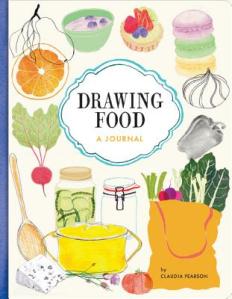
DrawingFood9781452111315 Here is a new resource that takes a fun and lighthearted approach to drawing. This resource provides more than prompts to remind you to draw everyday. It is a guided sketchbook complete with drawing techniques, instructions about how to use different media and a guidebook with plenty of room for sketching.

Drawing Food: A Journal by illustrator Claudia Pearson is composed of two key sections. The first section is titled, How to Draw Food, and contains instruction about how to draw fruit and vegetables, how to draw meat and dairy products, how to draw treats from the bakery, and how to draw household kitchen items. In this section, Pearson discusses line drawing, shading, how to work with colored pencils, and how to work with color pastels. Her instructions are clear, simple and doable.

In Part Two of her book, Pearson establishes a two-page spread for each week of the year and provides fun prompts for sketching enthusiasts. She challenges readers with thought-provoking tasks such as drawing what they find at their local farmer’s market, drawing something seasonal that isn’t produce, and challenges them to describe other culinary subjects in a visual way.

If the word “draw” makes you nervous, this book will help you begin to see your world through the eyes of an illustrator. It isn’t focused narrowly on any one culinary topic and provides plenty of room for you to take the journal in any direction you want to take it.

Interested in beginning your own illustrated food journal and discovering how plants intersect with our lives?

Join ArtPlantae next week when it launches the Botany Craft Bar, a creative place to learn about plants, during the Spring Open House at Aurea Vista on Friday,
May 17, 2013 (5-9 PM). In June, the Botany Craft Bar will become a regular feature during Riverside ArtsWalk, a monthly celebration of the arts in downtown Riverside.

If you can’t make it to the open house next week, visit ArtPlantae’s Botany Craft Bar on the first Thursday of the month during ArtsWalk. The Botany Bar will be open from 6:00 – 8:30 PM at Aurea Vista.

In my review of Marianne North: A Very Intrepid Painter by Michelle Payne, I ramble though calculations as I think aloud as to how Marianne North could have completed 832 paintings in 14 years. What have you discovered about how she worked that would make such an impressive accomplishment possible?

It is impressive! Calculated out it’s something like one painting every six days for fourteen years! And when we consider that the majority of this work was done on-the-spot in distant locales, the achievement becomes even more impressive. There are a few factors that made North’s project as prodigious as it was: first, and a great lesson to all, was the possession of an extraordinary work ethic. North woke early and worked through all kinds of weather, sometimes for up to twelve hours a day. She also famously preferred plants to people, and was often able to carve extra time to work by excusing herself from the many social obligations central to colonial and ex-pat community life in the places she visited. In Sarawak, for example…

Read More

Here is the latest at Classes Near You > Ohio!


Deborah Kopka, DK Designs

www.dkdesigns.org
Botanical illustrator, Deborah Kopka is the principal artist at DK Designs. Deborah licenses her artwork, creates illustrations for publishers, and teaches botanical art classes through her design studio.

    Botanical Illustration: Drawing in Graphite
    Owens Community College
    Mondays, June 3, 10, 17, 24 and July 1,8
    6-9 PM
    In this introduction to botanical illustration, participants will learn about drawing techniques used by contemporary botanical artists. Plant specimens are provided for the first class meeting. A supply list will be sent to registered participants.
    Limit: 12
    Cost: $249
    Download Summer Catalog (PLAY, May-Aug 2013)


    Botanical Illustration: Painting in Watercolor

    Owens Community College
    Mondays, July 15, 22, 29 and August 5, 12, 19
    Learn painting techniques used by natural science illustrators and how to use watercolor with other media. Plant specimens are provided for the first class meeting. A supply list will be sent to registered participants. Limit: 12
    Cost: $249
    Download Summer Catalog (PLAY, May-Aug 2013)


    Botanical Drawing Camp for Grades 6-12

    Owens Community College
    Students will learn how to draw botanical subjects and develop a new appreciation for nature. Art supplies and specimens are provided.
    Cost: $149 per student

    This four-day class will be taught at two locations:

    Owens Findlay Campus
    July 15-18, 2013
    9 am – Noon

    Arrowhead Campus (Maumee)
    July 15-18, 2013
    9 am – Noon

    Download Summer Catalog (PLAY, May-Aug 2013)

Summer classes with artist Susan T. Fisher have been announced at Wellesley College Botanic Gardens in Wellesley, MA.

Here is the latest at Classes Near You > Massachusetts.


Friends of Wellesley College Botanic Gardens
Certificate Program in Botanical Art and Illustration

www.wellesley.edu/wcbgfriends
This program offers several weekly and two- or three-day classes on botanical art and scientific illustration with Sarah Roche and Jeanne Kunze and and visiting instructors. The courses offered through this program cover all aspects of botanical art. Here is a peek at the 2012-2013 schedule:

  • Graphite Fundamentals: Basic Drawing Skills
  • Learning Botany by Drawing
  • Leaves 101
  • Plant Painting for the Petrified
  • Photoshop Demystified
  • Extreme Lumps and Bumps
  • smART Business
  • Colored Pencil Fundamentals


Summer 2013 Classes

Don’t miss these summer classes with visiting artist, Susan T. Fisher!

    Turn on the Lights!
    Friday, July 26 – Sunday, July 28, 2013
    9:30 AM – 3:30 PM BAC 14 132
    Go beyond flat botanical drawings with Susan Fisher. Graphite exercises shift your work from blah to bright and show how values enhance any illustration. Create art to grab the viewer; express a three dimensional quality, and fully express the important characteristics of the plant. Make better choices at the beginning of a piece to avoid a big “fix” at the end. Using supplied colored pencils, discover unusual approaches to seeing color and eliminate poor color choices forever. All skill levels. Cost: WCBG Friends Members $350 / Non-Members $440


    Optimizing Colors in Botanical Paintings

    Tuesday, July 30 – Thursday, August 1, 2013
    9:30 AM – 3:30 PM BAC 14 114
    You understand how to mix color, now focus on a systematic method for manipulating color to create your vision. How do you optimize color mixtures in your botanical watercolors? Do you use washes or glazes? Do you mix colors on the paper or on the palette? When you need to make adjustments what do you adjust first – value, hue or chroma?

    Increase your ability to make good color choices for different painting situations in a series of fun exercises with Susan Fisher. Learn to anticipate drying shifts and how they affect your work. Recognize various lighting aspects and see how they encourage or derail color choices. Focus on the challenging qualities of plant/vegetable specimens to practice color-mixing possibilities. A selection of watercolor exercises will guide students in the skillful use of warm or cool; light or dark; vivid or neutral colors; and related darks in botanical paintings. Although minimal drawing is needed, some watercolor experience mixing colors is required. Cost: WCBG Friends Members $350 / Non-Members $440

    To register: email: wcbgfriends@wellesley.edu or call (781) 283-3094

Learn more about Wellesley’s certificate program.
View current schedule

You have mentioned that the Marianne North Gallery mobilized botanical knowledge. Were there particular kinds of knowledge that North hoped to cultivate?

Yes, absolutely. There are several running themes in North’s work that are telling of the kinds of stories she wanted to capture and put on display. First among these was the sheer abundance and variety of botanical nature. North rarely painted the same thing twice, and opted instead to…

Join the conversation with featured guest, Katie Zimmerman

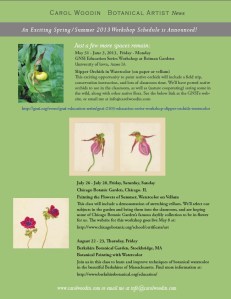
Click to view poster.

Click to view poster.

Annual Wildflower & Art Festival
Idyllwild Nature Center
Idyllwild, CA
May 25-27, 2013
9 AM – 4 PM

Visit the Idyllwild Nature Center in the mountain community of Idyllwild this Memorial Day weekend to learn about local wildflowers and native plants. This fun-filled weekend also includes guided nature walks, an art exhibition, and activities for the entire family.

Weekend visitors to Idyllwild also have the opportunity to start a personalized guide to plants at ArtPlantae.

Learn more below!


Free Workshops with Purchase of Sketchbook at ArtPlantae

Create your own personalized guide to plants! Purchase a sketchbook at ArtPlantae during the Annual Wildflower Show and Art Festival at the Idyllwild Nature Center (May 25-27, 2013) and attend any of the sessions below for free during the Memorial Day weekend. Limit 10 people per session.
Cost: $9.95 per person

Participants may repeat a session if space is available. Priority goes to first-time attendees. Waiting lists will be established if necessary. Please register early. Sessions will begin promptly at their scheduled start times.


Let’s Explore Plants
Memorial Day Schedule

    Saturday, May 25
    9:30 – 10:30 – What makes a stem a stem?
    11:00 – 12:00 – What makes leaves, leaves?
    12:00 – 1:00 – Lunch Break
    1:00 – 2:00 – What makes flowers, flowers?
    2:30 – 3:30 – What makes fruit, fruit?


    Sunday, May 26

    9:30 – 10:30 – What makes fruit, fruit?
    11:00 – 12:00 – What makes a stem a stem?
    12:00 – 1:00 – Lunch Break
    1:00 – 2:00 – What makes leaves, leaves?
    2:30 – 3:30 – What makes flowers, flowers?


    Monday, May 27

    9:30 – 10:30 – What makes flowers, flowers?
    11:00 – 12:00 – What makes fruit, fruit?
    12:00 – 1:00 – Lunch Break
    1:00 – 2:00 – What makes a stem a stem?
    2:30 – 3:30 – What makes leaves, leaves?

cre8time_ProudToSupport_image