Feeds:
Posts
Comments

The University of California Botanical Garden at Berkeley will host a special exhibition about plant-based fibers and dyes. The exhibition, Fiber & Dye, opens on Thursday, March 6 and continues through Sunday, March 23, 2014. The exhibit is free with garden admission.

Garden visitors have many opportunities to learn about plant fibers and dyes this month. Here is a look at the wonderful schedule of classes:

  • Chemistry of Dyes – March 8
  • Resist Dyeing Techniques with Kristine Vejar – March 9, 2013
  • Colors from Nature (Family Program) – March 15
  • Pine Needle Basketry – March 16
  • Film Viewing + 1,2,3 Indigo Vat Demo with Slow Fiber Studios – March 18
  • Plant Color Extractions for Cosmetics – March 22
  • Creating Pigments and Paints from Plants – March 23

View course descriptions and register on the Garden’s website.


Related

EcoLiteracy Curriculum Emphasizes Plant Restoration, Natural Dyes

As you know, then purpose of my Plants, Life, Riverside project is to make plants more visible in our increasingly busy world. It’s about telling the “plant story” of a suburban city and demonstrating we don’t need to travel to a designated natural area to see plants, animals and nature. Today I share with you an activity that not only supports this position, it also helps children and adults establish a sense of place about where they live.

I have always had an interest in maps. My interest in maps began when I saw an old globe (complete with sea monsters) at the Huntington Library when I was a young. Years later I was able to learn more about maps in a cartography class I took as an elective in college. I enjoyed the class very much. I got to sit still, draw, think and immerse myself in a subject in which I had a genuine interest.
The class was also respite from physics and organic chemistry!

It is my interest in maps that prompted me to investigate the article
Artistic Cartography by middle school art teacher, Miranda Nelken. In her article, Nelken (2012) explains how she uses topographic maps to connect students with the animals and natural areas in their area. Through a series of activities she describes in her article, Nelken teaches students how to merge animal drawing with geography, cartography and local history. She also introduces students to the work of Stuart Arnett, a Canadian artist who draws animals on topographic maps.

Applying the studio lesson presented in Nelken (2012) to botanical art will be easy to do. Nelken’s directions are very clear. What maybe isn’t so easy at first thought, is associating this lesson to the work of a contemporary botanical artist the way Nelken associates her classroom project with Arnett. Fortunately, I know of an artist who is the perfect match.

Allow me to introduce you to Susan Rubin, a botanical artist in Colorado whose work I have admired for many years. She blends maps with botanical art and I thought of Susan’s work the moment I came across Nelken’s article.

Susan has two cartography series in her portfolio. One series is about spice plants and their origins and the other is about houseplants and their origins. If you haven’t seen Susan’s cartographic images, I encourage you to take a look. They are exciting and make you think about more than just the plant and how you have come to know it.

To view Susan’s cartographic images, go to her online portfolio and click on Spice and Map. While you’re there, be sure to explore the series, Chlorophyll, a collection of colored pencil paintings about leaves.

Artistic Cartography is available online from SchoolArts magazine and can be downloaded for free.


Literature Cited

Nelken, Miranda. 2012. Artistic cartography. SchoolArts. April 2012. Retrieved from http://www.davisart.com/Portal/SchoolArts/articles/4_12_middle-school-studio-art-lesson-plan-artistic-cartography.pdf


Do you blend maps with natural history art?
Introduce us to your work below.


Plants, Life, Riverside is an ongoing interpretive project about plants in an urban setting, continuing ArtPlantae’s mission of encouraging an interest in plants and addressing the subject of “plant blindness”. Where do plants reside in this city of concrete, asphalt and stucco? Let’s find out.


CN_inrectangle.wseal.tag The Inland Empire region of southern California is home to many native species of plants and animals. It is also home to many invasive species that threaten local plant communities and animal populations. The Inland Empire is a two-county area east of Los Angeles composed of San Bernardino and Riverside counties. In terms of mileage, the Inland Empire (or “IE”) is generally 60 miles from Los Angeles. In terms of drive time…well, the 80-mile commute to west Los Angeles from Riverside can take 3.5 hours during peak commuting hours. 

Nestled below the San Bernardino Mountains, is the Santa Ana Watershed. The watershed is an area of land through which water flows from the mountains to a single outlet at the Pacific Ocean. Water flowing from the mountains travels through four counties on its way to the ocean. These counties are San Bernardino, Riverside, Los Angeles and Orange County. The Santa Ana watershed, its plant and animal communities and its namesake river are monitored by many resource conservation districts whose objectives are to promote the care of natural resources within the watershed.

The Santa Ana Watershed Association (SAWA) SAWAlogoTR2-2 began as a collaborative of local Resource Conservation Districts and the Orange County Water District. Formed in 1996, the purpose of the new association was to eradicate Giant Reed (Arundo donax) and other invasive species that had established themselves in the Santa Ana River. The Association became a nonprofit organization in 2000.

While earlier efforts focused primarily on field work, biological monitoring and habitat restoration, SAWA realized there was a need to educate the public about watershed issues. The Education and Public Outreach Department was formed in 2008 and in five short years, the three-person department has established itself as a major player in environmental education. The educators at SAWA participate in 30 outreach events per year, host four to eight educational events of their own and host four volunteer days (e.g., “clean up” events) at different locations in the Inland Empire. The Education Department connects with 12,000 people per year through its workshops, field trips and events, operates an interpretive center at Chino Creek Wetlands and Educational Park and is responsible for establishing the California Naturalist program in the Inland Empire.

You may already be familiar with the Master Gardener program and its requirement of 40 class hours and volunteer time. The California Naturalist program is similar in that it also requires 40 class hours. It differs from the gardening program in that it does not currently have the volunteer requirement. Participants are instead required to complete a capstone project to earn certification. Capstone projects must be a citizen science project, an educational or interpretive project, or be a work effort benefiting a local environmental organization.

river-2The California Naturalist program was created by UC Davis as a way to promote environmental literacy and engage California residents in the stewardship of California’s natural resources. This program exists in the Inland Empire because of the tireless efforts of Carrie Raleigh, SAWA’s Education and Public Outreach Manager. Carrie was already familiar with naturalist programs for the public because she herself had completed Florida’s Master Naturalist program in 2006. She returned to California, began work with SAWA and in 2011 began looking for a comparable program in California. She learned about the California Naturalist program through the UC Cooperative Extension. One of the first adopters of the program in inland southern California, Carrie worked on the program with her staff for two years and launched the Inland Empire California Naturalist program in
Fall 2013. 

Subject areas covered in the 40-hour program include: native plants, nature journaling, geology, climate, water resources, wildlife, forest and woodland resources, interpretation, communication, citizen science, and global environmental issues.

Thirty-six states have a Master Naturalist program. If you are interested in becoming a certified naturalist in your area, look for Master Naturalist programs near you.

If you live in the IE and want to learn more about the local California Naturalist program, see California Naturalist in the Inland Empire. To inquire about upcoming sessions, contact Carrie Raleigh.

UPDATE
On May 29, 2014, the Santa Ana Watershed Association closed its Education department. To inquire about future programming in the Inland Empire for the California Naturalist Program, please click on the link below.


Related Resources

© Amie Potsic, All rights reserved. Image courtesy Schuylkill Center.

© Amie Potsic, All rights reserved. Image courtesy Schuylkill Center.

Frost
Schuylkill Center
Philadelphia, PA
February 15 – April 18, 2014

Philadelphia artists Amie Potsic and Nancy Agati explore the meaning of winter through photography and mixed media at the Schuylkill Center for Environmental Education.

In winter, patterns emerge from the harsh relief of cold temperatures and heavy snow that illuminate the relationship between us and the changing environment in which we live. Photographer Amie Potsic explains, “I find winter to be particularly seductive as it simultaneously highlights the stark beauty of our environment’s dormant cycle while hinting at the potential growth of spring.” Nancy Agati’s mixed media work, explores the ephemeral through use of natural materials and emphasizes the cyclical patterns of the natural world. Agati writes eloquently about the details that are highlighted by winter: “Working in the studio while the snow falls – again. Linear patterns are further defined as I notice the stark contrast of branches against a pallid backdrop.”

Agati and Potsic draw elements of nature into their work, giving voice to the natural world and putting it in dialogue with both the viewers and the artists themselves. Potsic’s photographs and installations focus on the intersection of the physical, socio-political, and natural worlds, highlighting the change of seasons as indicators of ecological wellbeing.

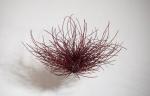
©Nancy Agati, All rights reserved. Image courtesy Schuylkill Center.

©Nancy Agati, All rights reserved. Image courtesy Schuylkill Center.

Agati’s sculptural installations use natural materials to create forms which resonate with the patterns, shapes, and complex structures of the natural world. Whether it is Agati’s striking sculptures or Potsic’s photography that transports you, Frost creates a world that is both uniquely its own and deeply connected to its inspiration: our natural world.

The public is invited to view the exhibition and meet the artists this weekend during the opening reception. The reception will be held on Saturday, March 1, 2014 at 4:00 pm.

Learn more about the Schuylkill Center for Environmental Education on their website at www.schuylkillcenter.org.

By Philadelphia Society of Botanical Illustrators

Every year the Philadelphia Society of Botanical Illustrators is given the opportunity by the Pennsylvania Horticultural Society to demonstrate our skills at the Philadelphia Flower Show. This is a wonderful chance for our organization to explain the fascination of botanical art to the world at large.

Some of the artists think this is great fun. But some do not. It is certainly different from the peace and quiet most of us experience when painting. People crowd around us. Small children want to see what we’re doing – up close. School groups ask endless good questions. It can be stressful.

It’s all a matter of attitude. The “best” attitude is that of a teacher who thinks that botanical art is the most fascinating subject in the world (which, of course, it is). You have to accept the obvious that there is no way that you’ll have the time to paint an entire watercolor. Maybe you can do a little work on one to show how laboriously slow it is. But do not expect to finish it. It is better to bring examples of your sketches, notes, drawings, tracings — whatever led up to the final artwork (which is shown on the wall behind us).

Instead of painting, your time will be taken up with talking to people: explaining how important it is to really “see” the plant, to understand how it grows and reproduces, to show aspects of the plant that photography cannot capture. You can possibly show how artists create form, a feeling of three dimensions. You might briefly touch on the long history of botanical art going back to the Egyptians. You must, however, talk in “sound bites.” Every sentence has to be a headline. And don’t be riled if your audience drifts away. Don’t expect to hold their attention.

You are there to rouse interest that might find an outlet at another time. Who knows? Your audience might someday take a botanical art class. They might become avid painters of wild flowers. They might even buy one of your botanical watercolors. But it’s not going to happen during the demonstration. So relax. Enjoy yourself. Stay calm and carry on.

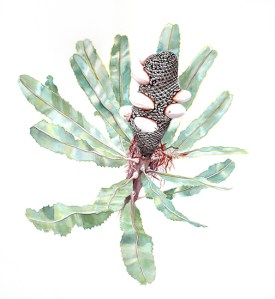
Raspberry Frost Banksia (Banskia menziesii), watercolor, 22x30". © Sharon Birzer, all rights reserved.

Raspberry Frost Banksia (Banskia menziesii), watercolor, 22×30″. © Sharon Birzer, all rights reserved.

Sharon Birzer
www.sharonbirzer.com
Scientific illustrator Sharon Birzer is a teaching artist at Seattle Pacific University and Frye Art Museum, and has completed illustrations for the Burke Museum of Natural History and Culture at the University of Washington. Sharon shows her work at Shift Collaborative Studio in Seattle, Washington.

Her work is currently on view in the exhibition Drawing on Nature: Flora and Fauna at the Washington State Convention Center in Seattle (January 15 – April 1, 2014). This exhibition features the work of members from the Northwest Chapter of the Guild of Natural Science Illustrators and The Pacific Northwest Botanical Artists’.

    Art in the Garden: One-Day Botanical Illustration Workshop
    Sunday, March 2, 2014
    9 AM – 3 PM

    The National Tropical Botanical Garden is offering a one-day botanical illustration workshop with natural science illustrator Sharon Birzer. For beginning and intermediate artists, ages 15 and up. Students will work in watercolor. This workshop will be taught at the Harrison Chandler Education Center, National Tropical Botanical Garden Headquarters Campus at 3530 Papalina Road, Kalāheo.
    View Details/Register

Looking for inspiration and adventure?

Artist Andie Thrams has announced her teaching schedule for 2014. Take a look!


Andie Thrams

www.andiethrams.com
Andie is a painter and book artist devoted to creative work in wild places. She teaches in California, Oregon, Alaska and Hawaii. Her work is widely exhibited and honored, and is held in many private and public collections. Get the latest news about Andie’s popular classes on her website. Here is what’s coming up in 2014:

  • Wild Yoga, Wild Art & Ecology on the Big Island of Hawaii – March 9-15
  • Individual Artist Mentoring & Creativity Coaching – March 31 – June 2
  • Field Journal Studies: San Francisco Botanical Garden – April & May
  • Field Journal Studies: UC Berkeley Botanical Garden – May 12
  • Color Mixing Intensive: Spring Wildflowers – May 23-25
  • Watercolors in the Wild: Sierra Flora – June 14-19
  • Botanical Explorations: Papermaking & The Artist’s Book – August 25-29
  • Watercolor Intensive: Methods, Materials & Magic – Sept. 2-5
  • Wild Forest Wild Art – October 3-5

This information has been added to Classes Near You > Northern California.