Feeds:
Posts
Comments

Lightbulbs. Cereal. Sandwiches.

This is what some kindergarten students cited as factors necessary for plant growth.

This and other interesting insights into what young students think about plants are revealed in Understanding Early Elementary Children’s Conceptual Knowledge of Plant Structure and Function through Drawings by Janice L. Anderson, Jane P. Ellis and Alan M. Jones.

Anderson et al. (2014) chose to investigate the conceptual knowledge of plants of K-1 students because, at this age, children are busily constructing explanations about what they see. The authors chose to analyze students’ drawings of plants for three reasons: 1) drawings enable young children to express what they cannot articulate verbally, 2) drawings offer insight into what children think, and
3) drawings offer insight into children’s stage of development with respect to conceptual thinking (Anderson et al., 2014).

The research team investigated student knowledge of plant structure and function specifically. They did this by creating a three-stage investigation. The data-collecting tools they used were a Draw-A-Plant instrument (based on the Draw-A-Scientist instrument), a plant survey, and interviews (Anderson et al., 2014). Study participants were K-1 students (n=182) from an elementary school in the southeastern United States.

Anderson et al. (2014) explain their research methods in detail, including how they coded student drawings. You can read about these methods in their paper. Today I provide only general insight into their findings.

Anderson et al. (2014) observed that:

  • Young students have some basic understanding of plant structure and function.
  • Young students have misconceptions about plants.
  • Some teachers spend more time discussing plants with students than others.
  • Some students learn about plants outside of the classroom.
  • Flowers and flowering plants are drawn most often.
  • Young students can identify the simple needs of plants.
  • Young students often exclude soil from their drawings.
  • Students sometimes demonstrate more plant knowledge in conversation than through drawing.
  • There is a lack of advanced conceptual knowledge about plant structure and function in young students.
  • Student interviews help researchers interpret their findings.
  • Students drawings provide insight into students’ life experiences.
  • There is a need to involve students in more inquiry-based activities about plant structure and function.

The paper by Anderson et al. (2014) is available for free through an Attribution-Noncommercial-Share Alike 3.0 Unported Creative Commons License. Click on the link below to download a PDF copy of the article that includes supplementary materials used in this project.


Literature Cited

Anderson, Janice L. and Jane P. Ellis, Alan M. Jones. 2014. Understanding Early Elementary Children’s Conceptual Knowledge of Plant Structure and Function through Drawings. CBE – Life Sciences Education. 13(3): 375-386. Retrieved from http://www.lifescied.org/content/13/3/375.full.pdf+html?with-ds=yes

Plants, Life, Riverside is an ongoing interpretive project about plants in an urban setting. How are natural areas managed in the 12th largest city in California? Let’s find out.


The City of Riverside has a new nature center!

The Ameal Moore Nature Center in Riverside’s Sycamore Canyon Wilderness Park opened June 14, 2014. Named in honor of former councilman Ameal Moore, the nature center is a testament to Councilman Moore’s dedication to connecting Riverside residents with local natural resources.

Excited about the start of a new school year, the nature center’s five part-time educators are ready to welcome students, teachers, parents and the community.

Managed by the Riverside Metropolitan Museum, the Ameal Moore Nature Center will soon announce educational programs supporting its citizen science objectives and the use of the park as an outdoor research center. The park’s 1,500 acres makes Sycamore Canyon Wilderness Park the second largest municipal park in the United States, second only to Griffith Park in Los Angeles.

Among the educational programs planned at the new nature center are programs about Native American culture. The museum has been working with faculty in Native American Studies at UC Riverside, the Sherman Indian Museum and members of the local Cahuilla indian community. The first program to emerge from this exciting collaboration is Spring Break Camp 2015, an immersive experience in Cahuilla culture. Participants will learn about the Cahuilla language, basket weaving and storytelling, and will also learn about the plants, animals and ecology of Sycamore Canyon Wilderness Park. This camp will be held March 30 – April 3, 2015 and will be open to students ages 6-12. Parents interested in enrolling their children in this fantastic opportunity are encouraged to contact the Riverside Metropolitan Museum at 951-826-5273.

Sycamore Canyon Wilderness Park is home to thirty-three plant families, four families of amphibians and reptiles, thirteen bird families and eight families of mammals.

Last year the Riverside Metropolitan Museum and its partners launched a citizen science project and a new app called Riverside Nature Spotter. The objective of the citizen science project is to document the plants and animals observed in Sycamore Canyon, as well as the plants and animals observed within the city. Riverside residents are invited to participate in this project. It is very easy to participate and regular trips to the museum or the nature center are not necessary.

To contribute to this exciting community project, Riverside residents only need to do the following:

  1. Download the Riverside Nature Spotter app (available at the Apple App Store or the Google Store).
  2. Use the Riverside Nature Spotter app to photograph the plants and wildlife they see in their neighborhoods while at home or while enjoying a leisurely walk, an urban hike or a bike ride.
  3. Upload photos to the Riverside Citizen Science project page at iNaturalist.org.


What is iNaturalist?

The iNaturalist website is an online community where people can communicate with fellow naturalists and scientists. This interactive platform, originally created as a Master’s project at UC Berkeley in 2008, was acquired by the California Academy of Sciences earlier this year. This platform enables groups to form projects on the iNaturalist website and the Riverside Citizen Science project is one of thousands of projects at iNaturalist.

If you would like to participate in this project but are worried about not knowing the names of local plants or animals, set your concerns aside. When you submit photos to the Riverside Citizen Science page, you can ask the museum’s naturalist (Curator of Natural History, James Bryant), to identify the plant or animal for you. If you prefer to identify unknown specimens yourself, resources are available to help you with this task. The Riverside Citizen Science page features links to field guides about local plants, mammals, insects, amphibians, reptiles and fish. These field guides can be viewed online or printed in a grid format, a book format or a journal format.

One of eight protected core reserves for the Federally-listed endangered Stephens’ kangaroo rat, Sycamore Canyon is noticeably void of the anxiety and stress of our 24/7 instant-messaging 21st-century lifestyle. This has no doubt contributed to the park’s popularity with mountain bike riders and fitness enthusiasts. There is much to see and a lot to learn at Sycamore Canyon Wilderness Park and the Ameal Moore Nature Center adds a new dimension to the park. Teresa Woodard, Curator of Education at the Riverside Metropolitan Museum, says the new nature center affords residents the opportunity to experience nature in the city and to experience nature as a leisure activity. She hopes the programs offered at the new nature center encourages people to look at life in the park more closely and encourages conversation about how to manage our natural resources.

Sycamore Canyon Wilderness Park is open 1/2 hour before sunrise and closes 1/2 hour after sunset. The nature center is open to the public Saturday and Sunday from 9 am – 5 pm and starting October 8th, Wednesday through Sunday from 9 am – 5 pm.

Get Involved
Riverside residents are invited to help the Ameal Moore Nature Center plan its public programs. To offer your thoughts, complete the short three-question survey at MySycamoreCanyon.com, the official website of Sycamore Canyon Wilderness Park. The survey is available in both English and Spanish.

Learn More
View video about the Ameal Moore Nature Center

By Philadelphia Society of Botanical Illustrators

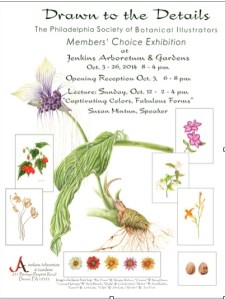
The public is invited to Drawn to the Details (October 3-26, 2014) the Philadelphia Society of Botanical Illustrators (PSBI) exhibition at Jenkins Arboretum & Gardens. Admission to both the exhibition and the gardens is free. Gallery hours are 9 am – 4 pm. psbi_flyer_DrawnToDetails

Viewers of the exhibit will be “drawn to the details” in each of the paintings. The carefully executed work appeals to all ages. In the last PSBI exhibition at Jenkins Arboretum & Gardens, the comments of visitors ranged from “The detail is amazing“ and “Incredible detail! [It] shows that in nature, beauty exists” to “I loved seeing the root system as well as flowers. Just beautiful!”

The artwork has been executed by the over 75 members of PSBI, a Philadelphia organization. Its purpose is “to educate, to celebrate the artistic development of our members, to provide an opportunity to exhibit together, and to bring Botanical Illustration to the attention of many audiences.”

To that end, PSBI provides free art classes for Philadelphia public school children as well as sponsoring many exhibits of botanical art, including one at the Philadelphia Flower Show. This is the second year that PSBI has exhibited at Jenkins.

Jenkins Arboretum & Gardens prides itself on providing “a tranquil, natural setting in a densely populated residential and commercial area.” It has over a mile of paved walkways that meander through native woodlands with labeled trees, shrubs and herbaceous plants. It is indeed an oasis in a busy world and an inspiration to botanical artists.

For more information, contact Sarah Maxwell at the PSBI (267-639-6053) or Janet Bauman at Jenkins Arboretum & Gardens (610-647-8870 ext. 152). 

Picturing Science

The infographics we all enjoyed last week from Compound Interest are wonderful examples of how science concepts and processes can be presented visually.

If you would like to introduce infographics into your classroom or program, you will want to read Using Infographics in the Science Classroom by chemistry teacher Rosemary Davidson.

Davidson (2014) explains how she guides students through the creation of infographics in her environmental chemistry class. She shares the spec sheet she and her students use to evaluate their work, explains how the creation of infographics develops science literacy skills, and provides 22 Web and print resources that will help educators create infographics in their own programs.

Rosemary Davidson’s article can be purchased online at the NSTA store for 99¢.


Literature Cited

Davidson, Rosemary. 2014. Using Infographics in the Science Classroom. The Science Teacher. 81(3): 34-39


You May Also Like

17th Annual International
American Society of Botanical Artists
at The Horticultural Society of New York
September 17 – November 26, 2014

The 17th Annual International Juried Exhibition of Contemporary Botanical Art opens today at the Horticultural Society of New York. This annual exhibition has become New York’s premier showcase of contemporary botanical art.

An opening reception will be held this evening from 6-8 pm. A “Last Look” reception with featured artists and jurors will be held on Wednesday, November 19, 2014 from 6-8 pm.

This year forty-two works by artists from the United States, Australia, Canada, France, Israel, Japan, and the United Kingdom are featured in the exhibition. A full-color catalog containing these works and an introduction by ASBA Founder Diane Bouchier is now available at ArtPlantae ($20, plus shipping).

Participating artists are:

ASBA Catalogs at ArtPlantae

ASBA catalogs at ArtPlantae

  • milly acharya, New York
  • Rosalind Allchin, Canada
  • Irene Blecher, Israel
  • Insil Choi, Rhode Island
  • Carrie Di Costanzo, New Jersey
  • Rosemary Donnelly, Australia
  • Jean Emmons, Washington
  • Margaret Farr, Virginia
  • Ingrid Finnan, New York
  • Kathleen Folino, Massachusetts
  • Monika deVries Gohlke, New York
  • Agathe Haevermans, France
  • Asuka Hishiki, Japan
  • Wendy Hollender, New York
  • Rose Marie James, New York
  • Haruyo Kawashima, Japan
  • Joan Keesey, California
  • Karen Kluglein, New York
  • Patraicia Luppino, New York
  • Dorothy McCauley, Massachusetts
  • Joan McGann, Arizona
  • Robert McNeill, United Kingdom
  • Carrie Megan, Massachusetts
  • Derek Norman, Illinois
  • Tomoko Ogawa, Japan
  • John Pastoriza-Piñol, Australia
  • Annie Patterson, France
  • Kelly Radding, Connecticut
  • Lynne Railsback, Wisconsin
  • Lesley Randall, California
  • Dick Rauh, Connecticut
  • Gillian Rice, Arizona
  • Betsy Rogers-Knox, Connecticut
  • Susan Sapanara, New Jersey
  • Margaret Hammes Saylor, Pennsylvania
  • Constance Scanlon, Minnesota
  • Deborah B. Shaw, California
  • Denish Walser-Kolar, Minnesota
  • Carol Woodin, New York

Three botanical art classes will be taught during the exhibition. Click on the links below to learn about each one-day workshop.


Related

“The Art of Botanical Drawing” by Agathe Haevermans


Updated November 12, 2015. Links to ArtPlantae’s old store at 11 Main were removed.

Click to view itinerary at Quench Travel.

Click to view itinerary at Quench Travel.

Travel to Puglia, Italy!

Award-winning botanical artist Margaret Best will teach in southern Italy next Spring. Join Margaret to spend eight luxurious days exploring the “heel” of Italy’s boot.

Travel highlights include visits to botanical gardens, local markets and historic UNESCO villages. Traveling artists will also participate in a cooking class and will have exclusive use of a large garden studio overlooking the Adriatic Sea.

Travel dates are April 12-20, 2015. Starting costs are €3555 per person. Actual cost varies, depending upon the accommodations selected. Register before October 10, 2014 and receive a discount of €125. Here is a currency converter to help you plan.

Reserve your spot in the garden studio at Masseria Montenapoleone today!

Contact Quench Travel


Related

The Chemistry of Plants

© 2014 by Andy Brunning. All rights reserved.

© 2014 by Andy Brunning. All rights reserved.

We spend a lot of time talking about plants in response to the way they appear. We draw them and try to match their colors.

But what makes them appear they way they do? Smell the way they do? Behave the way they do?

Answers to these questions can be found at Compound Interest, a blog by chemistry teacher Andy Brunning dedicated to the chemistry of everyday life.

Brunning’s explanations of chemical properties and processes are extremely clear and easy to understand. He accomplishes this through the use of infographics he designs himself. His informative graphics have been featured by several media outlets and are organized into the following categories:

  • Elements
  • Food Chemistry
  • Alcohol Chemistry
  • Organic Chemistry
  • Everyday Chemistry
  • Colourful Chemistry
  • Aroma Chemistry
  • Medicinal Chemistry
  • Underserved Reputations
  • Cosmetic Chemistry
  • Other Graphics

Of particular interest to our community of artists, naturalists and educators involved in plant-based and environmental education are the infographics about chilli, onion, coffee, tea, asparagus, chocolate, coriander, lemon, grapefruit, beet root, nutmeg, cloves, garlic, avocado, inorganic paint pigments, cut grass, the scent of the sea, the chemistry of catnip, the compounds of herbs and spices, and this week’s post about the chemicals behind the colors of autumn leaves.

Brunning’s infographics are available for educators to use for free. Packaged collections are available for purchase at the Compound Interest store, as are posters and Chemistry Spice Labels.

Add Compound Interest to your teaching toolbox!

Visit CompoundChem.com


Literature Cited

      A Brunning. (2014, September 11). The Chemicals Behind the Colours of Autumn Leaves. Retrieved from

http://www.compoundchem.com/2014/09/11/autumnleaves/#more-1759


Related