Feeds:
Posts
Comments

Welwitschia © 2006 Wilna Eloff. All rights reserved

Welwitschia © 2006 Wilna Eloff. All rights reserved

Wilna Eloff is a South African botanical artist whose specialty is indigenous trees and shrubs.

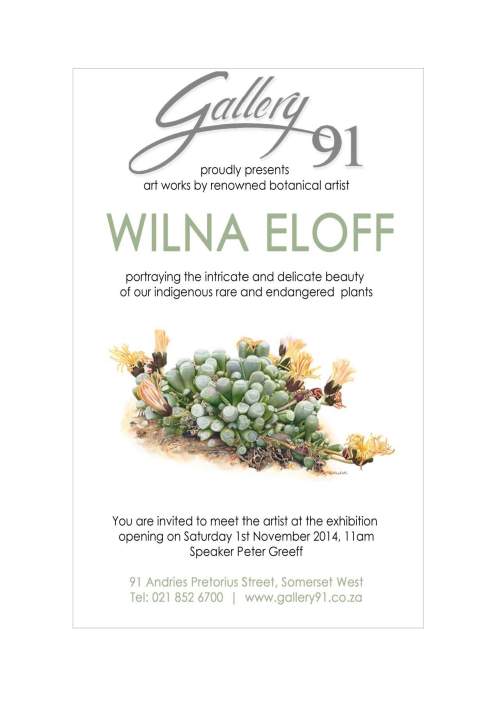
This weekend Wilna will open a solo exhibition at Gallery 91 in Somerset West. You are invited to attend the opening reception on Saturday, November 1, 2014.

Wilna is an award-winning artist who has earned several medals at the Kirstenbosch Biennale Awards (Gold Medals 2013, 2008, 2006; Silver 2010; Bronze 2004). Her work is in the collection at The Hunt Institute for Botanical Documentation at Carnegie Mellon University (USA), the Shirley Sherwood Gallery of Botanical Art at the Royal Botanic Gardens, Kew (UK), and in the First Rand Corporate Art Gallery (South Africa).

Her artwork was commissioned for publication in Field Guide to the Orchids of Northern S.A. and Swaziland by Douglas McMurtry, Lourens Grobler, Jolisa Grobler and Shane Burns (2008). ISBN: 1-919766-46-4

Join Wilna this weekend at Gallery 91 to learn about rare and endangered indigenous plants. Here is a flyer you can download, print and share with friends.

Gallery 91 Expo

Download flyer, share with friends

Download flyer, share with friends

Lyceum of Monterey County
www.lyceum.org
The oldest non-profit on the Monterey Peninsula, the Lyceum of Monterey County offers enrichment classes for adults and families. Included are botanical art classes for adults and families. The Lyceum “inspires a life-long love of learning” through its enrichment programs and academic events.

    Drawing Seeds and Pods and Berries with Nina Antze
    December 6, 2014
    10 am – 12 pm; 1 pm – 3 pm

    Discover the intricate details of fruit, capsules, nuts, pod and flowers. Using colored pencil techniques of layering and blending, learn how to mix a variety of rich and interesting browns and grays along with the colors of autumn. Cost: $60

    View Details/Register

Plants really do receive less attention than animals.

This was determined in a study of attention “blinks” by Benjamin Balas and Jennifer L. Momsen. Experiments confirming this physiological component of plant blindness can be reviewed in Attention “Blinks” Differently for Plants and Animals.

Using an established research protocol in the study of visual cognition, Balas and Momsen investigated the ability of individuals to detect plant and animal images presented to them in rapid succession. The protocol they used is a measurement of “attentional blink” which they describe as a “phenomenon in visual perception in which detecting the first of two targets in a sequence of rapidly presented images compromises the ability to detect the second target for a short time” (Balas & Momsen, 2014). They go on to explain that this compromise occurs because the first image captures the visual attention of the viewer. Because it takes time for a viewer to disengage from the first image (and free up visual attention), subsequent images appearing too close to the first one tend to go unnoticed (Balas & Momsen, 2014). That is, “attention blinks” (Balas & Momsen, 2014).

Balas & Momsen (2014) recruited 24 psychology students to take part in this study. Half were asked to detect plant images and half were asked to detect animal images. Students were placed in a darkened room and viewed image sequences on a MacBook laptop computer. At the end of each sequence, participants were asked to respond to questions about what they observed. Specific details about the research procedure and statistical analyses used by Balas & Momsen (2014) are described in their paper.

Data collected by the authors indicate:

  • Attention is not captured by plants the same way it is captured by animals.
  • Participants are more likely to miss plant images.
  • Participants more often report seeing plant images when none were present in the image sequence.
  • Participants’ attention to plants is delayed, suggesting “attentional resources are deployed differently for plant targets” (Balas & Momsen, 2014).

These results demonstrate a measurable difference in how humans perceive plants and animals and suggest that plant blindness may be a result of delayed attention, instead of reduced attention (Balas & Momsen, 2014).

So what does this all mean for educators?

Because plant blindness has a physiological base, Balas and Momsen (2014) offer these suggestions to educators:

  • Explain to students that plant blindness exists.
  • Incorporate engaging active learning opportunities about plants into your lessons.
  • Integrate plants into life science lessons and stop treating botany as a separate subject.
  • Add auditory and visual learning components to your lessons. Do not rely only on text and images.

The article by Benjamin Balas and Jennifer L. Momsen is available for free through an Attribution-Noncommercial-Share Alike 3.0 Unported Creative Commons License. Click on the link below to download a PDF copy of this article.


Literature Cited

Balas, Benjamin and Jennifer L. Momsen. 2014. Attention “blinks” differently for plants and animals. CBE – Life Sciences Education. 13(3): 437-443. Retrieved from http://www.lifescied.org/content/13/3/437.full.pdf+html.

WeirdWildWonderful The American Society of Botanical Artists, The Botanical Artists Guild of Southern California and The Huntington Botanical Gardens present

A Weird, Wild & Wonderful Symposium
July 23 – 26, 2015

in conjunction with the exclusive Southern California showing of

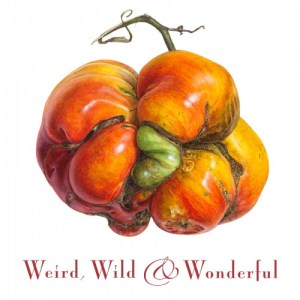
Weird, Wild & Wonderful

The Second New York Botanical Garden Triennial Exhibition of 46 captivating paintings and illustrations of exotic specimens by invited members of the American Society of Botanical Artists at The Huntington Library, Art Collections and Botanical Garden in San Marino, California.

Learn More

Plants, Life, Riverside is an interpretive project about plants in the urban landscape of Riverside, CA.


Cynthia Herrera
is a photographer and MFA candidate at California State University, Long Beach who explores new spaces through photography. In her current project, Making Ground, Cynthia tells the story of immigrant families and how they use the past and the present to create new spaces. In her project, Cynthia also addresses where families place plants around their homes and it is this element that inspired the theme for Making Ground and its focus on transplanting, grafting, herbs and community stories.

Making Ground had its beginning at Gloria’s Nursery, a family owned nursery operated by Celestino and Gloria Garcia. Cynthia chose the nursery for her project because she wanted to explore a space where families visit. Cynthia has spent a considerable amount of time learning from Celestino and Gloria and completing an oral history about the nursery. This history includes information about the development of Riverside’s historic Arlington Greenbelt.

Making Ground workshops are where the community can share living histories and practices that create roots, “make ground”, and generate new histories challenging traditional notions of space, place, ownership and access.

You are invited to take part in Making Ground and to contribute to this unique series. Please join Cynthia and fellow neighbors at one or more of the following event:

    Community Cuttings
    Saturday, October 25, 2014
    11:30 AM – 1:30 PM
    Storytelling and the community history of plants. This transplanting workshop will be held at the Orange Terrace Community Library at 20010-B Orange Terrace Parkway, Riverside, CA 92508. (map)

    La Sierra University Artist Talk and Pop-Up Transplanting Workshop
    Saturday, October 25, 2014
    Time TBA
    Making Ground: Community Engagement as Art Practice, Space and Place | Access and Agency will be presented by Cynthia Herrera.
    La Sierra University is located at 4500 Riverwalk Parkway, Riverside, CA 92505 (map)

    Common Ground: A Stakeholder Event
    Sunday, November 9, 2014
    10 AM – 3 PM
    Community members are invited to join workshops in grafting, transplanting and growing herbs in domestic spaces in an exchange of community histories. Participants will also enjoy a host of dishes from recipes made from plants grown on site. This community event will occur at Gloria’s Nursery in Riverside’s historic Arlington Greenbelt at 2078 Van Buren Blvd, Riverside, CA (map)

    Living Sculpture
    Sunday, February 22, 2015
    9 AM – 1 PM
    Participants will learn about the transitions of healing plants by local curanderas and help create a growing sculpture. The community will be invited to share histories and bring plants to share and exchange. This event will be held at The Farmer’s Market at Galleria at Tyler, 1299 Galleria at Tyler, Riverside, CA 92503 (map)

Making Ground is a community engagement project for hosted by the Riverside Art Museum.
Inquiries about Cynthia’s workshops should be sent to Making Ground 2014.


Event Information to Download and Share (PDF)

Cutting edge research meets botanical art in a new exhibition at the Shirley Sherwood Gallery of Botanical Art at the Royal Botanic Gardens, Kew.

The exhibition Inspiring Kew offers a historical perspective about how scientists at Kew have inspired artists. The exhibition features botanical paintings from the 17th century, as well as artwork by contemporary artists Rachel Pedder-Smith and Laurence Hill.

Many of you are familiar with the work of Rachel Pedder-Smith. Today I would like to introduce you to artist Laurence Hill.

Laurence Hill takes a systematic photographic approach to botanical art. Hill’s life-size presentation of the genus Fritillaria is not only beautiful to look at, it is a lesson in biodiversity. Titled Fritillaria: A Family Portrait, the composite image he created is composed of 80 Fritillaria and provides “insight into the biodiversity of life” (Hill, 2014). His digital photographic image stretches across 5 panels and is 10 meters long and 1.4 meters high (~33 ft. x 4.5 ft.). Specimens in the image are arranged according to the molecular phylogenetic analysis of the genus as described by Peter D. Day, Madeleine Berger, Laurence Hill, Michael F. Fay, Andrew R. Leitch, Ilia J. Leitch, and Laura J. Kelly (2014).

In the color booklet accompanying his exhibit, Hill describes his collaboration with Dr. Ilia Leitch and her research team at Jodrell Laboratory. He also presents a dendrogram explaining the taxonomic relationships between Fritillaria species and includes a replica of the 10 meter-long image now on view in the Shirley Sherwood Gallery of Botanical Art (the fold-out image is 1/10 the size of the original). This booklet can be purchased at the Shirley Sherwood Gallery for £2.50. It can also be purchased from Laurence Hill for £2.50 plus shipping (convert currency). Transactions will be processed through PayPal. To order the booklet from the artist, please contact Laurence Hill.

Laurence recently presented the first of two gallery talks about his work. His next gallery talk will be on November 5, 2014 at 2 pm. Seating is limited and reservations are required. To reserve a seat, please contact the Shirley Sherwood Gallery.


About Laurence Hill

Laurence Hill manages Fritillaria Icones, a searchable photographic database assisting with the identification, research and conservation of Fritillaria. This very informative database is an Open Access Web-based resource.

Laurence maintains a living collection of Fritillaria and has worked on Fritillaria Icones for many years. He graciously took the time to discuss his project and what educators will find at Fritillaria Icones.

Over several years I have been building a living collection which I systematically photograph and post online. This new dataset provides a supplement to other taxonomic resources, e-vouchers for published work and insight for many other botanical disciplines.

My living collection of Fritillaria, a genus of about 160 taxa, has over 700 accessions which are photographed at four stages through their annual cycle:

  • The bulb just after root growth has starts
  • The whole plant and a dissected flower at dehiscence of the anthers
  • The capsule just before seed dispersal showing it both whole and dissected
  • The seed just after germination

These images are dated, scale bars added and then formatted into PDF’s with accession details. Each PDF is put online with the URL incorporating the accession number and not the species name. This acts as a form of DOI or universal identifier so in the event of any taxonomic revision the image specimen set will continue to be associated with any reference.

These image sets can be used for species identification, delineation and classification but they also show:

  • Root structure
  • Period of growth
  • Photosynthesis period
  • Flowering point relative to other species
  • Mode and tempo of bulb renewal
  • Vegetative growth
  • Reproductive output
  • Seed type

Most herbarium specimens record a plant in flower and botanical illustrations prioritise the parts thought to be taxonomically important by the consensus of the day. I have chosen these four time points with Fritillaria to record a wide set of non-prioritised data. As photographs the information they carry is constantly open to re-interpretation. As a record of a botanical collection they have a phenotypic value and also service the interests of disciplines. Many of my accessions have been sampled for genetic research, both DNA sequencing and genome size, and these PDFs act as e-vouchers both for published work and online databases.

By combining images and textural information including synonyms and common names plus appropriate embedded metadata, the images on Fritillaria Icones have an enhanced visibility to internet search engines. Information, no matter how valuable, that lacks visibility will be underutilized.

My project is an example of how living collections in botanical gardens should be systematically recorded with photographic protocols established for genera or families. Databases need to move beyond random single images to embrace a more structured approach using horticulturists specifically trained to record the plants in their care. This would be an additional resource both to the taxonomic community but also to physiologist, genetics’ and non-traditional uses of taxonomic information.

These two PDF’s have the complete compliment of images.
Fritillaria amabilis
Fritillaria pontica

The information found in Laurence’s beautiful and informative database is available for educational use and is licensed under a Creative Commons Attribution-NonCommercial 4.0 International License.


Literature Cited

    Day, Peter D. and Madeleine Berger, Laurence Hill, Michael F. Fay, Andrew R. Leitch, Ilia J. Leitch, Laura J. Kelly. 2014. Evolutionary relationships in the medicinally important genus Fritillaria L. (Liliaceae). Molecular Phylogenetics and Evolution. 80:11-19

    Hill, Laurence. 2014. Fritillaria: A Family Portrait.

Plants, Life, Riverside is an interpretive project about plants in an urban setting. Today we learn how fruit and participatory art connects communities.


Fallen Fruit is an art collaborative founded ten years ago by David Burns, Matias Viegener and Austin Young. Since 2013, David and Austin have continued the collaborative work. Fallen Fruit uses fruit as a common denominator to change the way people see their world. David and Austin explain:

    “Fallen Fruit began in Los Angeles in 2004 with mapping ‘public fruit’ – fruit that grows on or over public property. Our projects include diverse site-specific artworks that embrace public participation. Fallen Fruit’s art works invite people to experience their city as a fruitful, generous place, inviting people to engage in sharing and to collectively explore the meaning of community and collaboration through temporary communities and exhibition programs. Our work focuses on urban space, neighborhood, located citizenship and community in relation to fruit.”

Fallen Fruit has held events and exhibitions in the United States, Mexico, Canada, Europe, Spain, Colombia, Australia and Greece. This weekend Fallen Fruit will host an event in Riverside, CA. On Saturday October 18, they will bring their Lemonade Stand to Cesar Chavez Community Center as a participant of Riverside Art Make, a community-focused campaign to bring the arts into Riverside’s 26 neighborhoods. Riverside Art Make is organized by the Riverside Art Museum.

Fallen Fruit’s lemonade stand is not your typical lemonade stand. Visitors to the pop-up beverage counter receive real lemons and are instructed to draw a self-portrait on their lemon. In exchange for their self-portrait, Fallen Fruit gives visitors a glass of organic lemonade. David and Austin explain that “the lemon self-portraits create a new form of public that illustrate some of the archetypes that construct community.”

David and Austin’s lemonade stand differs from traditional lemonade stands in yet another way. Their lemonade stand comes with a microphone set up for real-time storytelling. Visitors will be invited to use the microphone to respond to prompts selected by Fallen Fruit.

You are invited to take part in Riverside Art Make on Saturday, October 18, 2014. The lemonade stand will be open 11 am – 2 pm.
The Cesar Chavez Community Center is located at 2060 University Avenue, Riverside, CA (map).

This weekend’s Art Make event will be held in collaboration with the City of Riverside’s Neighbor Fest celebration in Bobby Bonds Park.

Watch Video About Fallen Fruit


About David Burns

David Burns is a life-long Californian and native of Los Angeles. He earned an MFA in Studio Art from UC Irvine and a BFA from California Institute of the Arts. David is a co-founder of Fallen Fruit, a contemporary art collective that uses fruit as a material for creating art projects that investigate the boundaries of public spaces, including urban geographies, historical archives and time-based media. Prior to his work with Fallen Fruit, David was core faculty in two programs at CalArts from 1994 to 2008. David’s curatorial practice investigates narrative structures in contemporary art with notable exhibitions for the journal Leonardo at MIT; the Armory Center for the Arts and Los Angeles Contemporary Exhibitions. Currently, David is faculty in the Social Practice graduate program at California College of the Arts in San Francisco. Concurrent to the development of his career in contemporary art and academics, David has also built expertise in corporate branding strategy, advertising and television as a technical consultant for projects with Mercedes Benz, Discovery Channel, SEGA Gameworks and others. David’s work activates the nuances of social spaces, public archives and cultural indexes as an authentic negotiation by creating works of art that are expressions of people and place and reframe the real-world and the real-time.

About Austin Young
Austin Young grew up in Reno, Nevada. He currently lives and works in Los Angeles and studied painting at Parsons in Paris, France. Early in his career, Austin transferred his interests from traditional painting and taught himself portrait photography. In many ways, Austin is more accurately described as an image-maker: his works illustrate the sublime qualities of character that make celebrated people unique. Based on a visual language of iconography, his trademark style and techniques have captured musicians, artists and celebrities including Debbie Harry, Leigh Bowery and Margaret Cho. In several series, Austin captures portraits of drag and transgendered subjects, confusing personality and identity issues in confrontational and unapologetic images of people who do not cross gender but instead split gender and socially-constructed identity. Recently, Austin’s portraiture practice has become a reality TV subject, with Austin featured as a recurring character on The Real Housewives of Beverly Hills and Gene Simmons Family Jewels. Austin directed and produced a feature length documentary, Hadda Brooks, This is My Life, about torch singer Hadda Brooks, and has completed production on his second feature film, a crowd-sourced musical titled TBD, a musical play and video by EVERYONE who comes. Austin is a co-founder of Fallen Fruit, a contemporary art collective that uses fruit as a material for projects that investigate the synergistic qualities of collaboration. Fallen Fruit performs works of art that are transgressive about authorship and prescribed meaning.


Related Interests

Fruitarians, Hunters, Politics & You


Many thanks to David Allen Burns for his help with this article.