Feeds:
Posts
Comments

Deborah Kopka of DK Designs in Ohio will travel to the Phipps Conservatory in Pittsburgh, PA this year to teach two classes as a Visiting Artist in the botanical illustration program.

Here is the latest from the Classes Near You sections for Ohio and Pennsylvania:


Deborah Kopka, DK Designs

www.dkdesigns.org
Botanical illustrator, Deborah Kopka is the principal artist at DK Designs. Deborah licenses her artwork, creates illustrations for publishers, and teaches botanical art classes through her design studio. Visit her website to read the latest issue of her newsletter, Botanically Speaking.

    Watercolor I: Underpainting Method for Botanical
    Watercolor Painting

    April 10-12, 2015
    10:00 AM – 4:30 PM

    Students will learn how to create photorealistic botanical portraits in watercolor by underpainting an initial value study that will be overlaid with surface washes of color. The techniques of wet-into-wet and gradated washes will be emphasized. Class assignments are designed to improve students’ abilities to see tonal values and work successfully in watercolor. The botanical subject for the first assignment will be provided.
    Cost: $230 members; $265 nonmembers

    This is a core course in the Botanical Art and Illustration Certificate program.

    Prerequisites: Botanical Drawing I and II
    Level: Intermediate to Advanced

    Register online or call Sarah at 412.441.4442, ext. 3925


    Watercolor II: Mixed Media

    July 10, 11, and 12, 2015
    9:30 AM to 4:00 PM

    Students will learn how to work beyond the traditional watercolor botanical portrait and enhance photorealistic effects by combining pen and ink, pastel, graphite, and colored pencil with watercolor. Class assignments are designed to help students explore ways to render details, texture, and volume with combinations of media. The botanical subject for the first assignment will be provided. Cost: $230 members; $265 nonmembers

    This is a core course in the Botanical Art and Illustration Certificate program.
    Prerequisites: Botanical Drawing I and II, Watercolor I
    Level: Intermediate to Advanced

    Register online or call Sarah at 412.441.4442, ext. 3925

View of Alder Canyon at UC Riverside Botanic Gardens.

View of Alder Canyon at UC Riverside Botanic Gardens.

Like so many botanic gardens before it, the botanic garden at the University of California Riverside began as a teaching garden. Originally called the “Life Sciences Experimental Area”, the garden was not open to the public and was established for school use only. The garden’s second director, Dr. George W. Gillett (1967-1973), began the garden’s public life in 1969 by conducting tours for special interest groups. Today the 51-year old garden is open to the public everyday except holidays.

Designed to support teaching, research and the extension of knowledge, the reach of this small garden extends far beyond campus. While used frequently by students studying biology, botany, the humanities and art, the interdisciplinary garden is also popular with local gardeners, naturalists and families.

For thirty-four of the garden’s fifty-one years, its relationship with the public has been cultivated by the Friends of the University of Riverside Botanic Gardens. The Friends group hosts wildly popular plant sales each spring and fall and hosts an elegant celebration of art, music, food and wine called Primavera in the Garden. Held each May, this year’s event will feature wineries from Temecula, food from local restaurants and art.

Herb Garden, UCR Botanic Gardens

Herb Garden, UCR Botanic Gardens

In commemoration of its 50th anniversary, the Friends started a Children’s Education Fund in 2013 to establish programing for children and families. This very small and emerging fund joins the garden’s other small funds supporting the rose garden and the butterfly garden.

Notice the emphasis on the word small in the previous paragraph. I bring attention to this word intentionally because I was surprised to learn that even though the garden is at a world-class educational institution, it has been operating on dangerously limited funds its entire existence.

The idea to establish a botanic garden was proposed in 1954 by botany professor, Dr. Victor Goodman. While the idea for a garden received support, funds weren’t allocated for another eight years. The garden was founded one year later in 1963 under the directorship of Dr. Frank Vasek. For most of its existence, the Garden has had a staff of two people. Today there are three staff members and the Garden’s Director, Dr. J. Giles Waines, who works 1/4 time. Most of the $200,000 the Garden receives from the University is used to pay for staff. After salaries and benefits are paid, very little remains. Maintenance is a never-ending expense. As a result, what remains from the University’s contribution, plus about $200,000 earned by the Friends group, is used to pay for maintenance and other expenses associated with keeping the garden open to the public.
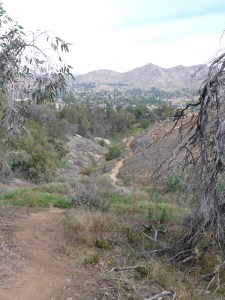
Canyon views at UCR Botanic Gardens

Canyon views at UCR Botanic Gardens

Nestled in a hillside canyon in the southeast corner of campus, the botanic garden is a fantastic outdoor classroom. It features a cross-section of native plants and plants that grow well in the Inland Empire. Horticultural collections feature California native plants and trees, a rose garden, an herb garden, a cactus garden, a subtropical fruit orchard, a lilac garden and a collection of more than 150 bearded iris cultivars. Also featured are plants from South Africa, the southwest, the Sierra foothills, Australia and Baja California. The garden has a pond, a geodesic lath dome and is a nature preserve with more than four miles of hiking trails covering rolling and rural terrain.

The garden’s unique collections are introduced to the public through docent-led tours and school tours. Dr. Waines is happy to report that students from local high schools, Riverside Community College and Cal Baptist University, are visiting in greater numbers.

The only area where the Garden is not seeing its attendance grow is with the general public. Contributing to this significantly is the fact that this 40-acre outdoor classroom does not offer programs and workshops year-round because of its small staff and the dire need to hire an Education Director to oversee the creation of public programs, especially programs for school children. Dr. Waines says the need for additional staffing and funding are the Garden’s biggest challenges.

After speaking with Dr. Waines and learning more about the history of UCRBG, I left our meeting bothered that the garden is in such a tight spot. They need money to increase the staff, yet don’t have the people-power to create more events that might result in increased revenue. Without additional funding, little can be done to move the UCR Botanic Gardens forward. Dr. Waines says he hopes the University will be able to one day offer more support for the garden, which is the only museum on campus open to the public on weekends.

Agave filifera, UCR Botanic Gardens

Agave filifera, UCR Botanic Gardens

The most support the garden receives is from those already committed to the garden and who are well aware of what the garden has to offer. An example of this kind of support was announced last year. In February 2014, it was announced the garden received a bequest from Dr. Victor Goodman, UCR’s first botanist, and his wife, Marjorie. The $1.3 million received from the Goodman estate will be placed in an endowment and will be used to complete specific garden projects. While these funds may be helpful in seeing the completion of certain maintenance projects, it does not get to the heart of what the garden needs, which is additional support staff and someone to establish year-round programing.

The UCR Botanic Gardens is one of Riverside’s hidden gems and is a wonderful way to begin learning about plants and the environment. It deserves more support and attention than it is receiving. If you live in Riverside or the Inland Empire, I encourage you to visit the garden and to explore its collections. When you visit, stop by the message board at the entrance to pick up a free map and to learn about upcoming events and what’s blooming in the garden. While in the welcome area, you can also purchase a guide to the colonial herb garden ($1) and a copy of Deserts of the Southwest ($2), an informative publication created specifically for the self-guided tour.

The UCR Botanic Gardens is located in the southeast corner of campus. From the 60 Freeway, exit Martin Luther King Drive and enter the campus at the corner of Martin Luther King Drive and Canyon Crest Drive (map). The UCRBG is open daily from 8 AM – 5 PM. The parking lot at the entrance has a modest parking fee (25¢ per hour). Overflow parking is in UCR Lot 10 (University parking rates apply in this lot). Admission is free. A donation of $5 per family is suggested.

Please note dogs are not allowed into the garden and professional photography is not permitted per UCR Policy 700-10 and 
UCR Policy 700-15.

Visit the UC Riverside Botanic Gardens


Plants, Life, Riverside
is an ongoing interpretive project about plants in the urban landscape of Riverside, CA.

Click to download flyer

Click to download flyer

Friends of Wellesley College Botanic Gardens
Certificate Program in Botanical Art and Illustration

www.wellesley.edu/wcbgfriends
This program offers several weekly and two- or three-day classes on botanical art and scientific illustration with lead instructor and Education Director Sarah Roche as well as Carol Govan, Carrie Megan, Carol Ann Morley, Esther Klahne, Patricia Buchanan and other visiting instructors. The courses offered through this program cover all aspects of botanical art. Along with Sarah’s twice-yearly offerings, Foundations of Botanical Drawing and Painting and the more advanced Techniques of Botanical Drawing and Painting.

Here is what’s coming up in April:

    Afraid of the Darks?
    April 14-16, 2015
    9:30 am – 3:30 pm

    Take your painting from blah to boom! Susan Fisher will teach you to distinguish and describe dark areas, dark colors and dark subjects. Watercolor skills required. Cost: WCBG Friends Members $350 / Non-Members $440

    Watercolor Workout: Stretching Your Skills
    April 18-20, 2015
    9:30 am – 3:30 pm

    Learn how to work through common challenges when painting in watercolor. Build skill and proficiency on how to paint washes and paint lines and edges in a variety of situations. For advanced beginners and intermediate artists. Cost: WCBG Friends Members $350 / Non-Members $440

    Unlocking the Mystery: Be Empowered When Composing Your Next Piece
    April 22, 2015
    9:30 am – 3:30 pm

    Study well-known paintings and learn how to analyze line, shape, value, color and structure. Cost: WCBG Friends Members $75 / Non-Members $95


View color flyer

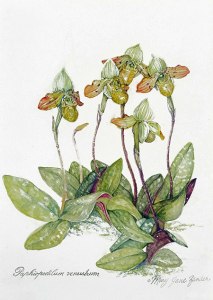
Paphiopedilum venustrum © Mary Jane Zander, All rights reserved

Paphiopedilum venustrum © Mary Jane Zander, All rights reserved

Lewis Ginter Botanical Garden
www.lewisginter.org
In 1884, Lewis Ginter purchased some property and built a gathering place for Richmond bicyclists. One hundred years later, the Lewis Ginter Botanical Garden was established on this same piece of property and soon became one of the top five destinations in Virginia. The Garden is home to Artbase a searchable database containing 2,500 botanical watercolor paintings by Alexandre Descubes. The Adult Education program at the garden includes workshops in botanical drawing and painting and a certificate program in botanical illustration.

The program also includes an Art in the Garden series that encompasses drawing, sketching, knitting.


Coming in March 2015
:

    Intermediate Watercolor for Botanical Illustration
    2 Tuesdays and 2 Thursdays, March 3, 5, 10, 12
    10 am – 3:30 pm, 20 total instructional hours

Create more vibrant and accurate paintings by learning more about the colors in your paint box and how to prevent your paintings from looking dull or “muddy”. Topics include: The basics of color theory, color schemes, characteristics of watercolor paint, and why some colors work better than others. Study how to paint light and reflected light on botanical forms and use that knowledge to begin a painting of a botanical subject using glazes and/or drybrush techniques.

Instructor: Dr. Mary Jane Zander
Cost: $214 / $170 LGBG member
View Details/Register

Questions?
Contact Registrar or call 804-262-9887 ext. 320


This information can also be found at Classes Near You > Virginia!

First-time artists and first-time botanists are invited to travel through time to learn how botanical illustration has informed our knowledge of plants. Participants only need to bring a sketchbook and a small camping stool or lawn chair to use out in the garden. Art supplies are provided.

This workshop, one in a series offered at the CSU Fullerton Arboretum through the InterpretPlants program, was featured in the Orange County Register last week. Reporter Angie Marcos was kind enough to inquire about the Arboretum program and included a brief excerpt of my conversation with her in the University section of the newspaper.

The 26-acre Fullerton Arboretum is a peaceful sanctuary in busy Orange County. Located in the northeast corner of campus near the intersection of Yorba Linda Blvd and the 57 Freeway, the Fullerton Arboretum is open daily from 8:00 AM to 4:30 PM.

Be an Artist-Explorer for an Afternoon
Register Today

Last week I posted an announcement about the new distance learning program in scientific illustration taught by natural science illustrator, Gretchen Kai Halpert. Today we have the opportunity to learn more about this program.

You are invited to join the conversation with Gretchen below. Gretchen is happy to answer your questions about her new program. If you have a question related to one of the topics below, please post your question in the proper thread. If you have another question you would like to ask, please enter it in the Comment box below. Thank you.


Save the Date

The next 10-week session of Gretchen’s distance learning program begins
January 20, 2015. To register, contact Gretchen.


Botanical Art with Cristina Baltayian

These classes will be exploring color pencil, graphite, pen and ink, and watercolor on various papers, vellum and other surfaces. The emphasis will be on plant observation, drawing, composition, color theory and matching, and medium techniques.

In addition, this year an exciting project is beginning, in which, in conjunction with the Botanical Artists Guild of Southern California, students will be studying and portraying many of the Arboretum plant introductions from the last 50 years. The goal is to build a collection of paintings that will celebrate and document the invaluable contribution of the Los Angeles Arboretum to the state of California.

Cristina  Baltayian  has a background in drawing (graphite, charcoal, pen and ink), two-dimensional design, watercolor, and colored pencils. Her work has been shown at  Filoli, the Los  Angeles County Arboretum, and  Chapman University. She is a member of the American Society  of  Botanical Artists, and The Botanical Guild of Southern California. 

Class participation is limited to a minimum of 5 students and a maximum of 12.

A supply list will be provided upon registration. You may bring your lunch or purchase it at the Peacock Café.

Cost: $275  Arboretum members per month; $295  non-members per month (includes Arboretum admission)
 
Tuesdays, 2015  (10 AM – 2 PM)
January 6, 13, 20, 27
February 3, 10, 17, 24
March 3, 10, 17, 24
April 7, 14, 21, 28        
May 5, 12, 19, 26          
June 2, 9, 16, 23          

Pre-registration Required
Please call the Class Registration line at 626.821.4623.


This information has also been aded to Classes Near You > Southern California.