Feeds:
Posts
Comments

Click for more information

Click for more information

Helen Byers
www.helenbyers.com
Helen Byers is an artist and illustrator who is active in several genres and mediums. Her professional background includes college-level teaching of fine art and literature, book illustration, art journalism, and a career as a writer and editor in educational publishing.

Since 2005, Helen has taught annually at Ghost Ranch Education & Retreat Center. She teaches courses in botanical drawing, botanical painting, and field-sketching of high-desert flora and fauna. Since 2012, Helen has also been teaching at Tower Hill Botanic Garden (MA), the Concord Center for the Visual Arts (MA), Fruitlands Museums (MA) and Tin Mountain Conservation Center (NH).

Helen’s botanical work has been exhibited at juried and invitational shows in Washington, Massachusetts, and Florida. Her natural history illustration credits include Coming to Terms with Archaeology & Paleontology: A Dictionary of Artifacts and Old Bones (The Museums at Ghost Ranch: Abiquiu, NM, 2013). Helen is a member of the American Society of Botanical Artists, the New England Society of Botanical Artists, the Rocky Mountain Society of Botanical Artists, and Concord Center for the Visual Arts.

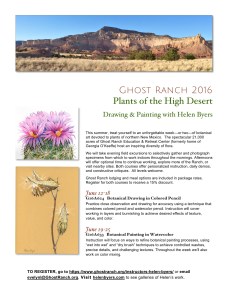
This summer Helen will teach two one-week classes at Ghost Ranch. Participants registering for both classes will receive 15% off the total price. Please contact the Registrar directly to receive this special discount.


    Botanical Drawing in Colored Pencil

    June 12-18, 2016
    Code: G16A624

    Practice close observation and drawing for accuracy using a technique combining colored pencil and watercolor pencil. Learn how to work in layers and how to burnish to achieve the desired effects for texture, value and color.


    Botanical Painting in Watercolor

    June 19-25, 2016
    Code: G16A633

    This class will focus on ways to refine the botanical painting process. Participants will learn how to use “wet into wet” techniques and “dry brush” techniques to achieve controlled washes, detail and texture. Color mixing will also be discussed.

For more information about each class, including lodging options, click here.

This information has also been posted to Classes Near You > New Mexico.

The New England Wild Flower Society has announced online classes for Fall.
The online botany classes include a field trip option. The native plants design class will be open for four months.

The Society would also like to tell you about their plant diversity class with research botanist, Arthur Haines.

Here’s the latest news at Classes Near You > Massachusetts:


New England Wild Flower Society

www.newenglandwild.org
Conserving and promoting New England’s native plants to ensure healthy, biologically diverse landscapes. Educators and parents may be especially interested in the Society’s Go Botany program.

    New England Plant Diversity: Session 4
    Sunday, June 26, 2016
    Instructor: Arthur Haines, Research Botanist
    1-4 pm

    Keeping up with changes in plant names can be challenging, but it reflects our expanding understanding of the plant kingdom based on genetics, a closer look at plant form, and new ways of analyzing relationships. Learn how to make sense of this new plant universe from one of the best botanists in the field, Arthur Haines. In the session 4 of this 5 session series, students will investigate advanced tricolpate families often referred to as euasterids (e.g., Lamiaceae, Plantaginaceae, Campanulaceae, Asteraceae).
     
    Note: We recommend you take New England Plant Diversity: Session 1 first; Sessions 2-5 may be taken in any order.

    Recommended text: Plant Systematics: A Phylogenetic Approach.

    Course: $46 (Member) / $54 (Nonmember)

    View Details/Register


    Plants 101: Introduction to the Green World

    Monday, September 12, 2016 to Friday, October 14, 2016
    Instructor: Dr. Elizabeth Farnsworth, Senior Research Ecologist

    Explore New England’s plant life. In this online and field course you will learn what plants are, how they function, and why they are essential to all life on earth. You’ll also discover many of the region’s native and non-native plants. This course includes five self-paced online modules offered over the course of five weeks, featuring lots of interactions with the instructor and fellow students. You can elect to join an optional field trip led by an enthusiastic botanist in your state.
     
    Field Trip Note: One field trip will be held in each New England state and participation is optional. If you would like to attend the trip as part of the course, please register for both the course and the field trip. Field trip dates and specific locations will be announced six weeks before the course launches.

    Course: $100 (Member) / $125 (Nonmember)
    Course + Field Trip: $128 (Member) / $160 (Nonmember)

    View Details/Register


    Plants 102: Deeper into the Green World

    Monday, October 17, 2016 to Friday, November 18, 2016
    Instructor: Dr. Elizabeth Farnsworth, Senior Research Ecologist

    Delve deeper into the New England Flora in this online and field course. Learn how plants change as they grow; how they interact with other species; and how geology, soils, land-use history, hydrology, and climate shape the plant communities of the region. You’ll adopt a plant to observe throughout the course and enjoy interacting with the course instructor and your fellow students. This course includes five weeks of online instruction. You can elect to join an optional field trip led by an enthusiastic botanist in your state. Plants 101 is a complement to Plants 102 but is not a prerequisite.
     
    Field Trip Note: One field trip will be held in each New England state and participation is optional. If you would like to attend the trip as part of the course, please register for both the course and the field trip. Field trip dates and specific locations will be announced six weeks before the course launches.
     
    Course: $100 (Member) / $125 (Nonmember)
    Course + Field Trip: $128 (Member) / $160 (Nonmember)

    View Details/Register


    Designing with Native Plants

    Open Enrollment (November 14, 2016 through April 2, 2017)
    Instructor: Dr. Elizabeth Farnsworth, Senior Research Ecologist

    This entirely self-paced online course will teach you the basics of designing with native plants and show you how to incorporate native plants into your garden and landscape. Discover the variety of native plants found throughout New England and learn how to design a visually interesting landscape that also supports biodiversity. Students complete the course at their own pace.

    Fee: $64 (Member) / $80 (Nonmember)
    Limit: Unlimited

    View Details/Register
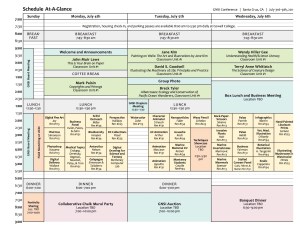
A full week of art and science at GNSI Santa Cruz.  This is only a hint. Click for more!

A full week of art and science at GNSI Santa Cruz. This is only a hint. Click for more!

The Guild of Natural Science Illustrators is coming to California!

The 38th Annual GNSI Conference will be at the University of California Santa Cruz July 3-9, 2016. If you like all things science and art, you don’t want to miss this conference.

The three-day core conference will be held July 3-6, 2016. Over the course of only a few days, there will be seven keynote addresses, 37 breakout sessions, an auction, a collaborative chalk mural party, the ever-popular and always inspiring portfolio sharing session and a techniques showcase where scientific illustrators generously share what they know with conference attendees.

Breakout sessions will address topics ranging from iPad use to science education outreach to 2D animation to nanoparticles to invasive plants to infographics to botanical illustration.

Several half-day and all-day workshops are scheduled for July 7-8. These focused workshops will address topics such as digital techniques, lab and field sketching, science comics, traditional media such as silverpoint, and the teaching of visual art in K-12 schools.

Optional field trips include whale watching, kayaking, hiking, wine tasting and visits to landmarks such as the Monterey Bay Aquarium and Henry Cowell State Park.

This brief mention does not do the conference schedule justice. Download the schedule to see it for yourself. There is so much to see, learn and do.

Go to GNSI Santa Cruz!

BAC ArtPlantae publicity for Summer Catherine Watters class-2 Learn how to master the textures and surfaces of the plant world!

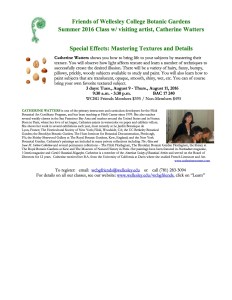
Catherine Watters, award-winning artist and one of the curriculum specialists for the Filoli Botanical Art Certificate Program, will teach Special Effects: Mastering Textures and Details at Wellesley College Botanic Gardens (WCBG).

Learn how light affects texture when painting hairy, fuzzy, bumpy, pillowy, prickly and woody textures. Then learn how to paint translucent, opaque, shiny and wet surfaces. This special three-day workshop will occur August 9-11, 2016 from 9:30 am – 3:30 pm each day.

Cost for WCBG Friends Members is $395; nonmembers $495.

For more information and to register, click on the image to download the flyer.


More Art at Wellesley Botanic Garden

Helen Allen, artist, teacher and director of The Chelsea School of Botanical Art in England will be at Wellesley College Botanic Gardens next week to teach a composition class. Last-minute openings means you have the unique opportunity to learn from Helen without flying overseas. Click on the image below to download the flyer.

Contact Wellesley College Botanic Gardens ASAP by email or by phone to register. The Garden’s phone number is (781) 283-3094.


Composition Challenge

Plant studies, colors, and drawings are the fun part of creating a beautiful painting, but the challenge is always in composing the page. Helen Allen leads the challenge to create an image that is balanced and draws the viewer to have a closer look – an image that can enchant and inform. Through three days, you will fall in love with your chosen plant, study its habit, and develop drawings that can be used to compose three different paintings. Identify blocks and position of color and study the balance of your compositions. Then choose the best and spend a day adding color to guide you in completing the painting at home.

3 days: Friday, May 20 – Sunday, May 22, 2016
9:30 a.m. – 3:30 p.m.
BAC 16 152 / 252
WCBG Friends Members $375 / Non-Members $475


BAC ArtPlantae publicity for Spring Helen Allen class

2016-RTshow-3
By Barbara Rose, Reed-Turner Artists’ Circle

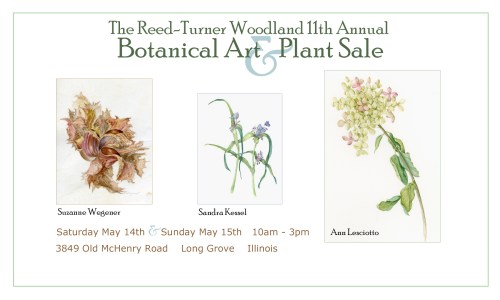
The ASBA Reed-Turner Artists’ Circle and the Long Grove-Kildeer Garden Club are pleased to announce the 11th Annual Botanical Art Exhibition & Plant Sale at the Reed-Turner Woodland Nature Preserve in Long Grove, Illinois. This exhibition and sale will be held May 14-15, 2016 from 9 am – 3 pm.

The Artists’ Circle consists of a dedicated and enthusiastic group of botanical artists, current and former students with provenance at the Chicago Botanic Garden. Consistent with the mission of the American Society of Botanical Artists, the group works to further the interest in botanical art, conservation science, botany, and horticulture at the local level. The group also strives to emphasize the beauty and importance plants play in our daily lives by increasing public awareness through education, promotion, and exhibition of its members’ art in collaboration with local institutions.

Anyone with an interest in botanical art is most welcome at the group’s meetings on the last Saturday of each month from 9:30-11:30 am at the Reed-Turner Woodland.

More about the Reed-Turner Artists’ Circle

Merian-PP-For-TRADE-Cat-190x150mm.inddMaria Merian’s Butterflies
The Queen’s Gallery, Buckingham Palace
London, England
April 15 – October 9, 2016

A new book about the Maria Sibylla Merian collection in the Royal Collection at Buckingham Palace features 150 color plates, many of which were published in Metamorphosis Insectorum Surinamensium (The Metamorphoses of the Insects of Surinam).

Kate Heard, Senior Curator of Prints and Drawings at the Royal Collection Trust, writes about Merian’s childhood fascination with butterflies and moths and her journey to Suriname to observe and document these insects and their host plants. Heard also writes about the people who influenced Merian’s artwork, and the fieldwork and research that earned Merian the title ‘the first ecologist’.

Every page of this book is a history lesson. If you are an admirer of Merian’s work, this book provides you the opportunity to study her paintings up close as her paintings fill most of the book’s 192 pages. If this is your first introduction to Merian and her contributions to entomology and natural history art, this book is sure to turn you into a fan of this fearless and passionate naturalist.

Maria Merian’s Butterflies compliments the exhibition of the same name now on view at The Queen’s Gallery in Buckingham Palace.

This book is now available at your local independent bookstore.


Related

Art, Ecology and Maria Sibylla Merian