Feeds:
Posts
Comments

ColorfulLeavesAt first glance Colorful Leaves looks like any other coloring book. But the moment you begin to read the introduction, you discover it is not your average coloring book. It is instead a coloring book and a how-to book rolled into one nice package.
Written by writer and illustrator Gail Selfridge, Colorful Leaves is a 45-page lesson in observing leaves, transferring images and capturing Nature’s colors. Selfridge, a member of the Guild of Natural Science Illustrators and the American Society of Botanical Artists (ASBA), was awarded the ASBA’s Anne Ophelia Dowden education grant in 2015. The award enabled her to write Colorful Leaves so she could introduce new audiences to the world of plants through the peaceful and revealing process of leaf rubbing.

The line illustrations in Selfridge’s new book should not be viewed simply as shapes to be colored. They should be viewed as the author intended, as templates to use while exploring color media and botanical art techniques. Selfridge helps new and experienced artists with their experimentation by offering recommendations for pencils, colored pencils, markers, paint and paper. Selfridge explains:

Botanical art is an art form that can be learned and enjoyed by both children and adults, and it is a pleasurable activity that can be pursued for a lifetime. Establishing a preliminary image is often the most challenging and difficult step in this learning process. By starting with these line images, fussing over measurements and details is avoided thus allowing one to get on with learning, not only about the specimen, but also about using various art materials and techniques. These preliminary images can be repeatedly transferred and used to explore many different techniques, both traditional and digital.

Colorful Leaves can be used for personal enjoyment or it can be used by community arts programs, botanical gardens, arboretums, public schools, 4H groups, garden clubs, etc. as an educational outreach activity that provides an enjoyable experience, encourages observation of plants, and provides tools for the accurate portrayal of plants.

Included in Colorful Leaves are line illustrations for 23 trees and four shrubs. Tree genera represented are: Quercus, Platanus, Acer, Cercis, Ulmus, Populus, Fraxinus, Gingko, Aesculus, Liquidambar, Prunus, Diospyros, Morus, Carya, Pyrus, and Malus. Shrub genera represented are Euonymus, Rhus and Rubus.

This week we have the opportunity to learn from Gail Selfridge. You are invited to join the conversation. Post your questions or comments below.


Special Opportunity for Educators from Gail Selfridge

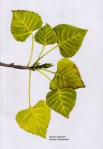
Populus deltoides © 2016 Gail Selfridge. All rights reserved

Populus deltoides © Gail Selfridge

The American Society of Botanical Artists funded Colorful Leaves, and my objective never was to make money selling it. I want to put the publication in the hands of persons who would make use of it. To that end I will send six complimentary copies (including shipping) to anyone who agrees to use them as part of an educational program in exchange for photos of the event and a short (no longer than one page) description of what they did, and the results/success of the program.

Request your complimentary copies of Colorful Leaves.
[Note: Offer no longer available]


Update June 2024
Colorful Leaves is now available for free on the ASBA website. Visit the page about Gail’s project to download a copy of the book and to read how teachers have used Colorful Leaves in their classrooms.


You May Also Enjoy

Here is what’s new at Classes Near You > California:


Joshua Tree National Park Association

www.joshuatree.org
Joshua Tree National Park Association is a not-for-profit organization formed to assist with preservation, education, historical, and scientific programs for the benefit of Joshua Tree National Park and its visitors.

    Night Sky Photography
    Saturday, September 24 – Sunday, September 25, 2016 
    Oasis Visitor Center, Twentynine Palms, CA
    If you enjoy photography and are fascinated by the desert night sky, this two-day hands-on workshop is for you! Dennis Mammana will teach participants how to use even the simplest of cameras to create magnificent celestial portraits. Class limited to 12 participants. Cost: $110 for JTNPA/PINE members, $120 nonmembers

    View Details/Register


    Picture the Park in Black and White

    Saturday, October 15, 2016
    Joshua Tree Visitor Center, Joshua Tree, CA

    There was a time when black and white photography was all we had. Though color has brought us incredible opportunities that would have been envied long ago, the classic black and white photograph is still highly revered. Join professional photographer Jim Smart as he leads you through a unique and extensive workshop covering a variety of aspects of black and white photography. Class size limited to 12 participants.
    Cost: $60 for JTNPA/PINE/OSHER members, $70 nonmembers

    View Details/Register


    Watercolor Painting in Joshua Tree National Park

    Sunday, October 16, 2016 
    Joshua Tree Visitor Center, Joshua Tree, CA

    Indulge your creativity with a day of painting in a beautiful, reserved campground in the Joshua Tree National Park. Participants will be immersed in the desert landscape to inspire originality and learn the observational skills that are essential to painting nature. John Scahill, artist and instructor, will help students shift the desert scenery to paper with watercolor paint.  Cost: $60 for JTNPA/PINE/OSHER members, $70 nonmembers.

    View Details/Register


    Light & Color: Oil Painting in Joshua Tree National Park

    Sunday, November 6, 2016
    Joshua Tree Visitor Center, Joshua Tree, CA

    Capture the vitality of Keys Ranch in this oil painting class with Diane McClary. McClary will teach fundamental plein air painting techniques while immersed in the beauty of the Keys Ranch, a National Historic Site. She will demonstrate and explain the method behind her unique use of color and her approach to color harmony in the field.
    Cost: $60 for JTNPA/PINE members, $70 non members

    View Details/Register


    Pine Needle Basketry

    November 12-13, 2016
    Oasis Visitor Center, Twentynine Palms, CA

    The craft of coiled basketry is practiced world-wide using a variety of natural and man-made materials.  Kathi Klopfenstein will teach you one of many techniques to start a coiled pine needle basket, basic stitching, how to shape your basket, and how to finish your basket.  You will learn about responsible collecting of pine needles, preparation, and storage of your materials.  A variety of coiled baskets will be available for the students to study.  Kathi will provide the basketry materials.  Beginner and experienced coilers are welcome. 
    Cost: $110 JTNPA/PINE/OSHER members/ $120 non members
     
    View Details/Register


    Fine Art Photography in Joshua Tree National Park

    Friday, November 18, 2016
    Oasis Visitor Center, Twentynine Palms, CA
     
    Immerse yourself in the wonders of Joshua Tree National Park and connect with the enchantment to be found there. The content of this workshop will focus, not only on the mechanics of photography, but, also on personal interpretation and expression which is the heart of the art. This is an “action packed” workshop, so, bring your camera equipment, camping equipment and enthusiasm and watch your creativity soar.
    Cost: $160 JTNPA/PINE/OSHER members/ $170 non members

    View Details/Register


    Smartphone and Point-and-Shoot Techniques to Make Your Travel Photos “POP”

    Sunday, November 13, 2016
    Oasis Visitor Center, Twentynine Palms, CA

    Elevate your travel photography by understanding elements of compelling images and the easiest camera you have with you – your smartphone or basic point-and-shoot.  Professional photographer and teacher, Diana Shay-Diehl, who has spent over 30 years capturing images from film to digital, will focus on basic approaches to photography while making extraordinary images from the ordinary. You will learn how to overcome the limitations of cellphone and other modern cameras.
    Cost: $60 for JTNPA/PINE members, $70 nonmembers

    View Details/Register


    Photographing the High Desert

    Saturday, December 3, 2016
    Big Morongo Canyon Preserve, Morongo Valley, CA

    Grab your camera and put on your hiking boots for this intensive all-day photo shoot in the Joshua Tree National Park!  Craig Fucile will guide the class in seeing the natural beauty of the park through the camera lens.  The class will begin with early morning light at the Big Morongo Canyon Preserve followed by a mid-morning instructional program at Black Rock Canyon Visitor Center.  The afternoon session will relocate to a special “photographers only” session at Keys Ranch, focusing on how to capture the buildings and historic remnants at this remarkable homestead. 
    Cost: $85 for JTNPA/PINE members, $95 non members

    View Details/Register

Order online from local independent bookstores.

Order online from your local bookstore.

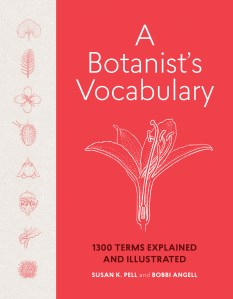
A Botanist’s Vocabulary is an illustrated guide to plants, a dictionary and an introduction to the plant sciences.

If you are familiar with Plant Identification Terminology by Harris & Harris (2001) and Hickey & King’s The Cambridge Illustrated Glossary of Botanical Terms (2001), you may be wondering how this new book compares to these two informative and indispensable standards. Allow me to come right out and say you can confidently add A Botanist’s Vocabulary as the third informative and indispensable standard to your botany-art library.

The key difference between this new title and the older titles is its focus. Co-authors Susan K. Pell and Bobbi Angell write for a general audience instead of an audience of mostly botanists. The authors have thoughtfully written A Botanist’s Vocabulary to to serve as a user-friendly reference for all plant enthusiasts. In the introduction, Pell and Angell explain:

We have attempted to define terms used by botanist’s, naturalists, and gardeners alike to describe plants. We have simplified and clarified as much as possible to encourage the use of a common language. The included terms mostly refer to plant structures and come from the horticultural and botanical literature and practice.

It is important to note the authors’ focus on practice. This new glossary features not only plant morphology terms, but terminology from many disciplines. In addition to words like scape, locule and whorl, are terms from at least 11 areas within the natural sciences. Here’s a short list as an example:

  • Soil science (e.g., calcareous)
  • Molecular biology (e.g., chimera)
  • Pollination biology (e.g., chiropterophily)
  • Plant ecology (e.g., clinal variation)
  • Plant taxonomy (e.g., conserved)
  • Horticulture (e.g., cultigen)
  • Genetics (e.g., hybrid swarm)
  • Tissue culture (e.g., explant)
  • Orchidology (e.g., keiki)
  • Ecology (e.g., myrmecophyte)
  • Biogeography (e.g., paleotropics)

You will not find terms like these in Harris & Harris (2001) or Hickey & King (2001). The inclusion of terms such as these helps readers see beyond the morphological features of plants and beyond botany.


Bobbi Angell’s illustrations teach as much as they explain
.

Copyright ©2016 by Susan K. Pell and Bobbi Angell. All illustrations are by Bobbi Angell. Published by Timber Press, Portland, OR. Used by permission of the publisher. All rights reserved.

Copyright ©2016 by Susan K. Pell and Bobbi Angell. All illustrations are by Bobbi Angell. Published by Timber Press, Portland, OR. Used by permission of the publisher. All rights reserved.

Journalers, botanical art enthusiasts and educators can learn a lot by studying the illustrations of scientific illustrator Bobby Angell. Lessons that can be learned include:

  • How changing the weight of a line portrays form (see all illustrations)
  • How massing leaves can relay form and density (e.g., see canopy)
  • How stippling can be used in line drawings (see all illustrations)
  • How plants can be drawn in a lively and organic way (e.g., see capitulum)
  • How depth and fullness are possible in line drawings (e.g., see mericarp)
  • How grounding a specimen and showing how it grows can be accomplished with a minimal amount of stippling (e.g., see caudiform)

I could go on and on because there is something to be learned from each illustration. However, I will not do this. I will instead encourage you to explore this new resource yourself.

A Botanist’s Vocabulary can be purchased online from your local bookstore.


Literature Cited

    • Harris, James G., and Melinda Woolf Harris. 2001.

Plant Identification Terminology: An Illustrated Glossary

    • , 2nd ed. Spring Lake Publishing, Spring Lake, Utah.

Hickey, Michael, and Clive Kind. 2001. The Cambridge Illustrated Glossary of Botanical Terms. Cambridge University Press, Cambridge, U.K.

Click for more information about this new course

Click for more information and materials list

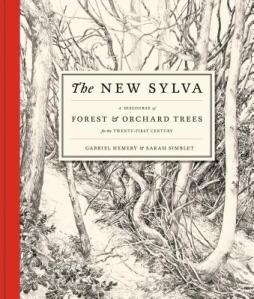
This summer the Ruskin School of Art will offer a new botanical illustration course with author and illustrator, Sarah Simblet. This five-day non-residential course is based on The New Sylva: A Discourse of Forest and Orchard Trees for the Twenty-First Century, a book Simblet co-authored with Gabriel Hemery, Chief Executive of the Sylva Foundation.

Students will each make a sketchbook and then fill their books with illustrations. Students will also learn about tree morphology and how to compose a botanical plate. Included are two visits to the historic Rousham House & Garden.

This exciting opportunity will be held August 6-10, 2016. Enrollment is limited to 12 participants. Only six places remain available. You are encouraged to act soon if you want to take this class. Beginners and experienced artists are welcome!

Ruskin courses are only available to adults over the age of 16 years.

Course fee:

    Adult – £700.00 (currency converter)

    Oxford University students, staff and alumni (10% discount) – £630.00

    Students (with a current NUS card) and OAPs (5% discount) – £665.00


View itinerary and other course details


Related

The making of The New Sylva

Download color flyer

Download color flyer

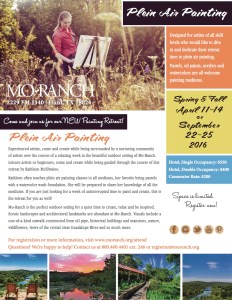
Mo-Ranch
www.moranch.org
Mo-Ranch is a retreat and conference center open to the public located on 500 acres in Hunt, Texas. It is also home to the Environmental Leadership Program, a hands-on outdoor program.

    Fall Painting Retreat
    September 22-25, 2016
    Class times vary

    Four-day, three-night painting retreat led by professional artists. Designed for artists of all skill levels who would like to dive in and dedicate their retreat time to plein air painting. Pastels, oil paints, acrylics and watercolors are all welcome painting mediums.

    Leisure artists, beginners and experienced artists welcome!

    Cost:
    Hotel, Single Occupancy: $550
    Hotel, Double Occupancy: $400
    Commuter Rate: $200

This information has also been posted to Classes Near You > Texas.

Botanical artists Carol Woodin, Kelly Leahy Radding, Judith Allen Efstathiou and Betsy Rogers-Knox study the relationship between plants and ecosystems for a new exhibition at the Coastal Maine Botanical Gardens.

Opening reception is this evening, 5-7 p.m. The public is invited. Please RSVP if you plan to attend.

This information has also been posted to Exhibitions to Visit.

How do you even begin to describe the collection at the Glass Flower Gallery at Harvard University?

When a video leaves you without words, imagine what seeing this collection does to you when you see it in person. I’ll have to get myself to Harvard some day because beginning tomorrow, the collection reopens to the public after undergoing a major renovation.

According to Harvard Staff Writer, Alvin Powell, the Ware Collection of Blaschka Glass Models of Plants at the Harvard Museum of Natural History was created between 1886 and 1936. These delicate, extremely life-like glass models were created for teaching purposes and boy are they good teachers!

Learn more about this collection and watch a wonderful video in Putting the Glass Flowers in new light, an article written by Powell for the Harvard Gazette.

Many thanks to the kind reader who brought attention to the grand reopening of this historic collection.