Feeds:
Posts
Comments
Botany and botanical art enter the digital workspace

Botany and botanical art enter the digital workspace


Niki Simpson
is an award-winning artist who has earned medals in photography and watercolor from the Royal Horticultural Society. In 2003 she began developing a technique combining digital photography and traditional botanical art. She has spent the past 12 years perfecting the art of digital botanical illustration and the creation of information-rich botanical plates she calls composite botanical illustrations.

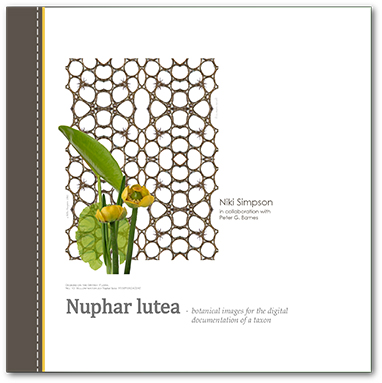
Since 2007, Niki’s digital botanical illustrations have appeared in four books. The most recent publication, Nuphar lutea: Botanical images for the digital documentation of a taxon was published this past May.

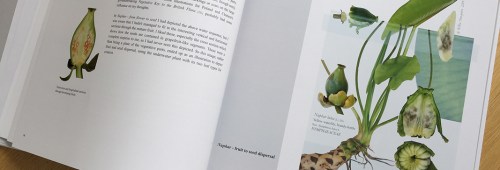
In her beautiful new book, Niki explores different ways of observing plants and demonstrates how composite botanical illustrations can be used to describe a specific plant species–in this case Nuphar lutea (Yellow Water Lily). Twelve botanical plates are featured in her new book, each highlighting some aspect of the morphology or life cycle of the yellow water lily. Botanists, gardeners, educators and artists will find Niki’s presentations exciting and informative. Because the illustrations were inspired by the engravings found in herbals, readers will find the format of these contemporary botanical illustrations very familiar, with the exception of two modern elements. In her signature style, Niki adds a 21st-century twist to her botanical plate by adding Nuphar lutea‘s DNA sequence and barcode to what would otherwise be a very traditional format.

While my images are inspired by, and draw heavily from, the accuracy and detail found in traditional botanical art, for me, the future of botanical illustration lies in exploring the potential of the dynamic digital workspace, so that botanical illustration can fully support botanists in the future.

— Niki Simpson

Keeping with her goal to blend botany, botanical art and digital technology, Niki also discusses design, smartphones, tablets, virtual books and other digital techniques. Here is look at the topics addressed in her new book:

  • Foreward
  • Artist’s statement
  • Introduction
  • Composite illustration or image voucher of Nuphar lutea
  • Nuphar–rearranging, resizing and recombining parts
  • Nuphar–from flower to seed
  • Nuphar–taking a closer look at the flower
  • Nuphar–evolution of my floral diagram
  • Nuphar–from fruit to seed dispersal
  • Nuphar–from seed to adult
  • Nuphar–foliage
  • Nuphar–for design
  • Nuphar–poster style
  • Nuphar–herbarium specimens
  • Composite illustration of Nuphar lutea including DNA sequence data
  • Composite illustration of Nuphar lutea including DNA barcode visualization
  • Nuphar–developing interactivity by starting with a virtual book
  • Nuphar–on smartphones and tablets
  • Nuphar–digital black and white line drawing
  • Nuphar–digital hybrid images
  • Nuphar–my virtual sketchpad
  • Final Thoughts
  • Acknowledgements
  • Bibliography

If you have an interest in botanical illustration or botany education, you will appreciate this book and the path Niki is forging in botany and botanical art education.

Learn more about Niki in this interview and learn how she is expanding the future of botanical illustration through her website Visual Botany.

Nuphar - from fruit to seed dispersal, ©2016 Niki Simpson, all rights reserved

Nuphar – from fruit to seed dispersal, ©2016 Niki Simpson, all rights reserved

A fun gift for children of all ages.

If you’ve ever led a flower dissection in your classroom or program, you know that this simple show-n-tell exercise takes a fair amount of planning because you need to shop for flowers, fill a bucket with water, pack scissors, pack paper towels and ask for a broom and trashcan so you can sweep flower parts and plant parts off the floor.

What if it didn’t need to be this way?

What if you could introduce students to plant morphology without the mess?

This is now possible thanks to biologist and illustrator Emily Coren, author of
Hey, Look! a Dandelion!, an engaging interactive guide about a plant familiar to many of us — the dandelion.

In twenty-nine creative pages, Emily masterfully guides readers through the dissection of the common dandelion. In her interactive guide, Emily calls on readers to tilt their book in all directions and to pull at its pages. She also encourages readers to blow into their book, something they do willingly without any inhibition whatsoever. With her book Emily has turned a fond childhood pastime into a very clever teachable moment.

This guide is a fun addition to any library and would make a great gift for the teacher, nature guide or garden docent in your life.

More about “Hey, Look! a Dandelion!”


Follow Emily Coren online at
:

By The Hunt Institute for Botanical Documentation

Soft Tree Fern, Dicksonia antarctica [Dicksonia antarctica Labillardière, Dicksoniaceae], watercolor on paper by Laurie Andrews (1936–), 2008, 76.5 ◊ 56.5 cm, HI Art accession no. 8078, reproduced by permission of the artist.

Soft Tree Fern, Dicksonia antarctica [Dicksonia antarctica Labillardière, Dicksoniaceae], watercolor on paper by Laurie Andrews (1936–), 2008, 76.5 ◊ 56.5 cm, HI Art accession no. 8078, reproduced by permission of the artist.

The Hunt Institute for Botanical Documentation presents our
15th International Exhibition of Botanical Art & Illustration from
15 September to 15 December 2016. This exhibition includes 43 artworks by 43 artists who are citizens of 15 countries. The Institute established the International series in 1964 with the hope of supporting and encouraging contemporary botanical artists. Every three years, the International series features the works of talented botanical artists from around the world.

Join us Thursday, 13 October 2016 from 6-8 p.m. for the reception. At 6:30 p.m. the curators will give a short introduction to the exhibition in the gallery.

A full-color, illustrated catalog with biographical data, portraits of the artists and reproductions of the artworks accompanies the exhibition. Collectively, the 15 International series catalogs include 1,172 artists and are the most comprehensive record available of contemporary botanical artists and illustrators to date.


View list of participating artists and selected artworks


Gretchen Kai Halpert

www.gretchenhalpert.com
Gretchen Kai Halpert is the founder and instructor of a new online program in scientific illustration. A graduate of the Rhode Island School of Design, Gretchen has many years of experience working as a scientific illustrator and teaching programs about natural science illustration.

Learn more about the distance learning program in scientific illustration at www.gretchenhalpert-distanceprogram.com and check out her latest blog post about the recent Guild of Natural Science Illustrators conference in Santa Cruz, CA.


    Scientific Illustration, Session I, Graphite

    September 14-November 16, 2016
    7:00-9:00 EST or email. A 1:00 pm EST will be added if enough interest.
    On-Line
    Session I includes basic drawing skills that are the background to any and all illustration. We cover lighting, scientific conventions, proportion, perspective and value, working from life and from a variety of natural history objects. Students work in graphite, and are introduced to crow quill with ink. This class is appropriate for both beginners and intermediate students. Advanced students should talk with Gretchen before enrolling. Live video conferencing, email, weekly critiques and assignments, recorded tutorials.

    Go to www.gretchenhalpert-distanceprogram.com to view application on home page.


    Scientific Illustration, Session III, Color

    September 12-November 14, 2016
    7:00-9:00 EST or email
    On-Line
    Session III includes watercolor, colored pencil, digital options, advanced composition and projects, professional practices and preparation for internships/independent studies. Live video conferencing, email, weekly critiques and assignments, recorded tutorials. Prerequisites: having completed Sessions I and II, or permission from instructor.

    Go to www.gretchenhalpert-distanceprogram.com to view application on home page.

This information can also be found at Classes Near You > New York.

Kelp Holdfast, watercolor, 11” x 10”; © Sharon Birzer, All rights reserved

Kelp Holdfast, watercolor, 11” x 10”; © Sharon Birzer, All rights reserved

Sharon Birzer
www.sharonbirzer.com
Scientific illustrator Sharon Birzer teaches art at Seattle Pacific University, Seattle Pacific Art Center Arts Corps, Evergreen State College, and Frye Art Museum. View a portfolio of her scientific, botanical and interpretive work on her website.

    The Nature of Drawing
    Frye Art Museum, Seattle
    Tuesday, August 9 – Friday, August 12, 2016
    10 am – 4 pm

    Students explore personal creative expression through biological illustration. Gain confidence in observing form while working with biological subjects to document and interpret what you see. The practice of illustration is complemented by critique sessions allowing students to discuss and respond to each others work. Graphite, watercolor and pen and ink will be covered. Click link below to view more information, including a link to the supply list for this class.

    Cost: $220 member, $280 non-member

    View Details/Register

This information has also been posted to Classes Near You > Washington.

Effective July 25, blog updates will come directly from the blog itself.

This change will streamline workflow in the office and will enable you to choose how often you receive mail from ArtPlantae. If you already subscribe to the blog, you do not need to do anything. If you only receive news via the MailChimp email campaign, please subscribe to the blog directly to continue receiving feature articles and news about classes, exhibitions, interviews and books. Beginning the week of July 25, MailChimp email campaigns will only be used for special announcements.

Subscribing to the blog requires only a few clicks. Here is what you need to do:

  • Click the “Follow” tab you see in your web browser (see example below).
  • Enter your email address.

Click the "Follow" Tab

You will receive an email with a link asking you to confirm your subscription. When it arrives click “Confirm follow”.

The next thing you will see is a window giving you the option to receive updates either immediately, daily or weekly. Click on the word “Immediate” to open up the drop down menu and then make your choice from this list. Save your changes.

Thank you for your continued interest in ArtPlantae and for taking a few moments to make this small change.


Facebook and Twitter Users

If you are on Facebook or Twitter, consider following ArtPlantae on these social media platforms.


UPDATE

If the built-in pop-up keyboard in your tablet or smartphone is causing problems when you try to enter your email address after clicking on the “Follow” tab, please use the “Follow Blog via Email” widget at the top of the column at right (it’s under the logo). Thank you.

Pomegranate and Magnolia with Bird, Qing dynasty, ca. 1700–1750. Artist: Ding Liangxian. Publisher: Jinchang district, Suzhou, Jiangsu province. Woodblock print with embossing, ink and colors on paper (multi-block technique with hand-coloring), 11 7/8 × 14 3/4 in. Museum of Fine Arts, Boston. Photograph © 2016 Museum of Fine Arts, Boston.

Pomegranate and Magnolia with Bird, Qing dynasty, ca. 1700–1750. Artist: Ding Liangxian. Publisher: Jinchang district, Suzhou, Jiangsu province. Woodblock print with embossing, ink and colors on paper (multi-block technique with hand-coloring), 11 7/8 × 14 3/4 in. Museum of Fine Arts, Boston. Photograph © 2016 Museum of Fine Arts, Boston.

Gardens, Art, and Commerce in Chinese Woodblock Prints
Huntington Library, Art Collections and Botanical Gardens
Boone Gallery
Sept. 17, 2016 thru
Jan. 9, 2017

The Huntington Library, Art Collections, and Botanical Gardens will present a major international loan exhibition exploring the art, craft, and cultural significance of Chinese woodblock prints made during their golden age, with works made from the late 16th century through the 19th century.

“Gardens, Art, and Commerce in Chinese Woodblock Prints” brings together 48 of the finest examples gathered from the National Library of China, Beijing; the Nanjing Library; the Shanghai Museum; and 14 institutional and private collections in the United States. The exhibition presents monumental visual accounts of sprawling, architecturally elaborate “scholar’s gardens,” alongside delicate prints with painterly textures and subtle colors depicting plants, birds, and other garden elements so finely wrought they might be mistaken for watercolors. A highlight of the exhibition is The Huntington’s rare edition of the Ten Bamboo Studio Manual of Calligraphy and Painting (ca. 1633–1703), on public view for the first time in this exhibition.

During the late Ming (1368–1644) and early Qing (1644–1912) dynasties, an increase in wealth, stemming in part from the salt, rice, and silk industries, led to higher levels of literacy and education. Consumer demand for printed words and images increased as merchants and scholars looked for ways to display their taste in drama, poetry, literature, and art. For these elites, gardens were central to a cultured life, appearing frequently in woodblock prints as subject or setting. By the 1590s, several enterprising publishers were successfully meeting the strong demand for woodblock prints. They hired renowned designers, carvers, and printers to produce sophisticated and exquisite works, raising the standards of printmaking. During the last decades of the Ming dynasty, several centers of printing around the lower Yangzi River delta grew in reputation, ushering in a golden age of Chinese pictorial printing.

Visitors will have the opportunity to learn about Chinese woodblock printing techniques in the Education Gallery. Lectures, a workshop and a symposium have also been planned. A summary of related programming follows:


    Is a Picture Worth a Thousand Words? Chinese Woodblock Prints of the Late Ming and Qing Periods

    October 3, 2016
    7:30 pm
    Free lecture, Rothenberg Hall


    “How Can I Disdain…this Carving of Insects?” Painters, Carvers, and Style in Chinese Woodblock Printed Images

    October 25, 2016
    7:30 pm
    Free lecture, Rothenberg Hall


    The Huang Family of Block Cutters: The Thread that Binds Late Ming Pictorial Woodblock Printmaking

    November 22, 2016
    7:30 pm
    Free lecture, Rothenberg Hall


    Word and Image: Chinese Woodblock Prints
    ,
    November 12, 2016
    8:30 am – 5:00 pm
    Symposium, Rothenberg Hall
    View schedule


    Chinese Color Woodblock Printing

    November 20, 2016
    Workshop
    See Huntington Calendar for details


More about this exhibition