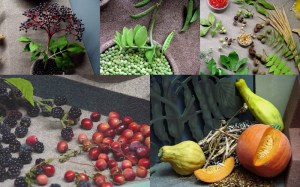
Plant models by Gary Hoyle. All rights reserved
What is the first image to come to mind when you hear the word,
diorama?
Do you see an open shoebox laying on its side containing a scene depicting life at one of California’s historic missions? How about a mountain scene? A desert scene perhaps?
While smaller and much simpler in construction, the classroom diorama is really no different from the dioramas seen in natural history museums. What they have in common, is they are all snapshots of life occurring at a site-specific location.
Dioramas were patented by Louis Daguerre in 1822 (Hoyle, 2008). Daguerre was a stage designer in the theatre and the inventor of the daguerreotype (Hoyle, 2008). Daguerre’s “stage window” (Hoyle, 2008) eventually evolved to become the nature scenes we know today.
These incredibly detailed landscape scenes are created by a dedicated team of curators, scientists, historians and artists who work together to connect the public to nature. Artists such as Gary Hoyle who specializes in creating representational work for museums.
How did Gary’s museum career get its start?
When Gary was ten years old, he saw his first wildlife diorama at the Museum of Science in Boston, Massachusetts. He says that after this visit, he became obsessed with creating environments for the clay animals he made as a young child. When he was fourteen, he was invited to watch Klir Beck, curator of the Maine State Museum, create the Black Bear Diorama. Sometime after this experience, he showed Beck his animal sculptures and, to his surprise, was invited to sculpt two box turtles for another exhibit. Months later, a 15-year old Gary presented the turtles to the Governor of Maine during a ceremony at the museum.
After high school, Gary studied biology instead of art because he had little interest in abstract art, which was the focus of art programs at the time. While he wanted to combine art and science in some way, Gary felt a burden to be practical because “the whole idea of having a profession in ‘diorama art’ seemed more like a childhood dream than anything remotely possible in the 1960s.” Because there were no scholarships and no way to create a degree with an interdisciplinary focus, Gary studied zoology at the University of Maine.
Years later while finishing up his degree and during his three years of teaching, Gary checked-in with the Maine State Museum periodically to see if they were hiring. In 1973, he was hired as a Research Associate in Natural History at the museum’s new home in the Maine State Cultural Building. Gary’s mentor for those first ten years was Fred Scherer. Scherer had retired from the American Museum of Natural History (AMNH) in New York and worked at the museum in Maine once per week as a museum consultant. Gary says Scherer taught him the techniques he learned as a preparator during his 38-year career at the AMNH. From Scherer, Gary learned how to make small plants, ledges, leaves and trees for the foregrounds of dioramas. He also learned some of the painting techniques Scherer had learned while working as a background painter for legendary artist James Perry Wilson. Gary says he still learns from Scherer, now 97, by phone and when he goes on walks. Gary says, “…when I walk in nature, (I) remember his advice.”
Gary’s first challenge in creating botanical specimens occurred after his mentor left the museum. While he had a good foundation in plant fabrication, this new project required Gary to create hundreds of berries, fruits, plant parts and life-like plant specimens for an exhibit about native American edible plants. Adding to this challenge was the size of his work space — a 12′ by 16′ lab at the museum. Gary says he had to do a lot of experimenting before he could even create his first plant specimen. At the time, there was only one other person in the US creating plant models in wax (Gary’s preferred medium because of its low toxicity). This other person was Dick Sheffield at the Museum of Science in Boston. Gary contacted Sheffield and Sheffield provided a lot of helpful advice about working with wax. Even with all of Sheffield’s generous advice, Gary said, “collecting, color noting, preserving, mold making, wax coloring, casting, fabricating and mounting consumed two years of my work days.”
Today Gary works as an exhibits consultant and a visual artist whose specialty is representational works for museums, corporations and individuals.
This month we have the unique opportunity to learn about plant models, exhibit design and dioramas from an expert with forty years experience in the museum field.
Please join me in welcoming Gary Hoyle, our featured guest for October.
Literature Cited
Hoyle, Gary. 2008. From theatrical illusion to ecological theater: The development of the classic wildlife diorama. Journal of the Guild of Natural Science Illustrators. Volume 40, Number 8.



 ArtPlantae Today