Feeds:
Posts
Comments

When you see a diorama in a museum, do you give it a passing glance or do you stop to look inside?

If you stop to look inside, do you notice the animals first? The plants? What do you see? How do you make sense of the scene before you?

Michael J. Reiss and Sue Dale Tunnicliffe of the Institute of Education at the University of London evaluate dioramas and study how visitors react to them. In Dioramas as Depictions of Reality and Opportunities for Learning in Biology, they explain how these small “rooms with a view” can be used as a teaching tool in biology.

Reiss and Tunnicliffe (2011) evaluated dioramas at the American Museum of Natural History in New York, the Museum of Scotland in Edinburgh and the Natural History Museum in London. In their evaluation, they observed each diorama carefully and answered the following questions:

  • What is happening within the diorama?
  • What was the intention of those who designed and constructed the diorama?
  • What do visitors notice and discuss?

Their evaluation of dioramas was followed by a review of visitor comments collected from 163 conversations recorded at the Natural History Museum in London.

The authors found that dioramas enhance visitors’ observational skills, encourage inquiry-based learning and inspire visitors to become storytellers. Reiss and Tunnicliffe (2011) observed that when visitors stop to view a diorama, a specific sequence of events occurs. First, visitors identify the specimens in the diorama. Then they make comments about the specimens and interpret the scene before them by drawing upon their prior knowledge. This is followed by visitors asking questions about the scene and devising a story to describe what is going on in the diorama.

It is the storytelling aspect of dioramas that Reiss and Tunnicliffe (2011) say make dioramas good tools for learning in biology. The stories visitors create about the scene before them blend their observations with their own life experiences and this makes it possible for visitors to internalize new information. Reiss and Tunnicliffe (2011) feel museum educators need to guide visitors in the storytelling process because sometimes dioramas can tell the wrong story.

What do Reiss and Tunnicliffe (2011) mean by this?

While the authors value dioramas and the attention to detail that goes into their construction, they have some concern about the messages they send. Their specific concerns have to do with dioramas moving away from “actual reality” and their tendency towards “interesting presented reality” (Reiss and Tunnicliffe, 2011). The authors are concerned that dioramas:

  1. Depict animals doing more interesting things than they would be doing in real life.
  2. Present animals engaged in “unrealistically frequent acts of predation” (Reiss and Tunnicliffe, 2011)
  3. Show only examples of healthy and fit animal life.
  4. Do not include humans interacting with nature, therefore suggesting that humans are separate from nature.

Think about the dioramas you have seen. Do you agree with the concerns raised by Reiss and Tunnicliffe?

Share your observations and thoughts by joining the conversation with artist and museum consultant Gary Hoyle, this month’s featured guest. Today the conversation is about dioramas and the visitor experience.


Literature Cited

Reiss, Michael J. and Sue Dale Tunnicliffe. 2011. Dioramas as depictions of reality and opportunities for learning in biology. Curator: The Museum Journal.
54(4): 447-459

This paper can be purchased online for $35 or obtained by searching the stacks at your local college library.


Also See

Teachers view humans as separate from the environment

This morning Gary Hoyle explains how plant models in a diorama are restored. Our interesting conversation continues!


ArtPlantae
: The dioramas in the Hall of North American Mammals at the American Museum of Natural History (AMNH) are in the process of being restored. The New York Times featured a story about the restoration last year. This article includes a behind-the-scenes video of diorama artists at work. The article focuses mostly on the restoration of mammals. My question to you is… what about the plants? The shrubs, grasses and trees surely fade over time like the fur of the mammals. How do you freshen up a 30-year old plant model?


Gary
: Well, I guess I could give a general answer. A 30-year old model might need some cleaning with a gentle current of air from an air brush and the use of a dry sable or camel hair brush, and very likely it will need a color restoration because of prolonged exposure to exhibit lights. However, the truth is that every situation is different, and sometimes it’s necessary to consult with specialists such as painting and objects conservators especially when dealing with exhibit models more than 50-years old.

Learn more about restoring plant models

Marie-Odile Bernez, project coordinator for the seminar series about images used in the service of science, has announced the 2012-2013 seminar schedule. Seminars will be held at Dijon University in France and will be given in English and in French.

Detailed descriptions about each seminar can be viewed on the Calendar page at the Illustrating Science website.


Scientific Illustration Seminars 2012-2013


October 26, 2012: Medical Illustrations

  • “The Eye and The Hand: Anatomist-Artist Co-operation on Two Dutch Anatomical Atlases (1685-1742)” – Tim Huisman, Museum Boerhaave, Leiden, Netherlands (English)
  • “Seizing the Cultures of ‘Medical Physics’ in the Nineteenth Century” – Josep Simon, University Paris Quest (English)
  • “Representing Delivery and Creating Obstetrics in Nineteenth-Century Spain Through Medical Textbooks” – Alfons Zarzoso, Universitat Autònoma de Barcelona/Medical History Museum of Catalonia (Engligh)
  • “Perception of Lipoproteins and Atherosclerosis Through Their Visual Representation” – Elisa Campos, Lisbon (English)


January 25, 2013: Anatomical Illustrations

  • “Les petites lettres de l’anatomie” – Hélène Cazès Montreal (French)
  • “Entre mémoire et métaphore, le corps humain comme maison” – Etienne Lepicard, Jerusalem (French)


March 22, 2013: Engineering Designs

  • “Delineating a Rational Profession: Engineers and Draughtsmen as ‘Visual Technicians'” – Frances Roberson, Glasgow (English)
  • “Displaced Representation and Nationalistic Appropriation: Illustrating the Atlantic Cable of 1858” – Mark Niemeyer, Dijon (English)


May 24, 2013: Biased Images?

  • “Scientific Images in the Logical Empiricist Tradition” – Richard Gawne, Duke University (English)
  • “Aesthetics and News Values in Online Imagery of Space” – Phil MacGregor, Bournemouth (English)


June 7, 2013: Les Sciences et Leurs Vulgarisations par L’image

  • “Graver des figures de géométrie au XIXe siècle: procédés, acteurs et enjeux éditoriaux” – Norbert Verdier, University of Paris-South (French)
  • “Les illustrations dans les livres scientifiques pour enfants au 19e 
    siècle comme objets communicationnels” – Daniel Raichvarg, Dijon (French)


Helpful Resource

Google Translate – http://translate.google.com

ArtPlantae: In reviewing the literature about dioramas, I noticed that the educational value of dioramas is a topic that comes up often. In your article, Saved From the Trash, you state that dioramas are in danger of disappearing because they are considered to be “outdated displays.” How do you defend the value of dioramas when others want to replace them with, say, something more interactive?


Gary
: There is a stark difference between an interactive exhibit and a diorama. Certainly interactive exhibits fit well with our cybernetic lifestyle. Dioramas do not, and that makes the diorama even more unique in today’s world. The “time freeze” in such an exhibit does not mean that the diorama is a contemplative and therefore outdated exhibit model. If done well, a diorama can evoke a powerful potential energy. Muscles straining on a tiger crouched in the grass or a ruffed grouse ready to bolt from cover can awaken something primal if we are willing to stop and really look. Publishers assumed that a child’s attention span was too narrow to read a book of over a hundred pages until J.K. Rowling blew that theory out of the water. The same is true of a diorama. I have seen young children, and adults too, thrill to that type of exhibit.

I have nothing against interactive exhibits. I actually think certain types of interactive exhibits keyed to elements within a diorama…

Read More

Laura Stickney: Aspects of Theodore Payne Foundation in Line and Color
Theodore Payne Art Gallery
Sun Valley, CA
Oct. 12 – Dec. 29, 2012

The Theodore Payne Foundation for Wild Flowers and Native Plants (TPF) invites you to the opening reception of the art exhibition celebrating the work of artist-in-residence, Laura Stickney. Luminous watercolors, richly colored oil paintings and seed-packet artist’s books will be on view. Created over the course of Laura’s one-year residency, each piece was inspired by the nursery, gardens, and other discoveries made at the Theodore Payne Foundation.

Laura Stickney is a graduate of USC with a major in printmaking. In addition to her work as an artist, Laura has taught art to all ages for 25 years at the well-known Barnsdall Art Park in Hollywood, and the art of printmaking at the Art Center College of Design in Pasadena.

Here are examples of the wonderful work Laura created during her residency. View the entire collection and learn from Laura yourself during the opening reception on Saturday, October 13, 2012. The reception will be held from
2:00 – 4:30 PM. The Artist Talk begins at 3:00 PM.

Many thanks to the Theodore Payne Foundation for this early look at the exhibition. Images and descriptions courtesy of The Theodore Payne Foundation.


Seed Packet Artist’s Books

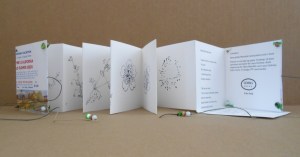
Laura’s artist’s accordion books are based on Theodore Payne seed packets. Unfolded, they reveal delicate graphite drawings of selected native plants, a tiny clear bag of seeds, and a poem written by Laura and inspired by that plant.

Seed Packet Artist Book 3, mixed media © 2012 Laura Stickney, all rights reserved


Pod Paintings

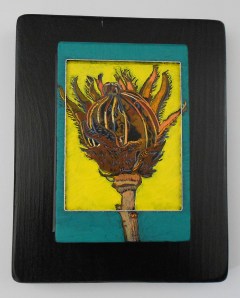
Painted from life, Laura’s series of small oil paintings of native seed pods at TPF are densely packed with information, texture and color. The images are painted on repurposed, rectangular Polaroid metal film canisters. The use of discarded film containers is linked and refers back to Laura’s concept of light. In some way, the paintings refill those empty Polaroid vessels with new memories.

Matilija Pod, oil on Polaroid metal film canister © 2012 Laura Stickney, all rights reserved


Watercolors

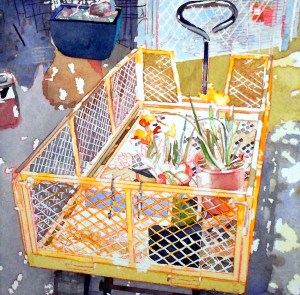
Laura’s iridescent watercolors capture the beauty of sunlight and the colors of TPF. Conceptually layered, they focus on the place where nature and culture collide, where the nursery plants and the evidence of their caretakers intersect: a plant cart, a plant pot, a secluded corner of the garden. “All of my work is about still life,” Laura says. One could call these watercolors of nature and culture “environmental still lifes.”

Plant Cart, watercolor on archival paper © 2012 Laura Stickney, all rights reserved

Here is a class that looks too good to miss!


The Art of the Creepy Crawlies Science and Art Drawing Class

Saturday, October 27, 2012
9 AM – Noon

In this unique art and science class, students in grades 5-8 will learn about illustrations created by 18th century explorers, examine “creepy crawlies,” and create their own scientific illustration. Students will practice basic observational drawing techniques and will apply their observation and drawing skills using the resources of the Lloyd Library. This class will be taught by medical illustrator, Marcia Hartsock. Cost: $25

View Details/Register

Plants wilt. It’s just the way it is.

It is possible, however, to work with a botanical subject that doesn’t fade within a couple of hours. You’ll have to make it yourself, though.

Today the conversation with Gary Hoyle focuses on the construction of plant models illustrators can use as tools.

You are invited to join this conversation already in progress.


ArtPlantae
: In your conference presentation, you made a distinction between making “highly realistic display pieces” and making simple models illustrators can use as tools. Nothing looked simple to me on this day. What would a “simple” model look like?


Gary
: The availability of the specific plant species dictates what a simple model would look like. Let’s take the branch of a deciduous tree for instance. If you have one in the neighborhood and it’s not winter or early spring, you can pluck a few leaves then use a copy machine to create your leaves. When you do this, don’t forget to place the leaves on the enlarger dorsal surface down…

Read More