Feeds:
Posts
Comments

When we last spoke with artist Mark Granlund, the conversation focused on the botanical art classes he was teaching online.

During our conversation with Mark, we learned about his book project The Book of Bartholomew, a collection of short stories about young adults and their experiences managing careers and relationships. Mark and fifteen fellow artists who have contributed to this project are ready to go to print and have launched a Kickstarter Campaign to raise funds to help cover publication costs. Mark says the objective of the current campaign is to “print 250 box sets of Volume 1 in the series, Bartholomew Makes a Garden, to sell online and at local bookstores and events. The illustrated box set includes the first twelve stories in the adventures of Bartholomew and all his friends.”

The story of Bartholomew and his friends has been evolving online and can be followed at www.bookofbartholomew.com and on Facebook.

Mark is still teaching art classes online. To learn more about his classes, visit his website or listing at Classes Near You > Minnesota.

No, Can’t, Don’t

When ArtPlantae participates in educational events, garden shows and other venues, I bring a traveling Guest Sketchbook with me and a sign that reads, “Please doodle in the Guest Sketchbook. Chicken scratch preferred. Words not necessary. Select any page. Thank you.”

All day long I invite people to doodle. Adults are the first to shake their heads no and to walk away. The usual response is “No. I can’t draw and I don’t doodle.” One man said, “Oh no. Not without a straightedge!”

The response I receive from children is very different. They are all over the sketchbook. Some return to draw again. Others lose track of time and space and draw for a long time. While most children respond in a positive way to my invitation, there have been some who have politely declined.

At an outdoor event where everyone is out enjoying a sunny day, having my invitation turned down is no big deal.

But what if you were using drawing as a learning tool for specific reasons and had a room full of students who groaned at the thought of having to draw for an assignment? What do you do then?

In Drawing Out the Artist in Science Students, science teacher Al Camacho, mechanical engineering professor Gary Benenson and Patricia Rosas-Colin, a graduate student in mathematics education have an answer to this dilemma. Their answer is quite simply, teach these students how to draw.

Not in an assertive “Draw or else!” sort of way, of course. But in a way that encourages them to become visual thinkers.

In their paper, the authors present five exercises designed to make students thoughtful and inquiring observers. Here I provide only a one-line description of each exercise. For all the juicy details, please see their paper.

In Camacho et al. (2012), you’ll find exercises about:

  • Sci-a-grams: What are they and how they can be used to demonstrate the value of simple sketches.
  • Basic Shapes – How to see shapes in everyday objects
  • Creating with Basic Shapes – How to create representational images
  • Information Through Labels – An exercise in communicating information
  • Diagram Design – An exercise in explaining how things work

You will also find in this paper a scoring rubric teachers can use to evaluate student drawings and assess student understanding.

The exercises presented in this paper do more than help students use drawing as a learning tool. They train students how to communicate information visually and equip students with a new way of thinking and expressing ideas (Camacho et al., 2012).

To obtain a copy of Camacho et al. (2012), you can buy this article online from the National Science Teachers Association (99¢).


Literature Cited

Camacho, Al and Gary Benenson, Carmen Patricia Rosas-Colin. 2012. Drawing out the artist in science students. Science and Children. 50(3): 68-73.
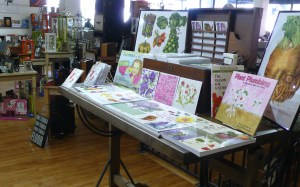
ArtPlantae brings botanical art, botany and its educational mission to Aurea Vista located in historic downtown Riverside.

Aurea Vista is located in a building whose life began in 1927 as a hotel built by architect G. Stanley Wilson. Today the building serves as an exciting new marketplace for local artisans, designers, importers, food sellers and craftspeople.

Visit Aurea Vista and discover many treasures such as delicious olive oils by Beyond the Olive, terrarium designs by Brenda Cook of Botanical Perspective, and yards of inspiration (and classes too!) at Raincross Fiber Arts.

Aurea Vista is located at 3498 University Avenue in Riverside on the corner of Lemon and University. Hours: Closed Monday, Tuesday-Saturday (11-7), Sunday (11-5). Store hours are extended for Riverside’s monthly ArtsWalk and other special events.

Parking: Free customer parking is available across the street in the parking lot with the ballet mural. Aurea Vista customers can park in spaces #1-8 that face University Avenue. Street parking is free after 5 PM Monday-Friday. Street parking is free on Saturday and Sunday.

Mariella Baldwin earned a diploma in botanical art at the English Gardening School fourteen years ago. Since then, she has gone on to earn degrees in fine art and the visual arts. Mariella teaches at West Dean College, at the English Gardening School, and at various venues. Her work can be found in collections at the Hunt Institute for Botanical Documentation at Carnegie Mellon University, the Chelsea Physic Garden in London, and at Hampton Court Palace.

Mariella is also the author of Botanical Painting, a thoughtfully written how-to book released in the US this past April. We’ll take a look at this book later.

Do you have a copy of Mariella’s book?

Have you written questions in the margins that you wish you could ask her yourself?

Here’s your chance! This month we are fortunate to have the opportunity to learn from Mariella in person.

Join me in welcoming Mariella Baldwin as our featured guest for November!

New ebook by Mindy Lighthipe


4″ x 6″

5″ x 7″

8″ x 10″

Drawings and painting in these sizes are easy to scan at home on a desktop scanner on a scanning surface that is
8.5″ x 11″. But what do you do with the rest of your work that is not only larger than this surface, but larger than your entire scanner?

Thanks to technology and natural science illustrator, Mindy Lighthipe, there is now a short practical guide to scanning your artwork.

Scan YOUR Art is a 17-page guide in which Mindy demonstrates how to scan a 11″ x 14″ painting using nothing more than your computer, your scanner, your printer and Adobe Photoshop Elements 9.0.

Mindy walks you through the process carefully and includes screenshots of each step so you can follow along as you replicate each step at home.

Mindy provides “how to” information such as:

  • How to create a folder for scanned images.
  • How to scan an image in two parts.
  • How to straighten a crooked image.
  • How to crop an image.
  • How to work with Layers in Adobe Photoshop Elements 9.0.
  • How to make quick color adjustments.
  • How to resize an image.
  • How to format a greeting card.

Mindy also provides information about printing companies and an online resource through which you can learn all the ins and outs of Adobe Photoshop Elements 9.0.

Scan YOUR Art is available as an ebook and can be purchased for $1.99.

Learn more about Scan YOUR Art

Bonnie S. Driggers
Botanical Artists for Education & The Environment


And the winner is…

On Sunday, October 28, Botanical Artists for Education & The Environment (BAEE) held a reception at Meadowlark Botanical Gardens in Vienna, Virginia. Author and teacher Anne-Marie Evans drew the winning ticket in the raffle for a copy of her book, An Approach to Botanical Painting. The lucky winner was Jerry of Bethesda, Maryland who is very happy to have won. He said, “I’ve never won anything before.”

BAEE greatly appreciates all of you who purchased tickets. The money earned will go to support the publication of our book, American Botanical Paintings: Native Plants of the Mid-Atlantic.

The Brenton Arboretum in Dallas Center, Iowa will conduct a walking tour of fruit trees and host educational games about fruit on Saturday, November 3, 2012. Budding botanists age 14+ are invited to join the fun.

Cost: Members, free; Nonmembers $5.

To register, call (515) 992-4211 or send a message to mail1@arboretum.org.

The Brenton Arboretum is a 140-acre arboretum established in 1997 featuring 2,600 trees and shrubs. Most of the more than 175 species of trees and shrubs are organized by species to ease learning and to emphasize the importance of trees in our world.