Feeds:
Posts
Comments

The words “draw” and “art” can be scary words. I observe this repeatedly when I interact with the public. It is for this reason that I invite the public to doodle in my traveling guest sketchbook instead of draw in it.

How people make meaning has been an interest of mine for many years. How they make meaning through drawing is of particular interest.

In this weekly column about teaching and learning, we often look at examples that involve drawing activities specific to some aspect of botany education. Less often we look at how drawing, the more expressive kind, affects understanding. We’ll do a bit more of this today.

In Do Attention Span and Doodling Relate to Ability to Learn Content from an Educational Video?, Ashley Aellig, Sarah Cassady, Chelsea Francis and Deanna Toops, student researchers at Capital University, evaluate the effect doodling has on student learning.

Thirty-four self-selected students participated in the study. Students were given paper and pens to take notes and doodle before watching a 25-minute video about communication styles (Aellig et al., 2009). Students watched the video together, then completed a questionnaire that included an assessment tool designed to measure attention span. Upon completing the questionnaire, students handed their notes, doodles and questionnaires to Aellig et al. (2009).

The research team found that there was not a significant relationship between doodling score, attention span, and the number of correct responses to the quiz about the video. Their hypothesis — students with shorter attention spans would have more complex doodles and lower scores on the video quiz — was not supported (Aellig et al., 2009). Instead what they observed were students who did very little doodling, but plenty of note taking. Of the students participating in the study, only six doodled while most of them (n=24) took notes (Aellig et al., 2009).

Why didn’t the students doodle during the video? Aellig et al. (2009) propose a few possible reasons:

  • The sample population is too embedded in the texting generation and may be less-likely to doodle.
  • The video’s content was not challenging enough.
  • The self-selected sample population (students at Capital University) are already engaged in their learning in ways that do not involve doodling.

In the discussion section of their paper, Aellig et al. (2009) propose an idea for future research about doodling in the classroom. They propose creating a doodling culture by embedding doodlers among the population of student research subjects. Their thought is that this would demonstrate to the sample population “that doodling is acceptable” as a form of notetaking (Aellig et al., 2009).

I would like to propose another suggestion to future student researchers who address this topic.

What if doodling were not left to chance? What if subjects were assigned a specific doodling activity to complete during a task, as was conducted by Jackie Andrade in her research about doodling and efficiency?

Readers, what do you think?


Literature Cited

Aellig, Ashley, Sarah Cassady, Chelsea Francis, and Deanna Toops. 2009. Do attention span and doodling relate to ability to learn content from an education video? Epistimi. 4: 21-24. Web. <http://www.capital.edu/epistimi-2009> [accessed 3 January 2013]

Epistimi is a student research journal at Capital University in Ohio.
How do I get work as a scientific illustrator?

This is question is asked often by young graduates with interests in art and science who want to become natural science illustrators.

I asked scientific illustrator and feature artist, Anita Walsmit Sachs, if she had advice for young illustrators looking for work.

She replied:

My advice to young scientific illustrators is to try to join an herbarium or museum and offer to help with illustrating or other relevant jobs as a volunteer. By doing this, an organization’s staff…

Read More

Anita Walsmit Sachs is the director of the art department and a scientific illustrator at the National Herbarium in the Netherlands at the University of Leiden. Ten years ago, Anita started teaching botanical art classes at the university’s botanical garden. During the next four years, enrollment in her classes grew. In 2006, Anita and some of her students formed the Dutch Society of Botanical Artists. Now 136 members strong, the Society will celebrate its seventh anniversary in April.

The focus of Anita’s work as a scientific illustrator is to visualize botanical information. Integrating information observed in dried plant specimens with the verbal instructions from botanists with whom she works, Anita creates line drawings in pen and ink that contain more information than could ever fit in a color photograph.

Please welcome Anita Walsmit Sachs, our special guest for January.

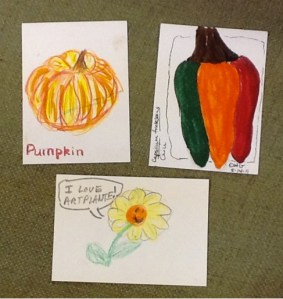
Trading cards from past events.

Trading cards traded at past events.

Looking to be more creative in the new year?

You are invited to begin your journey this week at Aurea Vista in downtown Riverside.

Visit ArtPlantae’s new sections celebrating plants, gardens and botanical art during the first ArtsWalk of 2013 and make artist trading cards to share with friends or other ArtsWalk visitors. Supplies will be provided.

Bring a friend.

See you there!


Artist Trading Cards with ArtPlantae at Aurea Vista

Thursday, January 3, 2013 (6-9 PM)
Lower level, across from the children’s boutique
Directions to Aurea Vista

Dear Friends,

Thank you for your interest in ArtPlantae. Before we close the door on 2012 and step into yet another new year, I would like to ask for a few moments of your time. I would like to ask for your help evaluating the ArtPlantae education website and the ArtPlantae Books site.

The link below will take you to a short 10-question survey. A quick click of the mouse is all that is required for most of the questions. If you have additional thoughts to share, there are places for you to expand upon your replies. All responses will be tallied anonymously. Your feedback is appreciated.

Thank you so much for your time,

Tania


This survey will be available through Sunday, January 6, 2013.

Open up that brand new 18-month calendar!

The New England Society of Botanical Artists will launch a traveling exhibition about native New England plants in May 2013. The exhibition, entitled
From the Mountains to the Sea: Plants, Trees and Shrubs of New England, will travel to Massachusetts, Vermont, Connecticut, Rhode Island and Maine through 2014. This exhibition will travel to the following venues:


    Duxbury Art Complex

    Duxbury, MA
    May 19 – September 8, 2013

    Montshire Museum of Science

    Norwich, VT
    Sept. – Nov. 2013

    Bartlett Arboretum Gardens

    Stamford, CT
    Jan. – March 2014

    Bedford Public Library

    Bedford, MA
    March – May 2014

    Audubon Environmental Education Center

    Bristol, RI
    May – June 2014

    Coastal Maine Botanical Gardens

    Boothbay, ME
    August – September 2014

Event dates will be posted when information becomes available. Check the “Exhibits to Visit” section for updates.

The New England Society of Botanical Artists is a chapter of the American Society of Botanical Artists and has about 130 member artists from all over New England and New York.

The American Society of Botanical Artists (ASBA), in collaboration with
Bartram’s Garden in Philadelphia, is curating an exhibition of original contemporary botanical artworks depicting plants discovered and introduced by John and William Bartram, American pioneers in botany and horticulture.

Very soon ASBA members will submit artworks for consideration and a team of four jurors will select about 40 works to be included in this traveling exhibition. This exhibition will focus on the native plant discoveries made by John and William in their travels throughout the eastern wilderness between the 1730’s and 1790’s. An illustrated, full-color booklet will be published in conjunction with the exhibition.

This traveling exhibition will be on view at the following venues:


    Bartram’s Garden Gallery

    Philadelphia, PA
    April 26 – May 24, 2013

    South Florida Museum

    Bradenton, FL
    September – December 2013

    Cherokee Garden Library

    Atlanta History Center
    Atlanta, GA
    March 1 – May 31, 2014

Additional venues will be posted in the “Exhibits to Visit” section as information becomes available.