Feeds:
Posts
Comments

Archive for the ‘teaching & learning’ Category

You don’t have to be a professional artist to enjoy drawing plants, any more than you have to be a professional writer to compose an e-mail or write a letter.

— Gail Selfridge

Scientific illustrator, Gail Selfridge, shares how she was inspired to start collecting and documenting Stapelia after reading a book about these interesting South African succulents. While she had prepared countless illustrations for books, journals, and museums as a professional illustrator, she had never prepared extensive illustrations for herself. Drawing her personal collection of Stapelia was a rewarding experience taking more than two years to complete.

In her article, Selfridge (2008) explains how she created her colored pencil illustrations and shares images of work-in-progress. Using little more than graphite pencils, colored pencils, a portable sketchbook, paper from a desktop printer, and discarded cardboard boxes from the grocery store, Selfridge (2008) built a collection of work about her favorite plant. With these mundane materials, she created a studio-worthy collection of portable drawing supplies, inexpensive sketching paper, and a homemade flat file. The “formal” art supplies in her studio included Prismacolor colored pencils, tracing paper, a kneaded eraser, drawing paper, illustration board, and a 10x linen tester with which to study a plant’s details (instead of an expensive dissecting microscope).

In Selfridge’s collection is an educational piece about Stapelieae designed specifically to introduce people to this group of plants and to “spark an interest in (viewers) to observe and learn more about their own plants through drawing” (Selfridge, 2008). This piece has traveled to museums and has been included in exhibitions such as Focus on Nature VII and a show at the Bruce Museum of Art and Science in Connecticut about flowers and their pollinators.

To learn more about Selfridge’s practical approach to creating a personal florilegium, contact the author to request a copy of her article.


Literature Cited

Selfridge, Gail. 2008. Drawing from your collection. Cactus and Succulent Journal. 80(1): 7-11.


QUESTION FOR READERS:

What everyday items do you like to use to document your observations about plants and nature? Tell us about your favorite simple art supply.


Updated June 20, 2016

Read Full Post »

The quest to understand the attitudes people have towards plants gets a statistical boost from biologists Jana Fancovicova and Pavol Prokop in Development and Initial Psychomatic Assessment of the Plant Attitudes Questionnaire. This study marks the first attempt to systematically evaluate the attitudes students have towards plants (Fancovicova and Prokop, 2010).

Fancovicova and Prokop (2010) used their new assessment tool in a study to determine the following:

  • Do students from families who maintaiin a garden exhibit a more positive attitude towards plants?
  • Do females have more positive attitudes towards plants than males?

Attitudes towards plants are the focus of their assessment tool and research because attitudes affect behavior and changes in behavior are necessary for humans to take responsibility for their role in the loss of plant biodiversity (Fancovicova and Prokop, 2010).

The Plant Attitude Scale (PAS) they created contains 45 Likert-style questions addressing student attitudes about the importance of plants, interest in plants, plant use in society and the costs and benefits of urban trees. The structure and reliability of the PAS was assessed using statistical analysis. The attitudes of 310 Slovakian students were analyzed. Students age 10-15 years were surveyed specifically because this age group has been found to be “important in the development of children’s cognitive abilities and their ecological awareness of the role of animals in their natural habitats” (Fancovicova and Prokop, 2010) and the authors assumed this was also true regarding this age group’s awareness of plants. Student participation was on a volunteer basis and dependent upon whether or not a teacher wanted to take the time to distribute the PAS to his/her students.

Fancovicova and Prokop (2010) found that student attitudes towards plants was neutral overall. Children who came from families who maintained a garden had a more positive attitude towards plants than their counterparts. While more positive, the difference in attitudes was statistically significant only with respect to Interest in plants. These results are consistent with the results found in other studies about student interest in plants. The authors also found there was no significant difference with respect to interest level between male and female students.

These findings, as well as additional observations, are discussed in detail in Fancovicova and Prokop (2010). Overall results suggest students do not value plants and that educational programs aimed at increasing student appreciation towards plants are important and necessary (Fancovicova and Prokop, 2010). Fancovicova and Prokop (2010) make several suggestions for future research using the sound assessment tool they created. Suggestions include assessing teacher attitudes towards urban trees, assessing the effectiveness of gardening activities in schools, and assessing the effectiveness of outdoor education programs.

The paper by Jana Fancovicova and Pavol Prokop can be purchased online from the Journal of Science Education and Technology for $34.95 or obtained at your local college library.


Literature Cited

Fancovicova, Jana and Pavol Prokop. 2010. Development and initial psychometric assessment of the Plant Attitude Questionnaire. Journal of Science Education and Technology. Volume 19: 415-421.


Related Information

Read Full Post »

By Carol Gracie

From the time I was a child, plants have always interested me, first for their beautiful flowers, but then because I would always notice something interesting happening on or near the flowers: insects visiting them (sometimes eating them!), other insects mating on them (rather risqué for a 10-year-old), colors or shapes changing; I always wanted to know why.

As an adult, I began teaching children and other adults about plants, both informally on nature walks and then on a professional basis at The New York Botanical Garden. Many people already appreciated the beauty of plants, but few gave them more than an admiring glance and failed to get to know the stories behind their pretty faces. It was my job to introduce them to the rich lives of plants and give them a sense of their role in the environment. Like animals, each plant interacts with its environment in some way. Since plants are stationary they have had to evolve creative strategies to accomplish tasks like reproduction, dissemination of their seeds, and protection from predators that are more easily carried out by mobile animals. Plants are particularly important because they are the very basis of life for most other organisms on earth; they can manufacture their own food, and without them, life as we know it would not exist.

Most of the adults that I taught were in class because they already cared about plants and wanted to learn more about them. However, capturing the interest of kids at the Garden on a school field trip was often more of a challenge. What to do? I found that a “hands-on” approach was best. Let them touch — sometimes even pull apart — what they were studying. Ask them questions about it. Get them to look and discover. When outdoors, I gave them magnifying lenses and let them observe what the insects were doing on/in the flower. The latter idea is easier said than done. The only insect that some city kids knew was the cockroach— in their eyes a creature put on this Earth to be stepped on – and many kids (and some adults) have such a fear of bees that they instinctively flail about when approached by one. Showing them that I wasn’t afraid of 6-legged creatures, and that the insects usually paid no attention to me if I remained still, would often give them the courage to become observers. And what keen observers young plant detectives can be! Once “into it,” they spot things that most adults miss — an insect camouflaged on a tree trunk, one hiding beneath a leaf, ants cooperating to carry something too heavy for one to bring back to the nest alone, etc. Being in the field with an interested child can open one’s eyes. However, I must admit that if a snake suddenly slithered across the trail, an immediate halt to all botanical education ceased. Things that move – fly, crawl, run, and slither — are just inherently more interesting to children. Since snakes have little direct connection to plants, I would share their excitement about the snake and once it had disappeared from view, get them to think about what snakes ate — often frogs or small mammals — and then to consider what those animals ate until we got back to plants, thus following the food chain back to the miraculous plants that didn’t need to “eat” anything else but could manufacture their own food. Of course, someone would always ask about “meat eating” plants, and we were off on another discussion. Several species of carnivorous plants are on display in the greenhouses of The New York Botanical Garden, so I could show them how each traps its prey and explain that the green plants still made their own food and only absorbed certain nutrients, which were lacking in the poor soils where they grew.

Although I no longer teach in a classroom setting, I still lead occasional wildflower walks and lecture about wildflowers. I find that the same techniques are effective with adults. I’ve led or co-led over 30 ecotours with a botanical focus, mostly to places in South America, but also to more local destinations. The location is not important. It’s getting people to take the time to really look at things. Once they learn to “stop and smell the roses,” they become interested observers and can enjoy the excitement of discovering something new, even if that something is long known, and only new to them.

We have had several artists, particularly natural history artists, travel with us over the years. Because they always seemed frustrated that they didn’t have time to do proper sketches before we moved on, we decided to offer some ecotours that included a separate component for artists. We offered one of these tours to Trinidad and two to the Amazon. On the Amazon tours we had one with the artists traveling together on the same boat with us and one with artists traveling on a separate boat that traveled along with the general natural history boat but was able to take longer stops at places where the artists could complete comprehensive sketches or photos. The artists’ boat would catch up with the other boat later in the day. What we found was that the artists didn’t want to miss anything that people in the general boat were seeing, and they preferred to stay with us, clipping specimens and keeping them fresh in water along the way. We would travel from one locale to another during the heat of the day, with most people on the “regular” boat taking a siesta or reading, while most of the artists were busily working away on the morning’s specimens or attending workshops led by our friend and artist-in-residence (or rather artist-on-board), Katie Lee. In the afternoon, we would be off in the canoes again, enjoying more of the Amazon’s wonders side-by-side with the artists. Over cocktail hour and dinner together we would view what they had created that day and marvel how each chose to focus on different aspects of nature, or used different styles, media, or techniques to depict the same species. As most of us settled in for the evening, we would notice lights on until late into the night on the artists’ boat as they diligently completed their work for the day. We all learned from each other and had a great deal of fun together on those trips. The Trinidad trip was a bit easier since we were based at a lodge with more spacious facilities for the artists to spread out. Nevertheless, they generally accompanied us on all excursions, and we often enjoyed sitting in on their workshops.

I hope to reach a larger audience with my latest book, Spring Wildflowers of the Northeast: A Natural History. In it I have included details about the lives of 35 plus wildflower species that have interested me over the years. As a photographer I’ve spent long hours in the field plant watching, and in the process learning about the plants’ lives. Knowing what pollinates them, how they reproduce, what eats them, etc. gives me a better understanding of how they fit into the environment and a deeper appreciation for their importance. It’s this information — from my own observations and that of many others — which I have written about in the book. Although I am not an artist I feel that depicting some of these interactions would make drawing or painting the wildflowers more interesting, both for the artist and for the viewer of his/her artwork.


About Carol
:
Carol Gracie is retired from The New York Botanical Garden, where over her three-decade career she served as Senior Administrator of Children’s Education, Foreign Tour Director, and a Research Assistant on tropical plant collecting expeditions. Aside from her current book, she is the co-author (with Steve Clemants) of Wildflowers in the Field and Forest: A Field Guide to the Northeastern United States (2006), co-author (with her husband, Scott Mori, and others) of A Guide to the Vascular Plants of Central French Guiana (Part 1, 1997; Part 2, 2004), principal photographer for Flowering Plants of the Neotropics (2004), and editor of Guide to the Natural Areas of the Lower Hudson Chapter of The Nature Conservancy, second edition (1981). Carol has five plant species named for her (and one named jointly for her and her husband) as a result of her work in the tropics. Carol and her husband live in South Salem, NY.

Read Full Post »

The tree which moves some to tears of joy is in the eyes of others only a green thing that stands in the way.

— William Blake

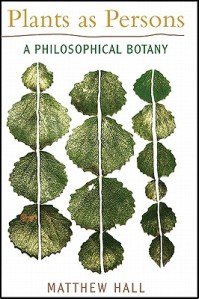
This observation by poet William Blake is one of the thought-provoking quotes included in Plants as Persons: A Philosophical Botany, an in-depth look at human-plant relationships in Western, Eastern, Pagan and Indigenous cultures by Dr. Matthew Hall, botanist and research scientist at the Center for Middle Eastern Plants at the Royal Botanic Garden Edinburgh.

Why write a book about seeing plants as persons?

This book was written to encourage humans to change their relationships with plants and to get them thinking about nature in a different way. Dr. Hall wants people to stop thinking of plants as “radical Others” inferior to humans (Hall, 2011) and to begin thinking of them as “other-than-human persons” worthy of respect and moral consideration (Hall, 2011). Plants are the foundation of all ecosystems and without them, the natural world would become a very unstable place.

Dr. Hall’s book is a survey of cultural and philosophical attitudes towards plants. In it he discusses the construction of hierarchies in nature by the Greeks, how plants and animals are viewed within Christianity, and how plants are devalued in the Western world’s hierarchical view of nature. In his discussion about Western attitudes, Hall (2011) addresses plant blindness and explains how this phenomenon falls short of explaining people’s ignorance about plants. He points out that by citing a physiological basis for plant blindness, Wandersee and Schussler (1999) imply that a “zoocentric attitude is in a sense natural and inevitable for all human beings” (Hall, 2011). He instead argues that zoocentrism is a “cultural-philosophical attitude” (Hall, 2011) and is not rooted in physiology. Hall supports his argument over and over as he introduces readers to the many ways people have relationships with plants; relationships that are very different than what is experienced in the Western world.

Hall (2011) explains human-plant relationships observed in Hinduism, Buddhism and Jainism. He discusses the relationship indigenous cultures have with plants, the relationship pagans had with plants before Christianity entered Europe, and the relationship contemporary pagans want to have with plants today. He introduces themes of personhood and kinship into the botanical literature and makes a very strong case for why humans need to be more mindful of plants and open to the idea of treating each plant as a fellow person — a person who is sensing and intelligent and worthy of moral consideration.

Intelligent? Sensing?

Yes.

Stories about plants communicating and having feelings are not only found in mythological tales and the folklore of ancient cultures. Stories about plants communicating, sensing their environment and regulating their own lives are also present in modern botanical research. Hall spends a chapter discussing research demonstrating how plants are capable of sensing changes to their surroundings and how they are capable of communicating with other plants to regulate their own growth. He discusses research studies about movement in plants, molecular signaling in plants, and theories about plant tissues capable of electrical signaling in a new field called “plant neurobiology” (Hall, 2011). He also introduces the controversial concept of plant intelligence to make the point that plants are active beings and not lumps of green waiting to be picked or eaten by humans.

Dr. Hall does a wonderful job of presenting many layers of research and insight in a very organized way. His introduction outlines the content of his book clearly and each chapter ends with a helpful summary and a smooth transition into the next topic of discussion.

There is a lot of information to think about in Plants as Persons.
All of it enlightening. Now here is a book that is hard to put down.


Plants as Persons: A Philosophical Botany
can be purchased at an independent bookstore near you.


Literature Cited

  • Hall, Matthew. 2011. Plants as Persons: A Philosophical Botany. New York: State University of New York Press.
  • Wandersee, James H. and Elisabeth E. Shussler. 1999. Preventing plant blindness. The American Biology Teacher. 61:84-86.

Related
Cover art for Plants as Persons by March Feature Artist, Mairi Gillies.

Read Full Post »

The research team of Melanie A. Link-Perez, Vanessa H. Dollo, Kirk M. Weber and Elisabeth E. Schussler continue their analysis of nationally-distributed textbooks in What’s in a Name: Differential Labelling of Plant and Animal Photographs in Two Nationally Syndicated Elementary Science Textbook Series. Last month we learned how their evaluation of the life science units in these textbooks revealed that more text was dedicated to non-human animals than to plants and that the number of animal examples used in textbooks exceeded the number of plant examples used in textbooks.

Today we look at their analysis of the photographs used in Macmillan McGraw-Hill’s Science (2005) series and Harcourt’s Science series (2006). Both textbook series were versions specific to the state of Ohio (Link-Perez, et al., 2010).

Once again, Link-Perez et al. (2010) studied only the life science section of the textbooks in each series. This time the research team wanted to know:

  • Are there different numbers of plant and animal photographs in the textbooks?
  • Are plant and animal photographs labelled differently?

To answer their first question, Link-Perez et al. (2010) considered photographs where plants and animals were shown at the organism level. They excluded from their analysis, photographs of plants and animals shown at the cellular level. They also excluded diagrams and drawings because these depicted concepts or processes and not only images of whole organisms. Photographs were grouped into the following categories: Plant Subject, Animal Subject, Landscape as Subject, and Dual Subject. In the dual subject photos, the featured plant and animal were represented equally (e.g., a photo showing a bee and a flower) (Link-Perez, et al., 2010).

To answer their second question, Link-Perez et al. (2010) looked to see if a label was associated with an image. Labels were categorized according to how it described the subject of the photograph. For example, a label’s “level of specificity” (Link-Perez et al. (2010) was considered to be broad if it contained general terms like plant or animal. Intermediate labels were those containing terms “corresponding to a phylum, class or order” such as gymnosperm or mammal (Link-Perez et al. (2010). Specific labels were those containing an organism’s common or species name. The research team considered photos to be labelled if they had a caption (not just referred to in the text). Two coders were trained to code the images. The coders worked independently of each other.

Link-Perez et al. (2010) found that of the 1,288 images they evaluated, 59.6% were of an animal subject, 25.6% were of a plant subject, 7.1% were of a landscape scene, and 7.6% were of a dual subject. They also discovered that animals shown in animal subject photos had more specific labels than plants shown in plant subject photos. The research team also discovered that plants were often identified by the name of a plant part or a plant life-form (i.e., “tree”, “flower”, etc.) instead of a more detailed description. In fact, intermediate-level labels were not used with plant photographs in textbooks for grades K-2; these labels only appeared in 3rd, 4th and 5th grade textbooks (Link-Perez et al., 2010). In contrast, intermediate-level labels were observed with animal photographs in textbooks for all grade levels (Link-Perez et al., 2010).

Of the 92 landscape images identified, most had labels that did not name the organisms in the image, but instead described a habitat or biome (Link-Perez et al., 2010). Ninety-eight dual subject images were identified and even though the featured plant and animal were weighted equally, 75% of the images had labels where the animal was identified more specifically than the plant (Link-Perez et al., 2010). Only 6% of the dual subject images featured captions in which the plant in the image received a more specific description than the animal in the image (Link-Perez et al., 2010).

Link-Perez et al. (2010) also observed that a more diverse selection of animal images were featured in both textbook series.

Because animal photographs outnumber plant photographs and because they have more specific labels than the plant photographs do, Link-Perez et al. (2010) recommend educators speak about plants using their specific names and by referring to them as whole organisms instead of as merely plant parts. They cite research studies demonstrating that student interest in plants can be encouraged if students are exposed to a diverse selection and if students are provided with the actual names of plants.

Link-Perez et al. (2010) include in their paper interesting discussion about how photographs improve student learning and information about the importance of naming plants properly. You can buy a copy of their article from Taylor & Francis Online ($36) or get a copy by visiting the reference section at your local college library.


Literature Cited

Link-Perez, Melanie A., Vanessa H. Dollo, Kirk M. Weber, and ElisabethE. Schussler. 2010. What’s in a name: differential labeling of plant and animal photographs in two nationally syndicated elementary science textbook series. International Journal of Science Education. 32(9): 1227-1242.

Read Full Post »

Cultural anthropologist, Emanuela Appetiti, and historian of science, Alain Touwaide, believe that cultures would not have invested time and energy into medical formulas if they were not effective. To preserve traditional therapeutic remedies before they are lost forever, Emanuela and Alain founded the Institute for the Preservation of Medical Traditions. The Institute is a research and education organization with non-profit 501(c)(3) status hosted by the Smithsonian. Through the Institute, Emanuela and Alain pursue their research activities, including research for the PLANT program.

The acronym PLANT stands for PLantarum Aetatis Novae Tabulae (meaning in Latin Renaissance botanical illustrations). The PLANT website is a historical encyclopedia of botanical illustrations found in Renaissance herbals and is a collaborative effort between the Smithsonian Libraries Digital Collections department, the Biblioteca Nazionale Centrale di Roma (National Library of Rome) and the Library of the Botanic Gardens of Padua. While still under development, the website contains a lot of interesting information and images. Visitors are able to view images from ancient herbals. Visitors can enlarge an image so they can view each illustration up close, closer than if each herbal were in front of them. When you visit the PLANT website, be prepared to be there for a while.

Today we have the unique opportunity to learn from Emanuela and Alain. Please join me in welcoming them.


    ARTPLANTAE
    : The PLANT project currently features 149 herbals created between 1470-1745. Funding was awarded in 2002 and research for this project began in 2003 in Rome, Padua, and Washington, DC. This comprehensive project has already been a 10-year effort. How much work remains?

    EMANUELA APPETITI and ALAIN TOUWAIDE:
    During 2003-2006 we browsed, analyzed and photographed all these books with the help of about 250 Earthwatch volunteers who came with us to work in the National Library in Rome, and later on in the Library of the Botanic Gardens of Padua. As a result, we have collected more than 70,000 images and generated three dictionaries of plant names, one for ancient names (Greek and Latin), another for Medieval and Renaissance names (including 32,000 items in Arabic, Medieval Latin and vernacular languages), and a third with the names of plants in five modern languages (12,000+ items). We are now in the process of double-checking all this information. We are writing original bios and essays about the authors and their books, based on the direct contact we have had with these works. We have completed our collection of portraits in collaboration with the National Library of Medicine and the Hunt Institute for Botanical Documentation, both of which own extensive collections of historical portraits. A few biographies have already been uploaded, such as those of Prospero Alpini and John Gerard.

    Once all the databases and the images are uploaded and connected, it will be possible to retrieve all the illustrations of the same plant in chronological order, so as to visually follow the transformation of the botanical drawing and knowledge. Each image will come up with its names from all the dictionaries listed above. This means that users interested in a plant of which they know only the vernacular or the common name, for instance, will be able to retrieve it and get all its names, including the scientific, binomial name. For the user to contextualize the books, the Latin names of cities where these books where printed are translated into their current name. Also, a short bio-sketch of publishers is provided together with the list of the botanical books they have published in order to see their contribution to the production of herbals. The cities should already be clickable on the website. We are currently working on the bios of the publishers, research that requires hours of investigation into the field of Renaissance publishing.


    AP
    : Many of the illustrations in the herbals are highly stylized renderings containing elements that look as if they were meant to serve as symbols of something else (e.g., Arbor vel lignum vite paradisi, folio 20 verso in the anonymous Ortus sanitatis (1491) published by Jacobus Meydenbach). How do you determine the accuracy of an illustration?

    When you know what a plant looks like, you have a sense of the elements that may have been a bit exaggerated (e.g., Ananas, page 268 in Trattato della historia, natura, et virtu delle Droghe Medicinali, & altri Semplici rarissimi, che vengono portati dalle Indie Orientali in Europa (1585) by Cristobal Acosta). But when you are not familiar with a plant, how do you check on the accuracy of an illustration, and more importantly, the accuracy of the species name?

    AT: These are two different cases, both very interesting and hinting at fascinating aspects of our work.

    One, the arbor paradisi (which is also the tree of knowledge), opens to the anthropological dimension of the research. Part of the text related to this tree (tree or wood of paradise life) reads as follows:

    “They naturally have such a property that he who eats its fruit, is invigorated by a perpetual strength [….] and will not be affected by any illness, anxiety, sign of tiredness, or weakness […]”.

    As you can understand from this extract of the text, this is an imaginary plant that serves educational and moral purposes. Theoretically, it should not appear in a book of herbs, but its presence clearly indicates that the benefits to be obtained from a plant were both physical and spiritual. And the Ortus Sanitatis is indeed about body and soul. Incidentally, you will note that the initial letter of the word arbor (tree) is missing. However a space has been left for it to be added, probably by hand, as a painted initial.

    The second case you mention, the ananas (pineapple), makes clear the function of this kind of illustration: it emphasizes the most characteristic features of the plants for identification purposes. So, when you did not know the plant, you memorized this peculiar morphology so as to recognize it in the field, being able to connect the plant with such characteristics and its name.

    Concerning the botanical identification, we use all possible available information to propose the best possible identification. This includes the text related to the illustration, the botanical tradition (coming from the most remote antiquity and continuously handed down up to the Renaissance), and the modern (= post-Linnean) scholarly and scientific literature, along with dry specimens from herbaria. Of course, we do this work in collaboration with botanists; sometimes, one ancient plant name corresponds to more than one modern taxon, and therefore we cannot arrive at the species level.


    AP
    : There are times when I wish I could read every language on the planet on demand. Exploring the herbals on the PLANT website made me wish for this ability yet again so I could learn more about the illustrations. In the herbals you have studied, is there any mention about how the illustrations were created?

    AT: In the preface of the herbals, several authors discuss this point. For example, Otto Brumfels, Leonhard Fuchs and Matthioli. Publishers were pushing authors to include illustrations with their texts. A significant case is the publisher and printer, Christian Egenolph, in Frankfurt, Germany. He created a set of woodblocks that he used for several texts, which were not originally illustrated. In so doing, he expanded considerably the market for his production. Though initially reluctant, the authors followed his example and agreed to have their works illustrated. Matthioli perfectly understood this logic and, besides repeatedly publishing new editions of his work, moved from small to large illustrations, each time also adding new items.


    AP
    : Do you know of any studies focused specifically on the marks used to depict form (or light and shade) in the herbals? Some of the marks seem a bit excessive and confusing (e.g. Rhamnus secundus, page 73 in Pedacio Dioscorides Anazarbeo, Acerca de la materia medicinal, y de los venenos mortiferos, Traduzido de lengua Griega, en la vulgar Castellana, & illustrado con claras y substantiales Annotationes, y con las figuras de innumeras plantas exquisitas y raras, por el Doctor Andres de Laguna (1570).

    EA: There is quite a body of literature on the history of botanical illustration in early printed books. However, studies have mainly focused on botanical accuracy, sources of illustration, floristic extensiveness and, more recently, on printing techniques. Rarely, analysis has addressed such an aspect at the crossroads of the visual arts and botanical knowledge.


    AP
    : The hand-colored illustrations I saw in the Kreuterbuch herbal by Adamus Lonicerus (1582) were colored loosely. It looks like the coloring was done very quickly. Is this approach to hand-coloring commonly observed in herbals?

    EA: There are indeed several herbals in collections worldwide that are hand-colored. Each and every such book is an individual case. Some have been very roughly and rapidly made like the Kreuterbuch, whereas others were artistically painted with botanical exactness, as in Fuchs. It depended on the personal choice of the owner of the book. Some probably wanted to have a nice copy, while others needed it to study and work with in the field.


    AP
    : I have a question about Alain’s Life & Literature slideshow that you shared with me. On the slide that shows what I assume to be Arabic characters, certain words/phrases were circled in red. Why were these words/phrases highlighted? What was the story behind this particular slide? I’m curious, that’s all.

    AT: Good catch! You are totally right in asking, and you’ll be amazed to know this story (which is one of our most cutting-edge programs). This is indeed the reproduction of a page from a Chinese manuscript containing formulae for medicines. This page should be vertical to read Chinese in the proper way (in columns), but I turned it horizontally to read what are, in fact, Arabic terms (names of medicines)! This story is long, but let’s make it short. Greek pharmaceutical texts were translated into Arabic and, the Arabic versions were transmitted up to China through India. So, we can state that Greek science traveled up to China.

    The most marvelous thing is that the terms in Arabic are actually Greek words written with the Arabic alphabet (what is called transliteration). And, these Arabic terms have been reproduced as such in the Chinese manuscript. This means that we have in China the Greek names of medicines, even though they are written in Arabic.

As mentioned above, Emanuela and Alain’s research includes the preservation of information about plants and their use in medicine. Their current focus is on Greek medical heritage and contributions to medicine made by the Arabo-Islamic World. The website of the Institute for the Preservation of Medical Traditions (IPMT) features a growing collection of books, images, digital texts and databases related to plants and medicine. The Institute’s website is very interesting and contains many layers of information. You are sure to spend hours on this website too.

Emanuela and Alain have studied medical traditions for decades and have worked in Spain, France and England. Emanuela says that they work in at least four languages everyday!

What is the relationship between the PLANT project and the Institute for the Preservation of Medical Traditions?

After moving to the US in 1999, Emanuela and Alain worked for a few years as independent scholars affiliated with the Smithosonian. Alain received a grant from the National Institutes of Health (NIH) to conduct research on the therapeutic uses of plants in Classical Antiquity. Alain conducted his research at the Smithsonian. The PLANT program arose as an extension of this NIH project and received early support from the EarthWatch Institute.

The PLANT project is a consortium composed of Alain & Emanuela (project authors and co-principal investigators), both libraries in Italy and the Smithsonian Institution Libraries (SIL). The SIL and the Italian libraries helped to collect the primary information for this project, and each library owns the rights of the images coming from its herbals and then published on the website. SIL Digital Collections is the e-publisher of this work.

The Institute for the Preservation of Medical Traditions (IPMT) is a natural extension of Emanuela and Alain’s research that, over time, grew into a new field of its own. This area of research needed its own space, so Emanuela and Alain created IPMT. The Institute is a self-funded entity that is now affiliated with, and currently housed at, the Smithsonian.

Alain and Emanuela work with about ten students and volunteers who help develop the Institute’s programs. The Institute has established an extended network of institutions and scholars with whom Alain and Emanuela work. A short list of their partners can be viewed on the IPMT website. It is IPMT’s mission to disseminate the concepts and methods they have developed to recover, preserve and analyze ancient knowledge. Emanuela says they want to educate the next generation of educators who will “expand the scope of our activity and broaden the audience we reach.”

The Institute hosts seminars at the Master’s and Doctoral level and conducts classes worldwide to interested audiences. The Institute’s educational activities address all disciplines related to its research, from ancient books to scientific technology. Emanuela describes the Institute’s mission succinctly, “We trace and follow the development and transmission of knowledge in the field of the natural and life sciences based on the written record, with a special focus on the Mediterranean area.”

Botanical artists painting medicinal plants and interpreters researching a heritage site will find the Science Services offered by IPMT especially interesting. Emanuela explains how the Institute can assist artists and interpreters with their research:

Our work is not only about collecting, but also, if not mainly, interpreting. We have created tools for a correct understanding of ancient botanical history and illustration, and also heritage sites. For example, in approaching ancient illustration of plants in books, we read the illustrations together with the related text. In so doing, we inject botany into history, and we are in a better position to properly understand the ancient documentation. Similarly, to approach a site, for example, we connect it to its contemporary botanical knowledge and create bridges between such knowledge, on the one hand, and, on the other, architecture and landscape. Alain has studied the representation of a garden in a 1st-century Roman palace and demonstrated that it reproduces the organization of a garden in nature, which, in turn, was based on the classification of plants in ancient botanical knowledge. There thus is a strong link between artistic creation and scientific theory.

When asked how they would like scholars, physicians and the public to use the IPMT website and its resources, Emanuela replies:

As a research entity, the IPMT is both a laboratory and a library collection. Alain and I have been collecting books on all the topics covered by our research for years and years and currently own a specialized library of circa 15,000+ items. This is a research collection for consultation. It is currently housed at the Smithsonian and is open to the scholarly and scientific community. We regularly receive requests for information, and for permission to visit the collection and take advantage of its resources from students and colleagues. In the future, we hope to be able to offer grants for students to stay in-house for a certain period of time, to carry on their own research.

As for our research, our vision is to generate new data from tradition and to inspire further innovative investigation. Ancient information is indeed a source for new developments that will contribute to (the improvement of) people’s health and healthy lives. In this view, we wish to partner with entities that will capitalize on our work and translate it into new applications, in the fields of medicines, food, hygiene and cosmetics.

A not-for-profit organization, the Institute for the Preservation of Medical Traditions relies on donations to conduct its research. Interested individuals can contribute to the Institute by becoming an Associate Member ($20/yr.) or by making contributions through NetworkforGood.org, JustGive.org, or Razoo.com.

The PLANT website will be the focus of a roundtable discussion during a meeting of the Renaissance Society of America in Washington, DC (March 22-24, 2012). On March 24, Alain will co-present The Digital Herbal: Roundtable on Renaissance Botanical Illustration on the Internet.


A Special Viewing

Emanuela and Alain’s research started, and still focuses, on handwritten manuals of therapeutics, conserved in libraries or private collections all over the world. Unlike printed books produced on a larger scale, each handwritten manuscript is unique. As an example of their analysis and study of manuscripts, Emanuela and Alain have provided a link to view the Padua manuscript. This section is still a work in progress, with several parts still to be presented. This is the first time this manuscript has been uploaded and Emanuela and Alain hope you enjoy the sneak preview!


Related

Read Full Post »
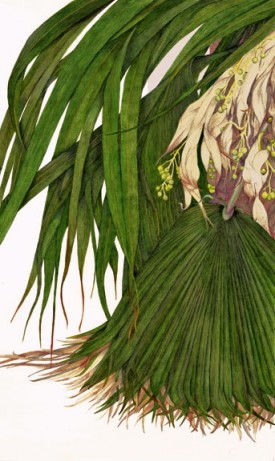
Pritchardia schauttaueri © 2011 Arillyn Moran Lawrence. All Rights Reserved.


Arillyn Moran Lawrence
is a southern California artist working in mixed media, watercolor and oil. Her paintings are both traditional and contemporary and have been featured in exhibitions across the US almost every year for the past 22 years.

Arillyn is also a botanical artist and a member of the American Society of Botanical Artists and the Botanical Artists Guild of Southern California. Five years ago, Arillyn began to document and illustrate endangered Hawaiian plants. Today we sit down with Arillyn to discuss how she preserves the plants of Hawaii for future generations through research and art.

ARTPLANTAE: You have traveled to Hawaii every year for the past 50 years. Not too many people can say they have done this. What is it about Hawaii that keeps you coming back?

ARILLYN MORAN-LAWRENCE: I fell in love with Hawaii when I first landed there as a Pan American stewardess. I loved the smell of the plumeria in the air. Driving down Nimitz Highway, I thought back to Pearl Harbor, to the history, and to the war in the Pacific. I read the book Hawaii by James Michner numerous times. I began working for Pan Am because I was not finding a use for my Bachelor’s degree in art and advertising. I did find jobs at NBC and ABC in advertising, but I was lacking the skills needed to produce art for television. I also investigated medical illustration as an option, but found that it was a male-dominated field. Pan American offered a way to see the world and to study art and other job opportunities. I flew to the Caribbean and South America. I then transferred to the Pacific Division and flew to Hawaii, Fiji, New Zealand and Australia. Trips to Asia presented Tokyo, Hong Kong, Manila, Saigon, Singapore and Bangkok. Pan Am’s Pacific Division also flew to Paris and London on the Polar Route from the west coast. When I left Pan Am, I married, had 2 sons, returned to college for a teaching credential and then …..returned to Hawaii as often as possible.


AP
: When did you begin to document and paint Hawaiian endangered plants?

AML: I believe it was 2005 when I first read in the ASBA journal that they were planning to have an exhibition titled “Losing Paradise”. As Hawaii has many of the most endangered species on earth, I felt that I wanted to complete some paintings and try for entry to the show. I began studying Hawaiian plant species on the Internet. I bought the book Remains of a Rainbow by David Liittschwager and Susan Middleton and studied it until I had a plan as to what to investigate. I then booked tickets for Honolulu.

I contacted Ho’omaluhia Botanical Gardens, near Kaneohe, and discussed any endangered species that they might have in their collection. Then, I was directed to Foster Gardens and Lyon Arboretum on the Honolulu side of the island and Waimea Arboretum on the north shore. I was provided names of botanists who would assist me. I made reservations with all the botanists before I arrived and they have all been very helpful with information and their time.


AP
: Explain how you work with a botanist. Is the botanist’s role only to answer questions about plant morphology or does he/she select the specimens for you?

AML: I usually arrive in Hawaii with plants that I want to study with the botanist at their arboretum. It is important to know when the plants are blooming as Hawaii is tropical, but not all plants are blooming all the time. However, on my first trip, I also wanted to see what they had to offer so I let them introduce me to the plants and their histories. Now that I have been doing this for about 6 years, I ask the botanists to show me plants that are of interest to me and my collection.

An exceptional botanist, Karen Shigimatsu, at Lyon Arboretum has helped me over the years. She has walked miles with me and provided me with much valuable and wonderful information. Also, David Orr at the Waimea Arboretum has assisted me in numerous ways by driving me around in a golf cart, going long distances so I can see everything, propping me up while I photograph on slanted hillsides and answering all of my questions. He is full of great information and the ultimate teacher.

It is a lot of work to digest everything the botanists know very well. I have my camera ready to photograph the plant label and then the plant. We work rapidly and move through a lot of specimens and information. Afterward, it is hard to sort out all of the information. But if you return to the specimens that you have seen, make notes and draw the plant, you will have good accurate information to use as a reference. Good shoes are a necessity in the gardens as volcanic ground can be difficult. The ground can be dusty, wet, slippery and rough. The deep red earth sticks to your shoes, you, and stains both. Long pants and tee shirts with long sleeves and bug spray is essential as the mosquitoes seem to know that you are new and have nice blood. With these problems solved you should be able to pay attention to the wonderful plants and get as much information as possible.


AP
: How many plants do you plan to illustrate?

AML: So far, I have completed Hibiscus clayi twice — one H. clayi from the sunny Waimea Arboretum on the north shore and one H.clayi from the Lyon Arboretum in the rain forest. Hibiscus arnottianus, Gardenia brighamii, Pritchardia schattaueri, a deep-red ancient sugar cane, and a beautiful black taro plant. I am currently working on Abutilon eremitopetalum. So eight plants so far. I plan to complete another 10-12 paintings.

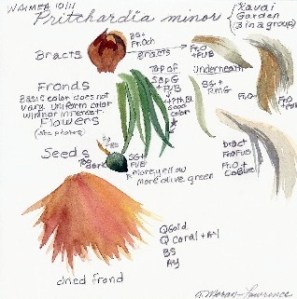
During my last trip to Hawaii in October 2011, I studied all of the Hawaiian Pritchardia palms in the Waimea Arboretum and the Lyon Arboretum. I spent days doing color test strips for the palms. In the beginning I used colored pencils but found that the colors were not easily translated into watercolors. So, I use a small light palette with all the necessary colors. I painted fronds, bracts, seeds, trunks and flowers and noted all the formulas I will use to recreate each part of the palm (e.g., Pth Bl+WYel+PRo, Pthalo Blue, Winsor Yellow, Permanent Rose).

My field sketchbook/journal is made by the Bee Paper Co. and is 6″ x 6″. The scan included in this article is from my book of color

Pritchardia sketch © 2011 Arillyn Moran Lawrence. All Rights Reserved

swatches with notes from my most recent trip. Keeping things small, I used a 6″ X 6″ book of hot press Italian paper by Cartiera Magnani. It is 140 lbs., acid-free and pH neutral. I normally use Fabriano Artistico cut into long strips, but I had to keep this simple and small so I could easily move around from palm to palm and store my notes easily. I had a carry-on bag with wheels and I used that in Waimea because of the distance I had to travel. I also had my light plein air collapsible chair with me, as I was working with the plants for hours. At the Lyon Arboretum, I had my husband drop me off with my backpack. It is nice to have a patient person there to help you out.


AP
: Do you work on your endangered plant project at home or do you only work on it while in Hawaii?

AML: I always work at home on all of my paintings because most of my paintings are large. You need to have clean work and that would not be possible in the tropics working plein air. I do the color test strips when on-site as I feel that leads to accuracy and knowledge.

Painting on-site is not easy as every plant I have painted requires lots of walking. The rain forest can be really wet and slippery. The earth can also be dry and it can be very hot as in Koko Head, where all the Hawaiian plants are located at the farthest point, so you don’t want to carry much. Also, volcanic earth on a steep hillside can give way and you can end up down at the bottom of the hill. It is soft so you aren’t hurt but now you need to climb back up to your specimen again. Or, it can be dry one minute and raining the next so an umbrella is a necessity. It is hard to manage a sketchbook, a water bucket, one or two brushes and some paper towels while you are moving around getting test strips for color. I travel light and know what I want to capture.


AP
: When this project is completed, what’s next?

AML:It is never going to be completed. Susan Frei Nathan suggested to me that I should continue with my passion for Hawaiian endangered species and then donate all of my paintings to a museum in Hawaii for future generations.


AP
: What advice do you have for botanical illustrators interested in studying and documenting local native plants?

AML: Know what your passion is. Study and paint and your passion will emerge.


Related Resources
:


View Arillyn’s Work

  • Catharine Lorillard Wolfe Annual Members Show at the Salmagundi Art Club at 47 Fifth Avenue, New York, NY (March 18-30, 2012)
  • Grow! A Garden Festival, Los Angeles Arboretum & Botanic Garden, Arcadia, CA (May 5-6, 2012)


Recent Awards

First Place, The Old Boat Yard, watercolor. Southern California Plein Air Painters Association Gallery, Newport Beach, CA. November 6, 2011 – January 2, 2012.

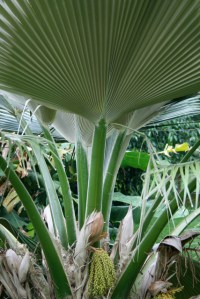
One of Arillyn's painting subjects. ©2011 Arillyn Moran Lawrrence. All Rights Reserved

Abutilon eremitopetalum, endangered; work-in-progress to become watercolor over graphite. © 2011 Arillyn Moran Lawrence. All Rights Reserved

Read Full Post »

« Newer Posts - Older Posts »