Feeds:
Posts
Comments

Archive for the ‘teaching & learning’ Category

There was much interest in last week’s article about the art strategies that can be used to enhance science communication, so I thought we’d take a few moments looking at the strategies that were used by Buczynski et al. (2012). The strategies they used came from Julia Marshall’s paper, Five Ways to Integrate: Using Strategies from Contemporary Art.

In her article, Marshall (2010) cites studies explaining how integrating art with other disciplines is worthwhile. She also provides teachers with specific ideas on how to integrate art into all subject areas.

The strategies defined by Marshall (2010) have one thing in common — they are strategies artists use “to manipulate ideas and imagery to make meaning” (Marshall 2010). Through the manipulation of ideas, artists re-frame information in direct or creative ways. Here is a quick look at these strategies and how they enhance learning.

    Depiction:
    A straightforward approach that involves drawing or creating from observation. Scientific illustration and botanical illustration fall into this category. According to Marshall (2010), this strategy is appropriate to use with all ages (preschool to adult) and aids in learning because it requires a learner to observe a subject, reproduce a subject and reflect upon the subject’s construction.


    Extension/Projection
    :
    This strategy calls upon artists to make predictions — to reflect on how a situation will change or to reflect on what might be possible. The implementation of this strategy aids learning because it requires learners of all ages to study an idea before they can think about how it could change (Marshall, 2010).


    Reformatting
    :
    This strategy requires learners to see things in a new context. Doing so is beneficial to learning because seeing a subject or a concept in a different way results in a new understanding of the subject or concept (Marshall, 2010). This strategy can be used in middle school and high school classrooms (Marshall, 2010).


    Mimicry
    :
    Mimicking the methods of others is simply doing what others do. Mimicking is beneficial because it provides an opportunity for experiential learning; this strategy can be implemented in grades K-12 (Marshall, 2010).


    Metaphor
    :
    The creation of metaphors requires identifying differences between similar entities. Creating metaphors aids learning because it requires analytical thinking and provides a way to identify connections between disciplines (Marshall, 2010). Marshall states this strategy is best used with high school students.

To learn more about each of these strategies, read suggestions about how they can be used in the classroom, and to view examples of art created through the use of these strategies, download a copy of Marshall (2010). A link to her paper is available on the website of the College of Performing and Visual Arts at the University of Northern Colorado.


Literature Cited

Marshall, Julie. 2010. Five ways to integrate: Using strategies from contemporary art. Art Education. 63(3): 13-19. Web.
http://www.arts.unco.edu/ciae/institute/documents/Articles/Marshall-Five%20Ways%20to%20Integrate.pdf
[accessed 19 July 2012]


You May Also Enjoy…

Read Full Post »

Nature Art
Science Art
Scientific Illustration
Natural Science Illustration

What do you call art that gets people thinking about nature and the environment?

Today I am going to use the label “natural history art” because it is nature that professor, Ashley Campbell, emphasizes in Avenues to Inspiration: Integrating the Life and Work of Nature Artists Into Middle School Science.

In her article, Campbell (2011) suggests several ways teachers can use art as a learning tool to connect with students whose reaction to the word “science” is less-than-positive.

Campbell (2011) suggests introducing students to the work of nature artists such as Maria Sibylla Merian (1647-1717) and John James Audubon (1785-1851). She provides suggestions about how teachers can use the work of nature artists to teach students about biological processes, local plants and animals, and occupations in the fields of life science, physical science and art.

She also offers suggestions about how teachers can create a “Science & Art” (Campbell, 2011) component in their classrooms and how they can keep this component fresh and engaging from September to June through the use of themes and interactive activities.

To learn more about Ashley Campbell’s ideas, visit your local college library to get a copy of her article.


Literature Cited

Campbell, Ashley. 2011. Avenues to inspiration. Science Scope. 35(2): 24-30


Teachers, Here’s Another Idea!

Participate in conversations with artists and educators right here on this website. Since 2007, ArtPlantae Today has been where artists, naturalists and educators have learned from people who use art to bring attention to plants and to important issues in botany education. We learn from a different featured guest each month. Would you like to join us?

Bring ArtPlantae into your classroom!

Share this unique learning opportunity with other teachers!

Before you go, however, meet this month’s featured guest Heeyoung Kim. Heeyoung is a botanical artist, teacher and advocate for America’s prairies. Today she tells us how she creates art with a message.

Read Full Post »

Valerie Littlewood has a lot of experience speaking with the public about pollinators. I asked her to describe the aspect of the plant-pollinator relationship with which the public is the least familiar.

She replied:

I think that many people are totally unaware of the number of insects that do pollinate flowers and crops but are also unaware of the needs of the insects. To thrive they need safe habitats, a variety of food, nesting sites, and a steady supply of both nectar and pollen plants throughout the year.

What else has Valerie observed?

Read Full Post »

Liz Leech’s new book, Botany for Artists, has been adopted by the English Gardening School as a recommended text. It joins other helpful references written for students of botany and botanical art. Which references do you like to use?

Teachers, which resources have you found most helpful while teaching?

Students, which resources do you like to use in your studies?

Find out why Botany for Artists has been called an “essential reference book” by teachers and students in the UK.

Join this conversation already in progress..

Read Full Post »

I asked this month’s featured guest, Liz Leech, to identify the aspect of plant biology she finds to be most unfamiliar to the public. She replied…

The most unfamiliar aspect of plant biology, and the greatest barrier, seems to me to be the ability to distinguish plant characteristics and therefore to differentiate between plants within generally recognizable broad groupings such as trees, grass, ferns, moss, flowers, seaweed etc. Most people can put typical examples into these rather loose “groupings” of plants but are lost as soon as they have to be more specific and have to look more closely at less obvious examples. For instance, I have found that most high school students, when faced with assessing how many different species there are in a patch of lawn, only recognized the existence of lawn daisies if the flowers were still left on! After mowing they gave 100% grass! Smaller plants and different grasses were certainly not “seen”.

Join this conversation already in progress…

Read Full Post »

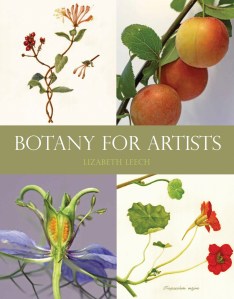
Botanist and botanical artist, Lizabeth Leech, has written a comprehensive introduction to botany for both artists and non-artists alike. In Botany for Artists, Liz does more than simply rattle off facts about plants. She teaches readers how to observe and record information about the plant specimens before them, as well as any fungi or lichen that may have taken their breath away.

Liz teaches readers how to see with “helpsheets” — worksheets designed to help artists see carefully, the morphological features of different plant groups. Blank helpsheets for flowers, winter twigs, gymnosperms, ferns, moss, and fungi are provided in the appendix and are easy to copy for personal use.

Each chapter of Liz’s book has information that will help artists navigate the plant world from an artist’s perspective. Sections of special note are:

    Liz’s Explanation of the Floral Formula. Helpsheet #2 (Recording Flower Details While Sketching and Annotating) found in Chapter 2, provides a helpful breakdown of the floral formula. This sheet will make recording data in the field easier and, most importantly, reliable! With this helpsheet completed, artists shouldn’t have too much of a problem keying out a plant back in the studio or keying out a plant at some later date.

    Labeled Line Drawings. Informative line drawings can be viewed throughout the book. Good examples are grass (Chapter 3), an orchid flower (Chapter 4), a winter twig (Chapter 8), and moss (Chapter 11).

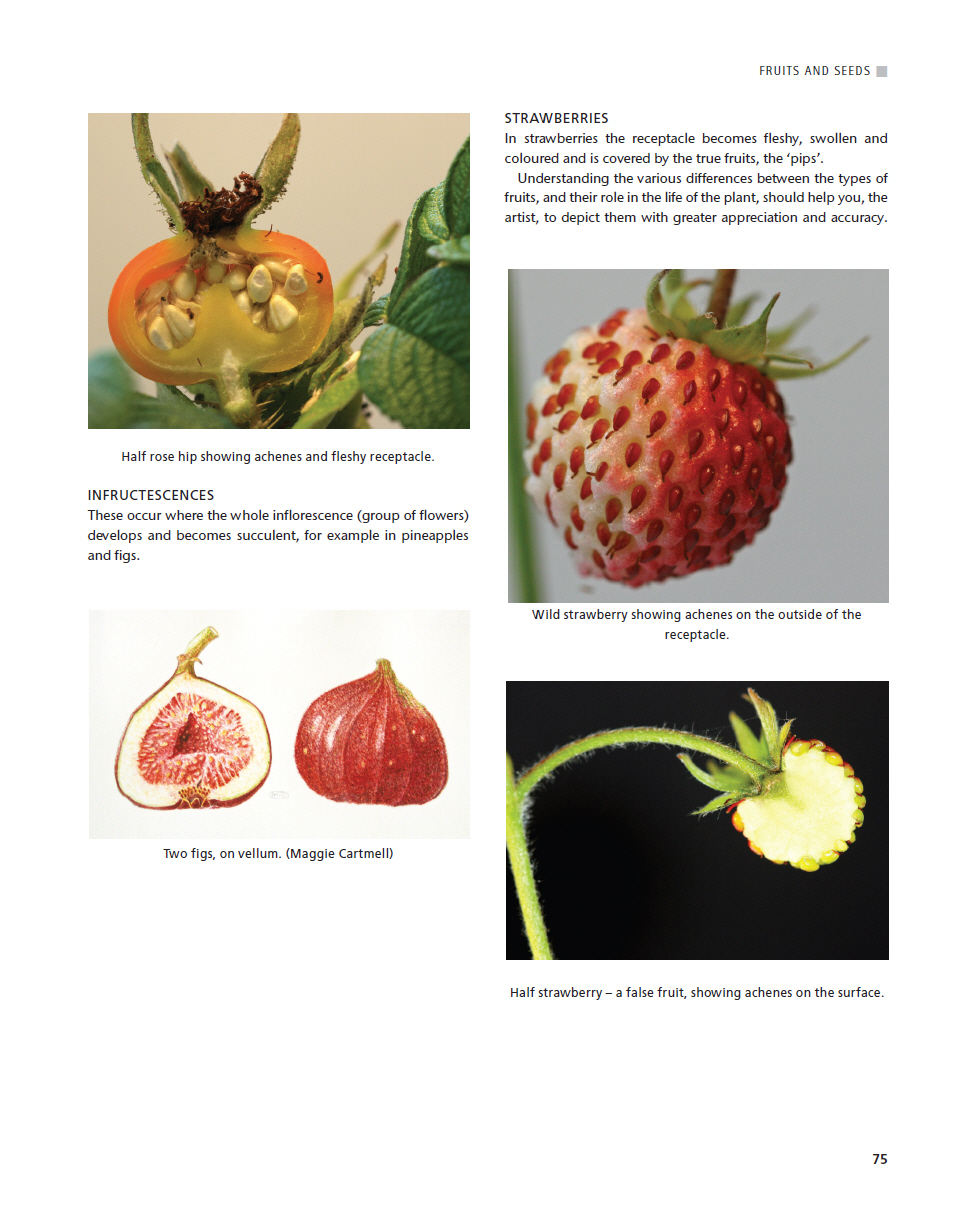
    Liz’s Thoughtful Explanations. Take, for example, Liz’s patient explanation of fruits and seeds. Liz takes her time explaining each fruit structure

    Courtesy Crowood Press. All rights reserved

    and seed dispersal mechanism. Her review is better than the usual charts and graphics encountered in a traditional botany class.

    Liz’s Review of Phyllodes, Climbing Adaptations and Roots. In Chapter 6, Liz stresses the need to observe leaves, fruit and stems carefully and for artists “to keep their wits about them to understand, and then depict and show, the links between structures and their functions.”

    Liz’s Review of Gymnosperms. In Chapter 9, artists will find descriptive photographs of different gymnosperms, a helpful table summarizing the phyla of gymnosperms and an example of how to complete Helpsheet #4 when observing gymnosperm specimens.

    Liz’s Review of Ferns, Club Mosses and Horsetails in Chapter 10, along with her illustrations and Helpsheet #5 (Ferns), ensure artists will develop a fluent understanding of these groups.

    Helpsheet #6 (Moss), in conjunction with Liz’s illustrations and photographs about the branching habits of moss and the leaf shapes of bryophytes, is sure to strengthen artists’ understanding of mosses and how they work.

    Liz’s Introduction to Fungi & Lichens will enhance artists’ understanding of where and how fungi and lichen grow. Helpsheet #7 (Fungi) is a helpful guide to collecting and observing capped fungi.

    How to Indicate Scale on a Drawing or Painting. Instructions on how to indicate scale can be found in the last chapter of Botany for Artists, along with a review of binomial names and plant-collecting equipment.

Lathyrus japonicus by Sara Bedford. Courtesy Crowood Press. All rights reserved

An explanation of the classification of plants, an introduction to the Hampton Court Palace Florilegium Society, a 297-word glossary, and a bibliography are also included in Liz’s new book.

Botany for Artists is a wonderful resource for botanical artists, as well as anyone incorporating botanical themes into creative projects who would like to learn more about plants.


Published in the UK in 2011, Botany for Artists is now available in the US and can be purchased at ArtPlantae Books. Use the coupon code presented at checkout to deduct 15% off your purchase.

Read Full Post »

Georgius Everhardus Rumphius (1627-1702), soldier and naturalist, has many “firsts” to his name. His “firsts” are outlined in the introduction to The Ambonese Herbal. They include being the first to write about epiphytes, the first to describe how orchids reproduce from seed, and the first to write detailed descriptions of coral (Beekman, 2011). And, of course, he was the first to describe the plants of eastern Indonesia.

Rumphius’ Ambonese Herbal is a significant botanical work for more than the fact it contains the medicinal uses of 1,300 plants. His herbal is an important piece of botanical literature because it is a documented history of eastern Indonesia, its dialects, its culture, and its beliefs (Beekman, 2011). It is a snapshot of what life was like in a part of the world not easily accessible by the average person.

What also makes The Ambonese Herbal an impressive resource is the fact it was published in spite of several unfortunate events. Events such as Rumphius losing his eyesight. Up until he lost his eyesight to glaucoma in 1670, Rumphius was writing the herbal in Latin. After he lost his sight, he had to start over. He started over not because there was anything wrong with his work. He had to start over so he could continue his work. This meant dictating the herbal’s contents in the only language his assistants understood — Dutch. Switching to Dutch also meant his herbal could be read by a larger European audience (Beekman, 2011).

A draft of the herbal’s 12 books was completed by 1687 (Beekman, 2011). This draft included half of the herbal’s illustrations which Rumphius drew himself. An accomplishment to say the least!

Continued forward movement would not come easily for Rumphius, however. In 1674, his wife and daughter were killed in a major earthquake that struck the island of Ambon. A neighborhood fire in 1687 destroyed all of his original illustrations (his manuscript was saved). In 1692, the first six books of the herbal, including the redrawn illustrations, were lost at sea. Fortunately, the then governor-general of Batavia was a naturalist and one of Rumphius’ biggest supporters. Before the original manuscript was shipped to Amsterdam, he had Rumphius’ manuscript copied. Now that the governor-general’s copy was the only one in existence, he ordered that a second copy be made, as well as two sets of illustrations (Beekman, 2011).

Adding to Rumphius’ misfortunes was the theft of completed drawings stolen from his office in 1695 (Beekman, 2011).

In spite of these setbacks, the completed herbal and the appendix were safely in the hands of the Dutch East Indies Company by 1701. There was only one problem, though. The Dutch East Indies Company did not want to publish the herbal because they felt it contained proprietary information; they were especially concerned about Rumphius’ notes about cloves and nutmeg (Beekman, 2011). The Company eventually changed its mind about publishing the herbal, but with the condition that they be allowed to review passages that “could be judged detrimental to the Company” (Beekman, 2011). This change-of-heart came too late for Rumphius, however. He died three months earlier.

You would think the Dutch East Indies Company’s change-of-heart would clear the way for the herbal to be published for public consumption as Rumphius had planned. But this did not happen. It would be another 34 years before the Dutch East Indies Company would release the manuscript. The manuscript was eventually received by Johannes Burman, a Dutch botanist and expert in tropical biology. The year was 1736. A mere seventy-nine years after Rumphius began the field work for his herbal upon transferring to the civil service branch of the Dutch East Indies Company.

The herbal was printed twice before the current English translation. The first edition was printed in 1741 (view it here) and the second edition was printed in 1750.

For convenience sake, Rumphius’ original twelve books are grouped into six volumes in the English translation. These volumes are arranged as follows:

  • Volume 1 (Book 1): Trees Bearing Fruit That Are Husbanded by People
  • Volume 2 (Books 2-4): Aromatic Trees; Trees Producing Resin, Notable Flowers or Hurtful Milk; Trees That Provide Timber
  • Volume 3 (Books 4-7): Wild Trees in No Particular Order; Shrubs – Domesticated & Wild; Forest Ropes & Creeping Shrubs
  • Volume 4 (Books 8-9): Potherbs Used for Food, Medicine and Sport; Bindweeds, Twining Plants and Creeping Plants
  • Volume 5 (Books 10-12): Random Wild Plants; Remaining Wild Plants; Sea Trees and Stony Sea Growths Which Resemble Plants
  • Volume 6: Index of Common and Scientific Names

The Ambonese Herbal is an amazing reference. Get two sentences into any page and Rumphius’ life opens up before your eyes.

Beekman’s English translation of the herbal matches the original Dutch version as closely as possible. He does not use modern-day terminology to replace or change descriptions written in Rumphius’ 17th-century Dutch. On occasion he explains why he chose to use some of the English words that he uses. Sometimes his choice of words are based on the fact that the modern word we would use and recognize today did not exist during Rumphius’ time. A thorough explanation about the translation of The Ambonese Herbal is included in Beekman’s introduction.

In this new edition, Beekman speaks to readers through incredibly detailed annotations located in the margins of the text. Their placement in the margin (both on the sides and on the bottom of the page) are a huge help to readers. There are many footnotes in the English edition and flipping back and forth to the back of the book would have been troublesome.

Reading the herbal is truly an engaging experience and for this we need to thank E.M. Beekman. Unfortunately Dr. Beekman, like Rumphius, did not see his masterpiece as a finished product. Dr. Beekman passed away in 2008.

Dr. Beekman spent many years of his life bringing Rumphius and his achievements to a larger audience. He wanted to bring attention to the plant world, especially the plants in The Ambonese Herbal that have gone extinct or are about to go extinct (Beekman, 2011). In a world where the current focus on the molecular study of plants separates plants from their native habitat, Dr. Beekman felt it important to emphasize the value of the descriptive texts written by early naturalists. He says texts written by Rumphius and others make “readers see, sense, and taste the reality they were trying to communicate” (Beekman, 2011).

As he brings his introduction to The Ambonese Herbal to a close, Dr. Beekman leaves readers with the following quote by 19th-century physician, William Osler:

We miss more by not seeing, than by not knowing.

What do you think?


Literature Cited

    Rumphius, Georgius Everhardus. 1999. The Ambonese Curiosity Cabinet. Translated, annotated, and with an introduction by E.M. Beekman. New Haven, CT: Yale University Press.

    Rumphius, Georgius Everhardus. 2011. The Ambonese Herbal. Translated, annotated, and with an introduction by E.M. Beekman. New Haven, CT: Yale University Press.

These books and Rumphius’ Orchids, also translated by E.M. Beekman, are available at ArtPlantae Books by special order.


Related Topic

Botany Superstars Become Rare Specimens

Read Full Post »
« Newer Posts - Older Posts »