Feeds:
Posts
Comments

Archive for the ‘Teaching & Learning’ Category

EEWK2016-PartnerBadge-Sunflower It’s National Environmental Education Week!

If you live in southern California’s Inland Empire, mark April 24 on your calendar. You are invited to spend a day in the garden with ArtPlantae and other environmental educators at In the Garden: Birds, Bugs and Blooms, a family day event at Sunnylands Center & Gardens in Rancho Mirage.

Participate in scavenger hunts, guided tours, arts & crafts activities, and learn about insects, birds, reptiles and plants. ArtPlantae will host two learning stations during this event. One station will be about botanical illustration and the other station will be about patterns and scientific illustration.

Join us for a full day of springtime fun!

    In the Garden: Birds, Bugs and Blooms
    Sunnylands Center and Gardens
    Rancho Mirage, CA
    9:30 am – 2:00 pm
    More Information
    Directions


More EE Week Resources for Parents and Educators

Browse the ArtPlantae EE Week archives below or conduct a search for related topics using the search box at right. Be sure to also see the resources available at the National Environmental Education & Training Foundation (www.neefusa.org).


EE Week Archive 2010
:


EE Week Archive 2011
:

Read Full Post »

TheBotanicalTreasuryConsidered the “plant clearinghouse” of the British Empire, the Royal Botanic Gardens, Kew has accepted plants from all over the world since 1793 (Mills, 2016).
Forty intriguing plants from their collection are described in The Botanical Treasury: Celebrating 40 of the World’s Most Fascinating plants through Historical Art and Manuscripts, a new book edited by Christopher Mills, Head of Library Art & Archiving at Kew.

Botanists, scholars and curators contributed to this collection of very interesting stories about plants, people, art, science and Kew itself. Contributing authors are:

  • Julia Buckley, Information Assistant, Kew Art & Illustrations Collection
  • Lorna Cahill, Assistant Archivist, Kew
  • Chris Clennent, Garden Manager at Wakehurst, Kew’s country estate in Sussex
  • Aljos Farjon, Conifer Specialist and Honorary Research Specialist, Kew
  • Gina Fullerlove, Head of Publishing, Kew
  • Lauren Gardiner, Career Development Fellow, palm and orchid specialist at Kew
  • David Goyder, Botanist, Kew Africa and Madagascar Team
  • Tony Hall, Honorary Research Associate at Kew, formerly manager of the Alpine and Bulb Unit
  • Christina Harrison, Editor, Kew Magazine
  • Christopher Mills, Head of the Library, Art and Archives Collections, Kew
  • Virginia Mills, Project Officer for Joseph Hooker Correspondence Project, Kew
  • Mark Nesbitt, Curator, Economic Botany Collection, Kew
  • Lynn Parker, Assistant Art and Artifacts Curator, Library of Art and Archives, Kew
  • Tony Rebelo, South African National Biodiversity Institute, Kirstenbosch, Cape Town
  • Martyn Rix, Horticulturalist, author and editor of Curtis’s Botanical Magazine
  • Kiri Ross-Jones, Archivist and Records Manager, Kew
  • Marcelo Sellaro, Collections Horticulturalist, Nurseries Department, Kew
  • Anna Trias-Blasi, Research Fellow, Kew
  • Maria Vorontsova, Research Leader of Integrated Monography, Department of Comparative Plant and Fungal Biology, Kew
  • James Wearn, Science Education, Kew
  • Richard Wilford, Head of Garden Design and Collection Support, Kew
  • Joanne Yeomans, Gallery Assistant, Shirley Sherwood Gallery of Botanical Art and Marianne North Gallery, Kew
  • Daniela Zappi, Cactus Expert, Kew

The historical accounts of each plant are accompanied by drawings, paintings and manuscripts. The manuscripts and the stories behind them provide insight into the relationship people had, and still have, with these plants.

Packaged in a beautiful clamshell box, this book comes with 40 collectible art prints. Botanical art enthusiasts are sure to enjoy this special collection of framable plant portraits that includes: Angelica, Banksia, Adansonia, Bromeliads, Ferocactus hamatacanthus, Camellia, Cinchona, Citrus, Datura and Brugmansia, Encephalartos, Fritillaria, Ginkgo biloba, Lagenaria siceraria, Grape Vine, Saccharin officinarum, Handkerchief Tree, Iris, Lilium mackliniae, Nelumbo, Magnolia, Zea mays, Nepenthes, Papaver, Vanda coerulea, Paphiopedilum fairrieanum, Coconut Palm, Pandanus, Paper Mulberry, Passiflora, Peony, Protea, Rhododendron, Damask Rose, Stapelia, Strelizia, Amorphophallus titanum, Tulipa, Victoria amazonica, Welwitschia, Wheat.

The Botanical Treasury is a beautifully packaged time capsule and is recommended for anyone with an interest in botany and botanical art history.

This book is now available in the US. Visit your local independent bookstore.

Read Full Post »

This week ArtPlantae is participating in the #SciArt Tweet Storm hosted by Scientific American’s science-art bloggers Glendon Mellow, Kalliopi Monoyios and Katie McKissick.

Natural science illustrators, science communicators and science fans are invited to take part in this event that occurs the first week of March. Illustrators Mellow, Monoyios and McKissick have outlined three easy-to-follow rules for this event. They are:

  • Tweet 3 pieces of your own #SciArt
  • Retweet 5 pieces of #SciArt by other people
  • Make sure you use the hashtag #SciArt

Works-in-progress, sketches, bioart and work from your personal archives can be shared. Nothing has to have been created within the past 12 months.

Do you write about science and art? You can join in too.

Follow the #SciArt Twitter stream for up-to-the-minute activity. Alternatively, you can follow the ArtPlantae Twitter feed located in the column to your right. This feed has been expanded for this event.

Interested?

Start Here!

Read Full Post »

Tendrils, leaves and ribbon

The March 2016 issue of Arts and Activities magazine has an article about shading, ribbons and proportions that made me think of the ribbon and basket weave exercise many of us learned from Anne-Marie Evans.

In “Ribbons and Spheres: An Introduction to Still Life”, art teacher Rebecca Tarman writes about an exercise she uses with high school students. Tarman says the purpose of her lesson is to help students:

  • Draw from life
  • Draw only what they see
  • Learn how to sight proportion
  • Learn how to shade

Tarman describes how she accomplishes these goals by using a still-life model made of ribbon, ornaments and a piece of foam board. She explains how she attaches ribbon to foam boards using T-pins and how she uses ornaments of different sizes to teach students how to sight proportion. Her clever and very portable idea made me think that this would be a good exercise for anyone teaching botanical illustration at multiple venues. It is a good way to introduce first-time botanists and first-time artists to how to look at the growth patterns of tendrils, strap-shaped leaves, lianas, and twisting seed pods.

It also made me think:

  • What if the round ornaments on students’ boards were replaced with fruit, leaves, flowers or inflorescences?
  • How many ways could this lesson be used in a botanical drawing workshop?

Take a look at Tarman’s article and share your thoughts. Her article Ribbons and Spheres is available online for free on the Arts and Activities website.


Literature Cited

Tarman, Rebecca. 2016. Ribbons and spheres: An introduction to still life. Arts and Activities. March. Retrieved from http://artsandactivities.com/ribbons-and-spheres.


Related

Read Full Post »

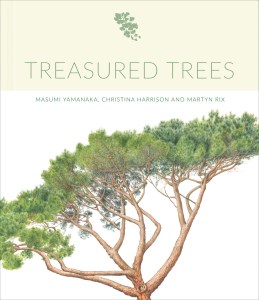
TreasuredTrees Botanical artist Masumi Yamanaka, horticulturist Christina Harrison and botanist Martyn Rix collaborate to write Treasured Trees, an introduction to the tree collection at Royal Botanic Gardens, Kew.
The book begins with Christina Harrison’s interesting story about the history of Kew, a topic she knows well. Harrison wrote a dissertation about the history of Kew’s trees and holds a MA in Garden History. Currently she writes educational material for the Garden and serves as the editor of Kew magazine. In the book’s introduction Harrison writes about the popularity of botany in 16th-century Europe, talks about the tree collectors of this era, and explains how Kew evolved to become the public garden it is today.

Following the introduction is a survey of twenty-two of Kew’s finest trees. Masumi Yamanaka’s illustrations and Martyn Rix’s historical accounts of each tree will prompt you to add a visit to Kew to your bucket list, if it isn’t on this list already.

Below is a list of trees featured in this book, plus small hints of fascinating history as shared by Rix. To learn much more about the history of each tree, pick up a copy of this book at your local independent bookstore.


Kew’s Treasured Trees
:

  • Sweet chestnut (Castanea sativa), a tree once valued for charcoal production.
  • Cedar of Lebanon (Cedrus libani), a tree celebrated for its strength and age.
  • Japanese pagoda tree (Styphnolobium japonicum), one of Kew’s original trees, planted in 1762.
  • Maidenhair tree (Ginkgo biloba), a tree species dating back to the early Jurassic.
  • Black locust tree (Robinia pseudoacacia), a tree grown in England as early as 1634 by John Tradescant.
  • Oriental plane (Platanus orientalis), a tree often depicted in Indian paintings.
  • Lucombe oak (Quercus x hispanica ‘Lucombeana’), a hybrid between the cork oak and the Turkey oak planted in the late 1700s.
  • Tulip tree (Liriodendron tulipifera), a tree once widespread in Europe before the last ice ages.
  • Turner’s oak (Quercus x turneri), the result of a rare cross between a holm oak and an English oak.
  • Corsican pine (Pinus nigra sups. laricio), the source of the rosin applied to bows used by violinists and cellists and the source of turpentine too!
  • Stone pine (Pinus pinea), a tree planted at Kew just as Sir William Hooker began to develop the garden as a scientific collection.
  • Chestnut-leaved oak (Quercus castaneifolia), a rare oak collected in Azerbaijan.
  • Giant sequoia and coast redwood (Sequoiadendron giganteum and Sequoia sempervirens), large impressive temperate trees introduced to England.
  • Armand’s pine (Chinese white pine) (Pinus armandii), a tree discovered by a plant hunter and introduced in cultivation in 1895.
  • Handkerchief tree (dove tree) (Davidia involucrata), a tree whose inflorescences feature large white bracts.
  • Indian horse chestnut (Aesculus indica), a tree Masumi Yamanaka painted in all stages of its life cycle; don’t miss this 9-page spread.
  • Bhutan pine (Pinus wallichiana), native to the Himalayas.
  • Nikko maple (Acer maximowiczianum), named after a Russian botanist who discovered the tree in 1860.
  • Indian bean tree (southern catalpa) (Catalpa bignonioides), native to Alabama and Mississippi, also present in Florida, Georgia and Louisiana.
  • Goat horn tree (Carrierea calycina), produces horn-like fruit.
  • Bogong gum (Eucalyptus chapmaniana), native to New South Wales and Victoria in Australia.
  • Sapphire dragon tree (Paulownia kawakamii), named after the daughter of Czar Paul I of Russia.

Treasured Trees features 40 paintings by Masumi Yamanaka. To view a selection of these paintings, visit the Kew Gallery.


You May Also Like

Read Full Post »

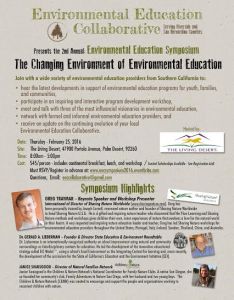
EEC Symposium 2016 Flyer Next month the Environmental Education Collaborative (EEC) of the Inland Empire will host its second annual symposium at The Living Desert in Palm Desert, CA.

The EEC formed in February 2015 when over 125 organizations participated in a strategic planning meeting near downtown Riverside. Quite a bit was accomplished during this one-day meeting and the Environmental Education Collaborative has grown steadily during its first year.

The EEC is lead by co-chairs Dave Ficke, Region 10 Coordinator of the California Regional Environmental Education Community, and Ginger Greaves, Executive Director of the Santa Rosa Plateau Nature Education Foundation. The purpose of the Collaborative is to:

  • Bring funding to the Inland Empire to increase environmental literacy in San Bernardino and Riverside counties.
  • Develop a network of environmental education resources.
  • Promote the programs of environmental education providers in the Inland Empire.
  • Monitor and influence environmental education policy in San Bernardino and Riverside counties.

Would you like to learn more about the EEC and support environmental education in the Inland Empire?

The Collaborative is seeking sponsors for their second annual meeting. All sponsorship packages include tickets to the symposium. To learn more about keynote speakers and to view the itinerary, click on the image above to download the event flyer.

To view sponsorship opportunities and benefits, download the Sponsorship package.

Read Full Post »

Pencil and Paper

The online magazine, Art of Education (AOE), posted an article recently about pencils and paper. I thought this article might be of interest to those of you who lead sketching and drawing workshops.

Tracy Hare, AOE Content Director and middle school art teacher, wrote How to Choose the Right Drawing Pencil and Paper Every Time. In her post she provides two helpful guides. One is a guide to pencil hardness/softness. The second guide is about the content, finish and weight of papers used in the art classroom. Both guides are free and available online. Download the guides and make copies for yourself and your students.


About AOE

The Art of Education is a resource dedicated to providing “Ridiculously Relevant™ Professional Development” to art educators. The service they offer includes online professional development classes and an online conference for art teachers.

Read Full Post »

« Newer Posts - Older Posts »