Feeds:
Posts
Comments

Archive for the ‘Teaching & Learning’ Category

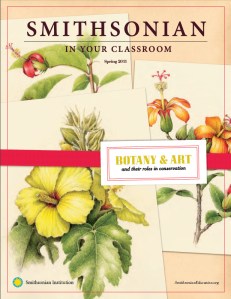
The Spring 2011 issue of Smithsonian in Your Classroom is dedicated to plant conservation and the role botanical illustration plays in the documentation of plants. This issue features interviews with Dr. Gary A. Krupnick (Head of the Plant Conservation Unit) and Alice Tangerini (Staff Scientific Illustrator). The Smithsonian provides many resources teachers can use in their classrooms. The materials provided at Botany and Art and Their Roles in Conservation are designed for students in grades 3 – 12. Visit the Smithsonian Learning Lab to view and download the following resources:

  • Botany and Art and Their Roles in Conservation. This booklet contains background information about how Dr. Krupnick and the Plant Conservation Unit classify plants as being threatened, likely threatened, or not threatened. It also outlines how illustrator Alice Tangerini works with botanists to document plants. This booklet contains two classroom activities. The first activity introduces plant conservation to students and engages them in the type of decision-making process Dr. Krupnick and his colleagues must engage in when studying the world’s flora. The second activity calls on students to collect plants and to create a botanical plate using the same techniques Alice Tangerini uses when illustrating plants at the Smithsonian National Museum of Natural History.
  • Activity Materials for Lesson 1. This document contains the photographs, plant specimens, and botanical paintings used in the first activity described above.
  • A Natural History Approach to Plant Study and Conservation – A video recording of a presentation Dr. Krupnick and Alice Tangerini made in January 2011.
  • To the Drawing Board – A recorded interview with Alice Tangerini.
  • Losing Paradise? Endangered Plants Here and Around the World – A link to the online exhibition hosted by the American Society of Botanical Artists (ASBA), in collaboration with the Smithsonian.


Also See

Read Full Post »

If the future of botany education is as uncertain as it appears, how can we ignite excitement and curiosity in young naturalists so they may perhaps become the botanical experts of the future?

Teacher-researcher, Karen Gallas has a suggestion — incorporate art into the biology curriculum.

Knowing that the arts celebrates differences among students instead of pointing them out in a negative light, Gallas (1991) created a research project integrating art activities into a unit about life cycles. This resulted in her students’ successful comprehension of life cycles as demonstrated through student drawings, paintings, poems, reenactments, and stories. Here is how she did it.

Gallas began her life cycles unit by identifying what her students knew about insects and by clarifying what they wanted to learn. She accomplished this during a brainstorming session with students.

She then facilitated their observations of mealworms and caterpillars and their developmental drawings of these wonderful creatures. The 18 eager first graders in her class also reviewed books, studied photographs, and analyzed insect drawings by other artists. Throughout this unit, students shared their artwork with each other, discussed what they were learning, and worked collaboratively to assimilate their new knowledge. The arts experiences Gallas integrated into her unit about life cycles helped students clarify their thoughts about life cycles and allowed them to “recognize the breadth and depth of their knowledge” by demonstrating it in some artistic way (Gallas, 1991).

Gallas’ accomplishments serve as an example of the power of incorporating art across the curriculum. By providing experiences in the arts, she allowed her students to find their voices, articulate their new knowledge, and empowered them to communicate with each other in spite of their socioeconomic, racial, cultural, and learning differences (Gallas, 1991). The act of visualization requires students to observe, compare, discuss, and question, therefore enhancing a student’s ability to think about and to discuss scientific concepts (DeCristofano, 2007).

How can the lessons learned by Gallas be applied to provide young naturalists with a working vocabulary about plants?

Read Gallas’ article and let us know what you think. You are invited to post your comments below.


Literature Cited

DeCristofano, Carolyn Cinami. 2007. Visualization: Bridging scientific and verbal literacies. Connect. Volume 21, No. 1 (September/October). Web. <http://cf.synergylearning.org/DisplayArticle.cfm?selectedarticle=666> [accessed 24 Feb 2011]

Gallas, Karen. 1991. Arts as epistemology: enabling children to know what they know. Harvard Educational Review. 61(1): 40 − 51. Web. <http://isites.harvard.edu/fs/docs/icb.topic33039.files/ArtsAsEpistemology.pdf> [accessed 1 March 2011]

Read Full Post »

In Sketching in Nature, animator April Hobart helps teachers integrate nature journal activities into their classrooms. In her article, she provides a review of easy-to-find art materials and recommends three drawing exercises. Two of the exercises are very familiar to most of you. Contour drawing exercises are part of any introductory course in drawing. These exercises require students to draw the outline of an object. Blind contour drawings require students to keep their pencils on the paper and to draw without looking at their paper. Regular contour drawing involves drawing the outline of an object while looking at one’s paper.

The third exercise Hobart recommends is the most interesting because it is a low-cost way of learning how to record changes over time and it encourages careful observation over a prolonged period. Hobart’s third drawing exercise involves drawing an ice cube and illustrating how it changes as it melts. Students divide a standard sheet of paper into six sections by drawing light pencil lines. They then place an ice cube on a paper plate and spend 15 minutes drawing and shading the ice cube. After 15 minutes has passed, students begin a second drawing in a new square and once again observe and illustrate changes to the ice cube over a 15-minute period. Students repeat this activity until all six squares are filled. This exercise not only improves the observation skills of “observers-turned-naturalists” (Hobart, 2005), it encourages the visualization of a concept – in this case, melting (DeCristofano, 2007). Visualization helps students articulate ideas, discuss their learning process, and discuss their experiences in science (DeCristofano, 2007). Hobart (2005) also points out that this exercise calls upon students to experiment with shading and to learn how to use their drawing materials under changing conditions.

Hobart (2005) encourages teachers to make drawing a year-round activity. She suggests requiring illustrations with writing projects, engaging students in a weekly drawing exercise, and encouraging students to share their work with others so they remain observant of the world around them.


Literature Cited

DeCristofano, Carolyn Cinami. 2007. Visualization: Bridging scientific and verbal literacies. Connect. Volume 21, No. 1 (September/October). Online at http://cf.synergylearning.org/DisplayArticle.cfm?selectedarticle=666
[accessed 24 Feb 2011]

Hobart, April. 2005. Sketching in nature. Science Teacher, 72(1): 30-33.
Search your local library

Read Full Post »

This article was published last year. I am digging deep into the scrolling archives to bring attention to past articles about teaching and learning. Links have been added to the new “Teaching & Learning” box in the column at right. Enjoy!


A Reference for Botanical Illustrators

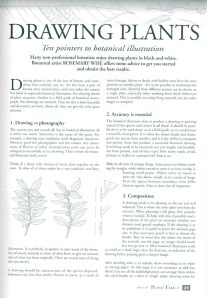
In the April 1999 issue of Plant Talk, Rosemary Wise (botanical artist at the University of Oxford) wrote an article about how to draw plants for documentation. In her article, Wise emphasizes how accuracy is important in a botanical drawing and explains how a botanical illustration can offer more information than a photograph. She also provides instruction on how to compose a botanical plate and discusses pen-and-ink drawing techniques in the process.

Wise also explains how to draw for publication, how to draw from herbarium specimens, how to draw dissections, how to hydrate dried material, and how to use tracing paper to draw dissections of symmetrical flowers.

The back issues of Plant Talk are no longer available. However a copy of this article is available for your use. This copy of Rosemary Wise’s article comes to you courtesy of the Eden Project and Plant-Talk.org.

Download – Drawing Plants: Ten Pointers to Botanical Illustration


Literature Cited

Wise, Rosemary. 1999. Drawing plants: Ten pointers to botanical illustration. Plant Talk. No. 17:29-32.

Read Full Post »

The Botanical Capacity Assessment project identified the need for more botany instruction in the classroom and in college programs. Creating new courses is definitely an important step forward to ensure we can take part in the management of such issues as food security, sustainability, and biodiversity (Kramer & Havens, 2010). But how do you know students will want to take these courses, especially in light of research indicating that careers in natural resource management have very low appeal among high school seniors (Hager et al., 2007)?

Research intern and high school student Sarah Hager of the South Carolina Governor’s School for Science, and Mathematics (Hartsville, SC), professor Thomas Straka and research associate Heather Irwin, both from Clemson University in South Carolina, employed traditional research methods and social media savvy to answer a very important question…

What do teenagers think of environmental issues and natural resources management careers?

The Research Tool
Hager et al. (2007) created a survey format that would appeal to teenagers. Their survey was short and contained a mix of closed-ended questions, open-ended questions, and a list of environmental issues. They sent a draft of their survey to peers in the fields of forestry, natural resources, and environmental education. Feedback from these professionals helped to shape the final survey.


How They Got The Word Out

Hager et al. (2007) used Myspace to poll teenagers during summer vacation. Twenty surveys were sent to Myspace participants in each state (n=1,000). Hager et al. (2007) used the filtering capabilities of the social network to target 17-year old high school students across the nation. Random numbers were used to identify random zip codes within each state.


The Results

Of those polled, 14.8% responded (n=148). Sixty percent of the respondents were female and 80% of the respondents were college-bound. When presented with a list of environmental issues, more than half rated the issues as “somewhat important” (Hager et al., 2007). Respondents rated the loss of wildlife habitat, pollution, and sustainability as the most important environmental issues. Global warming, urban development, fragmentation, private property rights, and invasive species followed in the rankings.

Hager et al. (2007) included in their survey a component to evaluate student awareness of natural resource careers. Student awareness was measured by their ability to accurately define what each profession does for a living. Most students could define what soil & water conservationists, wildlife managers, foresters, and park rangers do in their respective professions. When asked if these professions appealed to them, respondents stated these professions did not appeal to them. Park ranger was the most attractive of the choices, with forester being the least attractive. Respondents thought being a forester would be “boring” and expressed sentiments such as “I don’t like bugs” or “I’m not interested” (Hager et al., 2007).


The Big Picture

While high school seniors seem to be interested in environmental issues and take part in environmental programs, they have little interest in pursing a career in natural resource management (Hager et al., 2007). Hager, Straka, and Irwin describe student interest in environmental issues as being a “popular interest” shaped by the media because most students reported that the media is their primary source of information about the environment. In response to this, Hager et al. (2007) recommends that careers in natural resource management are presented as options during career counseling in high school and that enhanced marketing efforts should be employed to make careers in natural resource management more appealing.

A thorough analysis of survey results and an explanation of how Myspace was used to conduct this survey is provided in Hager et al. (2007).

This article is available online from the Society of American Foresters ($29.50) or at a library near you (enter your location in the search field).


Literature Cited

Hager, Sarah, Thomas Straka, and Heather Irwin. 2007. What do teenagers think of environmental issues and natural resources management careers? Journal of Forestry 105(2): 95-98.

Kramer, Andrea and Kayri Havens. 2010. Assessing Botanical Capacity to Address Grand Challenges in the United States. A report by the Botanical Capacity Assessment Project. Website http://www.bgci.org/usa/bcap [accessed 26 January 2011].


Related Articles

Read Full Post »
It was a great idea. Biology professor, Lyn Baldwin, created an assignment requiring her second- and third-year botany students to create an illustrated journal in lab. Yet when students told her their new drawing requirement made them uncomfortable, she needed to find a way to make them more comfortable with the drawing process.

To ease her students’ concerns, Baldwin partnered with Ila Crawford, a colleague in the Department of Visual and Performing Arts at Thompson Rivers University in British Columbia, Canada. Together they created a drawing tutorial and blended it into Baldwin’s botany course.

To relieve students of any anxiety that may stem from their “limited visual ability” (Baldwin & Crawford, 2010), the journal was pitched as “an exercise book in which you must practice looking at plants and recording what it is you see” (Baldwin & Crawford, 2010).

The drawing tutorial Baldwin and Crawford designed became the focus of the first two lab meetings. In the first week of lab, students were introduced to drawing techniques and drawing materials. They learned how to draw from observation, practiced contour drawings, learned how to sight and measure, and were introduced to media such as watercolor and pen and ink.

During the second lab, students evaluated each others work and shared their experiences with the drawing process. Student comments provided instructors with the opportunity to reinforce concepts and techniques introduced during the first meeting.

From this point forward, students worked in their journals on a weekly basis during their 3-hour botany lab. Students were assured that the quality of their observations mattered more than the quality of their drawings. Student journals were assessed using a rubric addressing an entry’s completeness, its presentation, and aesthetics. Of the 10 points possible for each lab, completeness was worth 6 points, presentation was worth 3 points, and aesthetics was worth 1 point. The rubric is included in Baldwin & Crawford (2010).

At the end of the school term, students provided feedback about the drawing tutorial and the illustrated journal assignment. Student comments indicate:

  1. The journal assignment had a positive impact on learning.
  2. Students became more aware of the morphological features found in plants.
  3. Students became more aware of their own learning.
  4. Drawing taught students to see and understand plants in a new way.

The positive feedback from students convinced Baldwin & Crawford that illustrated learning journals can complement traditional science activities. They especially praise their effectiveness in challenging students to become active learners instead of passive learners. They do make a special point in saying, however, that to effectively integrate drawing activities into a botany lab, instructors must provide continuous feedback. Baldwin’s students felt continuous feedback about their performance was very important.

Baldwin and Crawford are continuing their research and are collaborating on a project that will “relate the type of entries (visual vs. verbal, informational vs. reflective) students make in their learning journals and their achievement” in class (Baldwin & Crawford, 2010). Achievement will be measured using grades earned on quizzes, exams, and writing assignments.


Literature Cited

Baldwin, Lyn and Ila Crawford. 2010. Art instruction in the botany lab: a collaborative approach. Journal of College Science Teaching, 40(2): 26-31.

A copy of this article can be purchased online from The National Science Teachers Association for 99¢.


You May Also Enjoy…

Read Full Post »

Last year we took a look at plant blindness — a phrase used to describe the observation that people are largely unaware of the plants in their surroundings. Botanical illiteracy is more than a topic botanists discuss over dinner. It is a subject with broad-reaching consequences. Dr. Gordon E. Uno of the University of Oklahoma outlines the consequences and offers solutions to this problem in Botanical literacy: What and how should students learn about plants? published in the American Journal of Botany. One of the issues Uno identifies is the fact that the plant sciences are taught less often in school. This contributes to a chain of events involving reductions in research, reductions in funding, fewer students majoring in botany, and fewer students pursuing graduate studies in the plant sciences (Uno, 2009). This paints a very bleak picture for the future. What could the future possibly look like in light of all of this?

Botanical Capacity Assessment Project
In 2009, the Chicago Botanic Garden, the U.S. office of Botanic Gardens Conservation International, and several partners launched a one-year project to assess the strengths and weaknesses of plant science education, research, and habitat management in the United States. A literature review was conducted and data collected from “non-profit organizations, university personnel, graduate students, and government employees involved in plant science research, education and/or natural resource management in the United States.” The findings published by this group are disturbing. Before we take a look at them, I need to explain the phrase “botanical capacity”.

What does “botanical capacity” mean? This phrase refers to all factors contributing to the support and advancement of plant science education, research, and management. Botanical capacity is necessary to enhance our understanding of the many roles plants play in our lives. Think beyond native plants and butterflies for a moment. Think food security, climate change, biodiversity, biofuel production, and sustainability. Without the botanical capacity to address these issues, we won’t be able to manage them.

What does a world without botanical capacity look like?
The way it looks right now. Here are some gaps in botanical capacity identified in the report:

  • Fewer botanical degree programs at colleges and universities.
  • A dramatic reduction in botany courses at colleges and universities.
  • A shortage of botanists at government agencies.
  • Applicants unable to apply for jobs as federal botanists because they cannot satisfy the requirement for 24 credit hours in botany.
  • The retirement of almost half of the U.S. workforce with botanical expertise within the next ten years.

For quick insight into this project and its findings, watch the short video of Marsh Sundberg’s poster presentation at Botany 2010. The Botany conference is the joint annual meeting of the American Bryological and Lichenological Society, the American Fern Society, the American Society of Plant Taxonomists, and the Botanical Society of America.

For a more detailed analysis, download the 102-page report of the Botanical Capacity Assessment Project. A summary of the report is also available.

Another presentation from Botany 2010 that may be of interest to you is Dr. Judy Skog’s presidential address about botany education in the 21st-century.


Literature Cited

Uno, Gordon E. 2009. Botanical literacy: What and how should students learn about plants? American Journal of Botany 96(10): 1753-1759. Download open access article   [Link updated 27 June 2024]

Read Full Post »

« Newer Posts - Older Posts »