Feeds:
Posts
Comments

Archive for the ‘Teaching & Learning’ Category

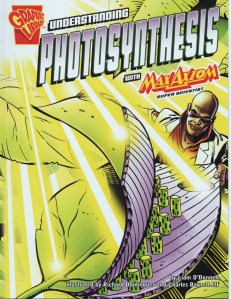
UnderstandingPhotosynthesisMaxAxiom A graphic novel about photosynthesis?

You bet.

And a good one too, thanks to the thorough explanation by super-intelligent Max Axiom Super Scientist and the illustrations by Richard Dominguez and Charles Barnett III.

In Understanding Photosynthesis with Max Axiom, Super Scientist by Liam O’Donnell, Max Axiom introduces young botanists to the word photosynthesis, explains how molecules are mixed and formed in the chloroplasts​ of plant cells, explains the role photosynthesis plays in the water cycle, and explains why plants cannot keep the air clean and the Earth healthy all by themselves. Max Axiom accomplishes all this in a conversational tone and without smothering readers with technical terms.

Includes a glossary, a list of recommended books and information about related Internet sites.

Target Age Group: 8-14
Reading Level: 3-4


Related

Plants & Comic Books

Read Full Post »

Were you into comic books when you were a kid?

I was not. I couldn’t get into the “Zoom”, “Pow”, “Boom” nature of the comic books I did encounter back then. The genre is much more than this, however, and today we take a look at comic books and comic strips with a “plant awareness” theme.

In Children’s Comics: An Opportunity for Education to Know and to Care for Nature? Joachim Woldschke-Bulmahn & Gert Groning present examples of how some garden topics are portrayed in comic books. Their review of American and German comic books is very interesting. They include excerpts from these books that address themes about gardening and the environment. The examples they include in their 10-page paper support the points they make and are best viewed within the context of their paper (it would be impossible to explain these scenes in words). The best I can do here is offer a summary of some of the points they make while discussing each comic strip.

During their survey of comic books, Woldschke-Bulmahn & Groning (1994) observed the following:

  • Comic books treat gardening as a social activity. The independent pursuits of the lone gardener are not interesting to comic book readers.
  • Yard work is a common topic and is often presented as an unpleasant chore.
  • The act of gardening is presented as a variety of activities in comic books (i.e., some enjoyable and some not so enjoyable).
  • Generational approaches to gardening are often portrayed (e.g., Dad’s opinion about topiaries versus his son’s opinion about topiaries).
  • Gardening competitions are a recurring topic.
  • Environmental protection is also a recurring topic.

Joachim Woldschke-Bulmahn and Gert Groning argue this genre has much to teach children about the environment and that comics should be read not only by students, but by their teachers too. You can read their paper online for free or look for a copy at your local college library.


Literature Cited

Wolschke-Bulmahn, Joachim and Gert Groning. 1994. Children’s comics: An opportunity for education to know and to care for nature? Children’s Environments. 11(3): 232-242


Related

Read Full Post »

If you are looking for ways to engage with your audience about plants instead of talking at them about plants, make note of the 5E Learning Model. Whether you teach children or adults, the 5E Learning Model provides a framework with which you can create experiences to introduce plants to new audiences.

The 5E Learning Model, created by the Biological Sciences Curriculum Study (BSCS 1989), helps teachers plan learning opportunities for their students so they can Engage, Explore, Explain, Elaborate and Evaluate a topic. An example of how to apply this learning model to teach students about plants is presented in Discovering Flowers in a New Light by professors Rebecca L. McNall and Randy L. Bell.

In the unit created by McNall and Bell (2004), students learn how to explore flowers, learn how to use a digital microscope, learn how to draw and record their observations, and gain experience presenting their findings to classmates.

McNall and Bell (2004) created a methodical and thoughtful series of investigations into flower anatomy, flower form and flower function. Students are engaged from beginning to end, illustrating observations, writing hypotheses, and contemplating the function of flowers and their parts. Students also become immersed in technology through their use of a digital microscope. Students use the digital microscope to look at flowers and to photograph what they see through the scope. Students then insert their images into an electronic worksheet where they label flower parts and describe the function of each structure.

To help teachers prepare for this multifaceted activity, McNall and Bell (2004) share sources for digital microscopes and resources about microscopy and hands-on activities for children.

A copy of McNall and Bell (2004) can be purchased online from the National Science Teachers Association for 99¢.


Literature Cited

    Biological Sciences Curriculum Study (BSCS). 1989. New designs for elementary school science and health: A cooperative project of Biological Sciences Curriculum Study (BSCS) and International Business Machines (IBM). Dubuque, Iowa: Kendall/Hunt. Search your local college library

    McNall, Rebecca L. and Randy L. Bell. 2004. Discovering flowers in a new light. Science and Children. 41(4): 36-39


Also See

Read Full Post »

Today let’s travel through time to learn about diagrams and the role they’ve played in communicating information and scientific knowledge.

The tour guide today is Clarissa Ai Ling Lee, a PhD candidate in the Literature Program at Duke University. This spring Lee was a guest contributor to Scientific American. In her three-part series, The Art and Science of the Diagram, Lee explains how diagrams have been used to communicate information about astrology, astronomy, geography, human anatomy, the physical sciences, the life sciences and, of course, natural history.

Lee begins her series by explaining how diagrams are used in math and physics and how they help to describe the invisible. In Part II of her series, she discusses natural history art, how diagrams of organisms transitioned from being abstract to representational during the Renaissance, and how cabinets of curiosities were their own form of diagram. And finally in Part III, Lee takes a look a volvelles, pop-up books and how a new technique called perspective changed scientific illustration during the Renaissance.

An informative series about how drawing has been used in the sciences,
Lee’s series can be read online at Scientific American. Follow these links:


You May Also Enjoy Reading…

Read Full Post »

Drawing teaches the arithmetic of space, as figuring teaches the arithmetic of numbers.

— T. R Ablett, Esq.

How do you begin to use drawing as a learning tool in a classroom with 35 students?

Here is an approach that may be worth trying in today’s busy classroom setting.

What follows is a format proposed by T.R. Ablett, Esq. as it was explained in the January 1888 issue of the journal Science. The article, The Teaching of Drawing, is about a paper Ablett presented at the College of Preceptors. In this paper, Ablett argues that drawing must become a subject every student learns, regardless of their future vocation. He argues that incorporating drawing across the curriculum has many advantages, namely:

  • It helps students think about proportion and scale.
  • It makes students better at describing what they see when they combine writing with drawing.
  • It develops students’ “graphic memory”.

In his presentation, Ablett describes a way to teach drawing to different grade levels. Here is the approach he proposes:

    Class 1: Students should learn how to observe, how to create contour drawings of simple subjects, and how to “ward off color blindness”.


    Class 2
    : Students should learn about simple forms and curves, should learn art-related terms and continue to develop their “graphic memory.”


    Class 3
    : Students should learn how to draw the outlines of common objects.


    Class 4
    : Students should learn how to draw rounded objects.


    Class 5
    : Students should learn how to shade live subjects.


    Class 6
    : Students should learn about other branches of art.

Ablett also argues that public perception about drawing needs to be raised. He says teachers need to do their part to prove that drawing is “one of the bases of education”, equal to other subjects such as arithmetic. He says that if students are going to learn arithmetic, there is no reason they shouldn’t learn drawing at the same time.

To accomplish such a formidable task, Ablett says teachers must learn how to teach drawing in a group setting. He says they can do this by using drawing subjects large enough for all students to see, by ensuring that all students have the same view of a subject, and by demonstrating the principles they are teaching with lots of enthusiasm.

The Teaching of Drawing is available online through the American Association for the Advancement of Science. One-day access to this article costs $20. Alternatively, you can search for this issue of Science at your local college library.


Literature Cited

The Teaching of Drawing. 1888. Science. 11(259): 30-31. Published by the American Association for the Advancement of Science.

Read Full Post »
Order online from author

It is one thing to research ways to connect botanical art with learning in the classroom and quite another to figure out how to make time to apply the wonderful ideas you’ve learned. Between work, family, volunteering and other responsibilities, how do you find time in your schedule to read a book, much less time to draw, paint and engage in other creative activities?

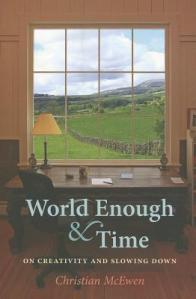
If something inside your body has been telling you to slow down and if you know you’ve been silencing your creativity and ignoring the call of your Creative Self, then now is the time to read World Enough & Time: On Creativity and Slowing Down by Christian McEwen.

When Christian talks about slowing down, she doesn’t mean simply removing one or two items from your list of To Do items. What she means is to slow down by physically moving more slowly. By walking instead of running. By writing with pencil and paper instead of typing. By doing whatever it takes to stop subjecting your body to “hurry sickness” (McEwen, 2011).

Christian encourages the tired and the overwhelmed to make time to converse with people in person. To figure out how to do nothing. To spend time with a child. To go for a walk. To learn how to look. Read a book. Keep a journal. Stop multitasking. Take a break. Dream. Learn to listen. Be grateful.

While all of this sounds simple enough to do, there is a reason why these simple acts are the focus of a 367-page book. Our culture has either forgotten how to do them or they have been deemed too time-intensive and impractical for daily life. Yes, a bit of planning and motivation might be necessary to engage in some of these activities, but not much. In World Enough & Time, Christian explains why these activities are important, shares with you interesting history, research and stories, and provides you with tactics to make the changes to your busy life that you probably already know are way overdue.

Value “slowness”. Create an “affluence of time” (McEwen, 2011).

Add World Enough & Time: On Creativity & Slowing Down to your summer reading list.


Literature Cited

McEwen, Christian. 2011. World Enough & Time: On Creativity and Slowing Down. Peterborough: Bauhan Publishing.


Related Topic

Read Full Post »

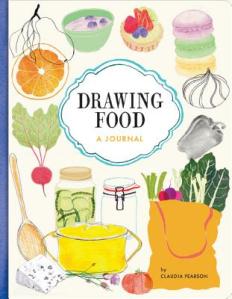
DrawingFood9781452111315 Here is a new resource that takes a fun and lighthearted approach to drawing. This resource provides more than prompts to remind you to draw everyday. It is a guided sketchbook complete with drawing techniques, instructions about how to use different media and a guidebook with plenty of room for sketching.

Drawing Food: A Journal by illustrator Claudia Pearson is composed of two key sections. The first section is titled, How to Draw Food, and contains instruction about how to draw fruit and vegetables, how to draw meat and dairy products, how to draw treats from the bakery, and how to draw household kitchen items. In this section, Pearson discusses line drawing, shading, how to work with colored pencils, and how to work with color pastels. Her instructions are clear, simple and doable.

In Part Two of her book, Pearson establishes a two-page spread for each week of the year and provides fun prompts for sketching enthusiasts. She challenges readers with thought-provoking tasks such as drawing what they find at their local farmer’s market, drawing something seasonal that isn’t produce, and challenges them to describe other culinary subjects in a visual way.

If the word “draw” makes you nervous, this book will help you begin to see your world through the eyes of an illustrator. It isn’t focused narrowly on any one culinary topic and provides plenty of room for you to take the journal in any direction you want to take it.

Interested in beginning your own illustrated food journal and discovering how plants intersect with our lives?

Join ArtPlantae next week when it launches the Botany Craft Bar, a creative place to learn about plants, during the Spring Open House at Aurea Vista on Friday,
May 17, 2013 (5-9 PM). In June, the Botany Craft Bar will become a regular feature during Riverside ArtsWalk, a monthly celebration of the arts in downtown Riverside.

If you can’t make it to the open house next week, visit ArtPlantae’s Botany Craft Bar on the first Thursday of the month during ArtsWalk. The Botany Bar will be open from 6:00 – 8:30 PM at Aurea Vista.

Read Full Post »

« Newer Posts - Older Posts »