Feeds:
Posts
Comments

Archive for the ‘Teaching & Learning’ Category

What kind of factors influence the drawing process in adults?

Psychology professors Dale J. Cohen and Susan Bennett explore this topic in a series of experiments conducted at the University of North Carolina at Wilmington.

In Why Can’t Most People Draw What They See?, Cohen and Bennett present four possible reasons why adults may not be able to draw what they see. They explain that drawing inaccuracies in adult drawings may occur because of:

    Artist Misperception of an Object
    Cohen & Bennett (1997) explain that an artist’s illusions and delusions can result in drawing inaccuracies. What’s an example of a delusion? An artist relying on what they know about an object instead of the actual physical features of an object.

    Artist Inability to Make Good Representational Decisions
    This refers to an artist’s inability to decide what to include in a drawing and how to represent it.

    Artist Motor Skills
    This refers to an artist’s ability to create the proper marks on paper after they have perceived an object and made good decisions about how to represent an object. Cohen & Bennett (1997) explain that mark making “is a physical process, not a perceptual or cognitive process” and that artists must have the “appropriate motor skills” to make the marks required to create a representational drawing.

    Artist Misperception of Their Drawing
    This refers to an artist’s perception of their own work. If an artist perceives a mark to be more accurate than it really is, drawing inaccuracies will go uncorrected.

Cohen and Bennett (1997) created four experiments to assess the effect decision-making, motor skills and artist misperception of drawings have on the drawing process. Each experiment was designed to investigate these effects in isolation. The participants in these studies were college students. Some served as experimental subjects (i.e., they completed rendering tasks assigned by the researchers) and some served as critics (i.e., evaluators) of the drawings created by the other students.

After methodically assessing the effects described above, Cohen & Bennett (1997) observed the following:

  • An artist’s decision-making capabilities are “a relatively minor source” (Cohen & Bennett, 1997) of drawing inaccuracies in adult drawings.
  • Motor coordination is not a significant source of drawing inaccuracies in adult drawings.
  • An artist’s misperception of their own work is not a source of drawing inaccuracies in adult drawings.

So what is a source of drawing inaccuracies in adult drawings?

An artist’s misperception of an object.

How Cohen & Bennett (1997) designed each experiment and assessed each effect in isolation is very interesting. For a detailed account of Cohen and Bennett’s materials, methods, findings and statistical analysis for each experiment, please see their paper. Their paper is available for free on the website of the University of North Carolina at Wilmington.

Cohen & Bennett (1997) is one of the many articles cited by Jennifer Landin in her dissertation. Do you have questions about drawing and learning?


Join our conversation with Jennifer


Literature Cited

Cohen, Dale J. and Susan Bennett. 1997. Why can’t most people draw what they see? Journal of Experimental Psychology: Human Perception and Performance. 23(3): 609-621. Web. http://people.uncw.edu/cohend/research/papers/Cohen%20and%20Bennett%2097.pdf [accessed 6 September 2013]


Related
Read Full Post »

Today I have announcements instead of the usual Friday column.

On Sunday, September 1, we’ll launch a month that will include much discussion about drawing, learning, and research. Watch your inbox for an email announcement or your Twitter, Facebook or LinkedIn timelines if you follow through these channels.

During August, the focus was on classroom resources. As this month comes to a close, I want to make you aware of changes at the store. The Classroom category has been updated and resources are now organized by age groups. The subcategories Activity and Reference have also been added. I hope you find these new categories helpful and the reviews relevant to your teaching whether you teach in a traditional classroom, teach as an informal science educator or teach at home. The new categories are expanding quickly.

Enjoy the long holiday weekend.

Read Full Post »

While plants may not be the most interesting subject to some people, did you know that young children have a genuine interest in plants?

What, then, do children know about plants and where do they learn about them?

Professors Patricia Patrick and Sue Dale Tunnicliffe address these questions in What Plants and Animals Do Early Childhood and Primary Students’ Name? Where Do They See Them?

To address these questions, Patrick and Tunicliffe (2011) used a three-layered interview approach to determine the kind of knowledge children had about plants and animals. They interviewed 108 children. Seventy-two from England and thirty-six from the United States. Their sample population was comprised of children from four age groups — 4, 6, 8 and 10.

Patrick and Tunnicliffe used a three-layer interview format to determine what children think of as a plant or an animal, and to investigate how they see relationships between organisms and habitats. They chose this approach over others such as drawing, concept mapping and pre- and post-testing because, as they explain, “…if knowledge is defined as the ability to evaluate ideas and share them through observation, verbalization, hypothesizing, and conversation then we propose that children’s knowledge of plants and animals may be ascertained through interviews” (Patrick & Tunnicliffe, 2011).

In separate interviews, children were asked about their knowledge of plants and animals. During each interview, children were asked to free-list as many plants/animals as possible within a 1-minute period. They were then asked to explain where they saw each plant/animal in their list. Children were also asked about the plants/animals living at their school and at their homes. Finally, children were asked to link a habitat with a plant or animal.

Data collected during the plant interviews indicate that children from England and the US include similar numbers of plants in their free lists (Patrick & Tunnicliffe, 2011). The authors observed that children from both counties name farm-raised plants more often and state they see these plants in home gardens. Patrick and Tunnicliffe (2011) also observed that children’s prior experiences with eating or planting plants with their families made a difference regarding their knowledge about plants. Because of this, the authors recommend that teachers include hands-on activities using real plants (not plastic) in their classrooms.

How did children’s knowledge about plants compare to their knowledge about animals? Here is a quick summary. Patrick and Tunnicliffe (2011) observed that:

  • Eight year old children listed more animals than the other age groups.
  • English children tended to include more exotic animals in their free lists, while US children included more endemic animals.
  • Children from both countries listed farm animals least often.
  • Children from both countries indicated they see animals in the media, at home in the garden, at zoos and at school.

Patrick and Tunnicliffe’s investigation into children’s encounters with plants and animals and where they see them is very detailed. Their paper contains much more information and would be of interest to classroom teachers and to informal science educators. Data from this study suggest children are more likely to remember the plants and animals introduced to them outside of school and that a formal classroom setting “does not have a considerable influence on how children understand objects in the natural environment, especially at younger ages” (Patrick & Tunnicliffe, 2011).

The authors provide extensive background into where children encounter plants and animals on a daily basis and explain the value of nature-based experiences outside of the classroom. Included in their paper are copies of the plant interview and the animal interview they used, as well as a long list of references about science education, botany education and environmental education.

Patrick and Tunnicliffe’s article can be purchased through SpringerLink for $39.95. You can also look for a copy at your local college library.


Literature Cited

Patrick, Patricia and Sue Dale Tunnicliffe. 2011. What plants and animals do early childhood and primary studens’ name? Where do they see them? Journal of Science Education and Technology. 20:630-642


Also see these studies cited in Patrick and Tunnicliffe (2011)

    Bebbington, Anne. 2005. The ability of A-level students to name plants. Journal of Biological Education. 39(2): 63-67.

    Lindemann-Matthies, Petra. 2005. “Loveable” mammals and “lifeless” plants: how children’s interest in common local organisms can be enhanced through observation of nature. International Journal of Science Education. 27(6): 655-677

    Schneekloth, Lynda H. 1989. Where did you go? The forest. What did you see? Nothing. Children’s Environments Quarterly. 6(1):14-17

    Tunnicliffe, Sue Dale. 2000. Talking About Plants: Comments of Primary School Groups Looking at Plants as Exhibits in a Botanical Garden. Paper presented at the British Educational Research Association Annual Conference, Cardiff University (September 7-10, 2000).

    Uno, Gordon E. 2009. Botanical literacy: What and how should students learn about plants? American Journal of Botany 96(10): 1753-1759

Read Full Post »

Digital Plant Stories

Today we stay within the realm of comic books and storytelling and combine drawing and storyboards with digital photography and movie-making tools.

While all this may sound complicated, educators Patricia Holloway and
Carol Mahan from the Missouri Department of Conservation make digital storytelling less intimidating in their article, Enhance Nature Exploration with Technology, in which they provide clear instruction and many excellent resources for teachers.

Sketchbooks, nature journals and good old-fashioned paper-and-pencil thinking is featured often in this space. I like paper-and-pencil thinking and do exactly this when I write this weekly column. A recent teaching experience with a group of energetic teenagers, however, encouraged me to think that paper and pencil aren’t necessarily the best tools to use with all audiences. If you’ve wanted to incorporate digital storytelling into your lesson plans, but haven’t taken on the task because the learning curve appears too steep, I would like to direct you to Holloway and Mahan’s informative paper. I bet you’ll find just the right kind of guidance, insight and structure that will help you take that first step.

Here is what you’ll be able to do after reading Holloway and Mahan (2012):

  • Connect students with nature and prepare them to become storytellers.
  • Lead a successful nature walk.
  • Create a sample storyboard so you can model the process for your students.
  • Guide students successfully through the digital-storytelling process.
  • Provide photography tips to students.
  • Walk students through the digital editing process (Holloway and Mahan provide step-by-step instructions for teachers).
  • Evaluate the storyboards students create (Holloway and Mahan provide a rubric for your consideration).
  • Learn how to present student projects to parents and the public.

You will also be able to explore the list of Web-based resources Holloway and Mahan provide for teachers.

Are you ready to take the leap?

Get a copy of Enhance Nature Exploration with Technology at the online store of the National Science Teachers Association. Right now it’s FREE!


Literature Cited

Holloway, Patricia and Carol Mahan. 2012. Enhance nature exploration with technology. Science Scope. 35(9): 23-28.


Don’t Miss This

The activity described by Holloway and Mahan (2012) requires students to use images and audio sounds when creating storyboards. As you research this process for your own classroom or program, keep these resources in mind:

Read Full Post »

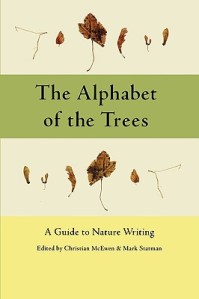
TheAlphabetOfTheTrees9780915924639 The problem most students seem to have is that they see nature as “Other.” Nature is a tourist destination, a place on a map, something saved by buying and selling crunchy candy. They rarely understand that they themselves might actually be part of it.

— Christian McEwen & Mark Statman


The Alphabet of the Trees: A Guide to Nature Writing
is a collection of twenty-nine essays by nature writers, poets, fiction writers and educators. More than simply a collection of essays about nature, The Alphabet of the Trees is a wonderful collection of ideas for the classroom and the field.

In their respective essays, contributors share their experiences teaching students how to write about nature. Contributors provide clear instruction, examples of student work and plenty of inspiration to last an entire school year.

McEwen & Statman (2000) published this book for teachers because they wanted to change how the subject of nature is approached in the classroom. They explain that they want nature to be more than a collection of facts. Their book has so many wonderful ideas and so many different ideas, it is impossible to summarize them. Instead of attempting a blanket summary, I would like to offer a glimpse into the type of nature writing activities contributors share with teachers. Listed below is the name of each contributor and the lessons and inspiration they invite teachers to bring into their classrooms.


Nature Writing Activities
:

  • Gary Snyder – The power of language and observation.
  • Matthew Sharpe – Ideas about how to lead a conversation about nature in an urban classroom.
  • Susan Karwoska – Using children’s literature to explore nature in the city.
  • Joseph Bruchac – Teaching the value of listening to connect with, and write about, nature.
  • Sam Swope – How to write about common objects in many different ways.
  • Eleanor J. Bader – How to write an advocacy essay.
  • Kim Stafford – Recording the thoughts and words of children.
  • John Tallmadge – Looking for wildness in the city.
  • Mary Oliver – How to keep a notebook of felt experiences.
  • Barbara Bash – Field sketchbooks in the city.
  • Sarah Juniper Rabkin – Seeing through the eyes of a scientific illustrator.
  • Clare Walker Leslie and Charles E. Roth – Nature journaling with school groups.
  • Christian McEwen – Using the five senses to write about nature. Also, how to set up an ode to nature or any topic.
  • Suzanne Rogier Marshall – How to transition from looking to writing.
  • Holly Masturzo – How to encourage observation through discovery.
  • Ann H. Zwinger – How to write a natural history essay.
  • Carolyn Duckworth – Tools for exploring an animal and an issue.
  • Mary Edwards Wertsch – How to write nature poems (specifically question poems).
  • Michael Morse – Writing about nature using the senses and observing transformations in nature.
  • Penny Harter – Lessons that address how to write about animals (grades 4-12).
  • William J. Higginson – How to write haiku and linked poems (includes renku topics and guidelines for teachers)
  • Cynde Gregory – A garden writing exercise that is a good lead-in to a unit about plants.
  • Jordan Clary – Using nature imagery in poetry.
  • Jack Collom – A wonderful collection of writing ideas for poetry.
  • Terry Hermsen – An exercise in creative memory (poems to help humans recall what they have forgotten about Earth, Wind, Air and Fire.
  • Margot Fortunator Galt – Nature as teacher and guide (circle poems, writing about landscapes, seasons).
  • Janine Pommy Vega – How to help students speak for something in nature (persona poems).
  • Barry Gilmore – Exercises in naming things, observing and describing.
  • Carol F. Peck – An idea to incorporate writing with social studies curricula.

Contributors each include a list of resources at the close of their essays. Editors McEwen & Statman reorganize these resources and provide teachers with a rich bibliography of nonfiction books, fiction books, books about poetry and books for children. They also provide a list of resource organizations and a short biography of each contributor.

The ideas in this collection can be used in many ways beyond the traditional classroom. Outdoor educators, naturalists and interpreters will also enjoy this book.

The Alphabet of the Trees: A Guide to Nature Writing is available at www.christianmcewen.com.


Reminder

Read Full Post »

There is no shortage of drawing, sketching and painting apps for iPads, iPhones and other gadgets. Which apps are the best? Which will help you draw, paint and match colors in a way resembling how you work with pencil, paper and paint?

Today I want to bring attention to a selection of apps created by Adobe and, specifically, to the interesting series of videos published last month about creating botanical illustrations on mobile devices.

Broadcasting from The Creative Cloud Classroom, instructor Mike McHugh demonstrates how to use Adobe’s Creative Cloud products to turn a botanical drawing into a finished painting. The products he demonstrates are Adobe Ideas (sketching), Adobe Kuler (color matching) and Adobe Illustrator CC (painting).

The color-matching app Adobe Kuler is especially interesting. Many of you are familiar with the color chart by the Royal Horticultural Society (RHS). Well, Adobe Kuler essentially functions like the digital version of the RHS color chart. This interesting app enables you to point your iPhone camera or iPad camera at a subject and instantly establish a color palette. It is fascinating to watch it work.

Now, in just these two paragraphs I have laid the foundation for some very lengthy discussion. I know a discussion like this can turn into as heated a debate as those about religion and politics. My objective today is not to stir the pot, but to share thoughts. To facilitate the sharing of opinions, I created a short survey where opinions can be cast as anonymous clicks. If you would like to post more extensive commentary, please feel free to do so in the Comment box below. All I ask is that you keep passionate commentary friendly.

Before you visit the anonymous survey, take a moment to view the wonderful tutorials in Adobe’s Creative Cloud Classroom. Each video runs about 12 minutes. Here are the links:


Here is the survey

You’ll be able to see how your opinions compare with other readers at the end.


Also See

Adobe Touch Apps for iPhone and iPad. Adobe Ideas and Adobe Kuler are FREE.

Read Full Post »

For this week’s teaching and learning column, Kellie and I contemplate how to help people see the value of drawing as a learning tool.


    In the weekly teaching and learning column I write, I occasionally bring attention to research or articles that call for drawing to be taught as a fundamental skill, much the same way reading, writing and arithmetic are taught as core life skills.

    In the 1880’s, T.R. Ablett said that public perception about drawing needed to be raised so the drawing could be accepted as one of the core fundamentals. As someone who was drawing first in a profession not affiliated with the arts (i.e., landscape design), how might we help people see the value of drawing as a learning tool and life skill in professions other than what people consider traditional art?


    Kellie
    : This is a very interesting question, as I feel that drawing and art skills are not valued enough in our society. How I feel would be a great way to help people see the value of drawing is to bring more awareness into our public schooling, from an early age. Many schools do offer art classes, but not as a requirement. In many of the art classes, they do not teach all the different careers options that the skill of drawing can be useful in, including landscape design. I had no idea that landscape design was even an option for a career in high school, and for that matter any horticulture related field. This was something I learned on my own outside of school. Art and creativity are very important for any career as I feel a creative mind brings more diversity and new thinking to any job. I hope drawing becomes more of a standard teaching practice with other life skills such as reading and writing.

Artists, naturalists and teachers…how can we help the public value drawing as a learning tool?

Join the conversation

Read Full Post »

« Newer Posts - Older Posts »