Feeds:
Posts
Comments

Archive for the ‘Teaching & Learning’ Category

Paardebloem [De Europische insecten], Merian, Maria Sibylla, 1647-1717,Transfer print, hand-colored, 1730, Dandelion, with caterpillar. Digital image courtesy of the Getty’s Open Content Program.

Paardebloem [De Europische insecten], Merian, Maria Sibylla, 1647-1717,Transfer print, hand-colored, 1730, Dandelion, with caterpillar. Digital image courtesy of the Getty’s Open Content Program.

Sometimes we work on projects and wish we could include an image from a historic resource or an image created by a famous artist to show connections or to reinforce learning. Many good ideas have been cast aside because of questions like — Where do I look for the image I want to use? How do I ask for permission to use it? How much will it cost?

The Getty Research Institute has made the dilemma of image use a little easier to manage thanks to their Open Content Program. Launched in August 2013, the Open Content Program features digital images to which the Getty holds the rights or images that are in the public domain. The database has more than 10,000 images of works of art that include paintings, drawings, artists’ sketchbooks, sculptures and much more. The Getty Museum released 4,600 Museum images in August and the Research Institute added 5,400 in October. These images can be used for any purpose. No permission is required and the images can be used for free.

Natural history artists and educators will find many items of interest in the Open Content Program. For starters, it has 1,397 images about the natural world. Included are works of art by Maria Sibylla Merian and Jan van Huysum. Users can search for artists by name, search for specific types of art (e.g., drawing, photographs, etc.) or search by topic. Searches for topics such as trees, plants, flowers, and insects will keep you busy for quite a while.

This database is large and you will find yourself clicking here, there and everywhere. If you get lost in your own search, all you have to do is click on the Search History tab at the top of the page to view your search history and to revisit subjects you have explored.

The Getty Research Institute has made art and history accessible to everyone and it is a wonderful resource for artists, naturalists and educators.

Visit the Open Content Program


Related

Read Full Post »

Many years ago I had the opportunity to help pilot test a new biology lab curriculum for nonmajors. It is through this experience that I came to see the many ways people learn. It is also how I came to appreciate the Herculean effort required to design, write, implement, evaluate and fine-tune a curriculum. I think of this experience often, especially when I read about activities such as the leaf-building activity that is the focus of this week’s column.

We’ve learned how describing a concept with words and how visualizing words can make invisible processes easier to understand.

Today we go 3-D and consider model-making. The leaf-building exercise we’re going to learn about was created by science teacher Patty Littlejohn. She describes the model-building process and how she uses the models to enhance student understanding of photosynthesis in Building Leaves and an Understanding of Photosynthesis.

Littlejohn (2007) makes photosynthesis easier to think about by making the process of photosynthesis larger than life.

To help her middle school students see, feel and experience photosynthesis, she has them build a model of a leaf, a plant cell and an animal cell. Students build leaves with veins, chloroplasts, stomata and an epidermis. Their plant and animal cells have cell membranes and organelles. Littlejohn says students benefit from the model-building exercise because it requires them to “see and manipulate the reactants and products of photosynthesis and cellular respiration” (Littlejohn, 2007).

In addition to their leaf and cell models, students also create reactants and products (i.e., carbon dioxide, oxygen, water, energy, glucose) and combine reactants to simulate the chemical reactions occurring within plant and animal cells. By engaging students in the construction of both cell types, Littlejohn (2007) is able to show students how energy is transferred between organisms.

Littlejohn (2007) includes detailed instructions and material lists in her article so that teachers can bring this same experience to their classroom or program. Littlejohn’s article can be purchased online for 99¢. You can also look for her article at your local college library.


Literature Cited

Littlejohn, Patty. 2007. Building leaves and an understanding of photosynthesis. Science Scope. 8(30): 22-25


Also See

Read Full Post »

Making images as natural as speaking.

– Heinemann Publishing

This is the focus of New Entries: Learning by Writing and Drawing by Ruth Hubbard and Karen Ernst, a collection of case studies about teachers integrating art, science and writing in their classrooms. Thirteen educators contributed to this book and generously share classroom activities and their own learning processes with readers. Here is what you’ll find inside this enlightening resource:

    Drawing Rachel In
    Susan Benedict, elementary school teacher
    Benedict shares how she helped a 4th grade student with her writing and reading through nature journaling.

    Widening the Frame: Reading, Writing and Art in Learning

    Karen Ernst, teacher and author
    Ernst describes how she created her artists workshop, a structured yet flexible workshop in which students actively engage in literature, art and writing.

    Writing Pictures, Painting Words: Artists Notebooks in Literacy Workshops

    Nancy Winterbourne, elementary school teacher
    Winterbourne’s research interests include how drawing in science journals helps students use complex verbs to explain their observations. In this chapter, Winterbourne provides examples of how children’s communication skills are enhanced when they integrate drawing and writing.

    Opening Up to Art: Imagery and Story in a High School Reading Class

    Peter Thacker, teacher
    Thacker shares how he became an artist and learned how to create images with his students.

    Beyond Answers

    Jill Ostrow, teacher and author
    Ostrow writes about how to look at math concepts visually. She shares the problem-solving picture strategies her students created in her class.


    Putting Art on the Scientist’s Palette

    Mary Stein (scientist) and Brenda Power (writer)
    Stein and Power offer practical suggestions about how teachers can integrate art, science and language to move beyond the perceived boundaries between disciplines. 


    Imagination Through Images: Visual Responses to Literature

    Ruth Shagoury Hubbard
    Hubbard discusses how students can use drawing and writing to help them understand what they read.


    Reading the Image and Viewing the Words: Languages Intertwined

    Irene C. Fountas (Professor, Education)
    Janet L. Olson (Professor, Art Education)
    Fountas and Olson discuss how reading informs drawing and how viewing images informs writing. 


    Parallel Journeys: Exploring Through Art and Writing in Fourth Grade

    Peter von Euler, teacher
    Peter von Euler explains how the use of “observational journals” helped his students unite writing and art. 


    I Look at My Pictures and Then Try It: Art as a Tool for Learning

    Jean Anne Clyde (Professor, Literacy)
    Clyde shares a story about a student’s use of art as a learning tool and how this student searched for meaning in texts, learned from others and integrated drama, art and math.


    Reclaiming the Power of Visual Thinking with Adult Learners

    Ruth Shagoury Hubbard
    Through her work, Hubbard aims to make “visual language” commonplace among adults. In this chapter, she offers suggestions about how to introduce adults to visual learning.


    Background, Foreground: From Experience to Classroom Practice

    Karen Ernst
    Ernst writes about a summer art workshop for teachers and how this workshop made teachers more sensitive to how their students learn.


    Drawing My Selves Together: An Editor’s Notebook

    Toby Gordon, education publisher
    Editor Toby Gordon describes how editing the book Picturing Learning by Karen Ernst helped move her past negative comments about her work made by her kindergarten teacher.


New Entries: Learning by Writing and Drawing
is no longer in print. Search for a used copy at your favorite independent used bookstore.


Literature Cited

Hubbard, Ruth Shagoury and Karen Ernst. 1996. New Entries: Learning by Writing and Drawing. Portsmouth, NH: Heinemann


Related

Read Full Post »

This month we’re looking at how our hands are involved in how we create, teach and communicate. Today we continue to explore this topic by considering what scientists draw and create with their hands.

In Envisioning Explanations – The Art in Science, professor David C. Gooding discusses how scientists tell visual stories. He distinguishes between static visualizations (i.e., printed images), multimedia images and the types of images visual artists and scientists create in their respective disciplines.

Regarding the latter, Gooding (2004) compares images in the visual arts to images in the sciences. He describes images in the visual arts as being “self-sufficient…carriers of meaning” (Gooding, 2004) and describes images in the sciences as having more than one purpose. He explains that scientific images have many functions. They first serve to convey “a tentative understanding” of an event and then serve as an aid to communicate this event to others (Gooding, 2004).

In his article, which is part of a collection of articles about science illustration, Gooding provides examples of how scientists have translated observations and large amounts of information into hand-drawn images and hand-built models — forms of visualization, he explains, science demands because “science is mostly about processes we cannot experience” (Gooding, 2004).

The examples of visualization he refers to include:

  • Michael Faraday’s sketch describing the relationship between electricity, magnetism and motion.
  • Re-animating extinct organisms by reconstructing fossils using drawings and the transformed mental imagery of the scientist and artist.
  • Constructing visualizations of vascular structures.
  • Stacking images to create 3-D models.
  • Plotting patterns to build molecules.
  • Using diagrams to explain an invisible process.

Through these examples and others, Gooding (2004) brings attention to the art (i.e., patterns, dots, sketches, datasets, etc.) in science while showing how scientists, as science communicators, try to deliver “intellectual understanding” (Gooding, 2004) of an experience through visualization.

While Gooding’s focus is science illustration in general, what he writes about applies also to the study of plants.

If you are interested specifically in how botanists and artists have historically described plants and presented plants to a general audience, consider books about the history of botanical art, such as Martyn Rix’s The Golden Age of Botanical Art and Karin Nickelsen’s superb book about the creation of 18th-century botanical illustrations.

Dr. Gooding’s Envisioning Explanations was published in a special issue of the journal of Interdisciplinary Science Reviews dedicated to the topic of science illustration.

Also included in this issue of Interdisciplinary Science Reviews is
When the Botanist Can’t Draw, an article about how Linnaeus described plants.


Literature Cited

Gooding, David C. 2004. Envisioning explanations – the art in science. Interdisciplinary Science Reviews. 29(3): 278-294. https://doi.org/10.1179/030801804225018792

(Link updated June 2024)


Also See

Imagery in Scientific Communication

Read Full Post »

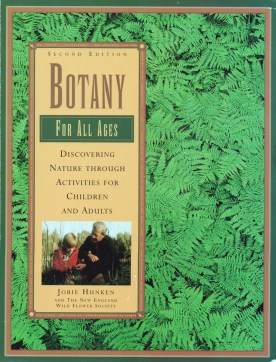
BotanyForAllAges Botany for All Ages is a collection of sensory-based environmental education activities created by volunteers and educators at Garden in the Woods in Framingham, MA. This book was written for parents, classroom teachers and informal science educators.

Written as a collaborative effort between Jorie Hunken and the New England Wild Flower Society,
Botany for All Ages begins with 26 short chapters offering instruction about how to lead environmental education activities. In their introduction to teaching with plants, Hunken and the Society address topics such as how to structure outdoor activities, how to enhance observational skills and how to develop a vocabulary that can be used to identify plants. Included in this section are study sheets to activities that call upon students to observe, listen, experiment, explain, draw, write or teach about the plant topic at hand.

Most of the remaining 101 short chapters are comprised of activities through which botanists of all ages can learn about plant morphology, plant physiology, pollination, seed dispersal, plant growth, plant succession, plant/insect interactions and soil science. There is even an activity involving transects encouraging thoughtful observation and the use of drawing to record changes in plant species.

This book has so many activities and tips that it is impossible to explain them all here. Also included is a glossary of terms and a bibliography of resources about environmental education, flowers, seeds, plant function, ​and ethnobotany.

This title is still available as a used book. Search for copies of Botany for All Ages at your favorite online used book provider.


Literature Cited

Hunken, Jorie. 1993. Botany for All Ages: Discovering Nature through Activities for Children and Adults. Second edition. Old Saybrook, CT: The Globe Pequot Press.


Also See

Go Botany: New England Wild Flower Society

Read Full Post »

WhyWouldAnyoneCutATreeDown We walk past trees all the time. They line sidewalks, grow in the backyard and are celebrated during seasonal activities like apple picking.

The tree on the sidewalk or in your yard probably doesn’t demand too much of your time. However trees, like annual flowers, require proper care and sometimes they need to be cut down. Why cut down a tree?

Author Roberta Burzynski explains the reasons why in Why Would Anyone Cut a Tree Down?. Published by the USDA Forest Service’s Northeastern Area State and Private Forestry in Newton Square, Pennsylvania earlier this year, Burzynski wrote her book in response to what students were telling her during classroom visits. While students were aware of the benefits of trees and the products they provide, they repeatedly told her that trees could never be cut down. As she explains in the preface of her book, she wrote her book to address their “gap in knowledge and understanding” about this subject.

Burzynski wrote Why Would Anyone Cut a Tree Down? for children, adults and families. It is an informative book illustrated with the peaceful, thoughtful and moving watercolor paintings of scientific illustrator, Juliette Watts. Burzynski discusses the ecological benefits of trees and the products derived from trees (e.g., pencils and paint brushes) in the first part of her book and then eases into the reasons why trees might need to be cut down in the second part. She closes her book with instructions about how to care for trees and supplies readers with resources about the following topics:

  • How to recognize hazardous defects in trees.
  • How to prune trees.
  • How to get help identifying tree pests.
  • How to use fire-resistant plants in the landscape.
  • How to buy trees and plant them in appropriate locations.
  • How to find wood markets in addition to commercial sawmills.

Burzynski’s text and Watts’ illustrations provide many talking points and learning opportunities for both children and adults. This wonderful book is available for purchase from the U.S. Government Printing Office for $10 (US) and $14 (International). It is also available as a free PDF from the USDA Forest Service. My personal recommendation is to purchase a print copy. This is a resource you will want on your shelf.

A sixteen-page curriculum guide is available for teachers and parents. This resource-rich guide includes 17 activities that can be completed in 15-60 minutes. Links to Web-based resources and books are also included.


Literature Cited

Burzynski, Roberta. 2013. Why Would Anyone Cut a Tree Down?. Newtown Square, PA: USDA Forest Service, Northeastern Area State and Private Forestry.


Also See

Updated October 29, 2014

Read Full Post »

While at a science education conference, I learned about a resource that may interest you as you build that “big picture” about plants for students.

The Nutrients for Life Foundation is a nonprofit organization educating students and the public about the role fertilizers play in feeding the world. They created lesson plans for elementary, middle and high school students that can be used by classroom teachers and homeschool teachers. The foundation was created in 2004 by leaders in the fertilizer industry. According to the information in the Fall 2013 issue of Nutrients for Life, the Foundation’s magazine, representatives from the following companies serve as board members or as members on the advisory board: PotashCorp, Transammonia, The Fertilizer Institute, Intrepid Potash, Simplot, Koch Fertilizer LLC, Yara North America, Inc., The Mosaic Company, International Plant Nutrition Institute, Agium Inc., CF Industries, Inc., Florida Fertilzer & Agrichemical Association. The Foundation has regional representatives in Colorado, Louisiana, Nebraska, Iowa, Florida, Illinois and the Northwest. 

The Nutrients for Life Foundation’s campaign to educate the public about fertilizer is extensive. They have placed ads on trains, created recipe cards and have taken their message to the radio. They also sponsored a traveling exhibition about soil science that began its run at the Smithsonian’s Natural History Museum (July 19, 2008 – January 10, 2010).

The Foundation’s curriculum, Nourishing the Planet in the 21st Century, is aligned to state standards and is available for free online. When downloading the lessons for your grade level, select your state to download the proper curriculum. Downloadable materials include lesson plans, pre- and post-tests and supply lists. Posters, bookmarks and other materials can also be ordered at no charge.

Visit the Nutrients for Life website to learn more about their soil science curriculum. You can view videos complementing their curriculum on YouTube. Here is a link to a video about a seed sorting activity for elementary school students. When you visit YouTube directly, search for videos by “Nutrients4Life”.


Related

Read Full Post »

« Newer Posts - Older Posts »