Feeds:
Posts
Comments

Archive for the ‘Teaching & Learning’ Category

Did you know there was once a movement to create a large botanical garden in metropolitan Los Angeles?

The Kew Royal Botanic Gardens uncovered records and letters about this garden in their archives and writes about the garden on their website. They tell the story of California naturalists who started a non-profit organization and who purchased 3,200 acres of land in the Santa Monica Mountains. The organization planned to use 800 acres to create a public garden and research center. The remaining 2,400 acres were to be sold as residential property. The proceeds were to fund the garden.

Called the “California Botanic Garden”, the garden opened in 1928. The stock market crash of 1929 and the Great Depression forced the garden closed in 1935. The garden and the surrounding land was sold and both were eventually enveloped into what is now L.A.’s Brentwood community.

What happened to all the plants?
Find out in The Forgotten Garden on Kew’s website.


You Might Also Enjoy This from the Teaching & Learning Archves

Public Perception of Botanical Gardens


Reminder: The weekly teaching & learning column is on a brief publishing break. This break will continue through June.
In the meantime, I hope you enjoy revisiting selected articles.

Read Full Post »

iStock_Pencils_CalendarThe weekly teaching and learning column is on a brief publishing break.

During this time, we are revisiting popular posts.

Today we revisit a 347-page guide to drawing and thinking containing 692 illustrations of easy ways to make and use drawings in your work and in your hobbies. We also learn about vintage (and downloadable) instructional books about how to use a pencil. Here are resources to consider for your studio or program:

Read Full Post »

Stories. Timelines. Visual data. Photosynthesis. Botanical art.

You’ll find them all in Historical Plant Studies: Tools for Enhancing Students’ Understanding of Photosynthesis by Dr. Stephen Thompson, professor of science education at the University of South Carolina.

Using the 5E learning model, Thompson helps students connect with scientists who, centuries ago, worked diligently to explain the source of plant matter.
Thompson (2014) prepares historical accounts of their studies and assigns one scientist to each student group in his class. Thompson’s students learn about the research of Jan Baptista van Helmont (1649), John Woodward (late 1600s) and Stephen Hales (1727), Joseph Priestly (1770s), Jan Ingenhousz (1790s) and Nicolas-Theodore de Saussure (1804).

After reading about the contributions made by their respective scientist, each student group begins the task of preparing an informational poster featuring their scientist’s hypothesis, materials and methods, results and conclusions.
Thompson (2014) encourages students to create their posters using mostly visual information and only the amount of text necessary to explain key information.

When completed, student posters are placed along a historical timeline and are presented in chronological order. As students present their poster,
Thompson (2014) gently corrects student misconceptions. Students are then asked to create a graphic organizer summarizing each study and are asked to draw models and write a description for one of the studies (Thompson, 2014). Thompson uses the drawing and writing exercise as an assessment tool to evaluate student understanding.

Photosynthesis is not an easy concept to grasp. Fortunately, Thompson (2014) makes this topic easy to understand and easy to teach, thanks to him sharing his written passages with fellow teachers. Get a copy of Historical Plant Studies and you’ll be ready to try this activity yourself and be ready to help students tell the story of how plants make food.

Thompson (2014) can be purchased online for 99¢ from the NSTA Science Store. You can also look for this article at your local college library.


Literature Cited

Thompson, Stephen. 2014. Historical plant studies: Tools for enhancing students’ understanding of photosynthesis. Science Scope. 37(6): 43-53

Read Full Post »

Thinking About Nature

Every new generation will have a more impoverished image of nature than the former one.

— Abraham A. Mabelis

Can the need to conserve biodiversity be understood by those who have hardly experienced nature?

Abraham A. Mabelis of the Netherlands wondered this very thing. To answer this question, he knew he had to find out what kind of preconceived ideas and beliefs people had about nature. Interested in what children thought about biodiversity and extinction, he surveyed Dutch school children ages 8-16. The results of his survey are the subject of the paper, Children’s Opinions about the Loss of Nature.

Mabelis (2005) surveyed 400 students — 200 elementary school students
(age 8-12) and 200 secondary school students (age 12-16). These children attended schools that did not have an environmental education program.
Mabelis surveyed students using a questionnaire. Students responded to three groups of questions. The first group inquired about how often students thought about pollution, dying forests, species extinction and accidents at nuclear power plants.

The second group of questions polled students about how seriously they viewed water pollution, air pollution, soil pollution, dying forests, the disappearance of natural forests, species extinction, nuclear power plant accidents, illness and death.

The third group of questions polled students about thoughts of their own future and thoughts about the future of their country.

Students were also asked to share their ideas about how to improve the environment.

Mabelis (2005) observed most of the students surveyed (71%) thought about pollution at least some of the time and that students considered air pollution to be more serious than water and soil pollution. More than half of those surveyed also thought about dying forests and species extinction. Mabelis (2005) observed that elementary school children think about extinction more often than secondary students and that, in general, indifference towards extinction varies by species.
It appears children, regardless of age, view the extinction of “large and attractive” species to be more serious than the extinction of “small and less attractive” species (Mabelis, 2005). He also observed that students viewed the extinction of rare species (he used an orchid as an example) as being more serious than the extinction of a common species such as a dandelion (Mabelis, 2005).

Could children’s views of species extinction be changed through education?

Mabelis (2005) investigated this too and surveyed students again after they received four months of instruction about the environment. He discovered that student indifference towards the extinction of some species can change after receiving visual information and in-class instruction. He observed statistically significant changes in student opinions about the death of forests and dandelion extinction.

When asked to offer suggestions about how to improve the quality of the environment, 70% of elementary school students responded, while 50% of secondary school students responded (Mabelis, 2005). Student suggestions addressed things people can do at home (e.g., recycle, use less packaging, etc.) and included the need to increase the number of natural areas and the need to provide better information about the environment at school (Mabelis, 2005).

Mabelis (2005) elaborates on his findings and student feedback in his paper.
He also compares his study to other European studies and provides insight into what European children think about biodiversity and the loss of nature. Mabelis also categorizes the responses he received from students and offers suggestions about how environmental education programs should be taught.

The core message of Mabelis (2005) is this — to help children understand biodiversity, conservation and nature-friendly behavior, adults need to explain the relationships between society and nature and provide examples of alternative ways of doing things.

How might change be encouraged in a classroom or on an even more personal level such as during spring break or summer vacation? Visit the “Teaching & Learning” column in the margin at right for ideas. Here some examples of what you’ll find:

Mabelis (2005) is available online for free, compliments of the
Environmental Education Association of Southern Africa (see link below).


Literature Cited

Mabelis, Abraham A. 2005. Children’s opinions about the loss of nature. Southern African Journal of Environmental Education. 22: 123-136.
Retrieved from http://eeasa.org.za/images/publications/eeasa_journal_22_2005/11-EEASA-Vo_22.pdf.


Related

Read Full Post »

Why bother with tallgrass prairies?

Whybother with tallgrass prairies?

Award-winning botanical artist and educator Heeyoung Kim continues her work documenting America’s prairies in Project 200: Botanical Documentation of Tallgrass Prairie, a project in which she is documenting 200 native tallgrass prairie plants and building an image database for scientific and educational use.

Heeyoung has worked to bring attention to the fragile state of America’s tallgrass prairies for many years. A combination of human activities have reduced the size of this ecosystem so much, that less than 1% of America’s original prairies remain. Heeyoung is working tirelessly to document prairie plants before they become extinct.

To continue building a database that will benefit future generations, Heeyoung has launched an Indiegogo campaign to help cover expenses and outreach activities. She estimates that Project 200 will take 10 years to complete if she paints full-time. Supporters of Project 200 will receive updates about the project and a gift of appreciation. Contribution requests begin at $5.

Learn more about Project 200 and pledge your support.

Go to Project 200!

Read Full Post »

There is nothing better than a good story about people and plants. If you like to read about plants, people and history too, consider reading The Big Apples of New York: The Story of How New York State Became The Big Apple by A.L. DuBois.

DuBois is a native New Yorker and a botanical artist who first learned about New York’s agricultural history when she moved to the Hudson Valley after graduating from college. At this time, she also learned that her family is linked to the founding of Flushing, Queens, the first apple town in the United States. Research on her family and the history of New York revealed a lack of books linking the state’s apple history to it’s current history, so she decided to combine her passion for history with her passion for botanical art and write a book of her own.

In The Big Apples of New York, DuBois explains apple history and symbolism, how the apple was the first fruit tree imported by colonists and how New York state established itself as a major apple producing area. She writes about the Prince family nursery, the first commercial nursery in the New World, and the prominent Livingston family — their orchards, hardships, successes and their link to the historic Montgomery estate. She also explores the mystery surrounding the expression “The Big Apple” and its link to slavery and the Underground Railroad. Her historical account of events occurring before, during and after the Civil War is interesting, disturbing and will change how you view apples at the grocery store.

DuBois’ book is as much about the current state of apples in present-day New York as it is about its history.

Chenango Strawberry. © A.L. DuBois, All rights reserved

Chenango Strawberry. © A.L. DuBois, All rights reserved

Garden historians, teachers, fruitarians, and anyone with an interest in apples will be pleased to learn that family-friendly events such as apple festivals are alive and well in New York. DuBois shares information about 9 festivals, one of which has an annual attendance approaching 70,000. She also shares how the Culinary Institute of America (CIA) honors the state’s apple history and discusses the orchard replenishment program by Slow Food NYC.

Included in The Big Apples are apple recipes for treats such as Apple Cobbler by the CIA and Fidget Pye, an apple, onion and bacon pie dating back to 1795. Also included are Apple Facts from the USDA, instructions about how to grow an apple tree from seed like the colonists once did, and a directory to 190 apple orchards in New York.
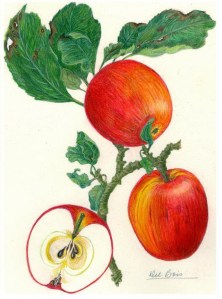
DuBois’ full-color botanical illustrations were created using watercolor, Derwent colored pencils and tempera paint. It took her more than two years to draw and paint the twenty-five varieties featured in her book.

The Big Apples of New York: The Story of How New York State Became The Big Apple is a self-published title and can be ordered directly from the author for $30.99. Please allow one week for shipping.


Literature Cited

DuBois, A.L. 2013. The Big Apples of New York: The Story of How New York State Became The Big Apple.


Readers,
Do you have a question for Ann about her research or the botanical illustrations created for her book?
Post your question below.


Read Full Post »

The featured activity this week goes beyond connecting an assignment to everyday life. This “activity” is actually a one-day event celebrating food plants, community and international cuisine.

The event I am referring to is called a “Plant Feastival”. The Feastival event was created by teachers Lynn Gilbert and Pam Mannon. They use the event as a way to end their classroom unit on plants. It’s true value, however, is as a community outreach vehicle and an interdisciplinary learning tool.

The Feastival designed by Gilbert and Mannon is an 11-day project culminating in an event similar to one of those “Taste Of…” events where visitors sample different cuisines in a festival setting. The difference is students prepare the food and serve up not only tasty samples during the Feastival, but also background information about their respective food plant, including its origins, how it grows, and how it is prepared.

During the research phase students are assigned to teams and each team researches their food plant’s history, origin and current distribution. They also look for a recipe for their food plant, work on conversion sheets to increase the yield of their recipe, write up their findings, prepare a poster presentation and work on their public speaking skills. The research tasks Gilbert and Mannon lead students through address standards in science, math, social studies and language arts. They also introduce students to topics related to economic botany, the culinary arts, cartography, botanical illustration and graphic design.

On the day of the Plant Feastival, students set up their poster presentations in the school cafeteria. Instead of sharing their research and culinary creations with other middle school students, Feastival participants share their research with 5th graders who will soon transfer to the middle school. You see, the Feastival is not only a class project, but a vehicle introducing incoming students to their new school. Fifth graders and their families are invited back later that same day to attend the evening session of the Feastival where, once again, 7th grade researchers become teachers and introduce their food plant, its history and its uses to parents as well as students.

The Plant Feastival by Lynn Gilbert and Pam Mannon can be purchased online for 99¢. Educators will find these helpful teaching tools in the article:

  • An 11-day planning guide.
  • Photographs of Plant Feastival events hosted by Gilbert and Mannon.
  • A list of questions teachers can use to guide students in their research of their food plant.


Literature Cited

Gilbert, Lynn and Pam Mannon. 2010. The Plant Feastival.
Science Scope. 33(8): 51-57.


Related

Read Full Post »

« Newer Posts - Older Posts »