Feeds:
Posts
Comments

Archive for the ‘teaching and learning’ Category

What kind of factors influence the drawing process in adults?

Psychology professors Dale J. Cohen and Susan Bennett explore this topic in a series of experiments conducted at the University of North Carolina at Wilmington.

In Why Can’t Most People Draw What They See?, Cohen and Bennett present four possible reasons why adults may not be able to draw what they see. They explain that drawing inaccuracies in adult drawings may occur because of:

    Artist Misperception of an Object
    Cohen & Bennett (1997) explain that an artist’s illusions and delusions can result in drawing inaccuracies. What’s an example of a delusion? An artist relying on what they know about an object instead of the actual physical features of an object.

    Artist Inability to Make Good Representational Decisions
    This refers to an artist’s inability to decide what to include in a drawing and how to represent it.

    Artist Motor Skills
    This refers to an artist’s ability to create the proper marks on paper after they have perceived an object and made good decisions about how to represent an object. Cohen & Bennett (1997) explain that mark making “is a physical process, not a perceptual or cognitive process” and that artists must have the “appropriate motor skills” to make the marks required to create a representational drawing.

    Artist Misperception of Their Drawing
    This refers to an artist’s perception of their own work. If an artist perceives a mark to be more accurate than it really is, drawing inaccuracies will go uncorrected.

Cohen and Bennett (1997) created four experiments to assess the effect decision-making, motor skills and artist misperception of drawings have on the drawing process. Each experiment was designed to investigate these effects in isolation. The participants in these studies were college students. Some served as experimental subjects (i.e., they completed rendering tasks assigned by the researchers) and some served as critics (i.e., evaluators) of the drawings created by the other students.

After methodically assessing the effects described above, Cohen & Bennett (1997) observed the following:

  • An artist’s decision-making capabilities are “a relatively minor source” (Cohen & Bennett, 1997) of drawing inaccuracies in adult drawings.
  • Motor coordination is not a significant source of drawing inaccuracies in adult drawings.
  • An artist’s misperception of their own work is not a source of drawing inaccuracies in adult drawings.

So what is a source of drawing inaccuracies in adult drawings?

An artist’s misperception of an object.

How Cohen & Bennett (1997) designed each experiment and assessed each effect in isolation is very interesting. For a detailed account of Cohen and Bennett’s materials, methods, findings and statistical analysis for each experiment, please see their paper. Their paper is available for free on the website of the University of North Carolina at Wilmington.

Cohen & Bennett (1997) is one of the many articles cited by Jennifer Landin in her dissertation. Do you have questions about drawing and learning?


Join our conversation with Jennifer


Literature Cited

Cohen, Dale J. and Susan Bennett. 1997. Why can’t most people draw what they see? Journal of Experimental Psychology: Human Perception and Performance. 23(3): 609-621. Web. http://people.uncw.edu/cohend/research/papers/Cohen%20and%20Bennett%2097.pdf [accessed 6 September 2013]


Related
Read Full Post »

To collect data to evaluate the use of drawing as a learning tool in a classroom setting, Jennifer had to create her own assessment tool. She created a tool called the Observational Skills Assessment. What did she think of this experience?

Ugh! That was the hardest part of my dissertation.


Learn more about Jennifer’s assessment tool

Read Full Post »

Jennifer Landin is a biology professor at North Carolina State University. She is also a scientific illustrator and a member of the Guild of Natural Science Illustrators (GNSI). She attended the University of Georgia and University of Montana for her undergraduate degree in Forestry & Wildlife Management. She received her Master’s degree in biology from Marshall University in West Virginia.

I first met Jennifer last year at the GNSI conference in Savannah, Georgia. It wasn’t until after the conference, when we were working on an article for the Guild’s journal, did I learn of Jennifer’s dissertation research about the use of perceptual drawing in the classroom. I have since read her dissertation and am excited that we have the opportunity to learn more about Jennifer’s research this month.

In her research, Jennifer addresses the use of drawing to improve observational skills and increase understanding in the biology classroom. To help you understand her project, here are her research questions as they appear in Landin (2011):

    1. Do students who participate in weekly drawing activities demonstrate a higher level of biology content knowledge when compared to students who participate in weekly writing activities?

    2. Do students who participate in weekly drawing activities show a more positive attitude toward biology when compared to students who participate in weekly writing activities?

    3. Do students who participate in weekly drawing activities display improved observational skills when compared to students who participate in weekly writing activities?

    4. What are student perceptions of drawing activities in relation to biological understanding?

    5. Are there correlations between the gains in content knowledge related to drawing activities and student cognitive processes?

Jennifer hypothesized that students who participated in weekly drawing activities would:

  • Demonstrate a higher level of biology content knowledge.
  • Demonstrate a more positive attitude toward biology.
  • Demonstrate a higher level of observational skills when compared to students who participated in weekly writing activities only.

Did the data support these hypotheses?

We’ll find out as this month progresses.

Please welcome Dr. Jennifer Landin as our special guest for September!


Literature Cited

Landin, Jennifer. 2011. Perceptual Drawing as a Learning Tool in a College Biology Laboratory. Dissertation. North Carolina University, Raleigh, North Carolina. 


Update October 2016

See Jennifer and her students at work in a video produced by North Carolina State University at https://youtu.be/MFuDDLqajVA.

Read Full Post »

When students arrive in your classroom, what is their attitude towards plants?
How did these attitudes form?

If you teach a traditional botanical art class, you most likely have enthusiastic students with vast amounts of plant-based experiences and knowledge. If you lead nature walks and work with the public, you may find that your audience does not have a particular interest in plants.

Do you ever wonder what people’s experiences with plants have been prior to meeting them?

I do. While I don’t have an answer to the question above, I can share a study that might serve as a first step to answering this question.

In the late 1980s, then-graduate student Margarete R. Harvey, conducted a study of how children experience plants and how their experiences contribute to their interest in the environment. She describes her research project and findings in Children’s Experiences with Vegetation.

Harvey (1989) conducted a study in which she evaluated children’s experiences with vegetation as play objects, as food, as tasks, as obstacles, as ornament and as adventure. She created subcategories for each experience. Because knowing these subcategories is important to understanding even this very brief look at Harvey’s research, I need to create a quick list of each experience and their respective subcategories. Here they are as presented in Harvey (1989):

    Vegetation as Play Object
    (tree climbing; playing in tall grass; playing hide-and-seek in bushes)

    Vegetation as Food
    (picking fruit and vegetables; tasting leaves, flowers or berries;
    planting seeds)

    Vegetation as a Task
    (mowing the lawn; watering plants; pulling weeds)

    Vegetation as an Obstacle
    (being stung by nettles; allergic reactions; plants interfering with
    an activity)

    Vegetation as Ornament
    (growing houseplants; putting flowers in a vase; pressing leaves
    or flowers)

    Vegetation as Adventure
    (playing in a park; walking in a forest; camping)

Harvey (1989) created a questionnaire that was distributed to 995 children, ages 8-11, at 21 schools in England. Her analysis is based on the 845 completed questionnaires she received. Harvey analyzed how often students engaged in the 18 activities described above, their level of enjoyment with these experiences, children’s attitudes towards vegetation and their attitudes towards trees, bushes and flowers on school grounds.

Large amounts of data were analyzed. Here are some interesting points from Harvey (1989):

  • Boys enjoy contact with vegetation as play objects and as adventure.
  • Girls enjoy contact with vegetation more as food and ornament.
  • Girls’ attitudes towards vegetation is more positive overall.
  • Both boys and girls liked bushes the least. Boys liked trees best, girls liked flowers the most.
  • Older children had fewer positive reactions to plants, than younger children.
  • Children of higher socio-economic status had more experiences with vegetation, more contact with vegetation and expressed more appreciation towards plants.
  • Experiences with vegetation had a positive influence on children’s attitudes towards plants.

These points only hint at what is contained in Harvey’s interesting paper. Pick up a copy of her paper to learn about the tools she used to measure degrees of enjoyment, student interest in vegetation, and how children’s past experiences with vegetation influenced their attitudes towards plants.

Get a copy of Children’s Experiences with Vegetation at your local college library.


Literature Cited

Harvey, Margarete R. 1989. Children’s experiences with vegetation. Children’s Environments Quarterly. 6(1): 36-43.


Related

Read Full Post »

Years ago when I was teaching in grad school, the SimLife game was used as an activity in the Bio 101 labs to teach non-majors about population biology. Students had control of an assortment of variables and could watch generations of their sample population change over time. Students enjoyed the exercise and it helped them understand how the traits they assigned to their sample population resulted in either their population’s survival or eventual demise.

One of the objectives of incorporating botanical drawing into studies about the environment is to use it as a way to tell Nature’s story. Botany’s story is more than complicated terminology, labels with arrows and expensive textbooks.
In today’s column, we move beyond look-see-draw and engage in a bit of storytelling.


Botanical Illustration in the Lab

How does botanical illustration fit into a lab about population biology?

How about as a game?

Educators Erik Lehnhoff, Walt Woolbaugh and Lisa Rew explain how to do this in Designing the Perfect Plant: Activities to Investigate Plant Ecology.

What Lehnhoff et al. (2008) do first is lead students in a conversation about plant ecology. They show students photographs of whole plants, leaves, seeds, growing situations and other imagery related to plant ecology (Lehnhoff et al., 2008). They then ask students to consider the advantages and disadvantages of the growth forms, growing conditions and plant traits observed in the photographs.

Student observations become the foundation of a class conversation about plant ecology. With this conversation fresh on students’ minds, Lehnhoff et al. (2008) call upon students to design a plant with traits they think will ensure their plant’s long-term survival. Instead of creating a plant using a computer program, students are asked to draw their plant and to include in their drawing every trait they assigned to their plant. The authors ask students for a detailed drawing because they have observed that the “act of drawing the plant characteristics allowed students to better comprehend each of them, and to recognize how the plant may fit into its environment.” (Lehnhoff et al., 2008).

With their plants drawn, students then engage in a competitive game of cards. The game they play enables them to live with their plants through 10 generations. The custom deck of cards they play with contains four categories of cards. These categories are Weather, Dispersal Mechanisms, Disturbance Factors and Predation/Disease. Each card drawn exposes the carefully designed plants to conditions that could impact their survival. The cards in this custom deck each have a point value. Plants with the highest points per generation survive. Plants receiving negative points in repeated generations spiral towards extinction. After living through ten generations with their plants, students are asked to write about their plant’s fate.

This clever activity provides a way to introduce botanical illustration as a tool to learn about broad ecological concepts and to move it beyond its use as a tool to learn plant morphology. Included in this paper by Lehnhoff et al. (2008) are examples of the playing cards they use in their game.

Designing the Perfect Plant is available for purchase from the National Science Teachers Association (NSTA) at the NSTA Science Store (99¢). You can also search for this article at your local college library.


Literature Cited

Lehnhoff, Erik and Walt Woolbaugh, Lisa Rew. 2008. Designing the perfect plant: Activities to investigate plant ecology. Science Scope. 32(3): 29-35.


Related

Read Full Post »

Today let’s travel through time to learn about diagrams and the role they’ve played in communicating information and scientific knowledge.

The tour guide today is Clarissa Ai Ling Lee, a PhD candidate in the Literature Program at Duke University. This spring Lee was a guest contributor to Scientific American. In her three-part series, The Art and Science of the Diagram, Lee explains how diagrams have been used to communicate information about astrology, astronomy, geography, human anatomy, the physical sciences, the life sciences and, of course, natural history.

Lee begins her series by explaining how diagrams are used in math and physics and how they help to describe the invisible. In Part II of her series, she discusses natural history art, how diagrams of organisms transitioned from being abstract to representational during the Renaissance, and how cabinets of curiosities were their own form of diagram. And finally in Part III, Lee takes a look a volvelles, pop-up books and how a new technique called perspective changed scientific illustration during the Renaissance.

An informative series about how drawing has been used in the sciences,
Lee’s series can be read online at Scientific American. Follow these links:


You May Also Enjoy Reading…

Read Full Post »

Order online from author

It is one thing to research ways to connect botanical art with learning in the classroom and quite another to figure out how to make time to apply the wonderful ideas you’ve learned. Between work, family, volunteering and other responsibilities, how do you find time in your schedule to read a book, much less time to draw, paint and engage in other creative activities?

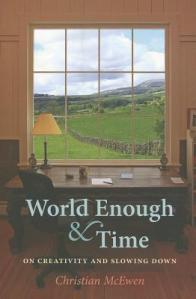
If something inside your body has been telling you to slow down and if you know you’ve been silencing your creativity and ignoring the call of your Creative Self, then now is the time to read World Enough & Time: On Creativity and Slowing Down by Christian McEwen.

When Christian talks about slowing down, she doesn’t mean simply removing one or two items from your list of To Do items. What she means is to slow down by physically moving more slowly. By walking instead of running. By writing with pencil and paper instead of typing. By doing whatever it takes to stop subjecting your body to “hurry sickness” (McEwen, 2011).

Christian encourages the tired and the overwhelmed to make time to converse with people in person. To figure out how to do nothing. To spend time with a child. To go for a walk. To learn how to look. Read a book. Keep a journal. Stop multitasking. Take a break. Dream. Learn to listen. Be grateful.

While all of this sounds simple enough to do, there is a reason why these simple acts are the focus of a 367-page book. Our culture has either forgotten how to do them or they have been deemed too time-intensive and impractical for daily life. Yes, a bit of planning and motivation might be necessary to engage in some of these activities, but not much. In World Enough & Time, Christian explains why these activities are important, shares with you interesting history, research and stories, and provides you with tactics to make the changes to your busy life that you probably already know are way overdue.

Value “slowness”. Create an “affluence of time” (McEwen, 2011).

Add World Enough & Time: On Creativity & Slowing Down to your summer reading list.


Literature Cited

McEwen, Christian. 2011. World Enough & Time: On Creativity and Slowing Down. Peterborough: Bauhan Publishing.


Related Topic

Read Full Post »

« Newer Posts - Older Posts »