Feeds:
Posts
Comments

Archive for the ‘teaching and learning’ Category

We’ve taken a look at grocery store botany in this column before. This week we return to the produce section of the grocery store to explore an online resource that can be used in anywhere there is Internet access.

Garden teachers, science teachers, scout leaders, botanical artists and more will appreciate the educational resource, Supermarket Botany, on the website of the Graham Centre for Agricultural Innovation. It is a free interactive tool helping students explore the botany behind the plants we store in our refrigerators.

Created by professors Geoff Burrows and John Harper, Supermarket Botany is very easy to use. The platform is composed of two parts. In one section, students can learn about plant morphology by viewing labeled photographs and reading concise descriptions. This review of plant morphology prepares students for The Challenge!, an engaging activity that makes up the other section of this resource.

The Challenge! is an exploration of 15 fruit and vegetables commonly found in the grocery store. When students begin the game, they are presented with shelves of fruit and vegetables and are asked to respond to the prompt, “What’s on the shelf?”. Students select a fruit or vegetable (i.e., plant part) and must decide if their selection is a root, stem, leaf, flower, fruit or seed. If students choose the correct answer, they are guided to a section where they can learn the technical reasons why their item is either a fruit or a vegetable. If students choose a wrong answer, a pop-up box appears explaining why their fruit or vegetable is not the option they selected. It is this part about this activity that I find especially useful. Students advance through the game understanding why their fruit or vegetable is not a root, stem, leaf, flower, fruit or seed.

Burrows and Harper designed handouts to go with students’ use of their online resource. Teachers can download these handouts free of charge.

Would you like to take The Challenge! yourself?

Go to Supermarket Botany


Related

Read Full Post »

If you like to tell stories about plants but come up against students who are indifferent towards botanical subjects, consider the strategies suggested by professor Rob Reinsvold in Why Study Plants? Why Not?.

In his short 2.5-page editorial, Reinsvold (1999) provides an overview of how students learn about plants in elementary school, middle school and high school and how what they learn contributes to their thinking that biology is primarily about humans and animals.

To make plants more interesting to students, Reinsvold (1999) suggests educators try the following:

  • Take advantage of society’s obsession with “the biggest and the best”
    (p. 3). Introduce students to the largest known creosote bush, the oldest living tree, the largest living organism, etc. and relate them to comparable examples in the animal world. Reinsvold talks about hosting an Organismal Olympics. You can learn more about this in his paper.
  • Show students that plants are active using time-lapse photography.
  • Explain how people use plants.
  • Talk about money. Discuss plant products as traded commodities.
  • Discuss how plant research has contributed to our knowledge about genetics, growth, development, biodiversity and climate change.

Reinsvold (1999) includes in his editorial a list of principles proposed by the American Society of Plant Physiologists. These principles address what the Society thinks every student and citizen should know about plants. An updated version of this list is available on the website of the American Society of Plant Biologists (ASPB). (Note: The Society changed its name since Reinvold’s editorial was published).

The principles proposed by the ASPB have been aligned with the National Research Council’s Life Science Standards. Educators may be especially interested in the bookmarks the Society created around these twelve principles. These double-sided bookmarks are available for free in limited quantities each month. Go to the Society’s Education page to learn more about the bookmarks, the Standards and the Principles of Plant Biology.

Reinsvold (1999) can be purchased online for $39. You can also search for back issues of this journal at your local college library.


Literature Cited

Reinsvold, R. 1999. Why study plants? Why not? Science Activities. 36: 3-5


Also See


Remembering Dr. James Wandersee

Dr. James Wandersee was a professor of biology education and one of the researchers to coin the term “plant blindness”. In 2009 I had the opportunity to communicate with Dr. Wandersee via email. I told him about ArtPlantae and we discussed some of my ideas. He was very encouraging and supportive. This weekend I was saddened to learn of Dr. Wandersee’s passing. I can’t read or write the phrase “plant blindness” without thinking of our email exchanges and his encouraging words. Dr. Wandersee was 67.


Read Full Post »

Druivenblossem [De Europische insecten] , Merian, Maria Sibylla, 1647-1717 , Engraving, hand-colored ,1730. Digital image courtesy of the Getty’s Open Content Program.

Druivenblossem [De Europische insecten] , Merian, Maria Sibylla, 1647-1717 , Engraving, hand-colored ,1730. Digital image courtesy of the Getty’s Open Content Program.

In 1699 after conducting many studies of European moths and butterflies, artist-naturalist Maria Sibylla Merian (1647-1717) traveled to Surinam to study insect metamorphosis. You may already be familiar with her paintings of insects and plants. Merian was more than an adventurous artist and divorcée. She was a dedicated independent scholar who made significant contributions to biology and the not-yet-established field of ecology.  

The complete extent of Merian’s contributions are not obvious by looking at her images. One can only begin to fully appreciate the value of her work by reading the text accompanying these images or by learning from someone who has read Merian’s descriptions, such as biology professor Kay Etheridge. According to Dr. Etheridge, Merian is known more for her art than for her scholarly achievements in part because her texts were written in German or Dutch and her written observations are not readily available in English (Etheridge, 2010). The only full English translation of her famous Metamorphosis insectorum surinamensium is a facsimile edition that is viewable in only about 20 libraries worldwide (Etheridge, 2011).

Today we have the opportunity to learn from Dr. Etheridge who is currently preparing for a two-day symposium about Maria Sibylla Merian at the University of Amsterdam (May 26-27, 2014). The symposium, Exploring Maria Sibylla Merian, will feature panels of invited scholars who will discuss their research about Merian’s life and her contributions to art and science.

Please join me in welcoming Dr. Kay Etheridge!


ArtPlantae
: The symposium about Maria Sibylla Merian sounds absolutely wonderful. How did this event come together?

Kay Etheridge: I co-authored a paper book chapter with a Dutch colleague, Florence Pieters, and we were giving a presentation about Merian’s influence on Mark Catesby (1683-1749) at a symposium about Catesby’s work. While at lunch we talked about what a similar symposium about Merian might look like. We discussed the idea with people at the University of Amsterdam, one thing led to another and this is where the symposium will be held. It is a perfect venue because Merian spent much of her life in Amsterdam, and the University has several of her books in their special collections.

There is a lot of misinformation out there about Merian. The one goal of the symposium is to have scholars gather to discuss what we really know about her.


AP
: How many Merian scholars are there?

KE: There aren’t that many. Probably less than one dozen who focus primarily on Merian, although many scholars do study her work to varying degrees. Then there are others who work on Merian, just not exclusively. There will be 10 scholars speaking at the symposium. They include an entomology historian, various science and art historians including a printing expert who discovered a letter by Merian, and a couple who is making a film about Merian. Dutch artist Joos van de Plas will also be at the symposium. Joos is fascinated by metamorphosis and became captivated by Merian’s work. She went to the insect collection in the Wiesbaden Museum, Germany, to study what may very well contain some of Merian’s insects. She matched a number of insect specimens to the engraved images in Merian’s book on Surinam insects and then printed a book of museum overlays.

My own work is an examination of the biology behind Merian’s work, something that I feel has been overlooked. For example, she conducted many of the earliest insect food-choice studies and was the first to look at plant-insect relationships in any detail.


AP
: I have seen one exhibition about Merian’s life and the focus was on her interesting life story, her art and her trip to Surinam. In your articles, you write about her many contributions to biology — such as being the first to “elucidate through word and art what we now think of as food chains and interactions within ecological communities” (Etheridge 2010, p. 21). You also mention that some historians tend to deny her the title of “scholar” and refer to her more often as “artist”, “housewife” and “mother”. Why do you think this type of labeling persists given our current understanding about her contributions to science? 

KE: I think that those who do not call Merian a scholar may define a “scholar” as someone who has university training. Many historians, however, do think of Merian as being a scholar. I believe that as people learn more about her work, her prominence in the history of science will increase.


AP
: In the essay Maria Sibylla Merian: The First Ecologist? you mention that Merian was influenced by Hoefnagel and that many artists and naturalists who came after her were influenced by her art and observations. Tracing the influence of Merian’s work sounds like it would be very difficult. How do you conduct such an investigation?

KE: Other scholars have posed various influences on Merian, but my interest is in who she influenced, that is, those who came after her. If you know who had access to her work and then you see how their compositions mirror hers, the connections are obvious. Before Merian’s books, plants and animals were usually depicted separated; she was absolutely the first to put together related organisms in an “ecological” composition. We now think of this as standard, but Merian set that standard in 1679 with her first book on European insects and their plant hosts.


AP
: You’ve completed extensive research about Merian’s life and work. What would you like the public to understand about Merian? How can the artists, naturalists and educators reading this interview contribute to this effort?

KE: By recognizing that people do not fully understand the scientific context behind Merian’s images and that people need to read the text. 

I am currently on sabbatical and working on the English translation of Merian’s butterfly books, completed by my colleague, Michael Ritterson. My book will include the first English translation of Merian’s initial work on European insects
(Der Raupen wunderbare Verwandelung und sonderbare Blumen–Nahrung, 1679), her accompanying images, and commentary on her numerous formative contributions to natural history.

Her most imitated invention was an “ecological” composition in which the life cycle of an insect was arrayed around a plant that served as food for the caterpillar. As mentioned above, prior to Merian’s Raupen books animal and plant images were segregated, usually in separate volumes. To date most scholarship on Merian has emphasized her fascinating life story or her artwork, and the science content of her books has not been examined in depth; her caterpillar books have been particularly neglected. Reasons for this omission will be addressed in my book, but one factor may be that no English translation of the Raupen books has been published. 

The title of my book will be Wonderous Transformation: Maria Sibylla Merian’s Catepillar Book.


Readers, do you have a question for Kay about her research or the upcoming symposium? Write your comments and questions below.


Literature Cited

Etheridge, Kay. 2010. Maria Sibylla Merian and the metamorphosis of natural history. Endeavour. 35(1): 15-21

Etheridge, Kay. 2011. In V. Molinari and D. Andreolle, Editors. Women and Science, 17th Century to Present: Pioneers, Activists, and Protagonists. Cambridge Scholars Publishing, Newcastle upon Tyne.


Related

(Links updated 27 June 2024)

Read Full Post »
Last week’s column about Jeanne Baret’s dedication was popular with many people. I thought I would follow-up and share an idea about how to integrate the field work of Jeanne Baret and other explorers into the classroom by using the field journal lesson plans written by Devon Hamner. Hamner presents the framework for four 50-minute journaling sessions in How Does My Garden Grow? Writing in Science Field Journals.

Throughout these four sessions, students are prompted to write about their observations, pay attention to detail, ask questions and are expected to investigate topics with which they are unfamiliar. They are also expected to act like researchers and are required to discuss their work with their peers. Hamner’s approach to learning about plants is very flexible and does not require an established schoolyard garden. Her activity can be applied to windowsill gardens and to container gardens. She even has a plan teachers can use in the event there is a mass die-off of students’ seedlings.

Hamner explains how to implement each journaling session and addresses everything from how to introduce students to gardening topics, to how to how lead collaborative inquiry-based activities.

If you’re looking for a way to merge botany, history, ​and art using exploration as a theme, consider adding Hamner’s article to your toolkit​. It is available for free online. Included are links to additional Web-based resources.

Also consider adding Paula Panich’s book about garden writing and Christian McEwen’s guide to nature writing to your teaching library.


Literature Cited

Hamner, Devon. How does my garden grow? Writing in science field journals. Retrieved from http://www.readwritethink.org/classroom-resources/lesson-plans/does-garden-grow-writing-846.html


Related

Read Full Post »

On occasion, ​ you come across an opportunity to combine a good story with the technical side of a subject. Such an opportunity presented itself recently and it allows me to weave the technical language botanists use into a fascinating story.

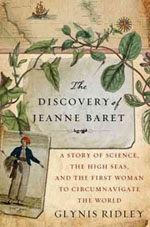
TheDiscoveryOfJeanneBaret_150

Today we revisit the story of Jeanne Baret, the herb woman and experienced field botanist who traveled on the Bougainville expedition (1766-1769) and who disguised herself as a man so she could join her boyfriend, expedition botanist Philibert Commerson. This historic journey made Jeanne (or “Jean” as she was known on board) the first woman to circumnavigate the globe.

Together Baret and Commerson collected more than 6,000 specimens; seventy of these specimens were named after Commerson while none were named after Baret (Tepe et al., 2012). Fortunately, this oversight was corrected two years ago. The plant honoring Jeanne Baret and her accomplishments is described in A new species of Solanum named for Jeanne Baret, an overlooked contributor to the history of botany by Eric J. Tepe, Glynis Ridley and Lynn Bohs.

The naming of Solanum baretiae Tepe, sp nov. was completed as part of an ongoing worldwide project to revise the genus Solanum. In Tepe et al. (2012), you’ll find detailed taxonomic information about the plant, information about Jeanne Baret, pen and ink illustrations by Bobbi Angell, color photographs of
S. baretiae, and GPS location data identifying where living specimens were examined.

The article by Tepe et al. (2012) serves as an example of how botanical illustration and botany work together to describe the diversity of plant life on earth. It is a good classroom example of how new plant species are described by botanists. Teachers might be interested in pairing this article with the book, The Discovery of Jeanne Baret: A Story of Science, the High Seas, and the First Woman to Circumnavigate the Globe by Glynis Ridley. Pairing the article with the book would help teachers link Baret’s life story to subjects related to plants, geography, ​and history.

To learn more about Jeanne Baret, read my interview with Glynis Ridley.

This article by Eric J. Tepe, Glynis Ridley and Lynn Bohs is available for free online.


Literature Cited

Tepe, EJ and Glynis Ridley, L. Bohs. 2012. A new species of Solanum named for Jeanne Baret, an overlooked contributor to the history of botany. PhytoKeys. 8: 37-47. doi: 10.3897/phytokeys.8.2101


You May Also Enjoy

Angiosperm Phylogeny Website
International Code of Nomenclature for Algae, Fungi and Plants

Read Full Post »

Many years ago I had the opportunity to help pilot test a new biology lab curriculum for nonmajors. It is through this experience that I came to see the many ways people learn. It is also how I came to appreciate the Herculean effort required to design, write, implement, evaluate and fine-tune a curriculum. I think of this experience often, especially when I read about activities such as the leaf-building activity that is the focus of this week’s column.

We’ve learned how describing a concept with words and how visualizing words can make invisible processes easier to understand.

Today we go 3-D and consider model-making. The leaf-building exercise we’re going to learn about was created by science teacher Patty Littlejohn. She describes the model-building process and how she uses the models to enhance student understanding of photosynthesis in Building Leaves and an Understanding of Photosynthesis.

Littlejohn (2007) makes photosynthesis easier to think about by making the process of photosynthesis larger than life.

To help her middle school students see, feel and experience photosynthesis, she has them build a model of a leaf, a plant cell and an animal cell. Students build leaves with veins, chloroplasts, stomata and an epidermis. Their plant and animal cells have cell membranes and organelles. Littlejohn says students benefit from the model-building exercise because it requires them to “see and manipulate the reactants and products of photosynthesis and cellular respiration” (Littlejohn, 2007).

In addition to their leaf and cell models, students also create reactants and products (i.e., carbon dioxide, oxygen, water, energy, glucose) and combine reactants to simulate the chemical reactions occurring within plant and animal cells. By engaging students in the construction of both cell types, Littlejohn (2007) is able to show students how energy is transferred between organisms.

Littlejohn (2007) includes detailed instructions and material lists in her article so that teachers can bring this same experience to their classroom or program. Littlejohn’s article can be purchased online for 99¢. You can also look for her article at your local college library.


Literature Cited

Littlejohn, Patty. 2007. Building leaves and an understanding of photosynthesis. Science Scope. 8(30): 22-25


Also See

Read Full Post »

Making images as natural as speaking.

– Heinemann Publishing

This is the focus of New Entries: Learning by Writing and Drawing by Ruth Hubbard and Karen Ernst, a collection of case studies about teachers integrating art, science and writing in their classrooms. Thirteen educators contributed to this book and generously share classroom activities and their own learning processes with readers. Here is what you’ll find inside this enlightening resource:

    Drawing Rachel In
    Susan Benedict, elementary school teacher
    Benedict shares how she helped a 4th grade student with her writing and reading through nature journaling.

    Widening the Frame: Reading, Writing and Art in Learning

    Karen Ernst, teacher and author
    Ernst describes how she created her artists workshop, a structured yet flexible workshop in which students actively engage in literature, art and writing.

    Writing Pictures, Painting Words: Artists Notebooks in Literacy Workshops

    Nancy Winterbourne, elementary school teacher
    Winterbourne’s research interests include how drawing in science journals helps students use complex verbs to explain their observations. In this chapter, Winterbourne provides examples of how children’s communication skills are enhanced when they integrate drawing and writing.

    Opening Up to Art: Imagery and Story in a High School Reading Class

    Peter Thacker, teacher
    Thacker shares how he became an artist and learned how to create images with his students.

    Beyond Answers

    Jill Ostrow, teacher and author
    Ostrow writes about how to look at math concepts visually. She shares the problem-solving picture strategies her students created in her class.


    Putting Art on the Scientist’s Palette

    Mary Stein (scientist) and Brenda Power (writer)
    Stein and Power offer practical suggestions about how teachers can integrate art, science and language to move beyond the perceived boundaries between disciplines. 


    Imagination Through Images: Visual Responses to Literature

    Ruth Shagoury Hubbard
    Hubbard discusses how students can use drawing and writing to help them understand what they read.


    Reading the Image and Viewing the Words: Languages Intertwined

    Irene C. Fountas (Professor, Education)
    Janet L. Olson (Professor, Art Education)
    Fountas and Olson discuss how reading informs drawing and how viewing images informs writing. 


    Parallel Journeys: Exploring Through Art and Writing in Fourth Grade

    Peter von Euler, teacher
    Peter von Euler explains how the use of “observational journals” helped his students unite writing and art. 


    I Look at My Pictures and Then Try It: Art as a Tool for Learning

    Jean Anne Clyde (Professor, Literacy)
    Clyde shares a story about a student’s use of art as a learning tool and how this student searched for meaning in texts, learned from others and integrated drama, art and math.


    Reclaiming the Power of Visual Thinking with Adult Learners

    Ruth Shagoury Hubbard
    Through her work, Hubbard aims to make “visual language” commonplace among adults. In this chapter, she offers suggestions about how to introduce adults to visual learning.


    Background, Foreground: From Experience to Classroom Practice

    Karen Ernst
    Ernst writes about a summer art workshop for teachers and how this workshop made teachers more sensitive to how their students learn.


    Drawing My Selves Together: An Editor’s Notebook

    Toby Gordon, education publisher
    Editor Toby Gordon describes how editing the book Picturing Learning by Karen Ernst helped move her past negative comments about her work made by her kindergarten teacher.


New Entries: Learning by Writing and Drawing
is no longer in print. Search for a used copy at your favorite independent used bookstore.


Literature Cited

Hubbard, Ruth Shagoury and Karen Ernst. 1996. New Entries: Learning by Writing and Drawing. Portsmouth, NH: Heinemann


Related

Read Full Post »

« Newer Posts - Older Posts »