Feeds:
Posts
Comments

Archive for the ‘Special Events’ Category

The 24th annual Made in California exhibition will be held March 22 – May 1, 2009 at the City of Brea Art Gallery. This juried exhibition is open to all artists living in California. Entries must be original and have been created within the past two years. Eligible media are oil, watercolor, acrylic, drawings, mixed media, graphics, photography, video, and sculpture (up to 50 lbs.). Please no crafts or functional art.

Approximately 80 works will be on view for five (5) weeks. Botanical art has been featured at this exhibit in the past, so don’t be shy!

Download an application at www.breagallery.com.

Read Full Post »

Every year Southern California independent bookstores distribute a holiday catalog to promote the outstanding selection and services independent bookstores provide to their communities. ArtPlantae Books is participating in this movement this year and is pleased to introduce you to the 2008 holiday catalog. coverholidaycatalog

It is easy to forget that ArtPlantae Books has the ordering capabilities of a traditional brick-and-mortar because our “brick-and-mortar” travels to events in different communities and has an online presence. While we specialize in art and nature titles, we can order books on any subject. Allow us to demonstrate. Let us assist you with your shopping this season and help you check-off gifts for the readers on your holiday shopping list. To place an order from the holiday catalog, download the order form and browse our electronic catalog (thank you SCIBA!). Then fax your order form to us and we’ll arrange to have your gift items sent to you. This is all there is to it. You now have time to sip a warm drink and plan your Spring garden.

What? Layout the garden in November?

Now, this is beyond luxury!

Read Full Post »

Members of The Society of Botanical Artists (SBA) have graciously responded to the Ask The Artist Q&A questions. Questions were presented to all artists. Each artist had the option to answer (or not answer) each question. You can jump into the Q&A by clicking on any one of the links below.

We would like to bring attention to the fact that one of our readers submitted questions from her home in rural Texas. She seized the opportunity to communicate with other artists and took advantage of the opportunities we are trying to create on this educational blog. This thrills us to no end! This is exactly how we want the blog to be used. We encourage each of you to post comments and to engage in conversation with others in our community. You might want to consider signing up to receive our RSS feed or convenient RSS email updates so that you can keep track of all updates and comments as they are posted. Click on Convenient Updates at the top of the right-hand column.

___________________________________________________________________________________

Available at ArtPlantae Books

Read Full Post »

Please describe your method and materials for blocking warped watercolor paintings.  Thanks!


Sandra Wall Armitage

I haven’t ever needed to do this.


Kathleen Baker

I would remove the warping first by placing the paper on a smooth folded bed sheet on a hard surface, finely spray it with water and iron it with medium heat, upper surface facing downwards. Then, I’d put the paper between two boards with weights on top.


Susan Dalton

I’m not entirely sure what you mean when you say ‘blocking warped watercolour paintings’. If you mean flattening paintings that have buckled when dry then I would suggest you try one of the following methods:

a) If the paper is not too warped then you could try gently ironing the back of the painting and then placing under a heavy weight for a couple of days – I have tried this on one or two occasions and have found it to be quite satisfactory.

b) If the paper is very warped I have heard of artists wetting the whole of the back of the paper and then stretching by taping it down to a suitable clean board with brown gummed tape until totally dry – however I would find this method too much of a risk!

Ideally prevention is better than cure and I would suggest that you either stretch your paper before you begin painting, use a heavier weight of paper or (as I do) use blocks of watercolour paper.


Brigitte Daniel

I mist the back of the paper using a fine spray (used for plants) several times (letting it
soak in each time).  I then lay the paper wet side down on a board sealed with yaught varnish and stick down the sides all around the edges using brown water-based paper tape.  I then let the painting dry.  Keep an eye on the fine detail between sprays to make sure it does not run.  Try to avoid this problem by using heavier paper.


Susan Hillier

Wet the back of the painting, and a wooden board. Tape the paper down with Gum Strip and let dry naturally.


Jennifer Jenkins

I never have this problem as I use Aquarelle Arches 140 lb. blocks and 140 lb. weight sheets of Fabriano paper for my watercolour paintings.


Kay Rees Davies

I ask my picture framer to dry mount any painting which might have buckled slightly.


Margaret Stevens

This is not a problem I have encountered.  I try to use sufficiently heavy paper suitable for the painting and try not to get it too wet.  I also prefer to work on blocks of paper rather than loose sheets which helps a lot.

___________________________________________________________________________________

Continue to Nature’s Colors

Return to Day Job

Read Full Post »

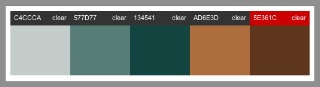
cr-spa-color-palette

I have [been] commissioned [to complete] a painting of an Englemann Spruce and the palette they want me to use for their spa label is close to a teal color (see color palette). I usually work with glazes and I was wondering if you have had experience in getting this color without mixing.  If not then what would be a mix you would use?

The blue seems closer to a light wash of colbalt blue deep?  I am getting a close match using a light wash of French ultramarine blue and then a glaze of Oxide of Chromium, then later a darker mix of the two.


Sandra Wall Armitage

I would be inclined to use a viridian with the addition of Paynes grey as a starting point. You could try laying down the Oxide of Chrome first as it is not transparent.


Susan Dalton

I’m not sure how accurate the colour reproduction is that I have printed of your colour palette, but having experimented a bit, I would suggest that you perhaps could use Oxide of Chromium mixed with Winsor & Newton ‘Winsor Blue (Green Shade) ‘ and / or Winsor & Newton ‘Cerulean Blue’.


Brigitte Daniel

Have you considered sourcing a pigment from a specialist supplier?  Take a sample of the colour you require to a good art shop.  My computer screen is not up to reproducing the colour which would permit a comment that would be of any use to you.


Susan Hillier

Don’t know exactly what you mean by ‘teal’.


Jennifer Jenkins

I cannot help with the first part of this question as the colours showing on my computer are not clear enough.


Kay Rees Davies

I chose Transparent Turquoise (Daler-Rowney 157), Olive Green (Winsor & Newton 447) and Indigo (W&N 322) as my mix for the teal colour on the colour palette. I tried layering them as you suggested but found it far quicker to mix them, and also more accurate.

For the paler teal I used Transparent Turquoise (as above), Indigo (as above) and Naples Yellow (Daler-Rowney 634) in a very dilute mix. In all these mixes you must experiment with the amount of each colour.


Margaret Stevens

I am afraid I am a very instinctive painter choosing my mixes and glazes by eye with scarcely a thought for what I am using.  This is why I had the cooperation of Kay Rees-Davies when writing the analysis of paints section of The Botanical Palette as she looks at her colours with a much more analytical eye.  For myself I prefer to try various glazes and mixes until I hit the right one and after more years than I care to think about this works best for me.  Perhaps Kay or Paul Fennell will  be good for answering this part of the question.

___________________________________________________________________________________
Continue to Commercial Reproduction (Watercolor)

Return to Blocking

Read Full Post »

Since I have not had any experience with having my work reproduced commercially, are there colors I should [avoid]? Do you work a piece differently if you know it is being reproduced? What are some of your techniques so that the final image is more defined and clear.

Thanks so much.  I live rurally in Texas where there is not a group of botanical artists to commune and learn from, so this opportunity is exciting.


Sandra Wall Armitage

I have never had a problem having work reproduced, although I find that Alizarin Crimson and Raw Umber are not good for flat washes. If I am working to a brief to exact scale, I find it easier to do all my drawing and corrections on tracing paper and then transfer the drawing onto the right support. This avoids any rubbings out or raising the grain of the paper.


Susan Christopher-Coulson

So far I have not had to work a piece differently for reproduction – for me, the colour and image in the original artwork needs to look “right”. However, the way you work will depend on what your brief or purpose for the work is. Inevitably with reproduction, there will usually need to be some adjustments made at the proofing stage so that the printing process can match the colours you have used but is impossible to second guess what these will be since printing processes and equipment vary. It is therefore important that the artist can cast a critical eye at the proofing stage if possible and indicate any adjustment to colour that they feel necessary. As the artist, you need to be happy with the final result and that it is as true a representation of the original as possible. This can take time and may involve a degree of compromise, which may depend on the end use of the reproduction – for example if it is, say, for a scientific journal or perhaps for product packaging? (Which I think may be the case here and may have specific colour requirements – possibly associated with branding for example).


Susan Dalton

I do not have much experience with having my work reproduced commercially, but I would suggest that you avoid using black. I have also heard that yellow does not reproduce well, but my painting in The Art of Botanical Painting of the Paeonia lutea (Yellow Tree Peony) is a good reproduction of the original colours. As I have never produced a painting that I know is going to be reproduced, I am unable to comment on whether I would work differently – my paintings that have been reproduced have all been fine, but perhaps I’ve just been lucky!


Susan Hillier

Work for reproduction should have extra “graphic bite”, you need to learn about methods of reproduction and any alterations in size.


Jennifer Jenkins

Regarding commercial work, I know of no colours you should actually avoid, however, it is best to be aware that green shades are not always printed exactly as painted. For reproduction work I ensure that the entire image is very clearly defined, especially the edges and serrations of leaves. They need to be really crisp and the paper should be spotless with no sign of any pencil or eraser marks etc. All must be pristine as the printing process is unforgiving.


Kay Rees Davies

I find that the glowing pink/red of Quinacridone Red (W&N) (perfect for red camellias) is darker when reproduced. I always try to have very clearly defined edges whether for reproduction or not. I examine them closely through a magnifying glass and correct any slight errors using a no. 2 brush with a perfect point, and using the same colour – don’t make it look as if it is outlined.


Margaret Stevens

I have never found it necessary to avoid any colours when working professionally. Colour reproduction is so much better than it was years ago when the tricky colours were greens and yellows. Greens almost always turn out disappointing when reproduced by mass commercial means although specialist printers can do a very good job. When printed for a printers commercial magazine my Lily step-by-step main picture in The Botanical Palette was so accurate it was unbelievable and far better than the Harper Collins repro in the book, where the greens are atrocious. Yellows have greatly improved – there was a time when they always had a brownish tinge but nowadays some good clear colours are achieved.

Apart from ensuring that a white flower has a definite edge when it is to be reproduced I make no allowances for reproduction. I have known my original returned from the printer with a pencil line drawn in to define the edge if it was not clear enough for their taste. I am talking about The Medici Society who were the leading card/print/calendar company for many years in the UK and highly respected.

___________________________________________________________________________________

Continue to Colors in Palette or Pencil Case

Return to Matching Nature’s Colors

Read Full Post »

Do any of you work with botanists and illustrate for journals and herbariums? If so, in which publications has your work been published?


Kathleen Baker

I am a trained botanist, holding M.Phil and Ph. D. degrees. I haven’t had illustrations published in any scientific journal.


Brigitte Daniel

Difficult to answer as I work as a painting botanist!  My work has often been bought by scientific collections, such as the Lindley Library and the Museum of Wales.  They usually ask for permission to publish in their in-house journals.  I have also sold work to botanists and botanical artists as reference works.


Susan Hillier

I used to work as a scientific illustrator for the Royal Botanic Gardens Kew and there I worked with world class botanists, as the work featured many dissections under amazing microscopes. It was published in scientific papers and specialist journals, such as Flora of Tropical East Africa (ISBN  90 6191 321 8 )


Jennifer Jenkins

No.


Margaret Stevens

 I worked on the 4-volume Royal Horticultural Society Dictionary of Gardening producing black and white drawings to scale of all the paphaeopediliums which theyn also used miun one of their orchid publications.  There is very little of this kind of work for botanical artists unless you are amongst the lucky few living near one of the botanical gardens.  Even then money is short and photography is cheaper so however much your work may be desired a University for example will be looking for a donation rather than a paid commission.  That is how it is in the UK at  any rate! And with your Carnegie Mellon University too!

___________________________________________________________________________________

Continue to Colors in Palette or Pencil Case

Return to Commercial Reproduction of Artwork (Watercolor)

Read Full Post »

« Newer Posts - Older Posts »