Martin J. Allen is an award-winning botanical artist from the UK who creates larger-than-life paintings with exquisite detail. He has earned three gold medals from the Royal Horticultural Society (RHS) and has shown his work in exhibitions held in England, Germany and the United States. Martin’s paintings have been published in three books and are featured in a series of Collectors’ Plates by the RHS. Martin is represented in the United States by Susan Frei Nathan Fine Works on Paper, LLC.
Please welcome Martin J. Allen, the Feature Artist for January!
ARTPLANTAE: Happy New Year. I am thrilled to begin the new year with the opportunity to introduce you and your work. The start of a new year is always a time when people think big and plan for the year ahead. It is fitting, then, that we begin this year discussing your big approach to botanical art!
The examples of your work that I have seen in catalogs are about 14” x 9”
(36cm x 23cm) in size. They are definitely larger-than-life. Where does the impulse to go big come from?
MARTIN J. ALLEN: The two main influences on going big have been the work of Rory McEwen, whose later works were much enlarged, and the German photographer Karl Blossfeldt in whose black and white images the identity of the plant is secondary to its aesthetic appeal.
The initial impulse came about because I was asked by Constance Hepworth, who owned the gallery Hortus in London at the time, to take part in a joint exhibition on tulips. In trying to think of a way of saying something about tulips that would be different, I enlarged the images.
Later I found that in taking a small part of a plant (about an inch in size) that would otherwise have been overlooked in the garden, and enlarging it to reveal its beauty in detail, enabled me to present something exciting and different without having to travel to exotic countries or search for obscure plant species.
It would have been difficult to create such images without access to a good macro lens on my camera, an A3 colour printer, and of course a computer through which to coordinate it all.
AP: In an article published by the Pittsburgh Tribune about the 13th International Exhibition of Botanical Art & Illustration held last year at The Hunt Institute for Botanical Documentation, it is explained that you enlarge photographs of your subject in Photoshop and use the printed image as a reference. You then create your original paintings using hand-painted dots. From this I assume you make limited use of washes, if you use them at all. How did you come to use this technique?
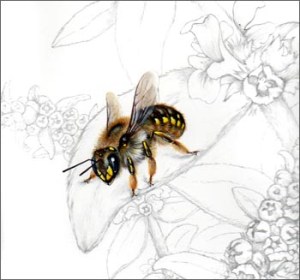
MJA: It can take me a month to finish a painting and no plant material stays in good condition for that long, so I always use photographs as reference material for this type of painting. I once had a part-finished painting on my desk for well over two years, as between work and bouts of ill health I didn’t have time to do any painting let alone get it completed. It was worth the wait though – it’s the painting at the top of this page.
My painting technique is a much messier affair than suggested in the article as it’s only tidying up at the end when the dots come into it. Basically I will do whatever I need to so that I get the effect I want.
To start, I add paint with a large brush (perhaps a number 4 or 6) and the paint is not really wet enough to be a wash and not dry enough for dry brush, but somewhere in between. I try to aim for the colour I see rather than building it up in layers, which is too complicated a technique for me. I invariably paint it a bit lighter than I want initially so I have to keep on adding more paint until it’s fairly close to the strength of colour I want. At this stage the painting all looks a bit scrubby (the stage when we all get bad tempered and say it’s not going to work), so I then spend a lot of time filling in the gaps to give the paint a smoother appearance on the paper with a number 2 brush – the smallest size I use. This is where the dots bit comes in as by that then it looks like I’m just adding little marks. It sounds laborious but I can do it quite quickly now.
I think my technique developed as a result of painting on Schoellershammer paper, on which paint lies very much on the surface like it does on vellum. If you paint over wet paint it will lift off the layer below. You can’t mess around with wet paint on the paper so you have to apply some paint and then let it dry. Only when it is dry can you add more paint, so I’ve got used to waiting until later to correct and tidy up.
The painting never looks right until the end. It always seems to me as if I spend all my time correcting mistakes I’ve made before. In my head I have this idea that every brush stroke should be perfect but life never works out like that. Sometimes I recognise a painting isn’t working but can’t see why, having looked at it too much. I hide the painting away for a couple of months and then look at it with fresh eyes. It’s surprising just how much easier it is to be constructively critical of your work once all the emotional baggage of applying the paint is forgotten.
AP: If you work mostly dry, how to you keep color consistent throughout a painting? It is one thing to use stippling technique with a single pen and an unchanging medium. But paint is fussy. How do you manage color mixing, pigment concentration, etc. from one area to the next?
MJA: Colour is so important in how real or natural a painted image looks, especially with a large image.
I spend time at the beginning of a painting working out which paints I will use to mix all the colours in the painting and I practise mixing those colours so I can get an idea of proportions and density of colour I will be using. I don’t actually have many paints in my palette (about six I use regularly – perhaps ten in total) to use anyway so the choice is not that difficult!
I have a flat palette and place blobs of the three colours I’ll be using most in the corners and then mix them in the middle of the palette. When I mix a colour, I mix small amounts and then put it on the painting – applying colour to a test swatch first to check it is right for the area I am painting, and then I get on with mixing up the next lot.
I’m reasonably consistent but there are always slight variations – it’s these slight variations that I think make a painting look more real. If you think about how you look at a plant, then you can see why this might be. Your two eyes see slightly different versions of the plant and your head is always moving, so your eyes will register constant slight colour changes over the plant as the light changes when your head moves. A slightly varying colour over the whole of the painting is the way I translate this onto paper.
AP: On your website, you explain that your objective is to “draw people into the painting and engage them.” How do you accomplish this? When you select a specimen, do you look for features that you think will draw people’s attention or do you choose your specimens based on your own reaction to them and then only later decide how to present the specimen in a captivating way?
MJA: Great question. I’ve spent a lot of time thinking about how a person views a painting. What they look for and what they see there depends on how much they know about art or about botany. I think there are a few generalities that can be made about what it is I am looking to create in a painting.
Firstly, a striking visual image when viewed from afar is needed to catch people’s attention so that they come and look at the painting at an exhibition. Then a clear focal point – a place in the image that immediately attracts the attention – to hook them in, followed by some secondary focal points so that the eye can move around the image and keep the viewer engaged. A variation in colour and texture also helps keep the image interesting.
Then I’ve tried to present an image that is not instantly recognisable; something that is ambiguous. A consequence of enlarging the plant material and taking it out of context is that we have no easy reference points in our brain and so we can’t identify it straight away. So the brain projects ideas of what it might be onto the image to try and get a best fit from our past experiences. It’s this that leads to the feeling that the paintings remind you of something else. I find this approach allows space for a more emotional and thoughtful response from the viewer than simply depicting all of the plant clearly as would occur in a botanical illustration.
In looking for plant material to paint, I basically wander round a garden or the local park and look for things that catch my eye. I bring them back to the studio and photograph them from different angles. Sometimes I chop things off if I think that will make a more striking image. I then choose what to paint when I look at the resulting photographs. It is surprising how things I am excited about in real life don’t always work on paper and then something I picked just because it was there, suddenly looks amazing when enlarged. There have been images that I knew I wanted to capture and so then I will visit a plant everyday to catch it at the right moment.
So my specimen choice works on a bit of luck, a bit of judgement, and a lot of discarding things that don’t work.
AP: Your career as a contemporary botanical artist spans 20 years. How has contemporary botanical art changed since 1992?
MJA: The general technical standard of paintings is so much higher now than it was when I started and there are so many more botanical artists painting – which is all very exciting. One thing I am really enjoying at the moment is the way some artists are pushing the edges of how we see plants within a botanical art context and producing a contemporary image that reflects the present Zeitgeist.
Also one very important advance has been the influence of the Internet, as it is now so much easier to keep up with what is happening no matter where you live.
AP: What would you like to see botanical art groups and organizations across the globe accomplish?
MJA: I think they should do whatever they want to do. There’s absolutely no point being an artist if you aren’t enjoying yourself and doing your thing on your own or as part of a group; it’s never going to make you rich, so you may as well be happy.
Visit Martin’s website to learn more about him and to view samples of his work. There you will also find links to websites of fellow botanical artists, descriptions of the classes he teaches, and a link to the exhibition guidelines for showing work at the Royal Horticultural Society.
Ask the Artist with Martin J. Allen
This month we have the opportunity to discuss botanical art and “seeing” with Martin. Do you have questions about his stippling technique? Have you been wanting to break out and take a more bold approach to botanical art? Let’s talk!
Please forward the link to this article to colleagues and friends who may wish to participate.
Related Information
Read Full Post »



 ArtPlantae Today