Feeds:
Posts
Comments

Archive for the ‘Special Articles & Interviews’ Category

Please describe your method and materials for blocking warped watercolor paintings.  Thanks!


Sandra Wall Armitage

I haven’t ever needed to do this.


Kathleen Baker

I would remove the warping first by placing the paper on a smooth folded bed sheet on a hard surface, finely spray it with water and iron it with medium heat, upper surface facing downwards. Then, I’d put the paper between two boards with weights on top.


Susan Dalton

I’m not entirely sure what you mean when you say ‘blocking warped watercolour paintings’. If you mean flattening paintings that have buckled when dry then I would suggest you try one of the following methods:

a) If the paper is not too warped then you could try gently ironing the back of the painting and then placing under a heavy weight for a couple of days – I have tried this on one or two occasions and have found it to be quite satisfactory.

b) If the paper is very warped I have heard of artists wetting the whole of the back of the paper and then stretching by taping it down to a suitable clean board with brown gummed tape until totally dry – however I would find this method too much of a risk!

Ideally prevention is better than cure and I would suggest that you either stretch your paper before you begin painting, use a heavier weight of paper or (as I do) use blocks of watercolour paper.


Brigitte Daniel

I mist the back of the paper using a fine spray (used for plants) several times (letting it
soak in each time).  I then lay the paper wet side down on a board sealed with yaught varnish and stick down the sides all around the edges using brown water-based paper tape.  I then let the painting dry.  Keep an eye on the fine detail between sprays to make sure it does not run.  Try to avoid this problem by using heavier paper.


Susan Hillier

Wet the back of the painting, and a wooden board. Tape the paper down with Gum Strip and let dry naturally.


Jennifer Jenkins

I never have this problem as I use Aquarelle Arches 140 lb. blocks and 140 lb. weight sheets of Fabriano paper for my watercolour paintings.


Kay Rees Davies

I ask my picture framer to dry mount any painting which might have buckled slightly.


Margaret Stevens

This is not a problem I have encountered.  I try to use sufficiently heavy paper suitable for the painting and try not to get it too wet.  I also prefer to work on blocks of paper rather than loose sheets which helps a lot.

___________________________________________________________________________________

Continue to Nature’s Colors

Return to Day Job
Read Full Post »

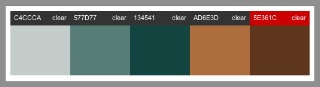
cr-spa-color-palette

I have [been] commissioned [to complete] a painting of an Englemann Spruce and the palette they want me to use for their spa label is close to a teal color (see color palette). I usually work with glazes and I was wondering if you have had experience in getting this color without mixing.  If not then what would be a mix you would use?

The blue seems closer to a light wash of colbalt blue deep?  I am getting a close match using a light wash of French ultramarine blue and then a glaze of Oxide of Chromium, then later a darker mix of the two.


Sandra Wall Armitage

I would be inclined to use a viridian with the addition of Paynes grey as a starting point. You could try laying down the Oxide of Chrome first as it is not transparent.


Susan Dalton

I’m not sure how accurate the colour reproduction is that I have printed of your colour palette, but having experimented a bit, I would suggest that you perhaps could use Oxide of Chromium mixed with Winsor & Newton ‘Winsor Blue (Green Shade) ‘ and / or Winsor & Newton ‘Cerulean Blue’.


Brigitte Daniel

Have you considered sourcing a pigment from a specialist supplier?  Take a sample of the colour you require to a good art shop.  My computer screen is not up to reproducing the colour which would permit a comment that would be of any use to you.


Susan Hillier

Don’t know exactly what you mean by ‘teal’.


Jennifer Jenkins

I cannot help with the first part of this question as the colours showing on my computer are not clear enough.


Kay Rees Davies

I chose Transparent Turquoise (Daler-Rowney 157), Olive Green (Winsor & Newton 447) and Indigo (W&N 322) as my mix for the teal colour on the colour palette. I tried layering them as you suggested but found it far quicker to mix them, and also more accurate.

For the paler teal I used Transparent Turquoise (as above), Indigo (as above) and Naples Yellow (Daler-Rowney 634) in a very dilute mix. In all these mixes you must experiment with the amount of each colour.


Margaret Stevens

I am afraid I am a very instinctive painter choosing my mixes and glazes by eye with scarcely a thought for what I am using.  This is why I had the cooperation of Kay Rees-Davies when writing the analysis of paints section of The Botanical Palette as she looks at her colours with a much more analytical eye.  For myself I prefer to try various glazes and mixes until I hit the right one and after more years than I care to think about this works best for me.  Perhaps Kay or Paul Fennell will  be good for answering this part of the question.

___________________________________________________________________________________
Continue to Commercial Reproduction (Watercolor)

Return to Blocking

Read Full Post »

Since I have not had any experience with having my work reproduced commercially, are there colors I should [avoid]? Do you work a piece differently if you know it is being reproduced? What are some of your techniques so that the final image is more defined and clear.

Thanks so much.  I live rurally in Texas where there is not a group of botanical artists to commune and learn from, so this opportunity is exciting.


Sandra Wall Armitage

I have never had a problem having work reproduced, although I find that Alizarin Crimson and Raw Umber are not good for flat washes. If I am working to a brief to exact scale, I find it easier to do all my drawing and corrections on tracing paper and then transfer the drawing onto the right support. This avoids any rubbings out or raising the grain of the paper.


Susan Christopher-Coulson

So far I have not had to work a piece differently for reproduction – for me, the colour and image in the original artwork needs to look “right”. However, the way you work will depend on what your brief or purpose for the work is. Inevitably with reproduction, there will usually need to be some adjustments made at the proofing stage so that the printing process can match the colours you have used but is impossible to second guess what these will be since printing processes and equipment vary. It is therefore important that the artist can cast a critical eye at the proofing stage if possible and indicate any adjustment to colour that they feel necessary. As the artist, you need to be happy with the final result and that it is as true a representation of the original as possible. This can take time and may involve a degree of compromise, which may depend on the end use of the reproduction – for example if it is, say, for a scientific journal or perhaps for product packaging? (Which I think may be the case here and may have specific colour requirements – possibly associated with branding for example).


Susan Dalton

I do not have much experience with having my work reproduced commercially, but I would suggest that you avoid using black. I have also heard that yellow does not reproduce well, but my painting in The Art of Botanical Painting of the Paeonia lutea (Yellow Tree Peony) is a good reproduction of the original colours. As I have never produced a painting that I know is going to be reproduced, I am unable to comment on whether I would work differently – my paintings that have been reproduced have all been fine, but perhaps I’ve just been lucky!


Susan Hillier

Work for reproduction should have extra “graphic bite”, you need to learn about methods of reproduction and any alterations in size.


Jennifer Jenkins

Regarding commercial work, I know of no colours you should actually avoid, however, it is best to be aware that green shades are not always printed exactly as painted. For reproduction work I ensure that the entire image is very clearly defined, especially the edges and serrations of leaves. They need to be really crisp and the paper should be spotless with no sign of any pencil or eraser marks etc. All must be pristine as the printing process is unforgiving.


Kay Rees Davies

I find that the glowing pink/red of Quinacridone Red (W&N) (perfect for red camellias) is darker when reproduced. I always try to have very clearly defined edges whether for reproduction or not. I examine them closely through a magnifying glass and correct any slight errors using a no. 2 brush with a perfect point, and using the same colour – don’t make it look as if it is outlined.


Margaret Stevens

I have never found it necessary to avoid any colours when working professionally. Colour reproduction is so much better than it was years ago when the tricky colours were greens and yellows. Greens almost always turn out disappointing when reproduced by mass commercial means although specialist printers can do a very good job. When printed for a printers commercial magazine my Lily step-by-step main picture in The Botanical Palette was so accurate it was unbelievable and far better than the Harper Collins repro in the book, where the greens are atrocious. Yellows have greatly improved – there was a time when they always had a brownish tinge but nowadays some good clear colours are achieved.

Apart from ensuring that a white flower has a definite edge when it is to be reproduced I make no allowances for reproduction. I have known my original returned from the printer with a pencil line drawn in to define the edge if it was not clear enough for their taste. I am talking about The Medici Society who were the leading card/print/calendar company for many years in the UK and highly respected.

___________________________________________________________________________________

Continue to Colors in Palette or Pencil Case

Return to Matching Nature’s Colors

Read Full Post »

Do any of you work with botanists and illustrate for journals and herbariums? If so, in which publications has your work been published?


Kathleen Baker

I am a trained botanist, holding M.Phil and Ph. D. degrees. I haven’t had illustrations published in any scientific journal.


Brigitte Daniel

Difficult to answer as I work as a painting botanist!  My work has often been bought by scientific collections, such as the Lindley Library and the Museum of Wales.  They usually ask for permission to publish in their in-house journals.  I have also sold work to botanists and botanical artists as reference works.


Susan Hillier

I used to work as a scientific illustrator for the Royal Botanic Gardens Kew and there I worked with world class botanists, as the work featured many dissections under amazing microscopes. It was published in scientific papers and specialist journals, such as Flora of Tropical East Africa (ISBN  90 6191 321 8 )


Jennifer Jenkins

No.


Margaret Stevens

 I worked on the 4-volume Royal Horticultural Society Dictionary of Gardening producing black and white drawings to scale of all the paphaeopediliums which theyn also used miun one of their orchid publications.  There is very little of this kind of work for botanical artists unless you are amongst the lucky few living near one of the botanical gardens.  Even then money is short and photography is cheaper so however much your work may be desired a University for example will be looking for a donation rather than a paid commission.  That is how it is in the UK at  any rate! And with your Carnegie Mellon University too!

___________________________________________________________________________________

Continue to Colors in Palette or Pencil Case

Return to Commercial Reproduction of Artwork (Watercolor)

Read Full Post »

How many colors are in your watercolor palette? Your colored pencil case?


Sandra Wall Armitage

More than I need for botanical as I often use different colours for other than botanical work. Also, I won [a] prize which included the whole range of watercolours.


Kathleen Baker

More than 40.


Susan Christopher-Coulson

I have the full set of 120 Derwent Artists’ pencils, which I mostly use (inevitably some colours more than others!) but I also have other favourite colours/pencil types which I can use when needed.


Susan Dalton

I probably have 50+ colours in my watercolour palette, although quite a large number of these are used only on rare occasions.


Brigitte Daniel

Lots!  But I tend to choose a set of colours for a particular painting.  Much depends on the harmonics within the plant and I try to match this – think of the overtones in a church bell – I look at colours in the same way.  For any particular plant, I usually choose a small number of colours that I mix in and mix out of using a large number of tints applied to the basic palette, ‘bending’ the colours to catch the colours of the plant.


Susan Hillier

Approximately 50.


Jennifer Jenkins

I work mainly with tubes of colour and have more than 50.


Kay Rees Davies

As I have specialized in using and mixing colours in different makes of watercolour paint, I have at least 200. I make very careful notes when mixing colour at the start of a new painting for future reference. In the case of finding the ‘teal’ colour I was able to refer to the notes I made when painting Puya alpestris about ten years ago. I am “addicted” to buying and trying new colours, but there are a few I hardly ever use. Warning – don’t get carried away!


Margaret Stevens

I have a complete set of Sennelier watercolours – around 80.  I also have a mix of Winsor & Newton Artists, Rowney and Schmincke.  About another 70 to 80. Some are hardly ever used and some are in constant use. However since setting up the Distance Learning Diploma Course, I get scarcely any time to paint.  It used to be about 40 paintings a year, mainly commissions and working non-stop.  I still work non-stop, but if I manage 10 pictures I am lucky which is frustrating at times.

___________________________________________________________________________________

Continue to Encouraging Budding Botanical Artists

Return to Working With Botanists

Read Full Post »

What do you say to budding artists when they ask you how they should develop their skills as a botanical artist?


Sandra Wall Armitage

That the eye and good accurate observation is essential and plenty of practice.


Kathleen Baker

You need to be observant, read up on the detailed botanical structure of plants generally and the species you are about to paint in particular. Dissection of the flower will reveal its structure. Practise drawing whenever you can and also try out the techniques mentioned in the many flower painting books.


Susan Christopher-Coulson

Probably the most useful skills to develop initially are accurate observation and drawing.


Susan Dalton

When asked by budding artists how they should develop their skills as a botanical artist, I advise them to look at works by other botanical artists, to look very closely at whatever specimen it is they are painting, to paint what they see and not what they think they see, to constantly try to make their next painting better than the last and lastly, never to be completely satisfied with any painting they produce.


Brigitte Daniel

Learn how to look.  This is the most important skill.  Do not try to adopt the style of another – develop your own style that matches your relationship with the plant.  You have to love what you paint.


Susan Hillier

Practice.


Jennifer Jenkins

I advise them (depending on their level of ability) to either enter an appropriate botanical art class, or join the SBA Distance Learning course.


Kay Rees Davies

I advise “budding artists” to work slowly and carefully after a detailed scrutiny of the specimen. Learn to look at the structure of the plant – how many stamens, the position of the veins, and so on. Work on the leaves as much as the flowers – they are just as important and frequently neglected. Make notes of the colours you use, making a chart so that the paint can be matched if you run out. Mix enough paint using a large, old brush. Many beginners use a small brush, mix a minute amount of paint and spend a lot of time mixing more.


Margaret Stevens

There is only one way to develop as a botanical artist and that is to pracise, practise, and practise.  The three peas – practise, perseverance, and precision! Keep that up for a few years and if you have some natural talent your work will eventually hit the spot.

___________________________________________________________________________________

Continue to Grounds in Various Media

Return to Colors in Palette or Pencil Case

Read Full Post »

What are your preferred grounds for working in graphite? Colored pencil? Watercolor? Gouache? Pen-and-ink?


Sandra Wall Armitage

Watercolour: I use either Fabriano Artistico 140 lbs which I stretch or the heaviest weight Fabriano Satinata


Kathleen Baker

I prefer to work with watercolour because I am able to produce the minute details, seen with a hand lens, in my paintings. The other media don’t allow me to do this.


Susan Christopher-Coulson

My preferred work surface for coloured pencil is a Bristol board with as white a surface as I can get. I like the smooth surface and clarity.


Susan Dalton

My preferred ground for working in is: Watercolour blocks of 140lbs Fabriano Artistico 300gsm hot pressed paper. I do not work in any other mediums.


Brigitte Daniel

I don’t understand this question.  If [you] mean what support I use, then I work on watercolour paper and vellum using a technique similar to chiaroscuro.  I build up the painting in layers, i.e. I use the paper as the light and work from light to dark.


Susan Hillier

For coloured pencil and w.c., Fabriano h.p., rag paper


Jennifer Jenkins

I always use the materials mentioned in question one, which are of high quality for watercolour, gouache, graphite etc.


Kay Rees Davies

For graphite, watercolour, pen and ink and coloured pencils I use hot-pressed paper, 300gsm (140 lbs). For gouache I have used dark-coloured mount board which works well. Have a look at Sally Keir’s exquisite work in The Art of Botanical Painting (Margaret Stevens).


Margaret Stevens

For graphite and watercolour I use Hot pressed 350gsm paper, preferably Fabriano Classico 5 which is hard to come by, Sennelier in the same weight and surface, or Arches. The latter is because I started an ongoing commission for old roses in the style of Redouté some 15 years ago and I cannot change papers now as they are all hung together, over 50 of them. I occasionally work on vellum in watercolour. I like mount board for gouache or Bockingford tinted paper when it is for reproduction.

___________________________________________________________________________________

Continue to Commercial Application of Botanical Art

Return to Encouraging Budding Botanical Artists

Read Full Post »

« Newer Posts - Older Posts »