Feeds:
Posts
Comments

Archive for the ‘Special Articles & Interviews’ Category

© Pamela Burgess. All rights reserved

Radiant Light: Shadow Sculpture of California Native Plants

October 1 – December 31, 2010

Rancho Santa Ana Botanic Garden
1500 North College Avenue
Claremont, CA 91711

This exhibition features 12 translucent sculptures and gossamer textiles by Pamela Burgess, the artist behind thought-provoking shadow drawings of California native plants. Pamela combines her interest in life cycles with textures and color to create sculptures and textile designs that bring attention to the natural world. Pamela will lead a guided tour of her exhibition on Saturday October 2, 1010 at 3:00 PM during the opening reception.

NEW! Visit the RSABG website to learn how this sculptural exhibition was created.

Read Full Post »

Wet and washy watercolor techniques can cause a lot of grief for some, but for artist Michele Banks, it sparked a passion with watercolor and an interest in the biology of life. Banks doesn’t paint plants, humans, and other animals. She paints what happens inside plants, humans, and other animals. On Friday September 24, 2010, TheScientist.com published an interview with Banks. Learn more about Michele Banks and her website at TheScientist.com.

Here is a glimpse of what you’ll find…

Read Full Post »

Readers submitted great questions for this month’s Ask The Artist with Diane Cardaci. A warm thank you to both readers and Diane. Diane has given generously of her time and expertise of graphite techniques and how to learn from the Old Masters. Be sure to read through the questions below to find out how you can download a special PDF document Diane created about studying the work of the Old Masters.


1. Your work is just wonderful. I love drawing and working with pencils (both colored and graphite) as well. I was excited to see the Ornithogalum on the cover of Flowers & Botanicals. I happened upon this same plant earlier this year and did a graphite drawing of nearly the same view myself! I notice that my rendering is not quite as smooth/delicate as yours, but see in Flowers & Botanicals that you used some graphite powder washes to lay down tone initially. This may sound silly, but my question is this – do you use graphite powder from a particular pencil, for example, a 2B or something softer? Or doesn’t it matter once it’s powdered? I would love to try it in my future drawings.

Thank you so much for your kind words, and sharing your beautiful drawing. I think that there is a great point here to make regarding both our drawings. Today, there is so much emphasis on “being different”, that we sometimes forget that the essence of creativity is our individual response to a particular subject/topic and that the subject does not need to be dramatically different from what others choose to draw/paint. We both chose the same subject and practically the same view, yet our drawings are clearly different and are a reflection of our individual styles.

Your question regarding the graphite powder is a great one. You will definitely find that using powder from different pencils will give different effects. I like to use powder from soft pencils, like a 6B. But I always want to encourage people to experiment with different pencils, techniques etc. and find out for themselves what “feels” right. I recommend making small swatches, using different grades of graphite, and also using different papers. It is also great to experiment with different ways of applying or smearing the graphite. Experiment with a brush, facial tissue, stumps, and anything else that you might think of. You can also purchase a jar of graphite powder if you really enjoy the technique.


2. This is a fascinating interview. Would (Diane) be willing to suggest several particular Old Master drawings that would be good to copy – where to begin?

I just love that you are thinking about Old Master drawings—fantastic! I think the most important thing to do when choosing a drawing is to find one that you really like. There are two reasons for this: 1) you will enjoy copying it more and will therefore learn more from it, and 2) you may find yourself wanting to incorporate what you learn into your own artwork.

If you haven’t spent time looking at Old Master drawings, I think the best place to start is on the Internet. You can Google artists such as Rubens, Michelangelo, Leonardo da Vinci, Degas, Seurat etc. and just spend some time looking at the images. When you find one that you are particularly drawn to, see if you can find a high-resolution image of it, or better yet, one that is in print. For example, if you find yourself really loving the Degas drawings, maybe you can go to the library and take out a book on him that has great reproductions.

If you want more detailed suggestions, I have put together a PDF (inspired by this question!). You can go to my blog www.dianecardaciblog.com and sign up, and you will receive a link for the download.


3. What are common mistakes made by people who are learning how to draw plants?

I think that whether you are learning to draw plants, animals or any other subject, the most difficult part is to learn to look at the whole instead of all the many wonderful details. For example, if you are drawing a face, you first want to look at the shape of the face, and ask yourself—is it round, long, etc., rather than looking at the individual features. The same goes for drawing a plant. If you are drawing a rose, you first want to look at the BIG SHAPE of the rose, and not the many details of the petals.

Another common difficulty is in establishing the correct angles. For example, when you are drawing the stem, you need to be careful that the angle is correct—that is, it is not leaning too much one way or another. Also, when you draw the stem, you want to be sure the stem is directed to the center of the flower.


4. To what extent should I develop a graphite drawing when my true goal is to create a watercolor painting?

For most artists, throughout the centuries, drawing has been considered a means of study, rather than a medium to be used for the final completed artwork. It is a relatively more recent development that artists have decided to use graphite pencil to create fully developed pieces of artwork. Since you prefer to work with watercolor, it would probably be good for you to follow the tradition of using your pencil for the purposes of studying your subject with pencil sketches. The advantage of the pencil is that it eliminates the color issue, so you can really study your subject, thinking only about the drawing (line, angles, proportions) and value. Watercolor is not very “forgiving”, so when you begin to paint, you want to understand your subject as much as possible, and your pencil sketches will give you that knowledge.

In terms of the actual execution of your watercolor painting, you may or may not want to include graphite. Some watercolor artists like to combine a more developed pencil drawing with their watercolors, but I would say that the majority of artists use the pencil just to get an accurate outline drawing down.


5. Is there a pill for patience?

I LOVE this question!! We live in such a high-speed world, and the pencil is such a SLOW medium! But then again, maybe the pencil is the perfect antidote to our 21st century craziness! It forces us to just slow down, you just cannot rush a pencil drawing or disaster will strike.

I think that one thing that can help us develop patience is to once again turn to the Old Masters. They created such beautiful magnificent art—but it was produced in a time when there was no such thing as broadband, cell phones and microwaves. Life went at a much slower pace. Try to imagine an employer today (and a very demanding one at that!) asking his employee to stay on his back for 4 years to paint a ceiling. And yet, Michelangelo did just that and painted the Sistine Chapel, probably the most admired artwork in Western Art. When you look at all the amazing masterpieces that have been painted in the last 500 years, you will be reminded that no great art can be produced without patience.

One thing I think that helps also to develop patience is to get yourself nice and relaxed BEFORE you start to draw. Meditate, go for a walk or run, listen to some soothing music—do whatever it is that helps you unwind from the 21st century speed. And keep your drawing space as quiet and peaceful as possible—for many years most of my artwork was done late at night because of the “peaceful” factor.


6. How do I blend in graphite from light to dark?

In one word—slowly! The key to delicate transitions is to use very light pressure at first and build up with many layers. One exercise you can do is to practice making “swatches”—first put down a strip of a very light even layer of tone by using parallel pencil strokes. Then add another layer of strokes, starting to the right of where you started at first. Keep building up layers, always starting the new layer a little to the right of where you started the last layer.

I like to use an HB for the first layers, and then as I go to the darker layers I switch to a 2B and then if I need to go very dark I will use a 4B or 6B pencil in the last layers.

It takes a lot of practice to develop smooth transitions, so it’s important to not let yourself get frustrated. After a while, you develop a “feel” for how much pressure you need to apply, and how to make the transition more gradual. The good news with the pencil is that it is very forgiving—if you get too dark, you can always use a kneaded eraser to pick up some of the graphite.


7. Which pencils are good for creating a smooth finished look?

I find that the most important factor for creating a smooth finish is the paper choice rather than the pencil choice. For my drawings, I usually only use 4 pencils—an HB, 2B, 4B and 6B. These pencils will create totally different effects on different paper surfaces. If you are striving for a smooth finish, it is best to use a smooth, plate finish paper—I like to use plate finish Bristol paper (acid free and preferably 100% Rag). These papers have very little texture, so that the pencil strokes go down smoothly. It is much harder to create a smooth look with a cold pressed (also called vellum) or rough finish paper. These papers have texture, so when you stroke the paper with your pencil, it picks up the graphite unevenly.


8. Do you use workable fixative on those pictures where you use powdered graphite or carbon pencils? Or would that ruin the contrast between regular graphite and carbon pencils and make them both with a less shiny finish? Also, if you put the carbon down, then workable fixative, would it be possible to use graphite pencils on top? Thank you.

I only use workable fixative when I am absolutely sure that I am finished with the drawing, and only if I know the drawing is going to be shipped or moved around a lot. I prefer not to spray fixative on my pencil drawings when possible, because it definitely changes the texture slightly. But if the drawing is at risk of being smeared through shipping, then I feel it is better to spray it.

I don’t use carbon pencil in the majority of my drawings—I show the technique in my books, because I know there are artists who would like to use the technique, and it is very effective for getting very deep darks. In the drawings that I have used carbon pencil, I have used the same procedure as for my 100% graphite drawings, which is that I spray only at the end of the drawing, and only if the drawing is going to be shipped or subject to a lot of movement.

I never draw on top of workable fixative-it totally changes the surface texture. But as always, I recommend that you experiment so you can see for yourself the effects.


9. What advice do you have about drawing leaf margins? Should I get the overall shape of a leaf drawn first and add the margins later? Or should I try to get them in early?

Leaf margins are a detail of the leaf. The rule in drawing is to always start with the BIG SHAPES, as I mentioned in Question 3, before you work on details. So you want to get the overall shape of the leaf, and once you are sure the shape is correct, you can than go in and draw the details, such as leaf margins. The key is to draw very lightly in the early stages of a drawing. If you draw light lines, your later shading will cover over the initial lines, and you won’t need to do a lot of erasing. Some artists find it difficult to draw lightly—in that case, the artist can use a very light/hard pencil, such as a 2H.


10. I have read a great deal about using graphite and many drawing techniques. However, I would like to know about carbon dust or carbon powder and how it is used. Susannah Blaxill uses carbon dust but she does not have a book out and her classes are in Australia. Her work in carbon dust is gorgeous. Do you know any artists who use carbon dust or powder and what their techniques are?

I was first exposed to carbon dust techniques in my days as a scientific illustrator. I believe this technique was really perfected by the early medical/scientific illustrators. By doing a search on Google, I found a nice description of the basic techniques that they used. In addition to using brushes, which is described in the above link, you can also experiment with using stumps, tortillions, chamois cloth, facial tissue etc.

I have found that I prefer to use my pencil with delicate stroking for most of my drawings, rather than using graphite or carbon dust. But I will sometimes incorporate the use of graphite powder techniques in my drawings, which I show in my books. I tend to use the powder mainly when I want to get a quick base tone (sort of like a wash) on a drawing. However, when I do subjects such as portraits, I do not do this.

This is why I always encourage experimentation. Although I absolutely love the look of the carbon dust drawings, I found through experimentation that I actually prefer to work in a different way. Over the years, I have always made it a habit to try new papers, new pencils, as well as new techniques. The great thing about the pencil medium is that all this experimentation does not cost a lot of money!


You May Also Like:


ArtPlantae Disclosure Statement

Read Full Post »
Jane Pinheiro’s Watercolors:
A Collection Lost and Re-Found

Now through September 30, 2010
Thursday to Saturday
8:30am to 4:30pm
Directions


By John Wickham, President
The Theodore Payne Foundation

In the early ‘90s, the Foundation had to make some tough choices to keep the nursery open. One of the toughest was the decision to sell most of our collection of 100 botanical watercolors by Jane Pinheiro.

The collection came to us in 1960, shortly after the Foundation was formed, thanks to a donation arranged by Tasker and Beula Edmiston of the Nature Conservancy and Bonnie Templeton from the Natural History Museum of Los Angeles County. “The Poppy Lady,” as Pinheiro was called, was well known for her watercolors depicting the flora of the Antelope Valley. She was a self-taught artist and botanist who took great pride in the accuracy of her illustrations, and her work was collected widely.

Born Jane Seymour, Pinheiro was raised in Salt Lake City and lived in Pasadena for years, helping her mother run a boarding house. One of the guests was Joseph Pinheiro, a native of the Azores. He and Jane married in 1930. In 1940 they moved to the Antelope Valley, where Jane became enamored with the desert flora. She was deeply involved in the civic affairs of the Antelope Valley region and instrumental in establishing the California Poppy Reserve. Though she did not survive to see the opening of the visitor center at the Reserve, 163 of her paintings are displayed there each spring.

Upon her passing in 1982, Pinheiro’s family donated dozens of additional paintings to the Foundation, providing a rich body of work for our art program. The original 100 paintings and several of the later acquisitions were large paintings depicting species in a natural landscape setting. Most of her later works were smaller unfinished studies and drawings.

A decade later, financial woes at the Foundation forced us to sell about 70 of the initial 100 paintings. It was a difficult decision, and one not taken lightly.
The Foundation is in a much better place today, and we’ve been able to recover several of these paintings from generous individuals. In 2005, seven Pinheiro works from our original collection were offered at auction, and we placed the winning bid!

Enter our newest heroine, Helen Moore, who had purchased 34 of our Pinheiro paintings during our very lean times. Sadly, Helen passed away in 2009. In May of this year, her family chose to return those paintings to the Foundation. And so it was that this group of remarkable botanical illustrations made its way back to Sun Valley. Most are still in their original frames with the original, though slightly faded labels, on their glass.

This season the Theodore Payne Art Gallery once again is proud to share with you the unique watercolors of Jane Pinheiro—thanks to Helen Moore, whose purchase helped us through a trying period and whose donation now helps rebuild our wonderful art collection. The exhibit runs through September 30, 2010.

We are also proud to have a dedicated corps of volunteers, the Theodore Payne Arts Council, who are working to develop new exhibits that celebrate our extraordinary native flora. Your support for the Foundation and the Arts Council helps us bring you new and inspiring exhibits each quarter. Times have changed at the Foundation, and we are thriving like never before.

And remember! There are still many Pinheiro paintings waiting to make their way back to the Foundation. Please keep your eyes peeled!


For more information, contact info@theodorepayne.org or call (818) 768-1802. Visit the Theodore Payne Foundation online at www.theodorepayne.org.

Read Full Post »

© Robin Brickman. All rights reserved

When Robin Brickman graduated from Bennington College with a degree in graphic arts and botany, she began her career as a freelance illustrator of magazines, trade books and textbooks, medical illustrations, and even postage stamps. When she had children of her own, she turned her attention to children’s picture books and how they were illustrated. Little did she know that she was about to establish herself as an award-winning children’s book illustrator and respected paper artist.


What prompted you to start tinkering with paper? Is there a paper artist who inspired you?

I had been a professional illustrator for 15 years doing pen and ink illustrations and adding watercolor and pastels to my portfolio. I have always liked experimenting with different techniques, and became intrigued by cut paper artwork. Some cut paper artists do work for advertising, either white-on-white or in color, but as 2-Dimensional or flat collage. I studied these styles and thought about what I wanted to do in order to depict nature accurately. I wanted to blend the scientific accuracy I’m known for with color, cut, and sculpted paper. When I discovered I could cut and shape paper art, in the early 1990′s, it was a “Eureka” moment. Initially, I made polymer clay molds of holly leaves and used those molds to shape paper. The leaves were stylized and not accurate enough, so I decided to skip the molding step and just cut the leaves out of paper directly. Paper is a wonderful medium. Depending on how you cut it, expressive and beautiful results can occur. It was transformative for me to begin working this way and allowed me to tap into my drawing skills immediately and comfortably. Although some paper artists use X-ACTO® blades, I use ordinary household and embroidery scissors. My cutting method feels quite graceful and I can do it for long stretches of time. Cutting and painting the individual elements of a painting is more forgiving than conventional flat, or two-dimensional art. Sometimes people think I’ve given myself more work, but I think it’s easier. I never worry that I have to start over with an entire painting if I spill coffee on a chipmunk! Plus, it is easier to change my mind and to reposition the pieces of a painting. This is very liberating. I wanted to set myself apart and the discovery that I could create wonderful sculpted watercolor images marked the beginning of my career as a children’s book illustrator. Some people assume the wood and leaves in my books are real or found objects, but I made them out of painted paper. This work does not happen quickly, primarily because of the scientific research and accuracy needed in my work, not because it is cut paper. I should mention, however, there is an added expense in book production costs for photographing 3-dimensional art. The maximum depth of my paintings is about 3 inches, and this makes them easier to photograph and frame.

Swallows In the Birdhouse was the first book I illustrated in cut paper. The production issues with that book were difficult for the publisher because programs such as Photoshop were brand new at that time. With the next book, A Log’s Life, I learned a lot about how to create the art so that it would be photographed and reproduced to its best advantage. Now there are a number of artists who do cut paper or dimensional art for books, but I believe that I am the only person to work with as much realism and who is creating from paint on paper, only, in my paintings.


How do you and an author work together? Do authors tell you what they have in mind for each page or do you design the art after reading their story?

Children’s picture books are created in different ways. Sometimes, an author and an artist present a collaborative package to a publisher. Other times, an author wants to use his own art or photos. In that case, publishers might tell an author that another artist’s work would be better for the book. For most books the author submits a story to a publisher and the publisher finds an artist for that book. I have been paired with authors by the different publishers I’ve worked with. A publisher might give an author input into the art stage of a book, but that is rare. Book illustrators usually don’t meet the authors of their books. In fact, publishers often keep authors and illustrators apart. My job as an illustrator is to take the author’s manuscript and to create the best possible art for the book. I met Wendy Pfeffer after A Log’s Life won the John Burrough’s Award. An editor at Simon & Schuster paired me with her manuscript. Charlesbridge matched me with Sneed Collard, and I have illustrated three of his picture books: Beaks!, One Night In the Coral Sea, and Wings. I met him after finishing the art for One Night In the Coral Sea. I had help from Stephen Swinburne (author of Swallows In the Birdhouse) for his book. Both Sneed and Stephen provided reference material that helped me create illustrations for their books. Collaborating from the beginning with an author can be very fruitful, though, and I hope to do that with a new author, later this year.


Do you sketch your scenes in pencil first? Do you paint an entire scene before constructing your 3-dimensional scenes?

I sketch out a painting with pencils and tracing paper, after completing the research that I need for accuracy and inspiration. I plan according to a book’s set format, working with galleys or the text after it has been typeset. Sometimes the page breaks are predetermined by the book’s format, as in Beaks! and Wings. Other times, it is my job to pace the text and the art of a book. (Note: A galley is an unedited manuscript)

I start by painting the featured animals and plants, or those that are in the front of a scene. Other times I might start by painting the background of a painting. It has taken me cumulative experience to realize what I want to portray in a scene and how to place things in a painting. The different levels might all be in focus, or some parts might be out of focus as the scene goes back in space. In other words, elements in the front are clear and defined but background elements may be more stylized or fuzzy. This is because a detailed background may not help a painting. Creating these transitions has become easier for me than at the beginning of this technique, but there is still a lot of back and forth. As you can see in the book Wings, the milkweed painting is an example of combining flat two-dimensional art with features of cut paper. Plus, after months of working dimensionally, it was nice to do some elements on the flat surface of the paper!

For stand-alone paintings or commissions, I talk to the client about what they have in mind. For example, one client wanted to commission a painting that related to her husband’s interest in fly fishing. After several conversations it became clear that the Colorado landscape surrounding the client’s second home was important to them, so I included that into the design of the painting.


Which elements of a scene are usually added as a painted background? In other words, are there elements that are always painted?

When I started to develop this type of art, I tried to create everything in cut paper. However I realized I preferred more painterly backgrounds and that it saved me time to make the background a wash of color. As I am cutting out different elements, though, I keep every scrap of paper that is made. I have used these bits of paper, often as small additions, to make a painting more interesting. Keeping all of these scraps both saves me time and adds to the complexity of my work. It is like using herbs and spices when I am making soup!


What other materials do you use in addition to paper?

I use clear or frosted mylar for insect wings. I also use paint mixed with glue (e.g., for eyes) and occasionally I use hair. Hair was used for spider webs and animal whiskers in A Log’s Life. In the book Wings, the dragonfly and the membranous wings of the lady bird beetle were created by inscribing lines into clear film. I then rubbed paint into the indentations. The veins on the termite wings were created by gently cutting into the surface of frosted mylar.


How do you create nature’s details out of paper?

To create an element like an insect, I deconstruct it into simple forms, such as legs, body parts, and wings. Then I reassemble the parts I’ve made. This deconstruction and re-construction step is often hard for younger students to understand, but it is second nature to me. When I create flowers, I cut a flower’s overall shape, like an oval or a sphere. Then I cut the individual petals, keeping them connected at the center of the oval. I will sometimes indent petals or leaves with my fingernail. The paint is darker inside those impressions. The center of some flowers are created by placing bits of paper pulp and painted glue onto a small disk. This disk is then added on top of the petals. By adding painted features I build up what I want to create. Feathers are made by cutting paper edges with scissors, like fringe. The feathers of a bird’s wings are layers of paper that are glued like shingles on a roof. The face of the King Vulture in Wings, was made using more than just cut and painted paper. The wattle is paint and pulp that was placed onto the piece of orange paper serving as the beak. The texture and hairs of the face were created in pen and ink, and the fringe on the top of the vulture’s head is composed of slender pieces of black paper that were glued to the top of the vulture’s head. The logs and dirt in A Log’s Life are other examples of detail. Soil scenes are created with paper pulp, bits of cut paper, paint, and glue. I push down on the pulp to make an uneven surface. I also use paint and additional scraps of paper to create a textured appearance. When people ask me what I do, I tell them I’m a painter. It is my combination of these materials that creates my paintings. If I get backed into a corner, artistically, I will experiment with my art supplies to figure out a solution. I discovered I could use glue to create a water drop on a log, and that hair makes a good spider web or chipmunk whiskers. Even so, the bat wings, in Wings, were difficult to create. The bats in flight required wings that are more transparent and membranous than the bats that are hanging upside down.


Are the raised forms (like tree trunks and branches) paper maché?

No, there isn’t any paper maché. The curves of tree trunks and branches are painted paper, reinforced on the backside with glue and additional paper. Sometimes I use craft wire to support slender branches or twigs. I also make paper pillars to prop things up, but mostly I can use paper pulp and glue to support elements from behind. I have studied bookmaking and paper making, so I already had a lot of book art skills to draw upon.


How did you begin the program you teach at schools? What do you teach?

I started to teach my workshops when my own sons were in elementary school. I was asked to talk about being a book illustrator because it’s an unusual profession. I realized that I liked the experience and I discovered that I had something unique to share — I could bring an art and science component to kids. I also wanted to have a message, namely the science of what I illustrate. As a parent, I knew that young children would get bored by a long presentation. So I created a workshop format where I show photos and movies of what I do as an artist, and then say, “Now it’s your turn!”

Over the past ten years, I developed several workshops based on my book illustrations. The most popular and successful workshop is the creation of a forest or ocean habitat mural. Even the youngest students practice my cut, color, and sculpted paper techniques with these programs. Sometimes the workshops supplement the curriculum at a school but my books are always the starting point. Other workshops are take-home projects, but the community murals stay at the hosting school and they include everyone’s art work in one scene. I like going to schools to demonstrate what I do and to show all ages they can do the same thing on their own using common materials such a paper, glue, paint, and scissors. The larger workshops for younger students use inexpensive paper, crayons, and scissors. I teach watercolor painting and more sophisticated techniques in smaller groups teenagers or adults, and when there is a longer time period available. I present workshops across the country and love doing it.


What do you do with the original illustrations you create for books? Do you exhibit the originals regularly?

I try to. It has been almost 20 years since I began working in my sculpted watercolor technique. A lot of the art from my books has been shown at galleries and in museums. Many of the paintings are in public and private collections, but I own a number of paintings for future showing options and to pass on to my family. I have been honored with three solo shows, one was at the Bennington Museum and two were at the Berkshire Museum. I think it is important for me to show the original paintings because they make quite an impression over the photographed images in the books. I have had several galleries representing me over the years. Currently, I have work in two shows and the rest of the paintings are at home. In addition to art for books, I do commission work for private individuals. Those paintings have been very gratifying to create and I welcome the opportunities to do them. A private commission is a luxury purchase for people, so I am grateful to the collectors of my work.


About Robin Brickman

Robin graduated from Bennington College with a B.A. in graphic arts and botany. She has been a freelance artist since 1976 and a workshop leader in schools since 1999. She has illustrated twenty books, including the following award-winning titles: Wings, One Night In The Coral Sea, A Log’s Life, BEAKS!, and Starfish. Robin has had her work shown in several exhibitions at museums and galleries such as the New York State Museum, the Norma Rockwell Museum, the Berkshire Museum, the Hunt Institute for Botanical Documentation, and the Smithsonian Institution. Robin is a member of the Guild of Natural Science Illustrators, the Western Massachusetts Illustrators Guild and the Society of Children’s Book Writers and Illustrators. In addition to creating detailed paper sculptures, Robin works in pen and ink, graphite, colored pencil, watercolor, airbrush, and pastel dust.


Take a Look!


  • See Robin’s painting, “Gambian Epauletted Fruit Bat” in the Image Gallery of the Focus On Nature XI website. New York State Museum (April 29 – October 31, 2010)
  • View Robin’s painting in the Vernal Pools mixed media exhibition at the Atrium Art Gallery at Lewiston-Auburn College in Maine (April 23 – June 30, 2010)
  • Books illustrated by Robin Brickman


A Log’s Life
is available at your independent bookstore.

A Log's Life

Read Full Post »

Jackie Andrade of the School of Psychology at the University of Plymouth in the UK, wanted to know if doodling improves or hinders one’s attention to a primary task. To find out, she created a study in which 40 participants were asked to listen to a rambling telephone message about a planned birthday party. Participants were divided into two groups – a control group and a doodling group. The doodling group was placed into a “doodling condition” (Andrade, 2009) where they were given a pencil to shade squares and circles on a sheet of paper while listening to the phone message. The control group did not receive materials for doodling. All participants were asked to recall information about who would be attending the birthday party.

Andrade’s results indicate that doodlers recalled 29% more information than the participants in the control group. This study is the first test of the idea that doodling aids concentration. Andrade proposes that doodling may be enough of a stimulus to prevent boredom and reduce the likelihood of daydreaming.

To research these findings further, Andrade says additional research is necessary to understand boredom, daydreaming, and the activities that alleviate these conditions.


QUESTION TO YOU:
Do you doodle? If so, when do you doodle? (on the phone, in class, in front of the TV, etc.)


Literature Cited

Andrade, Jackie. 2009. What does doodling do? Applied Cognitive Psychology 24: 100-106. Published online 27 February 2009 in Wiley InterScience at Wiley.com. Purchase Article ($35)

Read Full Post »


This article was published originally in the November 2004 issue The Southern California Botanical Artist
which was the newsletter of the Botanical Artists Guild of Southern California. It has been updated and is reprinted below with permission.

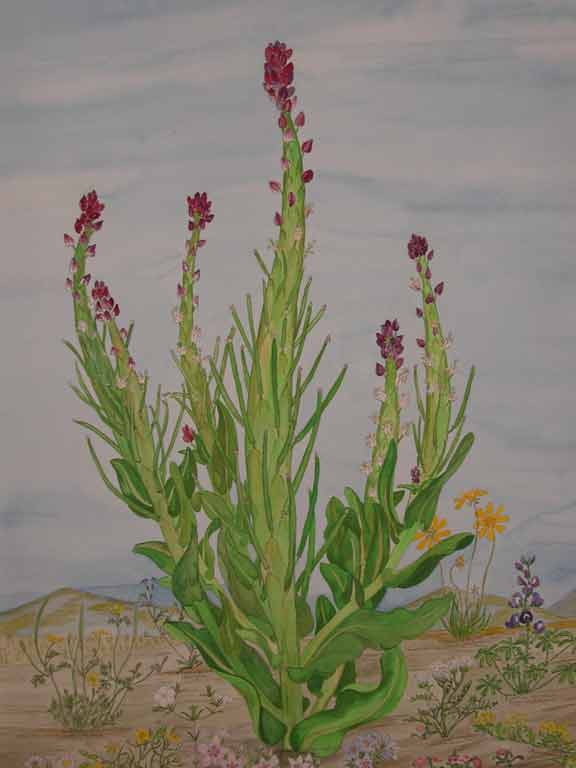
East Coast Artist Taken with California’s Desert Wildflowers
Henry R. Mockel paints the desert landscape

By Tania Marien

Impressed with what she saw during a visit to California to attend a nursing conference, Beverly Mockel returned to Cooperstown, New York to talk her husband, artist Henry R. Mockel, into moving to the Golden State. When she succeeded at this task, they moved to the town of Calico in the Mojave Desert in 1958. While residents of Calico, the Mockel’s often took trips to Joshua Tree National Park to see the wildflowers. They made frequent stops so Henry could paint flowers along the way. Eventually they decided they should move closer to the flowers, so they moved themselves and their 47-foot house trailer to Twentynine Palms in 1961. After settling into their new home, Henry and Beverly opened the Pioneer Art Gallery in what is now the Historic Plaza. One can only imagine that this new exciting desert lifestyle was quite a change for Henry, a former bookbinder, farmer and cattle rancher.

Henry Mockel was not an artist when he immigrated to the United States from Germany in 1923. His interest in art did not begin until after he moved to New York where he first studied engineering at City College. He then studied art at Grand Central School of Art and continued his art studies for 15 years. His specialty was etching and woodblock printing. Unfortunately, a studio fire destroyed his work and his equipment. Only a few of his etchings survived. After the fire, Henry began creating serigraphs. His original serigraphs are available for purchase at Henry R. Mockel’s – the business that distributes Mockel’s note cards and prints.

What are serigraphs? Serigraphs are screen prints. The fine art version of screen prints, that is, not the T-shirt type of prints. A drawing is made into a stencil and ink is forced through the stencil onto paper. Each color in a serigraph is its own print. Some of Mockel’s plant portraits are the result of 45 separate printings!

Taken with the desert and its flora and fauna, Mockel spent many days studying plants and drawing them in the field. He studied botany and took copious notes on his desert adventures with Beverly. The culmination of 14 years’ worth of observations resulted in a book they co-wrote in 1971 titled, Mockel’s Desert Wildflower Notebook. This book contains illustrations, photographs and descriptions of 133 desert plants. Mockel’s renderings of these plants were done as watercolors, scratchboard, or serigraphs. The Mockels wanted to create a reference that could be understood by anyone with an interest in plants, so they deliberately avoided the use of technical language in their plant descriptions. While no longer in print, this book can be viewed at the following locations: Theodore Payne Foundation, Blaksley Library at the Santa Barbara Botanic Garden, UC Davis’ Shields Library, the California Academy of Sciences, UCLA’s Biomed Library, UC Riverside’s Science Library, and the Riverside County Library System. Check your local library to see if this book is available near you.

Very little is printed about Henry Mockel as a person or an artist. According to Rosemary Brockway, owner of Henry R. Mockel’s and friend of the late Beverly Mockel, Beverly kept Henry protected so that he could focus on his artwork. As a result, the residents of Twentynine Palms knew very little about him. Fortunately, Henry did share some of himself and his interests in the books he wrote with his wife and in the articles he wrote for Desert Magazine. Henry wrote five articles for the magazine from 1961–1965. In these articles, he shares with readers that the first desert flower he ever painted grew in Mule Canyon in the Calico Mountains. He also gives readers a glimpse of how hazardous botanizing can be at times:

The Hole-in-the-Sand (Nicolletia occidentalis) we discovered while proceeding on tip-toe on a short-cut from Pioneer Town to Big Bear. The road was recommended to us as being scenic. We had to build only one bridge, while the rest of the time, as occasion demanded, a short hasty prayer sufficed (Mockel, 1963).

In the Desert articles, Mockel does not describe in detail how he sketched desert flowers. He did, however, mention that he drew his plant portraits only from living plant specimens and he never broke the stems of any plant he drew (Mockel, 1965). He also mentioned he spent many hours in the field sketching next to his subjects. Mockel printed limited editions of 100 of each piece he created. He then destroyed the stencils upon the completion of each printed series.

The Borrego Desert Nature Center has an exhibit of Mockel’s work. Originally scheduled to end in June 2004, this exhibit is on-going (although not always available for viewing). Approximately 20 serigraphs are featured in the exhibit and they are for sale as prints at $100 each (members of the nature center receive a 15% discount). An additional 30 serigraphs are in storage, so if you are looking for something in particular, be sure to ask for help. The Borrego Desert Nature Center is located in Borrego Springs in the Imperial Valley west of the Salton Sea. It is run by the Anza-Borrego Desert Natural History Association.

Mockel’s work is included in the Botanical Art Collection at the Hunt Institute for Botanical Documentation at Carnegie Mellon University in Pittsburgh, PA. The Hunt has 47 pieces of Henry’s artwork in the following media: serigraph (paper), serigraph (illustration board), scratchboard, pencil on tracing paper, watercolor (paper), watercolor (illustration board). Henry had three pieces of artwork accepted into the 2nd Annual International Exhibition of Botanical Art & Illustration at the Hunt in 1968.

Mockel’s artwork has also been seen in local publications. Two of Henry’s plant portraits were featured on the cover of Lasca Leaves in Autumn 1963 and Summer 1964. Lasca Leaves is a periodical that used to be published by the, then, California Arboretum Foundation of the Los Angeles County Arboretum and Botanic Garden. The Arboretum gift shop also sold a special collection of note cards featuring twelve plants and shrubs that Mockel painted at the Arboretum.

Henry R. Mockel died on May 3, 1981 in Joshua Tree, CA. His wife Beverly continued to sell Henry’s work at their gallery. Two years before she died, Beverly sold the business and it is now operated under the name Henry R. Mockel’s. Beverly passed away in March 1990.

To learn more about Henry R. Mockel first-hand through his own words, see the following resources:

  • Mockel, Henry R. 1961. An Eastern artist discovers the Mojave. Desert Magazine. 25: 22-23 (June)
  • Mockel, Henry R. 1961. Our Eastern artist settles on the Mojave. Desert Magazine. 25: 14 (September)
  • Mockel, Henry R. 1963. An Eastern artist finds the desert’s real treasure. Desert Magazine. 27: 19-21 (February)
  • Mockel, Henry R. 1964. The story of the date. Desert Magazine. 28: 47 (March)
  • Mockel, Henry R. 1965. Artist reveals desert’s real treasure. Desert Magazine. 29: 27-29, 36 (March)
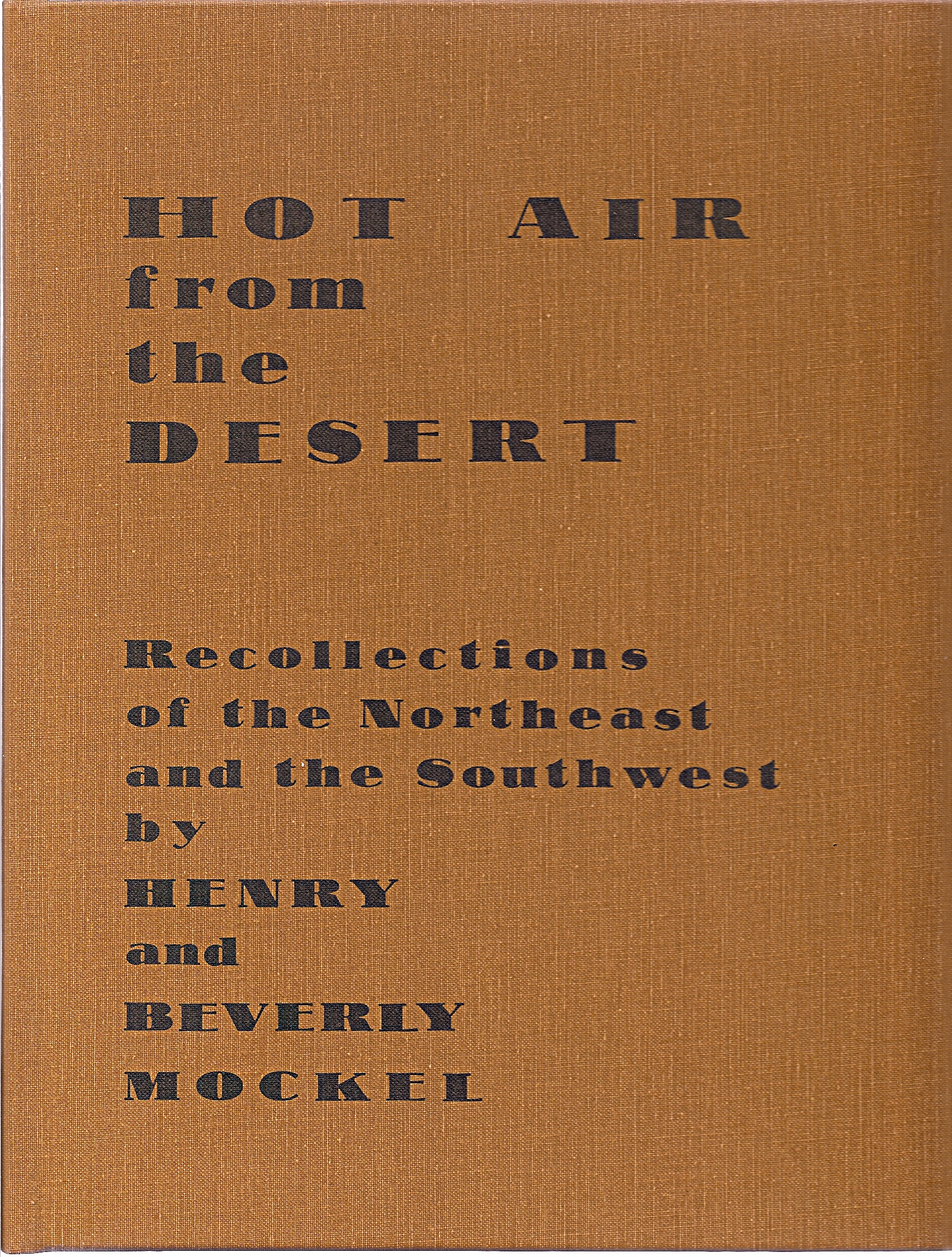
  • Mockel, Henry R. and Beverly Mockel. 1968. Hot Air from the Desert – Recollections of the Northeast and the Southwest. Self-published. Twentynine Palms, CA.
  • Mockel, Henry R. and Beverly Mockel. 1971. Mockel’s Desert Flower Notebook. Self-published. Twentynine Palms, CA.

*Note cards can be ordered from Henry R. Mockel’s in Twentynine Palms, CA. Request an order form by writing to: Henry R. Mockel’s, P.O. Box 726, Twentynine Palms, CA 92277 or call (760) 361-4832.


Related


UPDATE (March 2014)
:
Journalist Ann Japenga learns more about Henry Mockel. She writes about her discoveries in Henry Mockel: The Philosopher of Flowers at California Desert Art.

Read Full Post »

« Newer Posts - Older Posts »