Feeds:
Posts
Comments

Archive for the ‘Special Articles & Interviews’ Category

Margaret Best, EE Week Contributor

Different colours are generally associated with different emotional reactions in human beings. Not only that, the same colour may evoke different reactions in different people. As a result, a single colour can be associated with different and diverse emotions, some positive and some negative.

Blue is generally regarded as a colour of peace and tranquility, a calming colour. But it is also said that the impact of the colour can change as the shade of blue changes. For instance, electric or brilliant blues express exhilaration by becoming dynamic and dramatic. It has also been said that some shades of blue or the overuse of blue may come across as cold or uncaring.

The colour blue occurs in abundance in nature, two of the most obvious examples being the sky and the ocean. It is perhaps not surprising then, that it is apparently the most popular of colours with about equal appeal to both genders.

Blue has an interesting historical association with art, particularly as a result of the origin of the pigments used to produce blue paint. The most commonly referenced association of the colour blue with art, is in the religious symbolism of the colour in religious paintings of the medieval era.

Mary, the mother of Christ, a central theme in the many religious paintings of that period, was mostly depicted in blue. It is believed that it was because she was deemed worthy of the most expensive blue pigment available at the time, ultramarine. Ultramarine was acquired by means of the laborious grinding and processing of Lapis Lazuli, a relatively rare semi-precious stone mined in Afghanistan.

Some artists of the era could neither afford nor obtain this sought-after colour. They substituted with azurite, a more readily available, mineral-based pigment (copper carbonate) that was mined in vast quantities near Lyon in France. Unfortunately, blue paint made from azurite (commonly called azure) darkened over time to a dark grey or even an almost black appearance, depending on the environmental conditions to which the art was exposed. The result was a far cry from the striking brilliance and permanence of the more red-shade blue of Lapis Lazuli.

It is interesting to note that while it is sometimes assumed that the “marine” component of the name “ultramarine” has oceanic links, particularly with the Mediterranean, that is not the case. Its origin actually lies with the medieval Italian artists who referred to the highly-prized “Oltromarino” (“from beyond the seas”) as a pigment that had to be brought from a distant Afghanistan that was “over the sea.”

Today, artists have a wide range of blue pigments available to them. Fortunately, a less expensive source of the colour Ultramarine (PB29) has been manufactured synthetically for decades and, for the most part, has replaced the Lapis Lazuli source. The colour is vibrant, transparent and, equally important, it is permanent. It will not fade or change with age or as a result of exposure to ultra violet light.

The only downside is that for watercolourists, it can be a little annoying because it can easily separate if blended with other pigments and therefore requires constant stirring. But it is a vital component in mixing the deeper blues seen in the enormous waves of high-tide seas or in the brooding sky and water in the calm before the storm.

For seascape artists in particular, another vibrant pigment now readily available and which is perhaps closer to the more stereotyped colour of the ocean, is Phthalocyanine Blue (PB15:3). The jaw-breaking name is often shortened to Phthalo or Thalo Blue. This is a powerful green-shade blue that is rapidly gaining in popularity and showing up more frequently in the palettes of contemporary artists.

There are also a number of other blue pigments that have served artists well through the centuries. A quick visit to an art supply store will reveal a host of tempting names of blue options such as Cobalt, Cerulean, Indigo, Prussian, Turqouise and more. The choice of blue best suited to the artist’s individual needs and preferences often depends on the medium, for example, watercolour, gouache, acrylic, or oils. The key is to conduct tests and to follow the manufacturer’s advice on safety of use and its tendency to change over time.

Whether it is the blue of the sky, the blue of the ocean or any other blue subject, there are many choices available to artists who wish to capture it.


Learn More About Color

Margaret Best Discusses Color in Botanical Art

Read Full Post »

Today we are very fortunate to learn from sound recordist and engineer, Dan Dugan. Dan is a member of the Nature Sounds Society and serves on their Board of Directors. The Nature Sounds Society is based in northern California. Dan and other Society members travel to natural areas to record nature’s sounds.

Please welcome Dan Dugan!


ARTPLANTAE: Tell us about the Nature Sounds Society. How did it begin?

DAN DUGAN: The Nature Sounds Society (NSS) was founded in 1983 by Paul Matzner, then curator for the California Library of Natural Sounds at the Oakland Museum of California, and Marie Mans, retired from her first scientific career and actively pioneering nature sound recording to augment her photography and to assist natural scientists (such as Dr. Luis Baptista at San Francisco State University) to obtain data for their research. From their organizing work and interest in the conservation of natural quiet, they reached out to others to create an organization which would become a nexus for similarly interested professionals and amateurs in the scientific, educational, arts, and environmental arenas. The organizing committee that evolved decided that the principal purpose of NSS is to encourage the preservation, appreciation and creative use of natural sounds. The organization has been active and viable for almost 30 years and has members from all corners of the globe.


AP: How did you become involved with the Society?

DD: Paul Matzner brought the museum’s Nagra tape recorder to me for service 23 years ago. He invited me to join the Nature Sounds Society at their annual workshop at Yuba Pass in the Sierras. Technology and nature together? Sounded like a great idea. I’ve volunteered as a technical advisor ever since and more recently, as a Board member.


AP: How are recordings of nature’s sounds usually put to use?

DD: There are pure soundscape recordings that are appreciated by lovers of nature’s music in the raw. Species recordings that are used to help with species identification for scientists and birders. Smooth mixes used for relaxation by therapists and individuals. Many musicians like to mix nature sounds into their compositions. Radio producers, podcasters, and YouTubers use natural sounds to enhance their stories. National Public Radio (NPR) often features natural sounds in radio reports. The national parks need volunteer recordists to inventory and monitor their soundscapes. Visual artists — sculptors, painters, multimedia artists — use sound more and more in their installed works. Museums and teachers want nature sounds for their exhibits and demonstrations. Nature films depend on recordists to capture the sounds that go with their fabulous visuals.


AP: The theme for EE Week is Ocean Connections. When I think about the word “ocean,” I see and hear waves along a rocky coastline. I also hear seagulls and imagine a cool, damp, salty breeze. This scene is the default imagery in my head when it comes to any type of coastal scene. Drawing upon your experience as a sound recordist, what am I missing? What am I not hearing?

DD: OK, add a shreaking killdeer to your mix. How about a sea-lion barking in the distance? The hiss the sand and pebbles make as the edge of a wave recedes. The sounds of buoys or foghorns when the fog closes in. The changing rhythm of the waves as the tides turn over a 12-hour period. This very subject was the focus of a recent installation by Golden Gate National Recreation Area resident artist, Aaron Ximm.


AP: When you meet someone who is new to the discipline of sound recording or the practice of “listening,” how do you encourage them to open their ears?

DD: The most transformative experience for someone new to sound recording is to put on the headphones to a live recorder hooked up to a microphone array to experience what one of our members and educator, Arlyn Christopherson, calls “bionic ears.” Just as a field guide of birds magnifies each individual bird, the act of listening with bionic ears magnifies the soundscape elements. You suddenly become aware of things you’ve heard before, but never really listened to: birds, wind, water, and the intrusiveness of man-made noise. Putting on bionic ears is a bit like the aural equivalent of the moment the “Wizard of Oz” goes from black and white to color in film — a whole new world opens up.

Learning to listen to nature sounds requires a specific skill that takes some practice but is not hard to do. In our lecture-demonstration, we start by asking people to close their eyes and make an inventory of everything that they can hear in the (hopefully) quiet room. Then I play a brief rain forest recording several times over, each time pointing out a different element of the complex biophony, and how they fit together like the instruments of an orchestra. From there, we demonstrate the differences between mono, stereo and surround sound and begin a very general discussion about equipment and how to obtain the results that you are interested in hearing.


AP: One day in the eastern Sierra, I came upon an area possessing the purest and loudest silence I have ever experienced. It was different than simply a quiet spot along a trail. It was a startling experience. Paul Matzner, the founder of the Nature Sounds Society, writes about the value of quietude – “a state or situation where natural sounds can be heard uninterrupted” by the “technological sounds of humans.” He also writes that quiet places “are some of our most endangered habitats.” How does the Nature Sounds Society advocate for quietude?

DD: Paul’s description of the value of quietude — or natural quiet, the current terminology for quietude — is at the heart of the conservation efforts of NSS. Right now is a critical time for preserving natural soundscapes in our national parks. Federal regulations promulgated in 1999 defined soundscapes as a resource which requires preservation and management on an equal footing with other park resources. The parks are currently drafting soundscape management plans and putting them out for public comment. Recently, Zion National Park rushed through a plan that we objected to as compromising wilderness values too much in favor of the air travel industry. There is a draft environmental impact report open for comment right now regarding air tours in the Grand Canyon. If there can be no-fly zones over military reservations, why not have no-fly zones over national parks?

Members of NSS provide commentary individually and under the NSS umbrella regarding these plans and other topics related to natural quiet. They have also provided volunteer assistance to gather and present observational data for baseline studies and have provided opinion pieces. NSS provides a forum through its listening parties, lectures, technical discussions, workshops, listserve and partner with the Bay Area Sound Ecology (BaseBOT) group, the local chapter of the World Forum of Acoustic Ecology (WAFE), for discussions of these topics to take place.

Independent work includes a compelling short documentary “Hush” directed and produced by Stanford film school graduate, Mike Seely, featuring Paul Matzner narrating the importance of quiet places. A more recent documentary, “Soundtracker” (2010) by Nick Sherman, follows Gordon Hempton’s efforts to find quiet places to record. Bernie Krause, in his book Wild Soundscapes (which is also an excellent beginner’s guide to sound recording) describes the depredations to the natural soundscape over the arc of his career as an acoustic ecologist.


AP: You mentioned in an earlier conversation, you make regular trips to the Muir Woods. Your recordings indicate that old-growth forests are very quiet places. I don’t know how long you have been recording in the same location, but it seems to me that what you do not hear in your recordings speaks volumes. Your recordings provide valuable presence and absence data. Have old growth forests changed since you began recording data? If so, how?

DD: I haven’t been recording long enough to notice a major difference (about 5 years in this environment). Ask Bernie Krause, he’s been documenting soundscapes for forty years. Both Bernie and Gordon Hempton have noticed the increasing intrusion of man-made sound on even the most pristine landscapes and they have recorded all over the world as their life’s work.


AP: You are currently documenting the sequoia groves at Yosemite National Park. How do you go into the field to collect sound data? Do you have a structured approach and take samples for a specific amount of time? Or is your approach more relaxed? Briefly describe what a day in the field looks like.

DD: I do have a routine. I hike in to the location carrying between 30 to 50 pounds of equipment depending on the difficulty of the terrain. To avoid problems with bears, I carry only water. Not even a snack bar. I mount mics on my pack wired to a recorder on my belt, so if I hear something interesting on the trail I can catch it. I take pictures too. Everything is date- and time-stamped, and I slate my recordings extensively, describing the date, time, type of equipment being used, weather conditions, terrain, etc.

If it’s a new location, I go early so I can explore and find a good spot. I set up a four-channel surround array and a “cowboy camp” (no tent). I’ll record anytime something interesting happens, but I always start 90 minutes before nautical twilight and record the evening sounds till then.

Through the night I keep my recorder on standby. It has a ten-second prerecord buffer, so if I hear an owl, coyotes, or a tree falling, I hit record and I’ve already got it.

I set a timer to start recording at nautical twilight, in case I’m asleep. I’ll record the dawn chorus for 90 minutes. If there’s action and I don’t want to be somewhere else, I’ll continue beyond that. Then it’s pack up, hump the gear out and go for breakfast.

The most amount of time is spent in post-production back in the studio, which is never quite as much fun as collecting the recordings. I’ve developed, and stick to, a rigorous protocol documenting (in the field and in the studio) and transferring the recordings. I provide “raw” recordings to the National Park Service (NPS), but I put a lot of time in reviewing the recordings to mark events and will consult with experts on birds and animals to accurately identify what is recorded. I write a report following the NPS format which accompanies my submission along with the other written documentation.


AP: The Nature Sounds Society hosts listening parties. What happens at a listening party? Who attends these gatherings?

DD: Our members and friends. People bring their favorite recordings from the year to share. People out-of-town wire contributions, too. The mix is always lively — the rain forests and lemurs of Madagascar, ice breaking up, spiders dropping from a ceiling, thunderstorms, coyotes — and there’s always a great personal story to go with the sound. Oh, and the food’s pretty good, too.


AP: What recommendations do you have for teachers who may be interested in recording nature sounds for use in their classrooms?

DD: The NPS recently published a revised updated activity card for classroom use that was originally authored by educators and NSS members, Arlyn Christopherson and Mele Wheaton. They can get this card by contacting the NPS or the NSS.

Upcoming events for NSS include our Saturday May 14 Tech Talk and our annual Workshop at San Francisco State University’s Field Station at Yuba Pass, June 24-26. More information is on our website at http://www.naturesounds.org.

Anyone can subscribe to the Yahoo! group for questions and information.

Teachers can also subscribe to the Naturerecordists Yahoo! group and ask for advice there. This group is heavily technical and much of the discussion is about gear, but its members are always willing to help a newbie.


AP: Thank you, Dan, for making us better listeners.

DD: You’re welcome.


EE Week readers, do not miss…

Read Full Post »

Welcome to EE Week 2011!

National Environmental Education Week (EE Week) is organized by the National Environmental Education Foundation to connect K-12 teachers and their students to environmental resources informing the public about environmental issues affecting all of us. ArtPlantae is proud to once again serve as a national partner for EE Week.

This year’s theme inspires us to discover our oceans and to become more aware of the many ways we are connected to them, even though we may live miles and miles away. This year, like last year, I have had the opportunity to work with enthusiastic individuals committed to helping ArtPlantae show connections between plants, art, and the theme for EE Week. Please join me in welcoming each contributor as they are introduced.

We will discuss several interesting topics this week and learn a lot.

Let’s begin!

Read Full Post »

Carol Creech of CCreech Studio is a part-time artist who works in pen & ink, colored pencil, and graphite. She is a member of the American Society of Botanical Artists and the Guild of Natural Science Illustrators. She is also a business woman and has generously offered to discuss her use of Zazzle.com, a service that enables designers to create one-of-a-kind products featuring their designs and artwork.

Please welcome Carol Creech!


ARTPLANTAE: Thank you for participating in a conversation about the business of art with ArtPlantae readers. How do you balance time spent on business-related activities with time spent drawing and painting?

CAROL CREECH: Hello and thanks for having me! To answer your question, it can be challenging to balance drawing time with business activities, especially when I am currently just working part-time. The To-Do list is long on both sides! But as much as I enjoy doing the artwork, it’s equally exciting to get things uploaded and “out there” on Zazzle. I have spent a good bit of time over the last few months getting my storefront up and running. Not only is my work available to the world at large, but I can order small quantities of my own products (note cards, or other items) to use as promotional donations locally, as well as personal gifts to family and friends. It’s a great tool.


AP: On your website, you show examples of the wonderful house portraits you have completed for homeowners. Do you create illustrations for commercial home builders as well? How long have you been illustrating homes?

CC: I have not ventured into illustrations for commercial home builders. The house portraits can be time consuming to do as I tend to be very detailed in my style. It’s what people love about them, and what I love to focus on when I draw them, but doing that on a regular basis would be more involved than I have time for at the moment.


AP: When creating your animal portraits, do you visit with the star subject for a while to get a sense of his/her personality (e.g., see camel)? How do you know when you’ve captured “personality” in a drawing?

CC: Interestingly, I usually create the animal portraits only from photographs. If I have a chance to take the photos myself (e.g., the camel) then I can tell when I have captured the right view of the animal for a good portrait. The key to any good animal portrait is usually the eyes. If you can render the eyes, which I always do first, and capture the essence of the animal there the rest of the portrait will fall into place.


AP: How did you learn about Zazzle.com? When did you open the CCreech Studio Store on Zazzle?

CC: I opened my store back in 2009, but just recently started working on building it up since last October. I had heard of Zazzle on one of the art lists I follow. I am embarrassed that I can’t remember which one! I did some additional research online, and it seemed like a good option. I had wanted to find a way to get good quality note cards of my work printed in small quantities, and I have to say that Zazzle’s cards are fantastic in their quality. I love how my artwork looks on them!


AP: You feature 23 product categories in your store. How many product categories are possible through Zazzle? How did you decide upon the product categories you have chosen?

CC: There are currently 45 product categories listed, but within each category there are often multiple options. For example, within the tote bag category you can choose from six different styles, and within each style, a variety of different colors. Plus, Zazzle is always coming up with more product categories, most recently adding keychains, necklaces and coasters. I decided on my product categories by choosing ones that I thought would look good with my drawings, many of which are botanical subjects. So, obvious products like cards, buttons, and stickers work well, but also items like aprons, mousepads, and letterhead. Bottom line is that you never know what might appeal to someone, so give it try and see how it looks!


AP: How many pieces of artwork have you used on Zazzle products?

CC: I think about 25. I also have done some simple enhancements by adding digital borders and backgrounds to a few pieces and that has been a great way to expand my offerings.


AP: What types of artwork works best on Zazzle products? Are there specific media or colors that reproduce better than others?

CC: So far, all of the media I have used seems to reproduce really well! I am a big fan of pen and ink and have been very pleased with how my ink and colored pencil combination drawings have reproduced. Although I have to say that the drawings using colored pencil alone look just as great! I think as long as you upload digital images that are of an appropriate resolution and make sure that they look good on the products you are designing, then you will be very happy with the results. One area that I am careful with is the T-shirt category as they have so many different color combinations available for customers. Some of my artwork only looks right on lighter colored shirts. Fortunately, Zazzle allows me to choose that as a limit, so I can assure that potential customers only see my work at it’s best.


AP: What types of plant images sell better — images more in line with traditional plant portraits or stylized botanical images?

CC: I know that Zazzle has many designers offering floral work, whether traditional photos, drawings or paintings, as well as stylized graphic designs of botanicals. I’m really not sure which sells better. I tend to prefer the traditional style and my work reflects that, so I am hoping that with some additional marketing I can draw in (no pun intended) people who appreciate the simple beauty of a single, well-drawn flower or plant. We shall see!


AP: Have you tried making prints or posters of your work? If so, how did your prints &/or posters turn out?

CC: I have not yet ventured into prints or posters. That is one of the things on my To-Do list! Zazzle does offer great quality prints and posters, so I’d like to explore that further.


AP: Is Zazzle easy to use? Briefly describe the designing process.

CC: Zazzle is very easy to use, in my experience. To start, you choose Create from the navigation bar at the top of the Zazzle page and follow the buttons and prompts to upload the image you want to use. There is a design view that lets you adjust the size of the image by reducing or enlarging it, dragging it around the product template until it fits properly. You can then choose to add text, customize font style and size, and even add background colors and borders, depending on the product. Then you can choose to order your product yourself, or post it for sale in the marketplace. When you post for sale, you select up to two subject categories, and add a title, descriptions and keywords so that potential customers can find your item. It’s surprisingly straightforward and easy to do.


AP: Does Zazzle allow sellers to keep selected items as on-site inventory so they can have products for sale at their studio for events such as studio tours?

CC: Absolutely! This is one of the things I love about Zazzle. You can order your own products, with a seller discount and possibly quantity discount depending on how much you order, and keep them in your studio or have them to sell at an art show, etc. I have ordered sets of my own note cards for blog giveaways as well as a couple of local fundraising events that I donated to recently. It’s a wonderful way to get high-quality products of your own work without having to invest in large print runs.

Thank you, Carol, for telling us about Zazzle and about your experiences with the service.


Would you like to ask Carol a question?
Please post your question below.

Click on the image to see Carol’s complete line of greeting cards.

Read Full Post »

The year was 1765. Eminent botanist Philibert Commerson had just been appointed to a grand new expedition: the first French circumnavigation of the world. As the ships’ official naturalist, Commerson would seek out resources—medicines, spices, timber, food—that could give the French an edge in the ever-accelerating race for empire.
 
Jeanne Baret, Commerson’s young mistress and collaborator, was desperate not to be left behind. She disguised herself as a teenage boy and signed on as his assistant. The journey made the twenty-six-year-old, known to her shipmates as “Jean” rather than “Jeanne,” the first woman to ever sail around the globe. Yet so little is known about this extraordinary woman, whose accomplishments were considered to be subversive, even impossible for someone of her sex and class.
           
When the ships made landfall and the secret lovers disembarked to explore, Baret carried heavy wooden field presses and bulky optical instruments over beaches and hills, impressing observers on the ships’ decks with her obvious strength and stamina. Less obvious were the strips of linen wound tight around her upper body and the months she had spent perfecting her masculine disguise in the streets and marketplaces of Paris.
           
Expedition commander Louis-Antoine de Bougainville recorded in his journal that curious Tahitian natives exposed Baret as a woman, eighteen months into the voyage. But the true story, it turns out, is more complicated.


Who was herb woman, Jeanne Baret?

Find out during EE Week! You are invited to participate in a conversation with author Glynis Ridley during EE Week (April 10-16, 2011).

Immerse yourself into the life story of Jeanne Baret and get ready to ask questions. Order a copy of The Discovery of Jeanne Baret from ArtPlantae Books and save 20% off the list price for this special event.
Offer ends April 17, 2011.


EVENT DETAILS
:

    When: Saturday April 16, 2011 at 11 am-12 pm (PST) / (2-3 pm EST)
    Where: Discussion Forum on the ArtPlantae Facebook page.

UPDATE (4/21/11): Read interview with Glynis Ridley


Synopsis courtesy of Random House, Inc.

Read Full Post »

The artist does not do what he sees, but what he makes others see.

– Edgar Degas

Today we have the incredible opportunity to learn from Anne-Marie Evans, a popular botanical art instructor and the author of An Approach to Botanical Painting, now out of print. The book, which she wrote along with her husband, is without a doubt the most sought-after instructional book in botanical art of the past ten years. If you are searching for this title, you know I am not exaggerating. This book is extremely difficult to find. On occasion one might find a used copy on websites selling used books. This book is a hot item and used copies begin at $500. A near fine copy can cost $1,500.

I had the good fortune to meet briefly with Anne-Marie during her recent trip to teach in the Los Angeles area.


About Anne-Marie

Anne-Marie attended art school and earned a Distinction in Fine Art, then studied for a Masters in Fashion, also graduating with a Distinction. After some years painting large canvasses, she felt somewhat unfulfilled. A trip to the British Museum, where she saw an exhibition entitled Flowers of East & West, made her change the direction of her art. She was enraptured by the botanical art she encountered.

From this time on, Anne-Marie became interested in botanical painting as an art form in its own right. Although botanical illustration and flower painting had been around for a while, the discipline of botanical painting had not as yet been identified in the same way as fine art had been over the centuries. She became eager to learn herself and to develop this particular form of art. With that purpose in mind, she sought to analyze paintings and the process involved in the creation of botanical paintings (courses in botanical art were not available at this time). Accordingly, she began to visit museums, art libraries, private collections and botanical institutions to study their respective collections of botanical art.

She became increasingly engrossed in the process of teaching this particular form of art, fascinated by the pairing of science and art.

Wishing to make the painting experience easier for her students, she attempted to break down the process and to identify and isolate those skills essential to the process, thus establishing her 5-Step Method which is now widely adopted.

Anne-Marie teaches her 5-Step Method at various locations in the US, Australia, South Africa, Japan, France, Holland, and the UK. She has received an award for excellence in the service of botanical art from the American Society of Botanical Artists. In 2005, she received the Veitch Memorial Medal by HRH Prince Edward for the Royal Horticultural Society in honor of the role she plays in the “resurgence of interest in and greater understanding of the depiction of plants.”


How It All Began

Anne-Marie established the very first botanical art diploma course in the UK and taught this course at the Chelsea Physic Garden in London for 12 years. This program was the first of its kind. Students in the first graduating class created the florilegium of the Chelsea Physic Garden. Their work was published in a book and the florilegium is still an ongoing project. Anne Marie’s students are currently involved in the creation of other florilegia, such as the Hampton Court Florilegium and Prince Charles’ Highgrove Florilegium.


How The Book Came To Be

One day a publisher approached Anne-Marie and commissioned her to write a book about botanical art. She only had three months to write An Approach to Botanical Painting. Anne-Marie met her three-month deadline, however the publisher let the book sit for another 1.5 years. Her instructional manual about botanical art, the first book of its kind, was left to collect dust. During this time, Botanical Illustration in Watercolor by Eleanor Wunderlich was published. Anne Marie took her book back from the publisher, repaid her advance, and set off to have her book published another way.

Anne-Marie’s son-in-law offered to publish the book, but sending it to a designer would have cost thousands of pounds. So he advised Anne-Marie to buy a computer and design it herself. Anne-Marie followed his advice and bought a computer even though she had never seen one or used one. She spent three weeks in her night-dress laying out the book in PageMaker. Anne-Marie was so unfamiliar with how computers worked, that she did not know about the Tab button and what it did. As a result, she spent a lot of time counting out spaces throughout the entire document. When Anne Marie finished laying out her book, she sent her self-designed manuscript to the printer.

This now-classic book in botanical art was never advertised. It sold purely by word-of-mouth. Anne-Marie eventually shipped her book to Australia, Asia, Africa, America, and Europe. When it was released, Anne-Marie’s book was a unique resource because certificate programs in botanical art did not exist at the time. Her book was published before Shirley Sherwood’s collection of contemporary botanical art became well-known and credited as sparking the current renaissance in botanical art.


A Conversation About Drawing, Learning, & Botanical Art


ARTPLANTAE: What makes drawing such an invaluable learning tool?

ANNE-MARIE: Drawing specimens helps to acquire a keen sense of observation which may eventually be transferable to other disciplines and life generally. Botanical observation and drawing does not merely consist of copying what is seen, but explaining what is there. The artist has to exercise his or her judgment on what is to be described, extracting those diagnostic features which characterize the species of the plant pictured. This is the reason drawing still surpasses photography in the field.

I do feel that this particular form of drawing and painting should be included in the school curriculum, involving as it does the combination of brain and manual skill. It is interesting that observational drawing was a mandatory subject in military academies until the first World War.

Furthermore, botanical painting bridges many disciplines such as history, art, the sciences, etc.


AP: I have had conversations with people who think botanical art is nothing more than a hobby. Botanical art’s history of plant documentation, plant exploration, and the rest of it does not seem to matter as much to them as it does to us. Have you ever found yourself in a position to defend the discipline and the work of botanical artists?

AM: Yes I have, often. It is relevant that in The Dictionary of Artists, not one botanical artist is mentioned. I think this has to do with the fact that, historically, most botanical painters have been amateurs who had not learned the academic disciplines of drawing and painting. Consequently, much of the work was charming, decorative and sometimes lacking in depth, or it was solely scientific with little regard for aesthetic qualities.

In my view, I do not think botanical art has surpassed that of the late 18th- and early 19-century masters such as Bauer, Turpin, Redouté, etc. Such artists were aware of the three-dimensional aspect of painting and the resulting use of a wide range of tonal values to express form, thus making their work exquisitely refined, as well as more true.

Botanical art has to describe both scientifically and aesthetically what is observed. This involves skills and brain activity. Serious stuff and surely not merely a hobby!

Today, the emphasis appears to lean mainly towards color and, to a degree, self-expression and novelty rather than veracity, occasionally approaching the gimmick (mainly in composition). In the 1880’s there was a shift from academic disciplines where students had to draw from plaster casts to learn to express the three dimensions convincingly in their paintings. Rendering and translating successfully the illusion of the three dimensions onto a flat surface had to be learned. The botanical art of today shows little regard for this aspect of painting.


AP: What should teachers do first when teaching individuals who are new to botanical art?

AM: It is important to let students know that they can attain a competent standard if they are prepared. It is, after all, a skill which everybody can reach, but it takes time and effort and sometimes a little pain in order to acquire it. It is like ballet or tennis — one has to work at it to obtain excellence.


AP: How many students have you taught?

AM: Thousands. I like to think they are all still painting.


AP: What would you like to see the field of botanical art accomplish? What isn’t the field doing that you think it should be doing?

AM: I think the field is in danger of becoming superficial. Botanical art deserves to be treated as a serious subject. I would like it to retain this aspect.

I would like it to reach more people so they can enjoy it too. However, I would prefer not to sacrifice quality for the sake of popularity. There is a tendency now to paint clichéd images pandering to current trends.

I would also like the judging of botanical art to show some commonly agreed criteria. The process is ofter far too loose leaving too much subjective judgment to individuals who seem to show different priorities in their evaluation process. A system should be established, indeed as it is in academia and athletics, with points for specific areas. People would then know exactly how they are being judged wherever they happen to be. How many times have I heard comments from a judge such as, “it’s a good composition” or “she has good color sense.” These are unqualified statements of subjective opinion rather than specific criticisms.


AP: How long have you been teaching the 5-Step Method?

AM: I have been teaching my method since 1985. It has been refined over the years. I am told by former students that the 5-Step Method provides them with a sound and comforting foundation.


AP: What should a good foundation course in botanical art look like?

AM: A course should contain elements of botany, art, history of botanical art, and an apprenticeship in the skills of depiction.


AP: Thank you so much for your time and for the opportunity to introduce you to ArtPlantae readers. And thank you for allowing me to include the Degas quote with which you begin your courses.


You May Also Enjoy…

Read Full Post »

What is a gymnosperm?

The word gymnosperm literally means “naked seed” (gymno=naked, sperm=seed). Gymnosperms have their seeds exposed unlike flowering plants, the angiosperms, which have their seeds enclosed in an ovary (i.e., fruit). The word angiosperm derives its meaning from angio=vessel, sperm=seed.

Pine trees are the most often cited example of a gymnosperm. But what about the other gymnosperms? How do we know when we see one? Do all gymnosperms have cones?

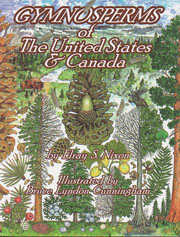
These questions and many others are answered in Gymnosperms of the United States & Canada. This user-friendly reference was written by Dr. Elray S. Nixon and illustrated by Bruce Lyndon Cunningham.

Lavishly illustrated, this guide is a welcome balance of botanical terminology and descriptive illustrations. Dr. Nixon’s jargon-free text is supported by Bruce’s informative illustrations. Dr. Nixon begins his book explaining what gymnosperms are and where they can be found. He then provides clear instruction on how to use identification keys and teaches readers how to begin thinking about cones, leaves, and bark — the three characteristics which are the focus of this book. Dr. Nixon focuses on these characters because they are observable throughout the year.
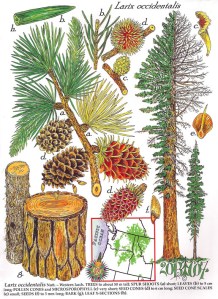
If you have used identification keys before, you are all too familiar with how easy it is to make a wrong turn while working through a dichotomous key. Fortunately in Gymnosperms of the United States & Canada, the likelihood of you going astray has been minimized by Bruce’s illustrations. If you ever doubt your progress working through any of the keys, all you need to do is refer to one of the 115 botanical plates Bruce created. Each plate includes a sketch of a mature plant and illustrations of leaves, cones, arils, seeds, and bark. A range map showing the distribution of each species is also included.

Dr. Nixon and Bruce describe 115 species of gymnosperms growing in coniferous gymnosperm forests, gymnosperm foothill (pinyon-juniper) forests, and gymnosperm (Ephedra) shrubland. The divisions, families and genera featured in this book are:

DIVISION: Cycadophyta
Family: Zamiazeae (Sago Palm Family)
    Genus: Zamia

DIVISION: Ginkophyta
Family: Ginkoaceae (Maidenhair Tree or Ginkgo Family)
    Genus: Ginkgo

DIVISION: Gnetophyta
Family: Ephedraceae (Ephedra Family)
    Genus: Ephedra

DIVISION: Pinophyta
Family: Taxaceae (Yew Family)
    Genus: Taxus
    Genus: Torreya

Family: Pinaceae (Pine Family)
    Genus: Pinus
    Genus: Larix
    Genus: Picea
    Genus: Tsuga
    Genus: Abies
    Genus: Pseudotsuga
Family: Cupressaceae (Redwood or Cypress Family)
    Genus: Taxodium
    Genus: Sequoia
    Genus: Sequoiadendron
    Genus: Juniperus
    Genus: Callistris
    Genus: Cupressus
    Genus: Chamaecyparis
    Genus: Thuja
    Genus: Calocedrus

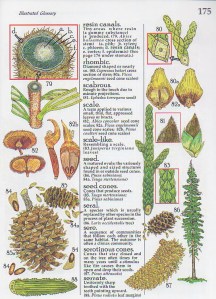
Abundant illustrations, easy-to-follow keys, and clear descriptive text make this guide a great resource to use when learning about the gymnosperms in your area. This guide also serves as a gentle introduction to dichotomous keys. If you have avoided plant keys because of the botanical terminology they contain, you might want to try the keys in this book. Dr. Nixon provides concise definitions to the botanical terms you need to know and Bruce provides an illustration for each term. This all-inclusive resource is sure to be a welcome companion on your next trip to your local forest or national park.


Learn How Bruce Creates Illustrations for Field Guides

Join us for Ask The Artist with Bruce Lyndon Cunningham on Monday December 13, 2010 from 12:00 PM – 1:00 PM (PST). Bruce has illustrated many field guides and during this live online event, he will discuss how he worked with Dr. Nixon to create the illustrations for this new book. This event is FREE. To join in on this conversation, register here. Event Closed


Gymnosperms of the United States & Canada
can be purchased at www.forester-artist.com.

Read Full Post »

« Newer Posts - Older Posts »