Feeds:
Posts
Comments

Archive for the ‘Special Announcements’ Category

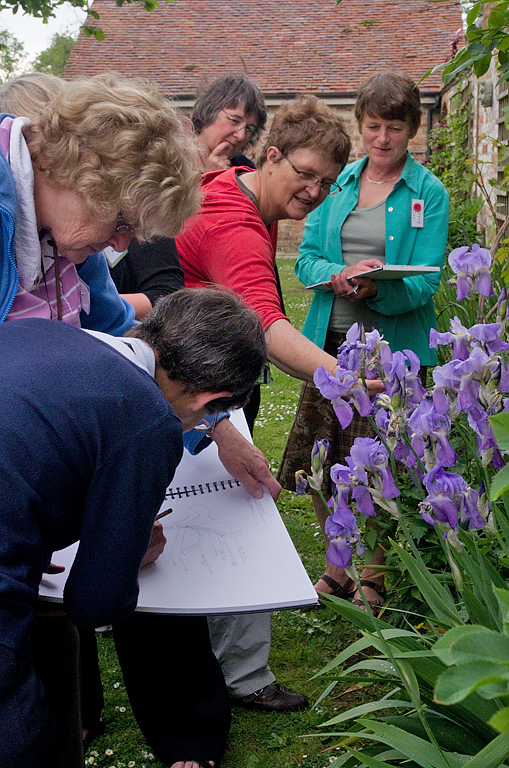
Students in "Botany for Botanical Artists" pilot program. Photo by Anne Bebbington.

The Institute of Analytical Plant Illustration (IAPI) in the UK has been hard at work developing a botany program specifically for botanical artists. This course aims to help those with some experience in botanical illustration to gain a better understanding of plants and to refine botanical illustration techniques. Between September 2010 and July 2011, the pilot for the course Botany for Botanical Artists was taught by Mary Brewin and Anne Bebbington. This ten-week course concentrated on flowering plants. The first five sessions were dedicated to learning about leaves, flowers, fruit, whole plants, vegetative reproduction and winter twigs. The second half of the class was dedicated to investigating plant families. Each class session began with an hour-long critique session that allowed students to see each others’ work, ask questions and discuss any problems they encountered. Between sessions, participants were encouraged to use their art to explore a botanical topic associated with the program. The purpose of these projects was to help students assimilate what they had learned and to assess their understanding.

Last weekend, Mary Brewin and Anne Bebbington reviewed the pilot course with students and other IAPI members at a group meeting. This review of the pilot course was held in conjunction with an exhibition of student work at
Nature in Art in Gloucestershire. Anne Bebbington explains:

A well-attended meeting began with a brief course description, followed by presentations from several of the course members. These interesting talks demonstrated well both the variety of background of the students, their interests and how the course would inform their art work in the future. Michael Hickey was the founder of IAPI and is remembered by many of its members not just for his botanical illustration skills, but for his inspirational teaching about plants. We were therefore delighted to welcome Robin Hickey, Michael’s widow, to the meeting and honoured that she had agreed at the end of this session, to present the students with their certificates of course completion.

Viewing the exhibition. Photo by Anne Bebbington.

The extended lunch break provided an opportunity to talk to both students and tutors and look at the exhibition. This included a display of course materials and some finished pieces of artwork. Of particular interest, however, were the students’ botanical sketchbooks and works in-progress, demonstrating the botanical journeys they had followed and the impressive amount of work they had done. A short practical session in the afternoon on fruit structure and seed dispersal also gave the meeting a flavour of the course.

The meeting concluded with a discussion session considering the delivery of future courses. A number of courses are already running or being planned for 2012 as a result of the pilot course and there was general agreement that there was real demand for such courses. The format of the pilot course was successful, but it was felt that there was room for a variety of formats to suit different needs. These might include one-day workshops, weekend courses, residential courses and distance learning. They should be accessible over as wide a geographical area as possible. Working with other organizations, for example the Field Studies Council and art societies such as the South West Society of Botanical Artists (SWSBA), the IAPI with its membership of botanists as well as artists, and its aim of drawing botanists and artists together, is uniquely placed to help support and deliver such botanical courses .

Students receive certificates from Ronin Hickey. Photo by Anne Bebbington.

Anne continued to explain that feedback from participants was very positive and all participants felt the course will benefit their future work. Participants felt the home-study projects were especially helpful and that they are an important part of the IAPI curriculum.

Learn more about the Institute of Analytical Plant Illustration in upcoming articles.


Acknowledgements

Sincere thanks and appreciation go to Anne Bebbington and Mary Brewin for their significant contributions to this week’s teaching and learning column. Read more about Anne and Mary below.

Related


About Mary Brewin

Mary Brewin, an adult education tutor since 2002, was able to develop her interest in art and plants through pursuing the University of Birmingham Higher Certificate course in Botanical Illustration – completed in 2005. Mary has worked with many adult learners through teaching botanical illustration and organizing various exhibitions of their work. She was secretary to the Institute for Analytical Plant Illustration (IAPI) and now serves on the IAPI education subgroup. Mary is keen to promote a good understanding of plant structure and plant family characteristics among students, artists and illustrators who want to draw and paint them realistically. The pleasure of discovering the finer details of the plant world through running a botany for botanical artists course with Dr. Anne Bebbington, cannot be over-emphasized as adult learners always open up avenues of interesting inquiry!


About Anne Bebbington

Dr. Anne Bebbington, a keen naturalist, trained as a botanist and worked for over 30 years for the Field Studies Council. As well as teaching environmental studies at all levels from young primary pupils to undergraduates, she has tutored many wild flower courses for adults both in Britain and further afield in Europe, Canada and Australia. Her interest and expertise in illustration have always formed an important part of her work. In retirement, as a freelance natural history illustrator, she works mainly in pen and ink. She is also very keen to share her enthusiasm for plants and runs a local botany group as well as running botanical workshops for artists. She is President of the Institute of Analytical Plant Illustration.

Read Full Post »

The coloring book, Colorful Edibles, was the brainstorm idea of botanical artist and organic farm owner, Wendy Hollender. Grounded in a desire to promote the work of the American Society of Botanical Artists (ASBA), a small committee was formed to raise awareness about the ASBA through the development and sale of products created by its members. It took about one year for the first idea, a coloring book, to take shape. Botanical illustrator Bobbi Angell signed on as Co-Project Coordinator and Editor. Graphic artist and book designer, Charlotte Staub Thomas, also joined the project. Together they created a coloring book highlighting the contemporary botanical art of 26 ASBA members.

Editor, Bobbi Angell, says it was easy to get artists involved in this project. The project team made a specific request for pen-and-ink illustrations so that they could include as many ASBA artists as possible. They received 85 submissions from 38 artists. Because they wanted to keep the book inexpensive, only 36 illustrations were selected. The illustrations in Colorful Edibles showcase the strong and diverse line work of ASBA members, and includes work from new artists along side work by more established artists, things Angell said the project team was hoping to accomplish.

Most pages of the coloring book feature a full-page illustration. Informative passages about each fruit and vegetable are included on each page. Angell wrote the passages with young readers in mind. Through her writing, Angell makes reference to the origin and domestication of each fruit and vegetable so that readers learn about the history of their food. She also includes comments from contributing artists.

Colorful Edibles is truly a coloring book for all ages. Garden teachers will find this activity book to be a helpful teaching tool because it not only explains where familiar fruit and vegetables come from, it touches upon the subjects of botany, history, agriculture and nutrition.

The project team hopes to expand the coloring book format to other books about native plants and wildflowers.

Colorful Edibles can be purchased on the ASBA website.

Read Full Post »

Next week at Dijon University in France, an exciting new program will begin.

Scholars from all over the world will contribute to a seminar series about illustrations used in the service of science, specifically the relationship between scientific texts and their illustrations and the role illustrations play in the scientific process.

The seminar series will occur over three academic years (2012-2015). Topic areas include illustrations used in medicine, physics, biology and other disciplines, as well as chronological reviews of history (e.g., illustrations during the Renaissance, the Enlightenment, etc.). Leading discussions during 2011-2012 are scholars from Belgium, France, Greece, the United Kingdom and the United States.

Marie-Odile Bernez is the project coordinator of this seminar series. I had the opportunity to ask her a few question about the three-year program.


    ArtPlantae
    : What made you decide to create this seminar series?

    Marie-Odile Bernez: My training is originally as an English teacher, specializing in the 18th century and the history of ideas. My research lab/centre focuses on the relationship between text and images, and has so far restricted its studies to the arts, the cinema and literature. I thought it would be a good idea to develop interdisciplinary seminars focusing on scientific illustration, in a historical perspective, mainly to strengthen the links between hard sciences and the humanities. Because we are in Burgundy, I was also involved in the organization of a 2007 conference commemorating the tercentenary of Georges Louis Leclerc, Comté Buffon’s (1707-1788) birth and it struck me at the time how important the illustrations for the Histoire naturelle were. Burgundy was the home of Marey also, and I thought we were totally legitimate in our approach, and could build on those two “ancestors”.


    AP
    : How long did it take to launch this series and get presenters scheduled?

    MB: It didn’t take very long. In fact, I posted the first call for papers last January and was astonished at the amount of positive responses I received. I was invited to join a seminar in Spain (Minorca) last May, where I met several historians of science including Klaus Hentschel from Stuttgart, Daniela Bleichmar from California and Nick Hopwood from Cambridge, and many of their students. This gave me more contacts and, from then on, I tried to organize a schedule. The schedule for 2012/13 is almost ready too.


    AP
    : What do you hope to accomplish through this seminar series?

    MB: This is a tricky one. My first aim was to reinforce our links with the hard sciences and show how much the history of ideas depends on the developments occurring in different scientific domains. Then, I would also like to advance our understanding of the relations (between) text/image, and especially see how images illustrating scientific texts differ from other images, because their acknowledged end is to contribute to our understanding of an accompanying text, but I think also that all images, even scientific ones, are connected to a wider context, and add to the text, by expressing other things than what they are supposed to illustrate. Is this different however in the case of scientific images?


    AP
    : You mentioned there is a publication planned that will focus on the presentations presented during this series. Will the publication be in book format? In journal format (i.e., a collection of articles)? Will the publication be available to the public?

    MB: My colleagues have suggested we should publish the collection of articles, preferably in English and in a book format, so that something remains of the seminars. My intention is to collect the papers over the next two years, which should give us quite a range of subjects, but also enough material to present a coherent project to a publisher. As far as I know, the series of seminars should go on after that, if funding remains available, and so perhaps two publications might be available eventually, to cover two two-year periods.

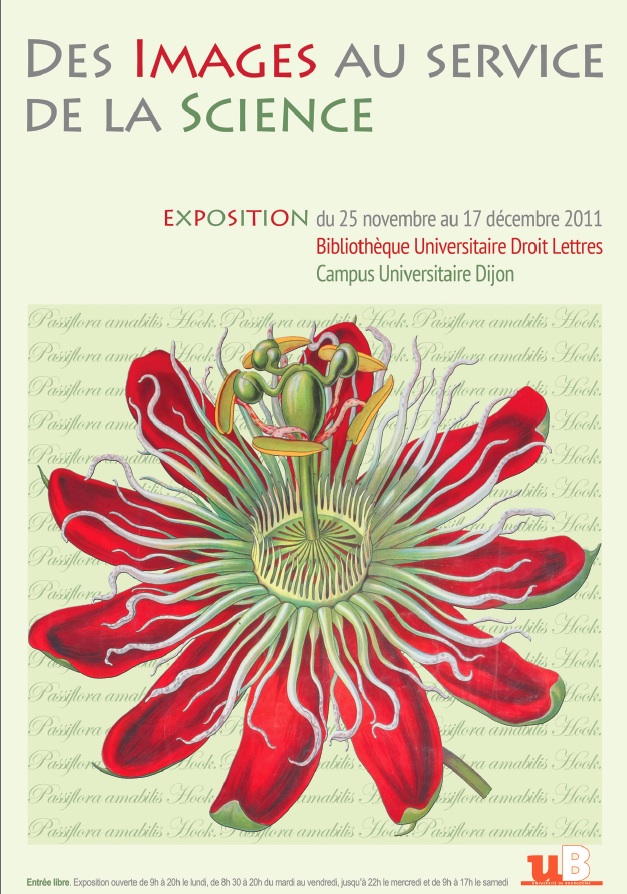
The Department of Communication & Documentation and the fund dealing with the Scientific Collections at the University of Burgundy are pleased to announce an exhibition entitled Images in the Service of Science, in conjunction with the launch of this special seminar series about scientific illustration organized by the Interlanguages Centre. The exhibition highlights various modes of scientific illustration, from wall panels to rare books about natural history.

Images have always been essential to the sharing of scientific knowledge. At a time when 3-D imaging and virtual images dominate, it should be remembered that up until the 20th century, the only way to show to the wider public what was observed, was through illustrations.

Images in the Service of Science will be on view November 25 – December 11, 2011 in the main University Library for Arts and Humanities on the campus of Dijon University.

The scholars presenting during the inaugural year of this unique program are:

    Valerie Chansigaud (France)
    Research Focus: Issues surrounding the discovery of biodiversity and early attempts to protect it. Dr. Chansigaud is also interested in how people can transmit their knowledge about wildlife using technology.
    Presentation: Five Centuries of Naturalistic Illustrations, Between Tradition and Evolution
    November 25, 2011


    Richard Somerset (University of Nancy 2, France)

    Research Focus: Relationships between science and literature, also the history of ideas in the 19th century.
    Presentation: Telling the Story of Evolution in Images: The Popularising Work of Arabella Buckley
    January 27, 2012


    Marie-Odile Bernez (University of Burgundy, France)

    Research Focus: 18th-century Britain and the history of ideas relating to the sciences and political events. Bernez translated the works of the French Revolution by Mary Wollstonecraft and has published articles about 18th-century aspects of the development of modernity.
    Presentation: Richard Bradley and Some Pre-Evolutionist Illustrations
    January 27, 2012


    Stephen Boyd Davis (Middlesex University, UK)

    Research Focus: The visualization of historical time, chronographics, electronic visualization and the arts
    Presentation: The Eye of History: Pioneering Depictions of Historical Time
    March 9, 2012


    Eric Kindel (University of Reading, UK)

    Research Focus: The history of stenciling. Kindel also served as the principal investigator for the research project, Isotype Revisited.
    Presentation: Recording Knowledge: Christiaan Huygens and the Invention of Stencil Duplicating
    March 9, 2012


    Maria Rentetzi (National Technical University of Athens, Greece)

    Research Focus: Sociology of science
    Presentation: Visualizing Postwar High Energy Physics: A Gendered Task
    May 11, 2012


    Sigrid Leyssen (Basel University, Belgium)

    Research Focus: History and the philosophy of psychology, scientific images, theories of image perception, psychological instruments and early cinema studies.
    Presentation: Perceiving Pictures and Picturing Perception
    May 11, 2012


    Alix Cooper (State University of New York at Stony Brook, US)

    Research Focus: European history, the history of science and medicine, women’s and gender history and environmental history.
    Presentation: Picturing Nature: Gender and the Politics of Description in Eighteenth-Century Natural History
    June 15, 2012


    Valerie Morrison (University of Burgundy, France)

    Research Focus: Irish cultural history, the links between art in the field of politics and the evolution of cultural nationalism in Ireland during the 20th and 21st centuries, visual representations of the Irish by the British in the 19th and 20th centuries.
    Presentation: Photographic Portraits in Anthropological and Ethnological British Journals, 1860-1900
    June 15, 2012


Related

Read Full Post »


A Botanical Painting Holiday with Elaine Searle

Hotel Il Collaccio
Umbria, Italy
May 2-9, 2012
Cost: Euro 960 (convert currency)

Artists of all ability levels are invited to paint the orchids and Spring flowers of Umbria with botanical artist and teacher, Elaine Searle. This 7-day trip includes five days of instruction, plus a full day trip that includes a visit to a national park, shopping at a market in a medieval town, and lunch at the gastronomy capital of the region. Non-painting companions are also welcome. There is plenty to see and do in this region of Italy.

Click on the image above to download a color brochure containing a complete itinerary, photos of the 2011 trip, and a helpful FAQ section.

This botanical art holiday has also been listed in Classes Near You > Italy.


Related

Elaine Searle Shares Her Passion for Botanical Art, Discusses How Students Learn Best

Read Full Post »

Spend the afternoon at the Mobile Museum of Art!

Learn about ornithological art and visit the exhibition about John James Audubon , on view now through January 8, 2012.

Mobile Museum of Art
www.MobileMuseumOfArt.com
The Mobile Museum of Art is the largest museum along the Gulf Coast from New Orleans to Tampa. The museum offers classes for children and adults. They are currently accepting proposals for educational programs for adults.

    Audubon-Inspired: Birds in Art, from the Photograph to the Easel – Sunday, November 20, 2011; 2 PM. Ornithological artists, William C. Morris and Terry Hartley, will share their experiences drawing, painting and photographing birds. Attendees are invited to bring a sketchbook and follow along as Morris and Hartley discuss how to capture the anatomical features and colors of birds. For more information, click here.

This information has also been added to Classes Near You > Alabama.

Read Full Post »

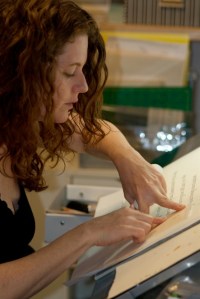
Kelly Houle at work in her studio.

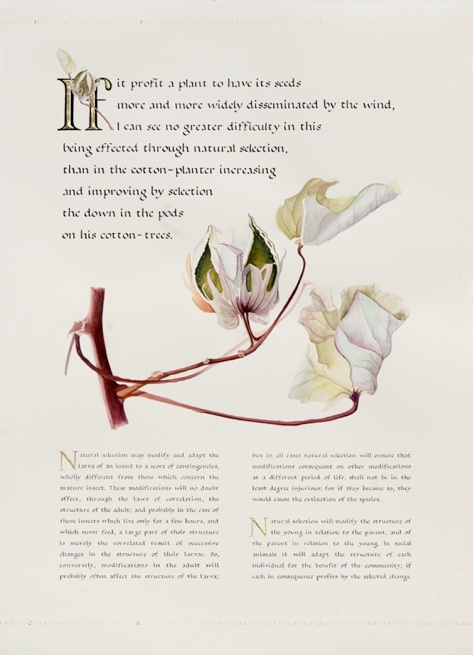
Natural history artist, calligrapher and science educator, Kelly Houle, is creating a large-scale illuminated manuscript based on Charles Darwin’s The Origin of Species. Each page will be designed as a work of art. All text will be written by hand and natural history illustrations will be illuminated with iridescent watercolors and 23-karat gold. The completed manuscript will be 22 x 30 inches and is expected to have 300 pages and over 500 illuminations.

Kelly has established working relationships with biologists and evolution experts from all over the world who will advise her during this project (see timeline). Kelly’s goal is to enhance public understanding of Darwin’s text. She explains:

I believe that the main barrier to understanding The Origin of Species is the perceived difficulty of the writing. The concepts themselves are simple, yet profound. I hope to improve understanding of The Origin by integrating poetic arrangements of Darwin’s words with visually striking presentations of the evidence. I will use elements of poetry, traditional realism, lettering art, graphic design, and fine art illustration in the service of communicating one of the most important ideas in science. 

Kelly has been raising funds on the funding website Kickstarter. Donors donating $10 or more will receive gifts of art related to The Illuminated Origin of Species. All donors will have their names written in a special section of the illuminated manuscript. In addition to individual donations, Kelly is looking for an institutional donor to fund the entire Illuminated Origin of Species project in exchange for the completed manuscript.

To read more about this project, watch a short video and to make a donation, visit the The Illuminated Origin of Species.


Related


Read Full Post »

While this is a busy time of year, there is always time to enjoy botanical art. Below are a few opportunities to view drawings and paintings by contemporary botanical artists.

This information has also been added to the Exhibits to Visit section in the column to your right.


Put Yourself on the Map

Results from the ongoing Reader Satisfaction Survey show the Exhibits to Visit section is popular with readers. Help fellow artists, naturalists, educators and collectors find you. Send your announcements to education@artplantae.com.

Read Full Post »

« Newer Posts - Older Posts »