Feeds:
Posts
Comments

Archive for the ‘scientific illustration’ Category

The disciplines of science and art are intertwined in more ways than you can imagine. The benefits of using art to communicate science is articulated beautifully in Communicating Science Concepts Through Art: 21st-Century Skills in Practice by Sandy Buczynski, Kathleen Ireland, Sherri Reed, and Evelyn Lacanienta.

In an article published two weeks ago, Buczynski et al. (2012) explain how it is necessary for the next generation of scientists to communicate using more than words. They explain that the scientists of the future will need to use artistic means of communication that include “illustrating, animating, videography, cartooning, and model building” (Buczynski et al., 2012).

To show how art can be used to reinforce learning in science, they cite the results of their work with students at a college prep academy. Students were taught how to use fundamental art techniques as tools to aid their comprehension of science content.

Buczynski et al. (2012) explain how they and the academy’s art teacher put into practice the five conceptual art strategies identified by Julia Marshall (2010). The academy’s art teacher taught students how to draw, how to observe angles, how to observe positive and negative spaces, and how to observe patterns and textures (Buczynski et al., 2012). Students were also taught how to shade, how to create form and how to apply highlights using colored pencils, graphite pencils, charcoal and ink pens (Buczynski et al., 2012).

The authors then incorporated Marshall’s art strategies into lessons about the human body, the scientific process, science communication through popular culture, and botanical exploration.

Briefly, here are the conceptual art strategies Buczynski et al. (2012) used and how they used them:

  • Depiction – Seventh-grade students were asked to apply their new knowledge about “scale, shadow and proportion” (Buczynski et al., 2012) to observe and draw the human body. This strategy was employed to move students away from the usual “stick figure”-type of thinking often observed in science lab notebooks.
  • Projection – Students were asked to predict the outcome of a scientific event using hand-drawn images instead of words.
  • Reformatting – Utilizing art forms from popular culture, students were asked to reformat scientific content into “a comic book, magazine, advertisement or film” (Buczynski et al., 2012).
  • Mimicry – Students were assigned the task of becoming botanists by mimicking how botanists collect information in the field.
  • Metaphor/Analogy – Students were asked to create a visual metaphor to describe how the digestive system works.

Buczynski et al. (2012) explain how they evaluated student work and what they learned from implementing each of these strategies. To learn more about their study, visit your local college library to get a copy of their new article or buy this article online for 99¢ from the National Science Teachers Association.


Real-life Science Communicators

This week I had the opportunity to attend the annual conference of the Guild of Natural Science Illustrators (GNSI). As expected, my appreciation for what scientific illustrators do has increased yet again. Scientific illustrators are a significant force in the field of science communication and their contribution to this field knows no bounds. From children’s books, to outdoor sculpture, to magazines, to cultural exchange (take the virtual tour), they make science and the natural world easier to understand through everything they do.

This year the conference theme was Scientific Illustration: Frontiers Past and Future. Featured were presentations about explorers and natural history artists from the past and presentations about how scientific illustration is used and created today in the 21st century.

Learn more about the Guild of Natural Science Illustrators at www.gnsi.org.

Looking for a scientific illustrator to work on a project? Visit Science-Art.com, a resource connecting artists and art buyers in the nature, science and medical community.

The host of the GNSI conference this year was the Savannah College of Art & Design (SCAD). The Illustration Department at SCAD offers a minor in scientific illustration and is doing their part to create the next generation of science communicators. Learn more about this wonderful school and their students at www.scad.edu.


Literature Cited

    Buczynski, Sandy and Kathleen Ireland, Sherri Reed and Evelyn Lacanienta. 2012. Communicating science concepts through art: 21st-century skills in practice. Science Scope. 35(9): 30-35.

    Marshall, Julia. 2010. Five ways to integrate: Using strategies from contemporary art. Art Education. 63(3): 13-19.
Read Full Post »

Here is a fantastic learning opportunity at The Campbell Center for Historic Preservation Studies in Mount Carroll, IL.

Register today to secure your place in class!


Scientific Illustration for Natural History

August 13-15, 2012

Four-day course taught by scientific illustrators, Peggy MacNamara and Dan Brinkmeier. Open to participants with all levels of drawing skills or art. Choose to concentrate on simple visualization techniques leading to the development of exhibit elements, educational materials and educational activities or choose to concentrate on illustrations used in publications or electronic media. Participants have the option to work on a group project to experience working in a manner similiar to the way a museum exhibit team would function to produce a diorama, mural, or exhibit.

There is so much more to read about this course. View other key aspects in the course description.

Cost: Tuition and Materials Fee, $735
Includes housing, breakfast, lunch and snacks.
Registration Information

Read Full Post »

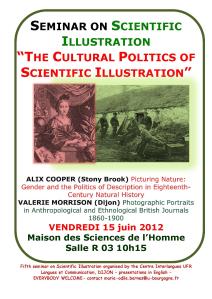
The fifth seminar on scientific illustration led by Marie-Odile Bernez at the University of Burgundy in France, will be held on Friday June 15, 2012 in the Maison des Sciences de l’Homme. Beginning at 10:15 AM, professor Alix Cooper from Stony Brook University will focus on gender and the depiction of nature in the eighteenth century. Then Valérie Morisson will present a number of ethnographic and anthropological photographs from the end of the nineteenth century, questioning the issue of ethnic groups in science. Both speakers will address the question of scientific illustrations in the context of political/cultural prejudices.


Seminar on Scientific Illustration, June 15

    Picturing Nature: Gender and the Politics of Description in Eighteenth-Century Natural History (Alix Cooper, Stony Brook, USA)

    Photographic Portraits in Anthropological and Ethnological British Journals 1860-1900 (Valerie Morrison, Dijon, France)

Read Full Post »

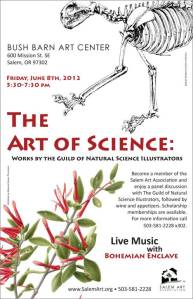
The Art of Science
Bush Barn Gallery
Salem, OR
June 1 – July 28, 2012

On Friday, members of the newly formed Oregon group of the Guild of Natural Science Illustrators (GNSI) will launch The Art of Science at the Bush Barn Gallery in Salem, Oregon. This exhibition is the group’s first juried exhibition.

A panel discussion with group members and biologist, David Craig, will be held on Friday, June 8, 2012 at 5:30 PM. The panel will discuss the field of scientific illustration and how illustrators work. Artists participating in the panel discussion are: Rebecca Brown-Thompson, Kristie Potwora, Jeanne Debons, Barbara Gleason, Kris Kirkeby and Cynthis Kranch. This discussion is open to members of the Salem Art Association and their guests. Wine, appetizers and entertainment will follow. To become a member of the Salem Art Association, complete a membership application online.

Gallery Hours:
Tuesday – Friday, 10 AM – 5 PM
Saturday and Sunday, Noon – 5 PM
Closed Monday


Also See…

Guild of Natural Science Illustrators

Read Full Post »

Interested in making scientific illustration a part of your classroom’s culture?

Then you will be interested in reading about the pilot program created by illustrators, Patricia Ferrer and Joseph E. Trumpey. Ferrer & Trumpey (1999) created a pilot project through which they taught observational drawing to third grade and fifth grade students. They discuss their program in Assessing the Effectiveness of Scientific Illustration as a Learning Tool in the Elementary School Classroom.

Through a learning sequence they developed, Ferrer and Trumpey (1999) taught students how to observe subjects, how to take visual notes, how to discuss their observations with their peers, how to apply new knowledge to new drawings, and how to continuously assess their understanding of a subject. Ferrer and Trumpey (1999) measured learning gains using an assessment tool that was administered three times during the sequence and once after the sequence was completed. The fourth assessment was administered to determine how much information students retained one week later.

The Ferrer & Trumpey Learning Sequence was integrated into a biology unit about grasshoppers and into a unit about the classifying characteristics of eight phyla of invertebrates. The grasshopper lesson prepared by Ferrer & Trumpey (1999) was administered to 24 third grade students. The grasshopper unit was designed to teach students:

  • Grasshoppers are insects.
  • Grasshoppers do not have a backbone.
  • The physical characteristics of grasshoppers.
  • How to make accurate observations and how to draw what is observed.

The lesson about invertebrate phyla was designed to teach both third grade students (n=46) and fifth grade students (n=54):

  • Invertebrates are classified according to a variety of characteristics.
  • All invertebrates lack a backbone.
  • How to make observations and to draw what has been observed.
  • How to engage in inquiry activities leading to higher-level thinking.

In both lessons, students followed the methodical and thoughtful steps of the Ferrer & Trumpey Learning Sequence. These steps included:

  • A pre-assessment quiz to establish students’ prior knowledge of a subject. The quiz included a variety of questions (fill-in-the-blank, multiple choice and questions calling for matching, observational drawing and written observation).
  • Unguided observation. Students were allowed to make their own observations without any instruction from the teacher. Students then shared observations with each other in groups.
  • A second assessment quiz. This second assessment was administered to determine what students “can learn on their own when given the opportunity” (Ferrer & Trumpey, 1999).
  • Guided observation. Classroom teacher provides formal instruction about a subject and corrects any student misconceptions about a subject. Students create new observational drawings applying their new knowledge.
  • A third assessment quiz. The key question here is, How do structured lessons aid the learning process?
  • A fourth assessment quiz. This assessment is conducted one week later to determine how much information students retain about a subject.

Ferrer & Trumpey (1999) assigned the objective questions of the assessment quiz a value of 2 points each. They created a rubric for the questions requiring students to make visual and written observations. Data collected indicate assessment scores improved between Assessment 1, Assessment 2 and Assessment 3. Students improved an average of 4.1 points between Assessment 1 and Assessment 2 and demonstrated an increase in knowledge between the unguided and guided assessments (Ferrer & Trumpey, 1999). While scores for Assessment 4 dropped an average of 0.9 points, data indicate an average overall point gain of 8.4 points between Assessments 1 and 4 (Ferrer & Trumpey, 1999).

Ferrer & Trumpey (1999) also observed that students spent more time doing science when drawing was involved, that student drawing ability increased over time and that students paid more attention to detail as the lessons progressed. Because of the results observed through their pilot program, Ferrer and Trumpey (1999) feel that scientific illustration-based activities are effective tools that can be used to teach science in the classroom.

The paper by Patricia Ferrer and Joseph E. Trumpey was published in the third volume of the Journal of Natural Science Illustration, an excellent publication published by the Guild of Natural Science Illustrators (GNSI). While back issues of Volume 3 are no longer available for purchase at the GNSI Store, other issues of the Journal are available, as well as GNSI Technique Sheets II, a publication highlighting the techniques used by scientific illustrators.


About Patricia Ferrier

Patricia received her M.F.A. in medical and biological illustration from the University of Michigan, Ann Arbor. She is the founder of ScientificIllustration.org and the owner of FerrerBeals Biomedical Illustration + Design. Follow Patricia on Twitter at @ScientificArt.


About Joseph E. Trumpey

Joseph is an associate professor at the School of Art & Design at the University of Michigan, Ann Arbor. He also serves as the Director of International Engagement at the school. Joseph received a M.F.A. in medical and biological illustration from the University of Michigan and prior to joining the faculty at the university, was the chief medical illustrator and director of graphic arts for the College of Veterinary Medicine at North Caroline State University. Joseph is the founder and director of Michigan Science Art, one of the largest groups of science illustrators working together in North America.


Literature Cited

Ferrer, Patricia and Joseph E. Trumpey. 1999. Assessing the effectiveness of scientific illustration as a learning tool in the elementary school classroom.
Journal of Natural Science Illustration. 3(1): 33-42.

Read Full Post »

The second session of the lecture series, Images in the Service of Science, will be held this week at the University of Burgundy. Presenting will be Richard Somerset from the University of Nancy 2 (France). Somerset focuses on the relationships between science and literature and the history of ideas in the 19th century. On Friday, he will discuss the work of Arabella Buckley in Telling the Story of Evolution in Images: The Popularising Work of Arabella Buckley.

An article written by Somerset about this topic can be read online at
Scientific Illustration Dijon, the informative new website created specifically for this lecture series by project coordinator, Marie-Odile Bernez. Please note that Somerset’s article is written in French. Fortunately, reading his article is easy thanks to the wonderful tools that help us translate text online.

While his paper may be in French, Somerset’s presentation will be given in English. As will the presentation by Marie-Odile Bernez about Richard Bradley’s
A Philosophical Account of the Works of Nature (1721).


Event Information

Images in the Service of Science
Maison des Sciences de l’Homme (Room 3)
University of Burgundy
January 27, 2012
10:15 AM – 12:30 PM

Read Full Post »

Please welcome scientific illustrators Catie Bursch and Lee Post from
Homer, Alaska to Classes Near You > Alaska!


Alaska Islands & Ocean Center

www.islandsandocean.org
This visitor’s center was created through a partnership between the Alaska Maritime National Wildlife Refuge and the Kachemak Bay Research Reserve. Admission is free. Check website for hours, programs and to take a virtual tour of the Center.

    Drawing Nature: Scientific Illustration Workshop for Students
    January 24-26, 2012; 3:30 – 5:30 PM. An after-school program taught by Homer illustrators, Catie Bursch & Lee Post. This workshop is for students age 12-18. Free. Details

Read Full Post »

« Newer Posts - Older Posts »