Feeds:
Posts
Comments

Archive for the ‘Science Library’ Category

plantsecretsHorticulturalist and author, Emily Goodman, introduces children to plant growth stages by focusing on the most observable elements of the growth process – seeds, plants, flowers, and fruit. Goodman leads children through a logical progression of plant growth stages and emphasizes the need for soil, water, sunlight, and air during each stage.

Goodman cleverly links each growth stage to plants with which most children are already familiar. She draws on childrens’ prior knowledge of roses, oaks, peas, and tomatoes to tell her story. Children are presented with the seeds of these plants at the beginning of the book and are encouraged to match each seed to their respective parent plant. Goodman then teaches children how seeds become plants, how plants produce flowers, how flowers become fruit, and how fruit are nature’s seed packets. She then reviews each growth stage and describes how these stages are best observed in roses, oaks, peas, and tomatoes.

Plant Secrets is a wonderful introduction to how plants work and is written for children ages 4-7. Accompanying Goodman’s lessons about plant growth are colorful illustrations of fruit, flowers, leaves, plants, and seeds by illustrator, Phyllis Limbacher Tildes. All illustrations were painted with gouache on 4-ply Strathmore Bristol 500 paper.

Plant Secrets is available at ArtPlantae Books ($7.95).
Read Full Post »

Representing leaves accurately is one of the many challenges faced by botanical illustrators. Illustrators need to capture the gesture, movement, texture, color, and veining patterns of leaves. Exhaustive leaf studies are not always possible because leaves wilt. Quickly. Some very quickly.

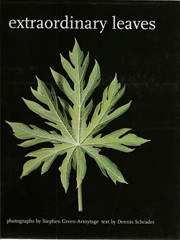
A new book, Extraordinary Leaves by Stephen Green-Armytage and Dennis Schrader, is the perfect reference book for botanical illustrators. The photographs by Stephen Green-Armytage are breathtaking. They contain exactly the type of information illustrators will find invaluable. Many hours can be spent studying color, texture, leaf margins, and veining patterns from the images in this book. Accompanying the sharp detailed photographs is text written by Dennis Schrader, a professional horticulturist, garden designer, and regular on Martha Stewart Living. Schrader shares interesting information about each chapter topic, insectivorous plants, skeletonized leaves, and twenty-nine of the plants featured in this book.

Extraordinary Leaves is comprised of 13 chapters, each dedicated to either a physical feature of leaves (e.g., color, pattern, edges, texture, shape, size, and climbing patterns) or dedicated to a specific plant group (e.g., caladium, kale, ferns, coleus, vines, autumn plants).

The publisher has sample pages of this book on its website. However, these images do not do this book justice. The selected images do not give any indication of what the book truly contains. There is nothing that lets the reader know what there is to learn about the structure of the midrib and secondary veins of Giant Elephant Ear (Alocasia calodora ‘Persian Palm’), the color in Coleus leaves, or the undulating pattern observed in fronds of the Lasagna Fern (Asplenium nidus ‘Plicatum’).

This book is more than exciting. It is spectacular!
_____________

Now available at ArtPlantae Books (Go to Classroom > Reference)

Read Full Post »

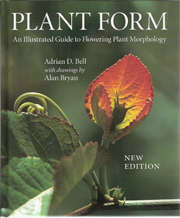
Adrian Bell describes the processes behind plant morphology in the new edition of Plant Form: An Illustrated Guide to Flowering Plant Morphology. Written for amateur botanists and plant enthusiasts, this book is an excellent reference containing bite-sized morsels of information. Author/botanist Adrian Bell and illustrator, Alan Bryan, combine interesting and informative text with detailed pen-&-ink illustrations to provide insight about the following topics:

  • General plant morphology
  • Leaf Morphology: Bell describes thirty-seven morphological aspects of leaves including development, shape change along a shoot, venation patterns, leaf folding, spines, prickles, and hairs.
  • Root Morphology: Bell describes nine morphological aspects of roots including development, root systems, tree root architecture, root modifications, and tubers.
  • Stem Morphology: Thirteen morphological aspects are described including development, bark, prickles, shape, scars, rhizomes, and corms.
  • Reproductive Morphology: Ten morphological focal points including the branching patterns of inflorescences, floral morphology, pollination mechanisms, fruit morphology, and seed morphology are described.
  • Seedling Morphology: Terminology, germination, stem development, and growth are discussed.
  • Vegetative Multiplication: Rhizomes, corms, tuber, stolons, runners, bulbs, and root buds are described.
  • Grass Morphology: Eight morphological aspects are described, including vegetative growth, inflorescence structure, spikelet and floret structure, bamboo shoots and rhizomes
  • Sedge Morphology
  • Orchid Morphology
  • Cactus Look-alikes
  • Constructional Organization of Plants: Forty-two topics including the arrangement of leaves on a stem, the Fibonacci sequence, rhythmic and continuous growth, galls, plant branch construction, tree architecture, and herb architecture are described.

This new edition contains over 1,000 illustrations and promises to be an invaluable asset to both illustrators and gardeners. This book will have you saying, “So that’s what that is!”

Now available at independent bookstores.

Read Full Post »

« Newer Posts