Feeds:
Posts
Comments

Archive for the ‘general botany’ Category

The Gateway Science Museum and the Friends of the Chico State Herbarium sponsor many wonderful classes throughout the year. Below is a list of what’s coming up next on the calendar. To view a full listing of classes and to obtain registration information, go here.

  • Introduction to the Willows of California (SALICACEAE) – June 13
    This workshop is in danger of being canceled because of low enrollment. This class will be canceled by the close of business next Monday if enrollment remains low. Please send in your registration right away, and let the Gateway museum office know that it is in the mail so we can count you at COB Monday if your registration hasn’t arrived yet (gateway@csuchico.edu or (530) 898-3511). Only paid registrations can count towards the minimum enrollment. 
  • Flora of the Western Great Basin – June 21-28
  • Home Composting: From Basic to Advanced – June 27
  • Introduction to the Sunflowers (ASTERACEAE) – Sept. 12
  • Oak Woodland Ecology and Management – October 10
Read Full Post »

Illustrated Roadside Field Guides

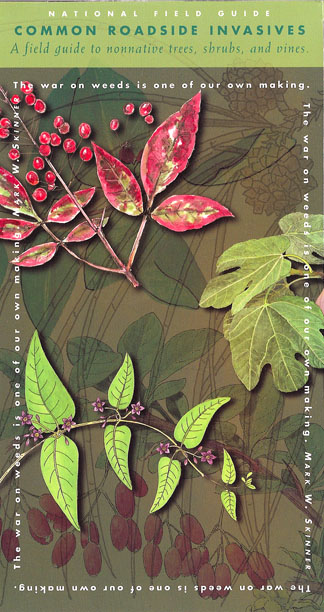
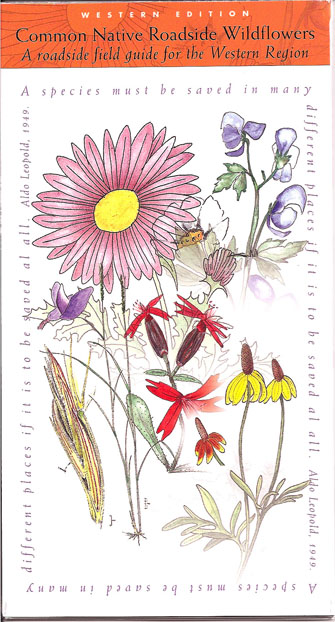
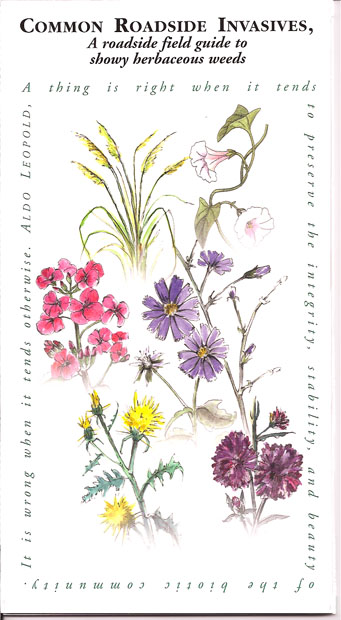
The Federal Highway Administration provides illustrated roadside guides to vegetation managers and maintenance crews to assist them in the identification of common roadside plants, both native and invasive. These folded and laminated guides fit conveniently into the glove compartment of any car. Three of the five available guides are listed below. A detailed description of the plants in each guide can be found in Science Library > Field Guides.

U.S. Department of Transportation. Federal Highway Administration. Roadside guides for vegetation managers. Artists contributing to the FHA roadside guides are: Wendy Brockman, Dorie Gallagher, Marilyn Garber, and Vera Ming Wong. Download these FHA instructions about how to request guides and how to purchase other references.

  • Common Roadside Invasives: A Roadside Field Guide to Showy Herbaceous Weeds. PUB. NO FHWA-EP-02-003.
    A guide for roadside vegetation managers and maintenance personnel to assist in the identification and control of invasive plants in their respective areas.
  • Common Roadside Invasives: A Roadside Field Guide to Non-native Trees, Shrubs, and Vines. National Field Guide. PUB. NO FHWA-HEP-07-021. A guide identifying 60 common weedy trees, shrubs, and vines.
  • Common Native Roadside Wildflowers: A Roadside Field Guide for the Western Region. PUB. NO FHWA-HEP-05-047. A guide identifying 100 native forbs and grasses. Introduced plants that have been naturalized are not included in this guide.

fharoadsideinvasivesherbs_smfharoadsideinvasives_smfharoadsidewldflswest_sm

Read Full Post »

Now in Science Library > Journals:

Curtis’s Botanical Magazine. 2008. Volume 25(4): 285-388. Martyn Rix, editor. Blackwell Publishing for the Royal Botanic Gardens, Kew.
This issue contains information, illustrations and color plates of the plants listed below. Artists’ names are in parentheses. Lathyrus transsylvanicus (Georita Harriott); Lathyrus roseus (Georita Harriott); Lathyrus neurolobus (Georita Harriott); Lathyrus heterophyllus (Georita Harriott); Lathyrus latifolius (Georita Harriott); Lathyrus vestitus (Georita Harriott); Vicia americana (Georita Harriott). Also in this issue are the following articles and book reviews: An Introduction to the Genus Lathyrus L. by Gregory Kenicer; Lathyrus at Weaver’s Cottage, West Wickham, Cambridge, and the Species Illustrated in Curtis’s Botanical Magazine by Sylvia Norton; William Kilburn’s Calico Patterns, Copyright and Curtis’s Botanical Magazine by E. Charles Nelson; Jelena and Robert De Belder – Generous as Nature Herself (book review) by Susyn Andrews; Treasures of Botanical Art by Shirley Sherwood and Martyn Rix (book review) by Victoria Matthews; Atlas of the Vegetation of Madagascar (book review) by Graham Duncan.


Subscribe to Curtis’s Botanical Magazine at Wiley.com. Enter the journal’s name in the search field.

Read Full Post »

plantsecretsHorticulturalist and author, Emily Goodman, introduces children to plant growth stages by focusing on the most observable elements of the growth process – seeds, plants, flowers, and fruit. Goodman leads children through a logical progression of plant growth stages and emphasizes the need for soil, water, sunlight, and air during each stage.
Goodman cleverly links each growth stage to plants with which most children are already familiar. She draws on childrens’ prior knowledge of roses, oaks, peas, and tomatoes to tell her story. Children are presented with the seeds of these plants at the beginning of the book and are encouraged to match each seed to their respective parent plant. Goodman then teaches children how seeds become plants, how plants produce flowers, how flowers become fruit, and how fruit are nature’s seed packets. She then reviews each growth stage and describes how these stages are best observed in roses, oaks, peas, and tomatoes.

Plant Secrets is a wonderful introduction to how plants work and is written for children ages 4-7. Accompanying Goodman’s lessons about plant growth are colorful illustrations of fruit, flowers, leaves, plants, and seeds by illustrator, Phyllis Limbacher Tildes. All illustrations were painted with gouache on 4-ply Strathmore Bristol 500 paper.

Plant Secrets is available at ArtPlantae Books ($7.95).

Read Full Post »

Representing leaves accurately is one of the many challenges faced by botanical illustrators. Illustrators need to capture the gesture, movement, texture, color, and veining patterns of leaves. Exhaustive leaf studies are not always possible because leaves wilt. Quickly. Some very quickly.

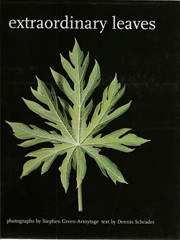
A new book, Extraordinary Leaves by Stephen Green-Armytage and Dennis Schrader, is the perfect reference book for botanical illustrators. The photographs by Stephen Green-Armytage are breathtaking. They contain exactly the type of information illustrators will find invaluable. Many hours can be spent studying color, texture, leaf margins, and veining patterns from the images in this book. Accompanying the sharp detailed photographs is text written by Dennis Schrader, a professional horticulturist, garden designer, and regular on Martha Stewart Living. Schrader shares interesting information about each chapter topic, insectivorous plants, skeletonized leaves, and twenty-nine of the plants featured in this book.

Extraordinary Leaves is comprised of 13 chapters, each dedicated to either a physical feature of leaves (e.g., color, pattern, edges, texture, shape, size, and climbing patterns) or dedicated to a specific plant group (e.g., caladium, kale, ferns, coleus, vines, autumn plants).

The publisher has sample pages of this book on its website. However, these images do not do this book justice. The selected images do not give any indication of what the book truly contains. There is nothing that lets the reader know what there is to learn about the structure of the midrib and secondary veins of Giant Elephant Ear (Alocasia calodora ‘Persian Palm’), the color in Coleus leaves, or the undulating pattern observed in fronds of the Lasagna Fern (Asplenium nidus ‘Plicatum’).

This book is more than exciting. It is spectacular!
_____________

Now available at ArtPlantae Books (Go to Classroom > Reference)

Read Full Post »

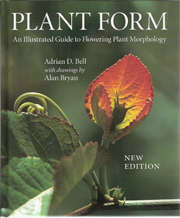
Adrian Bell describes the processes behind plant morphology in the new edition of Plant Form: An Illustrated Guide to Flowering Plant Morphology. Written for amateur botanists and plant enthusiasts, this book is an excellent reference containing bite-sized morsels of information. Author/botanist Adrian Bell and illustrator, Alan Bryan, combine interesting and informative text with detailed pen-&-ink illustrations to provide insight about the following topics:

  • General plant morphology
  • Leaf Morphology: Bell describes thirty-seven morphological aspects of leaves including development, shape change along a shoot, venation patterns, leaf folding, spines, prickles, and hairs.
  • Root Morphology: Bell describes nine morphological aspects of roots including development, root systems, tree root architecture, root modifications, and tubers.
  • Stem Morphology: Thirteen morphological aspects are described including development, bark, prickles, shape, scars, rhizomes, and corms.
  • Reproductive Morphology: Ten morphological focal points including the branching patterns of inflorescences, floral morphology, pollination mechanisms, fruit morphology, and seed morphology are described.
  • Seedling Morphology: Terminology, germination, stem development, and growth are discussed.
  • Vegetative Multiplication: Rhizomes, corms, tuber, stolons, runners, bulbs, and root buds are described.
  • Grass Morphology: Eight morphological aspects are described, including vegetative growth, inflorescence structure, spikelet and floret structure, bamboo shoots and rhizomes
  • Sedge Morphology
  • Orchid Morphology
  • Cactus Look-alikes
  • Constructional Organization of Plants: Forty-two topics including the arrangement of leaves on a stem, the Fibonacci sequence, rhythmic and continuous growth, galls, plant branch construction, tree architecture, and herb architecture are described.

This new edition contains over 1,000 illustrations and promises to be an invaluable asset to both illustrators and gardeners. This book will have you saying, “So that’s what that is!”

Now available at independent bookstores.

Read Full Post »

« Newer Posts