Feeds:
Posts
Comments

Archive for the ‘general botany’ Category

Click to find a Pollinator Week event near you.

Welcome to National Pollinator Week at ArtPlantae.

This week featured guest
Valerie Littlewood will discuss her work documenting wild British bees and how she teaches the public about the bees and their plants.

As you know, one way Valerie informs the public about plants and pollinators is through her book series, BUZZ. In Volume I of this series, Valerie pairs exquisite drawings and paintings with information about 14 bee species. Each two-page spread features a detailed painting of a bee and a graceful pencil drawing of a plant the featured bee pollinates. In her description of each species, Valerie includes interesting information about a bee’s identifying characteristics, its behavior, and its conservation status. She includes with her text thumbnail sketches of work-in-progress revealing how her finished drawings were completed.

Volume II of BUZZ is in preparation and will highlight 14 additional species of British bees. Overall, there are over 250 species of bees in Britain.

Thank you again for joining us Pollinator Week. You are invited to ask Valerie questions or post comments as our conversation progresses. Simply post your question in the Comment box below.

Read Full Post »

Ask and they will see.

In What Do You See?, professors Julianne Maner Coleman and M. Jenice “Dee” Goldston explain how to implement questioning strategies to enhance visual literacy in students.

What is visual literacy?

Visual literacy has to do with the ability to interpret the diagrams, charts, tables and illustrations that accompany text. Science textbooks contain many photographs, graphics and scientific illustrations. But do readers really understand them? Do they even look at them? Do teachers spend time discussing them?

After reviewing the teacher’s guide to a popular K-6 science textbook series, Coleman and Goldston (2011) concluded that teachers were probably not spending much time discussing the diagrams in their science textbooks. During their review, they found that the teacher’s guide provided little instruction about how to incorporate textbook diagrams into conversations about content. In their paper, Coleman and Goldston (2011) offer a solution to this problem and show how teachers can use “purposeful questions” (Coleman and Goldston, 2011) to enhance visual literacy and student learning.

The authors present their solution in a vignette in which a 4th grade teacher guides her student’s review of a plant cell diagram. The diagram students analyze is a cutaway diagram showing the structure of a plant cell and its contents. In the vignette presented by Coleman and Goldston (2011), the teacher guides her students’ review of the cell by asking questions such as:

  • Why did the authors include this diagram?
  • What do you see in this diagram?
  • What in the diagram helps us to know what we are seeing?
  • What can we learn about plant cells from the diagram?
  • How does the artist show the cell is like a water-filled baggie and not flat like the paper?
  • How does the artist draw the plant cell to show its depth?

These questions spark much discussion about what the students see in the cutaway diagram. It becomes clear that students understand the authors of their textbook included this particular diagram because they wanted students to learn what plant cells look like and what’s inside of them.

Because of their teacher’s thoughtful questioning, students make insightful observations about how the artist used a line to mark the cell’s edges and used different colors to make it look three dimensional. The teacher supports her students’ observations by explaining how artists use shading, lines and other techniques to present information that is otherwise not easy to see (Coleman & Goldston, 2011).

In the vignette, this conversation is followed by an activity in which students use microscopes to observe onion cells, Elodea cells, and then compare these live cells to the diagram in their book.

In What Do You See?, the dialogue between the teacher and her students is written out in detail and clearly demonstrates how purposeful questioning can support student understanding of diagrams and other graphics used in science textbooks.

In their paper, Coleman and Goldston (2011) provide three tools teachers can use to enhance the visual literacy of their students. These tools are:

  • A classification guide describing the types of diagrams found in textbooks.
  • A sample evaluation sheet students can use during inquiry activities.
  • A guide to questioning strategies and examples of the type of purposeful questions teachers can ask their students.

What Do You See? is recommended reading for anyone with an interest in visual literacy and the role images play in science education.

This paper can be purchased online (99¢) from the National Science Teachers Association. Alternatively, you can search for a copy of this article at your local college library.


Literature Cited

Coleman, Julianne Maner and M. Jenice “Dee” Goldston. 2011. What do you see? Science and Children. 49(1): 42-47.


Related

Read Full Post »
The Los Angeles County Arboretum and Botanic Garden has put selected treasures from its rare book room online and has created a new experience for Arboretum visitors. Now visitors to this popular southern California landmark can compare 19th-century botanical illustrations to living plants in the Arboretum’s collection.

The Arboretum Library has about 500 books in its Rare Book Room. The plants featured in the new Rare Book Walk are plants native to Mediterranean climates. Using a smartphone, visitors can click on markers posted on a Google map that reveals a plant’s location in the Arboretum. Accompanying each marker is a brief description of the plant and an illustration from one of the historic botany or horticultural books in the Arboretum’s library.

To see how the Rare Book Walk works with Google Maps, click here.

Learn more about this special project on the Arboretum’s website.


About the Arboretum

The Los Angeles County Arboretum & Botanic Garden is a 127-acre botanical garden and historic site. It serves as the site for many garden-related events, including GROW! A Garden Festival. The Arboretum is a popular filming location and has served as a backdrop to many films, television shows and commercials. It is also home to the botanical illustration program founded by Olga Eysymontt. To view the current schedule of botanical art classes, visit the Arboretum’s listing at Classes Near You > Southern California.

Read Full Post »

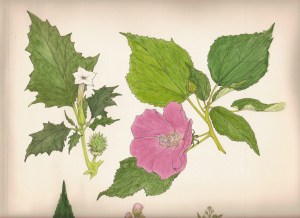
Swamp Mallow, courtesy of the Arnold Arboretum

From Newcomb’s Wildflower Guide to The Curious Naturalist magazine, from the Garden in the Woods in Framingham to the Missouri Botanical Gardens tropical rainforest exhibit,
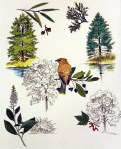
Gordon Morrison has illuminated the natural world for over four decades. A retrospective of his work is now on view at the Arnold Arboretum in Boston.

A Natural Curiosity: A Retrospective of Images by Gordon Morrison is a look at his botanical work, highlighting the best of the thousands of illustrations he has created for education and conservation organizations.

This exhibition includes illustrations from Newcomb’s Wildflower Guide (1977), a book that is still in use and praised by many experts. Morrison’s illustrations, combined with a novel key system, made identifying wildflowers in the eastern United States simpler than ever before.

Original plates from the Peterson Field Guide to Forests series, Gordon’s own children’s book series; the Birds In The Garden series and the Native American series, both for Horticulture magazine, as well as interpretive panels completed for the New England Wildflower Society and the Missouri Botanical Gardens will also be on view.

Morrison’s work appears regularly in Mass Audubon’s Sanctuary magazine and in a variety of field guides and other natural history publications.

A Natural Curiosity: A Retrospective of Images by Gordon Morrison will be on view at the Arnold Arboretum Hunnewell Visitor Center through July 1, 2012. Visitor center hours are Monday-Friday (9 AM – 4 PM), Saturday (10 AM – 4 PM) and Sunday (12-4 PM).


You’re Invited!

You are invited to take part in a conversation

Trees for Nell, courtesy of the Arnold Arboretum

with Gordon Morrison. An Artist Talk with Mr. Morrison will be held at the Arnold Arboretum on Wednesday,
June 27, 2012 from 7:00-8:30 PM. Registration is requested for this FREE event. To register, click here.

You may also enjoy:

Read Full Post »

Yesterday the Transit of Venus across the sun received a lot of attention. Many of us were able to view it on the Internet through the many gadgets we have at our disposal. In 1769, however, James Cook, Joseph Banks and surviving members of the Endeavour crew had to endure many months at sea to watch this event unfold in Tahiti. Observing and documenting the Transit of Venus was one of the expedition’s assignments. They did see it and they did take notes.

This wasn’t their only mission, however. The Endeavour crew was sent out to confirm the presence or absence of a certain land mass in the southern hemisphere (i.e., Australia).

With the current attention focused on the Transit of Venus, I thought it would be a good time to give a little attention to the work of botanist Joseph Banks.

During the Endeavour expedition’s travels to South America, Tahiti, New Zealand, and Australia, Joseph Banks and his crew collected and described thousands of plants. Specimens were drawn by artist Sydney Parkinson who also applied watercolor to his sketches as a way of recording the colors of each plant.

The hard work of Banks’ team was to be recognized in a florilegium Banks wanted to create. He hired artists and master engravers, but in the end, never published his book. The 743 plates created by his team of artists and engravers were transferred to the British Museum and were not printed until 200 years later.

Today we are able to gain insight into the printing of Banks’ florilegium thanks to The National Museum of Australia. They created Banks’ Florilegium: From Plant to Print, an online gallery featuring nine plates from this historic work. This online gallery is more than a collection of nine colorful thumbnail-sized images. The gallery provides information about the materials behind each plate. Viewers are able to compare each plate to its herbarium specimen, the original sketch by Sydney Parkinson, and the final watercolor painting that was based on Parkinson’s sketch. The information in the interactive gallery is presented thoughtfully and provides an engaging learning experience.

Tour this fascinating exhibit for yourself. Go to Banks’ Florilegium: From Plant to Print.


Related

Read Full Post »

Botanist and botanical artist, Linda Ann Vorobik, will teach workshops in four states this summer and fall. Here is what’s new in the Classes Near You section for California, Oregon, Washington, and Hawaii.


Vorobik Botanical Art

www.vorobikbotanicalart.com
Linda Ann Vorobik, Ph.D. is a botanical illustrator and botanist who teaches at the Jepson Herbarium at UC Berkeley, conducts field research in the Siskiyou Mountains in Oregon and teaches botanical illustration in California, Oregon, Washington and Hawaii. Visit Linda’s website to view her current teaching schedule, online gallery, blog, and to sign-up for her newsletter. Upcoming classes include:

  • Introduction to Botanical Illustration – May 31 – June 3, 2012;
    9 AM – 5 PM. Siskiyou Field Institute, Selma, Oregon.
  • Botanical Art: Field Sketching to Studio Watercolors
    June 22-24, 2012. Point Reyes, CA.
  • Crash Course in Flowering Plant Families – July 7-10, 2012.
    Siskiyou Field Institute, Selma, Oregon.
  • Painting Orchids on the Big Island of Hawaii – October 14-20, 2012. Captain Cook, Hawaii.

An exhibition of Linda’s botanical art and hand-painted silk scarves will open on June 9 at the Chimera Gallery on Lopez Island in Washington.

Linda will also participate in the Lopez Island Studio Tour scheduled for Labor Day weekend (September 1-2, 2012).

Read Full Post »

Kate Nessler and Beverly Duncan will teach at Wellesley Botanical Garden this summer. Here’s the latest update at Classes Near You > Massachusetts:


Friends of Wellesley College Botanic Gardens
Certificate Program in Botanical Art and Illustration

www.wellesley.edu/wcbgfriends
This program offers several weekly and two- or three-day classes on botanical art and scientific illustration with Sarah Roche and Jeanne Kunze and seminars with visiting instructors including Susan Fisher, D. L. Friedman, Kathie Miranda, Carol Ann Morley, Kate Nessler, Elaine Searle, Catherine Watters and more. The courses offered through this program cover all aspects of botanical art. The following is only a glimpse of what this program offers:

  • Foundations of Botanical Drawing and Painting
  • Techniques of Botanical Drawing and Painting
  • Plant Drawing for the Petrified
  • On Location: Daylilies with Sarah Roche
  • Fruit from the Orchard
  • Botanical Painting on Vellum
  • Flowers as They Grow
  • Playing with Transparency: Colored Pencil on Mylar
  • View current schedule & instructor bios


Additional Learning Opportunities

NEW! Painting on Vellum with Kate Nessler – July 10-12, 2012;
9:30 AM – 4:30 PM. Discover how to draw and paint on Kelmscott vellum. Advanced beginners and more experienced artists will learn from Kate and from each other through classroom discussion, demonstration, and one-on-one instruction. Kate Nessler is an award-winning artist whose awards include three Gold Medals from the Royal Horticultural Society. Cost: $475 WCBG Friends Members, $595 Nonmembers. Cost includes one piece of Kelmscott vellum. Download Details

NEW! Seasonal Compositions with Beverly Duncan – July 14, 2012 or September 15, 2012. Award-winning botanical artist, Beverly Duncan, will teach participants how to compose drawings and paintings using seasonal materials. Some experience necessary. This course is designed for artists working in watercolor, graphite, colored pencil &/or pen and ink. Two sessions are available. Register for one or both. Session I: Saturday, July 14, 2012 (9:30 AM – 3:30 PM). Session II: Saturday, September 15, 2012 (9:30 AM – 3:30 PM). Cost of each session: $75 WCBG Friends Members, $95 Nonmembers. Download Details

Daylilies at Collamore Field Gardens – July 17-19, 2012; 9:30 AM – 3:30 PM. Learn about daylilies at Collamore Field Gardens, an American Hemerocallis Society Display Garden featuring over 650 varieties of daylilies. Sketch lilies in the garden during peak bloom and learn how to transform your sketch into a watercolor painting in the studio. Botanical artist and instructor, Sarah Roche, will show you how! Cost: WCFG Friends Members $225, Non-members, $275. To register, contact wcbgfriends@wellesley.edu or call (781) 283-3094.

NEW! Introduction to Botanical Art – Mondays, August 13-17, 2012;
9:30 AM – 2:30 PM. Explore the world of botanical art in this course designed especially for beginners. Sarah Roche guides your experience through structured exercises, projects, and demonstrations. She exposes you to the basic techniques and methods of botanical drawing and watercolor painting. If you have an interest in plants and botany and a yearning to record what you see on paper, then this class is for you. Sarah Roche is a botanical artist and teacher and the Education Chair of the American Society of Botanical Artists. Cost: $250 WCBG Friends Members, $300 Nonmembers. Download Details

Read Full Post »

« Newer Posts - Older Posts »