Feeds:
Posts
Comments

Archive for the ‘Reference’ Category

Animals are fun.

They engage us with their movements, have big round eyes, have cuddly fur and come in intriguing shapes, sizes and colors.

Plants, however, just sit there.

These truths, plus other interesting facts about how people perceive organisms are discussed by Petra Lindemann-Matthies in “Loveable” Mammals and “Lifeless” Plants: How Children’s Interest in Common Local Organisms Can Be Enhanced Through Observation of Nature.

Lindemann-Matthies evaluated a program created to enhance children’s knowledge of biodiversity. The program, Nature on the Way to School, was administered at 525 Swiss primary schools from March – June 1995 to celebrate the “European Year of Nature Conservation.” In her paper, Lindemann-Matthies makes the point that environmental education studies investigating student knowledge of the environment are different than educational studies in biodiversity focusing on “children’s direct observation and investigation of local wild plants and animals” (Lindemann-Matthies, 2005). Lindemann-Matthies states that the outcomes of biodiversity education have not been studied extensively and it is this topic that is the focus of her research.

Lindemann-Matthies (2005) says dedicated efforts to teach biodiversity to children must be taken to take advantage of young children’s interest in learning about living organisms. In her paper, she refers to biodiversity studies completed in Austria and Germany. In these studies, it was determined that incorporating outdoor experiences with classroom instruction was more effective at enhancing student awareness of local plant and animal species, than simply talking about local plants and animals in the classroom (Lindemann-Matthies, 2005).

The Nature on the Way to School program was created by the Swiss conservation organization Pro Natura. Classroom material and instruction was provided to teachers. Teachers ordering these materials were invited to take part in Lindemann-Matthies’ study. The program’s hands-on activities called upon students to engage in activities such as drawing plants and animals, caring for invertebrates like snails and earthworms in the classroom, and recording what was observed while walking to school (Lindemann-Matthies, 2005). Of the many classrooms in which this program was administered, Lindemann-Matthies evaluated the program’s effectiveness in classrooms where the teacher completed and returned the pre- and post-test questionnaire required for Lindemann-Matthies’ research. Her final study group was composed of 248 classrooms and over 4,000 students ages 8-16.

Research questions addressed by Lindemann-Matthies (2005) were:

  • Which plants and animals do children like best, and which organisms are especially valued on their way to school?
  • Did the educational program Nature on the Way to School change children’s preferences for species?
  • Did the age and sex of the children influence their preferences for species and did age and sex influence the effect of the program?


Results

When students were asked which plants and animals they liked best before participating in the Nature on the Way to School program, students listed garden plants or decorative plants such as roses, tulips and daffodils and few made reference to the local plants of Switzerland (Lindemann-Matthies, 2005). After the program, the number of students listing local plants (especially wildflowers) increased. The increase observed in the experimental group was significantly higher (11.4%) than in the control group (2.6%) (Lindemann-Matthies, 2005). When students were asked to name their favorite animals, students listed pets (especially cats, dogs and horses) more often than local Swiss animals prior to the study. After the study, students still listed pets more often than local animals (Lindemann-Matthies, 2005). When it came to plants, children’s preferences for plants were not influenced by sex or age (Lindemann-Matthies, 2005). This was in contrast to Lindemann-Matthies’ findings about preferences for animals where it seems more girls like pet animals and more boys like exotic animals (e.g., lions and tigers) and wild animals (e.g., squirrels and deer).

Lindenmann-Matthies (2005) observed that the plants and animals students claimed to appreciate the most were directly related to the plants and animals to which they were exposed. So if children were exposed mostly to garden variety plants, they referred to these plants more often when asked which plants they liked (or appreciated) the most.

Lindenmann-Matthies (2005) also observed a positive relationship between the number of program instruction hours received by students and their appreciation for the wild plants and animals of Switzerland. The more instruction students received, the more they demonstrated an appreciation for local flora and fauna. On average, teachers from the 248 participating classrooms spent 17 hours teaching the Nature on the Way to School program, with the actual hours of program instruction ranging from one hour to sixty hours across all classrooms (Lindemann-Matthies, 2005).

Teachers in 144 of the 248 classrooms incorporated the program’s Nature Gallery activity into their curriculum. This clever activity called upon students to serve as interpreters for their favorite local plant or animal. In this activity, students were asked to frame the plant or animal they liked best during their walk to school. More than 50% of the items framed by students were wild plants, followed by plants whose identification were unknown (16.2%), which was then followed by garden variety plants (15.5%) (Lindemann-Matthies, 2005). The wild animals framed by students were represented by anthills, spider webs and birds nests (13.7%) (Lindemann-Matthies, 2005). After framing their subject, students were encouraged to spend one week providing information about their subject to fellow students, to parents, to anyone walking by and in some cases, the media. Students had to explain why they chose their subject and while students cited many reasons for selecting their subject, most students chose to frame a subject because of its beauty (22.5%), “likeability” (20.2%) or some specific feature students found interesting (Lindemann-Matthies, 2005). The plant framed most often was a dandelion and Lindemann-Matthies (2005) reports that the students framing this plant tended to do so because it was “growing in unusual places.” Lindemann-Matthies states the Nature Gallery activity was the “highlight” of the Nature on the Way to School program.

Citing the observations above and many other observations described in her 22-page paper, Lindemann-Matthies (2005) concludes:

  • The Nature on the Way to School program was successful at making students more aware of the diverse number of plant and animals species in their local area.
  • There appears to be a strong association between awareness and preference. In this program, as students became more aware of local plants, their preference for local plants increased.
  • While student preference for pets did not change, their preference for pet animals decreased with the number of program instruction hours received. Lindemann-Matthies (2005) proposes that the average number of instruction hours received (17 hours) is not enough to increase student appreciation for local wild animals.
  • Even successful programs have sobering limitations. When students were asked what they would have liked to frame in a Nature Gallery if given a choice, students “still preferred ‘loveable’ animals, in particular mammals from countries other than Switzerland.”

To learn more about Lindemann-Matthies’ research, visit your local college library to pick-up a copy of this paper or purchase it online for $34.


Literature Cited

Lindemann-Matthies, Petra. 2005. “Loveable” mammals and “lifeless” plants: how children’s interest in common local organisms can be enhanced through observation of nature. International Journal of Science Education. 27(6): 655-677
Read Full Post »

Today we are very fortunate to learn from sound recordist and engineer, Dan Dugan. Dan is a member of the Nature Sounds Society and serves on their Board of Directors. The Nature Sounds Society is based in northern California. Dan and other Society members travel to natural areas to record nature’s sounds.

Please welcome Dan Dugan!


ARTPLANTAE: Tell us about the Nature Sounds Society. How did it begin?

DAN DUGAN: The Nature Sounds Society (NSS) was founded in 1983 by Paul Matzner, then curator for the California Library of Natural Sounds at the Oakland Museum of California, and Marie Mans, retired from her first scientific career and actively pioneering nature sound recording to augment her photography and to assist natural scientists (such as Dr. Luis Baptista at San Francisco State University) to obtain data for their research. From their organizing work and interest in the conservation of natural quiet, they reached out to others to create an organization which would become a nexus for similarly interested professionals and amateurs in the scientific, educational, arts, and environmental arenas. The organizing committee that evolved decided that the principal purpose of NSS is to encourage the preservation, appreciation and creative use of natural sounds. The organization has been active and viable for almost 30 years and has members from all corners of the globe.


AP: How did you become involved with the Society?

DD: Paul Matzner brought the museum’s Nagra tape recorder to me for service 23 years ago. He invited me to join the Nature Sounds Society at their annual workshop at Yuba Pass in the Sierras. Technology and nature together? Sounded like a great idea. I’ve volunteered as a technical advisor ever since and more recently, as a Board member.


AP: How are recordings of nature’s sounds usually put to use?

DD: There are pure soundscape recordings that are appreciated by lovers of nature’s music in the raw. Species recordings that are used to help with species identification for scientists and birders. Smooth mixes used for relaxation by therapists and individuals. Many musicians like to mix nature sounds into their compositions. Radio producers, podcasters, and YouTubers use natural sounds to enhance their stories. National Public Radio (NPR) often features natural sounds in radio reports. The national parks need volunteer recordists to inventory and monitor their soundscapes. Visual artists — sculptors, painters, multimedia artists — use sound more and more in their installed works. Museums and teachers want nature sounds for their exhibits and demonstrations. Nature films depend on recordists to capture the sounds that go with their fabulous visuals.


AP: The theme for EE Week is Ocean Connections. When I think about the word “ocean,” I see and hear waves along a rocky coastline. I also hear seagulls and imagine a cool, damp, salty breeze. This scene is the default imagery in my head when it comes to any type of coastal scene. Drawing upon your experience as a sound recordist, what am I missing? What am I not hearing?

DD: OK, add a shreaking killdeer to your mix. How about a sea-lion barking in the distance? The hiss the sand and pebbles make as the edge of a wave recedes. The sounds of buoys or foghorns when the fog closes in. The changing rhythm of the waves as the tides turn over a 12-hour period. This very subject was the focus of a recent installation by Golden Gate National Recreation Area resident artist, Aaron Ximm.


AP: When you meet someone who is new to the discipline of sound recording or the practice of “listening,” how do you encourage them to open their ears?

DD: The most transformative experience for someone new to sound recording is to put on the headphones to a live recorder hooked up to a microphone array to experience what one of our members and educator, Arlyn Christopherson, calls “bionic ears.” Just as a field guide of birds magnifies each individual bird, the act of listening with bionic ears magnifies the soundscape elements. You suddenly become aware of things you’ve heard before, but never really listened to: birds, wind, water, and the intrusiveness of man-made noise. Putting on bionic ears is a bit like the aural equivalent of the moment the “Wizard of Oz” goes from black and white to color in film — a whole new world opens up.

Learning to listen to nature sounds requires a specific skill that takes some practice but is not hard to do. In our lecture-demonstration, we start by asking people to close their eyes and make an inventory of everything that they can hear in the (hopefully) quiet room. Then I play a brief rain forest recording several times over, each time pointing out a different element of the complex biophony, and how they fit together like the instruments of an orchestra. From there, we demonstrate the differences between mono, stereo and surround sound and begin a very general discussion about equipment and how to obtain the results that you are interested in hearing.


AP: One day in the eastern Sierra, I came upon an area possessing the purest and loudest silence I have ever experienced. It was different than simply a quiet spot along a trail. It was a startling experience. Paul Matzner, the founder of the Nature Sounds Society, writes about the value of quietude – “a state or situation where natural sounds can be heard uninterrupted” by the “technological sounds of humans.” He also writes that quiet places “are some of our most endangered habitats.” How does the Nature Sounds Society advocate for quietude?

DD: Paul’s description of the value of quietude — or natural quiet, the current terminology for quietude — is at the heart of the conservation efforts of NSS. Right now is a critical time for preserving natural soundscapes in our national parks. Federal regulations promulgated in 1999 defined soundscapes as a resource which requires preservation and management on an equal footing with other park resources. The parks are currently drafting soundscape management plans and putting them out for public comment. Recently, Zion National Park rushed through a plan that we objected to as compromising wilderness values too much in favor of the air travel industry. There is a draft environmental impact report open for comment right now regarding air tours in the Grand Canyon. If there can be no-fly zones over military reservations, why not have no-fly zones over national parks?

Members of NSS provide commentary individually and under the NSS umbrella regarding these plans and other topics related to natural quiet. They have also provided volunteer assistance to gather and present observational data for baseline studies and have provided opinion pieces. NSS provides a forum through its listening parties, lectures, technical discussions, workshops, listserve and partner with the Bay Area Sound Ecology (BaseBOT) group, the local chapter of the World Forum of Acoustic Ecology (WAFE), for discussions of these topics to take place.

Independent work includes a compelling short documentary “Hush” directed and produced by Stanford film school graduate, Mike Seely, featuring Paul Matzner narrating the importance of quiet places. A more recent documentary, “Soundtracker” (2010) by Nick Sherman, follows Gordon Hempton’s efforts to find quiet places to record. Bernie Krause, in his book Wild Soundscapes (which is also an excellent beginner’s guide to sound recording) describes the depredations to the natural soundscape over the arc of his career as an acoustic ecologist.


AP: You mentioned in an earlier conversation, you make regular trips to the Muir Woods. Your recordings indicate that old-growth forests are very quiet places. I don’t know how long you have been recording in the same location, but it seems to me that what you do not hear in your recordings speaks volumes. Your recordings provide valuable presence and absence data. Have old growth forests changed since you began recording data? If so, how?

DD: I haven’t been recording long enough to notice a major difference (about 5 years in this environment). Ask Bernie Krause, he’s been documenting soundscapes for forty years. Both Bernie and Gordon Hempton have noticed the increasing intrusion of man-made sound on even the most pristine landscapes and they have recorded all over the world as their life’s work.


AP: You are currently documenting the sequoia groves at Yosemite National Park. How do you go into the field to collect sound data? Do you have a structured approach and take samples for a specific amount of time? Or is your approach more relaxed? Briefly describe what a day in the field looks like.

DD: I do have a routine. I hike in to the location carrying between 30 to 50 pounds of equipment depending on the difficulty of the terrain. To avoid problems with bears, I carry only water. Not even a snack bar. I mount mics on my pack wired to a recorder on my belt, so if I hear something interesting on the trail I can catch it. I take pictures too. Everything is date- and time-stamped, and I slate my recordings extensively, describing the date, time, type of equipment being used, weather conditions, terrain, etc.

If it’s a new location, I go early so I can explore and find a good spot. I set up a four-channel surround array and a “cowboy camp” (no tent). I’ll record anytime something interesting happens, but I always start 90 minutes before nautical twilight and record the evening sounds till then.

Through the night I keep my recorder on standby. It has a ten-second prerecord buffer, so if I hear an owl, coyotes, or a tree falling, I hit record and I’ve already got it.

I set a timer to start recording at nautical twilight, in case I’m asleep. I’ll record the dawn chorus for 90 minutes. If there’s action and I don’t want to be somewhere else, I’ll continue beyond that. Then it’s pack up, hump the gear out and go for breakfast.

The most amount of time is spent in post-production back in the studio, which is never quite as much fun as collecting the recordings. I’ve developed, and stick to, a rigorous protocol documenting (in the field and in the studio) and transferring the recordings. I provide “raw” recordings to the National Park Service (NPS), but I put a lot of time in reviewing the recordings to mark events and will consult with experts on birds and animals to accurately identify what is recorded. I write a report following the NPS format which accompanies my submission along with the other written documentation.


AP: The Nature Sounds Society hosts listening parties. What happens at a listening party? Who attends these gatherings?

DD: Our members and friends. People bring their favorite recordings from the year to share. People out-of-town wire contributions, too. The mix is always lively — the rain forests and lemurs of Madagascar, ice breaking up, spiders dropping from a ceiling, thunderstorms, coyotes — and there’s always a great personal story to go with the sound. Oh, and the food’s pretty good, too.


AP: What recommendations do you have for teachers who may be interested in recording nature sounds for use in their classrooms?

DD: The NPS recently published a revised updated activity card for classroom use that was originally authored by educators and NSS members, Arlyn Christopherson and Mele Wheaton. They can get this card by contacting the NPS or the NSS.

Upcoming events for NSS include our Saturday May 14 Tech Talk and our annual Workshop at San Francisco State University’s Field Station at Yuba Pass, June 24-26. More information is on our website at http://www.naturesounds.org.

Anyone can subscribe to the Yahoo! group for questions and information.

Teachers can also subscribe to the Naturerecordists Yahoo! group and ask for advice there. This group is heavily technical and much of the discussion is about gear, but its members are always willing to help a newbie.


AP: Thank you, Dan, for making us better listeners.

DD: You’re welcome.


EE Week readers, do not miss…

Read Full Post »

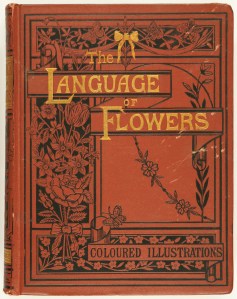
Cover of Robert Tyas’ The Language of Flowers, or Floral Emblems or Thoughts, Feelings and Sentiments (London, George Routledge and Sons, 1869), HI Library call no. DG21 T977L.

Courtesy of The Hunt Institute

FLORA’S LEXICON
25 March–30 June 2011

Flora’s Lexicon explores the 19th-century European and American phenomenon of The Language of Flowers, the common understanding that plants and blooms were charged with sentiment and meaning and held the potential to express emotion or to communicate privileged messages within the strict confines of social etiquette. Flower associations made their way into Victorian language from various sources, including Japanese, Middle Eastern, Turkish, Greek and Roman cultures, religions and mythology, as well as the literature of Shakespeare and the still-life painting of 17th-century Dutch artists. The result was a fashionable system of floral connotations that blossomed during a time of burgeoning public interest in botany and its scientific importance.

So pervasive and popular was The Language of Flowers trend that it launched the introduction of the floral dictionary or Language of Flowers book, a small, beautifully bound and illustrated volume devoted to the decoding of each flower’s secret meaning. This sentimental craze and the books associated with it originated in France, the most notable being Le Langage des Fleures of 1819 by Charlotte de Latour. This volume was reprinted in multiple editions, translated into English and imitated by other French, British and American authors until the trend waned in the mid-1880s, shortly after English author and illustrator Kate Greenaway (1846–1901) published her charmingly illustrated floral dictionary, The Language of Flowers (1884).

The Language of Flowers book phenomenon also attracted the skills of numerous

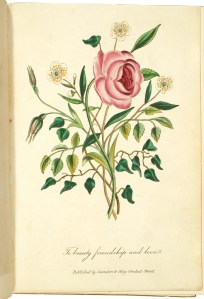
To beauty, friendship and love (rose, ivy and myrtle), hand-colored engraving published by Saunders and Otley, Conduit Street, from Anna Christian Burke’s The Illustrated Language of Flowers (London, G. Routledge and Co., 1856), HI Library call no. DG21 B959I.

respected botanical artists of the era, including Pierre-Joseph Redouté (1759–1840), Pancrace Bessa (1772–1846), Pierre-Jean-François Turpin (1775–1840) and Pierre-Antoine Poiteau (1766–1854). Although their illustrations for this genre differed slightly in scale and scientific detail from their major works, they were prized for their beauty and added to the appeal of these intricately bound and decorated volumes while serving to familiarize a large segment of the population with the artists’ talent.

Flora’s Lexicon presents books from the Hunt Institute’s Library and botanical portraits from the Art Department in an examination of the scope of The Language of Flowers phenomenon, from the influences on its beginning to its continued presence in 21st-century publishing. Differing approaches to the floral dictionary are displayed, while intricate systems of meaning are explored through artworks of many key 18th- and 19th-century botanical artists and illustrators.


Location & Hours

The exhibition will be on display on the 5th floor of the Hunt Library building at Carnegie Mellon University and will be open to the public free of charge. Hours: Monday–Friday, 9 a.m.–noon and 1–5 p.m.; Sunday, 1–4 p.m. (except 22–24 April; 15 and 29–30 May). Hours subject to change, please call or email before your visit to confirm viewing hours. For further information, contact the Hunt Institute at 412-268-2434.


Hunt Institute for Botanical Documentation

5th Floor, Hunt Library
Carnegie Mellon University
4909 Frew Street
Pittsburgh, PA 15213-3890
Telephone: 412-268-2434
Email: huntinst@andrew.cmu.edu
Website: http://huntbot.andrew.cmu.edu
Directions: View map

Read Full Post »

Looking for new trails to explore? Try the Sierra Club’s directory of trails for hiking, cycling, walking, and many other outdoor activities. Trails can be searched by keyword, city, state, and zip code. Trails are sorted according to activity level (easy, moderate, strenuous), features (hiking, canoeing, etc.), and river class for those who enjoy whitewater adventures.

Are you a birder? A fan of Yosemite? Be sure to search the group directory to locate individuals with similar interests. The Sierra Club’s Trails website has a lot of information, so you’ll want to take your time when you visit. If you have a favorite trail that is not listed, add it to the directory!

Be sure to read the blog too. Of particular interest is the Nature Art column, a weekly column written by Sue Fierston. Recent articles highlight sketching and stamping (nature printing).

Read Full Post »

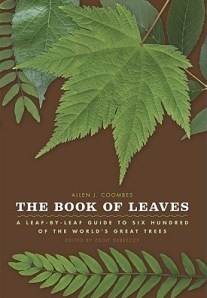
The Book of Leaves: A Leaf-by-Leaf Guide to Six Hundred of the World’s Great Trees
Coombes, Allen J. 2010. University of Chicago Press. ISBN: 9780226139739

If you have a recurring daydream about having a labeled leaf collection composed of perfect leaves that never wilt, dry, and get crunchy, stop dreaming. You can now take one step closer to making your dream a reality. Author Allen J. Coombes (Coordinator of Scientific Collections at the Herbarium and Botanic Garden of the University of Puebla, Mexico) and editor Zsolt Debreczy (Research Director of the International Dendrological Research Institute in Boston) have created a glorious collection of leaves.

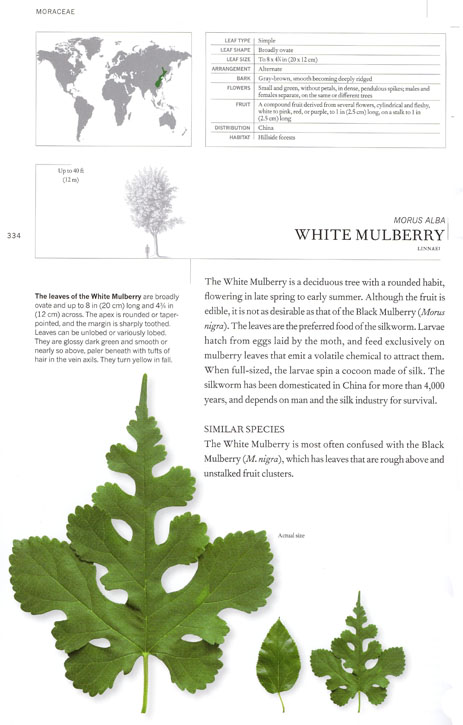
Each leaf is actual size. Leaves are arranged by family, genus, and then species. Coombes and Debreezy provide an overview of leaf morphology and teach readers how to look at leaves and how to arrange them systematically. Each entry is accompanied by a description of a leaf’s type, shape, size, and arrangement along a stem. A summary about each tree’s bark, flowers, fruit, distribution, and habitat is also included. Information about each tree’s growth pattern, observable changes in leaf appearance, ethnobotanical use, and similarity to other trees is provided as well. Of interest to plant enthusiasts and botanical illustrators in particular, is the section in which the authors arrange leaves by their position along a stem, their overall shape, the type of margin they have, and the status about their evergreen or deciduous nature. Categories in this section are labeled as “Alternate, Simple, Lobed, Deciduous” and “Opposite, Pinnately Compound, Entire Leaflets, Deciduous” and contain corresponding photographs of leaves.

Not only is this book an informative reference, it is a great way for botanical illustrators to study venation patterns and leaf margins. One look at this book and you’ll be reaching for your 0.2 mm mechanical pencil!


The Book of Leaves
is available at your local independent bookstore ($55).


Images used with permission from The University of Chicago Press

Read Full Post »

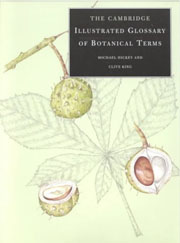
The Cambridge Illustrated Glossary of Botanical Terms
Hickey, Michael and Clive King. 2002. Cambridge University Press. ISBN: 9780521794015

We know that being able to draw plant subjects as accurately as possible is critical. Most of us have at least one glossary of plant terminology in our libraries (e.g., Plant Identification Terminology – An Illustrated Glossary by James G. Harris & Melinda Woolf Harris). Harris & Harris’ book is invaluable when trying to decipher detailed information about a plant specimen. When we reach for this book, it is because we are presented with terminology we do not understand. The illustrations accompanying each term in Harris & Harris help us see what we have never before noticed. But what do you do if you have only your plant specimen in front of you, lack the words to describe what you see, and therefore cannot look anything up?

You turn to Hickey & King’s illustrated glossary. Descriptive illustrations get top billing in this book. Most of this book is dedicated to labeled illustrations. A glossary of botanical terminology is provided for you to decipher unfamiliar terms. The illustrations in this book are very helpful, as is the way they are organized. Illustrations are organized in the following way: Roots, Storage Organs and Vegetative Reproduction; Seeds and Seedlings; Growth and Life Forms; General Features of Flowering Plants; Plant Features and Responses; Leaf-like Structures & Other Vegetative Features; Leaves; Hairs and Scales; Floral Features; Flower Structures; Features of Certain Plant Families; Fruits; Conifers and Conifer Allies; Ferns and Fern Allies.

The authors of this book express their hope “that readers at all levels of understanding, both amateur and professional, will find (this book) helpful in their chosen area of study, especially plant science, horticulture, field studies and botanical illustration.”
Plant Identification Terminology
Buy this book and Harris & Harris (2001) from your local independent bookstore.

Read Full Post »

Jackie Andrade of the School of Psychology at the University of Plymouth in the UK, wanted to know if doodling improves or hinders one’s attention to a primary task. To find out, she created a study in which 40 participants were asked to listen to a rambling telephone message about a planned birthday party. Participants were divided into two groups – a control group and a doodling group. The doodling group was placed into a “doodling condition” (Andrade, 2009) where they were given a pencil to shade squares and circles on a sheet of paper while listening to the phone message. The control group did not receive materials for doodling. All participants were asked to recall information about who would be attending the birthday party.

Andrade’s results indicate that doodlers recalled 29% more information than the participants in the control group. This study is the first test of the idea that doodling aids concentration. Andrade proposes that doodling may be enough of a stimulus to prevent boredom and reduce the likelihood of daydreaming.

To research these findings further, Andrade says additional research is necessary to understand boredom, daydreaming, and the activities that alleviate these conditions.


QUESTION TO YOU:
Do you doodle? If so, when do you doodle? (on the phone, in class, in front of the TV, etc.)


Literature Cited

Andrade, Jackie. 2009. What does doodling do? Applied Cognitive Psychology 24: 100-106. Published online 27 February 2009 in Wiley InterScience at Wiley.com. Purchase Article ($35)

Read Full Post »

« Newer Posts - Older Posts »