Feeds:
Posts
Comments

Archive for the ‘Reference’ Category

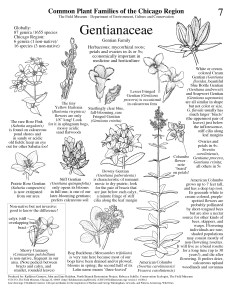
Image courtesy of Kathleen Garness. All rights reserved

Image courtesy of Kathleen Garness. All rights reserved

This week we have the good fortune to learn from Kathleen Garness, a scientific illustrator in Illinois whose botanical illustrations are being used to encourage an interest in native plants in the Chicago area. Kathleen has graciously stopped by to discuss her current projects.


    ArtPlantae
    : How did you become involved in the Chicago plant families project?

    Kathleen: I have become passionate about the need for natural areas restoration since joining the Chicago Botanic Garden’s Plants of Concern rare plant monitoring program in 2001. Plants of Concern (POC) uses a nationally-acclaimed systematic scientific protocol that records data about the species, its associates, threats to the population and land management history. Right now I am responsible for monitoring about 40 populations of 26 rare species at ten different sites in four counties in our region, reporting our findings to the Chicago Botanic Garden and the landowners.

    Why? Our rare, and even common, native species are being crowded out by non-native shrubs such as European buckthorn and herbaceous plants such as garlic mustard and teasel. Because of this, we are losing our valuable pollinators, and if we allow this trend to continue it will have disastrous economic and nutritional impacts on our well being, not to mention the tragic loss of so much of our botanical natural heritage.

    Several years ago I had been asked to consider “adopting” one of my monitoring sites, Grainger Woods, since it did not have a steward, and they hoped that restoration efforts would be able to keep it nearly pristine. Two years ago we achieved the highest level of natural areas protection afforded by the state. Now, over half of the site is an Illinois dedicated nature preserve. Grainger Woods has over 300 species of plants and is an important bird study area for Lake County IL, because the rare red-headed woodpecker has been known to nest there. One Saturday morning every month, in addition to our POC work (which may involve one or more extensive surveys per season per species and site) we clear the area of invasive non-native trees, shrubs or herbaceous plants.

    While the Chicago region is arguably the nation’s leader in natural areas restoration, our biennial Wild Things conference draws well over a thousand attendees from the region. Many volunteers lack a depth of botanical knowledge that, a hundred years ago, used to be an essential part of every high school curriculum. But now, this knowledge is in danger of being lost entirely. And many site managers and stewards don’t have the time to train their volunteers about the finer points of plant taxonomy, even if they felt it would be valuable. So one of the region’s leaders, Barbara Birmingham, a retired science teacher, has been trying to address that deficit by offering monthly field botany classes at her site every year for the past three years. She asked me to assist her in developing new materials, and since each month she focused on a different common plant family, and would be using these materials in coming years, I felt this was a worthwhile use of my skills and time.

    As the project evolved, we realized this could be useful region-wide, so I enlisted the help of many local scientists and stewards, emailing them the pages for their comments, according to their area of specialty. Chicago Botanic Garden’s Plant Conservation Manager of Regional Floristics, Susanne Masi, who co-authored The Sunflower Family in the Upper Midwest, edited the Asteraceae pages; Stephen Packard, director of Audubon Chicago Region and Kenneth Robertson from the Illinois Natural History Survey, contributed to the Rosaceae; and many others contributed to the rest of the series. John Balaban, one of the original Cook County North Branch stewards, and Rebecca Collings provided dedicated support from the Field Museum of Natural History here in Chicago. We are more than halfway through the project, having completed fourteen of the twenty-six most common plant families here. (Rebecca and I first become acquainted when I was asked by their botanist Bil Alverson to assist with Keys to Nature Orchids.

    The Field Museum provided the template, which was consistent with the other Rapid Color Guides they had already developed. We worked together as a team to come up with the design and content for each page, which I wrote and illustrated. We chose species that restoration volunteers might easily come across, as well as a few that are invasive or of special concern, to watch out for and report. Since we have so much biodiversity in our region, it was hard to choose, and for that I was very grateful for the team approach. Some of the families, such as the gentians and arums, were able to be completed in one page — the others were just an overview. We also wanted to suggest some of the important ecological relationships plants have to animals and used Milkweed Metropolis as that one example.


    ArtPlantae
    : What are the goals of this project? How do the project sponsors – The Field Museum – plan to use this information?

    Kathleen: We will be promoting the pages next February during the
    Wild Things Conference at the University of Illinois at Chicago. The Field Museum will be giving their ecology students the pages as handouts this next field season, and providing the link to the pages so that folks can also access them via mobile technology such as smartphones or digital tablets. Stewards will be able to use them as handouts in their field botany walks and restoration instructions, too.

    And I feel a clarification is in order here – by no means are they intended to replace field guides or taxonomic keys. Rather, they are a quick visual way for folks new to natural areas exploration or restoration to begin to familiarize themselves with botany basics, not feel so intimidated by the diversity our area offers, and maybe eventually purchase a field guide such as Peterson’s or Newcomb’s. So they are intended to complement the use of field guides, providing a quick visual identification to family; from there an unknown plant can hopefully be keyed to species using a field guide or an online resource such as the USDA PLANTS Database or Flora of North America. The page set also includes a short glossary.


    ArtPlantae
    : Do you envision other uses for this guide?

    Kathleen: We have shown them to regional scouting program leaders and
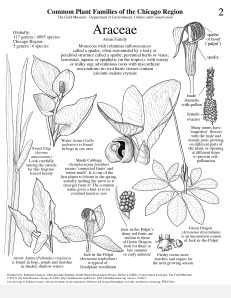
    Image courtesy of Kathleen Garness. All rights reserved

    Image courtesy of Kathleen Garness. All rights reserved

    high school science teachers, and some teachers are providing them to their classes for extra credit work. We would be thrilled to offer them to Mighty Acorns, a junior naturalist program sponsored by the Cook County Forest Preserve. Recently, the American Society of Botanical Artists graciously awarded me the Anne Ophelia Dowden grant for 2013, with which I will be able to offer art classes and distribute sets of materials, including these plant family pages, to five regional community centers, as outreach to underserved populations. These pages have sort of taken on a life of their own, now!


    ArtPlantae
    : You have mentioned in the past that there needs to be a grassroots effort to help people “make the connection between plants and well-being.” From what you’ve observed through your work with the public, where would be a good place to start?

    Kathleen: Well, we’re hoping these materials will begin to assist with this! For the last twenty years or so, there has been a groundswell of interest in natural areas restoration, organic gardening, urban horticulture, even beekeeping, not just regionally or nationally, but worldwide. Well before this, the Midwest was blessed with being the epicenter of the ecology movement, through the pioneering work of famous naturalist Robert Kennicott, who worked for the Smithsonian Institution and was a founder of the Chicago Academy of Sciences; Stephen Forbes, who was the first head of the Illinois Natural History Survey; Henry Chandler Cowles, University of Chicago, today considered the father of ‘dynamic ecology’; Aldo Leopold; and the tireless May Theilgaard Watts, who was one of Morton Arboretum’s most famous naturalists. These intrepid naturalists got out into the field every day, marveled at the wonders of nature, made careful observations, and inspired several generations that followed. So this generation, I feel, is standing on the shoulders of giants, and we need to keep the momentum going – we need to get folks outside, to have them experience the beauty of nature firsthand on a regular basis, but also provide them the tools to really SEE and appreciate what they are looking at. That is the goal of my current botanical illustration work and I see no proper end to it. I hope artists and naturalists in other regions see the value in this and do it for their communities too.


    ArtPlantae
    : You are working on another project in which economic botany and ornamental horticulture are the focus. What are the educational objectives of this project?

    Kathleen: The Oak Park Conservatory, where I am Artist-in-Residence until November 2013, has also engaged me to make similar materials about the plants in their tropical greenhouses. So far I have completed two sets – cacao and poinsettias – of the eight sets commissioned, and am now starting on the cacti and succulents. These are not family pages per se because each set’s scope is broader than just one family. I also interact with the Conservatory visitors, show them how a botanical artist works, chat about the various collections if they’re interested, and will hopefully complete my tenure there with an exhibit of new watercolors!


    ArtPlantae
    : You are doing wonderful work, Kathleen. Thank you for spending time with us this week.


More About the Field Guide

The pages of Common Plant Families of the Chicago Region are standard 8.5″ x 11″ pages and fit easily into a 3-ring binder. Since they are a standard size, the pages are also easy to laminate. Users of this guide may be interested in creating their own color-coding system while learning the features of each plant family (similar to what is used in Botany Illustrated).

Featured in this guide are the following plant families:

  • Apiaceae (Parsley Family)
  • Araceae (Arum Family)
  • Asclepiadaceae (Milkweed Family)
  • Asteraceae (Sunflower Family)
  • Brassicaceae (Mustard Family)
  • Fabaceae (Legume Family)
  • Gentianaceae (Gentian Family)
  • Lamiaceae (Mint Family)
  • Liliaceae (Lily Family)
  • Onagraceae (Evening Primrose Family)
  • Orchidaceae (Orchid Family)
  • Ranunculaceae (Buttercup Family)
  • Rosaceae (Rose Family)
  • Scrophulariaceae (Snapdragon Family)

A glossary of botanical terms is also included with the guide.

The guide Common Plant Families of the Chicago Region is available online for free.


About Kathleen Garness

The botanical/scientific illustration certificate program at Morton Arboretum was the turning point for me. While I had painted watercolors of tropical orchids for many years previous, the classes at Morton refined my pen and ink skills and fueled an interest in learning about and documenting local native species.

I really enjoy my work as a volunteer natural areas steward for Grainger Woods. My two passions – preserving habitat and documenting native species – seem to feed off each other. In 2008 my colleague Pat Hayes and I were surprised with a Chicago Wilderness Grassroots Conservation Leadership Award for our work in developing educational materials for youth as part of the national Leave No Child Inside initiative.

What feels like an eon ago, I served as board member and president of the historic Palette and Chisel Academy of Fine Arts in Chicago, and am still currently active in several local and national arts organizations. One of my most exciting opportunities, though, was the acceptance of one of my paintings into the Shirley Sherwood Gallery, Kew Gardens, London, as part of Losing Paradise? Endangered Plants Here and Around the World and in the 2011 edition of Smithsonian in Your Classroom.

I am the mother of one son, Ian Halliday, who encouraged me in this work by buying me a Wacom tablet one year for Christmas when he saw me laboring over my other avocation, the illustrations for the Little Gospels, published by Liturgy Training Publications for the Catechesis of the Good Shepherd curriculum. I still have to figure out how the Master’s in Religious Education and 20+ years teaching Sunday school figures into the artist side of me, but it all seems to fit somehow!


Additional Information About Plants of the Chicago Region

Read Full Post »

If you’re new to botanical art, you have many resources at your disposal to help you find your way. There are websites, tutorials, professional organizations, certificate programs, classes and of course, books! Many more than what existed 15 years ago. I have had the good fortune to share many books on this site and today I have the pleasure of sharing one more.

Botanical Painting by Mariella Baldwin is a rich resource for those who have a growing interest in learning how to paint plants.

In her introduction, Mariella explains she wrote her book to show people how to paint plants without fear. While she does not stress a technical, scientific approach to drawing and painting plants, Botanical Painting is definitely not a book about expressive flower painting. Far from it. It is a book about drawing with accuracy and painting for pleasure.

The thoughtful and patient conversation Mariella has with readers who lack prior painting experience made a big impression on me. Mariella clearly cares about connecting with her readers and provides confidence-building advice at just the right moments during the drawing and painting process. Always supportive, Mariella is respectful of the path each individual takes to a finished painting.

Novice botanical illustrators will appreciate Mariella’s thoughtful instruction about how to begin a

Click to enlarge, image courtesy Crowood Press

drawing. Through her guided instruction, beginners learn how to use graph paper to take measurements, how to create a mask around their work, how to approach investigative sketching and how to draw the form of their subject.

When it comes to painting, beginners are shown how to turn the painting process into manageable tasks. The instructions Mariella provides for her practice techniques are as clear as her instructions for the “official” painting steps she outlines. Throughout, photographs of her own sketches and painting studies support the written text.

Some of the topics Mariella addresses in her book are:

  • How to work with specific colors (white, yellow, orange, brown, red, pink, green, blue, purple, black and silver).
  • How to paint bi-colored flowers.
  • How to paint roots, bulbs, stems.
  • How to draw and paint leaves.
  • How to draw and paint leaf surfaces and textures.
  • How to draw and paint buds and flowers.

Click to enlarge, image courtesy Crowood Press

In a chapter both new painters and experienced painters will appreciate, Mariella reviews special techniques that will help them paint velvet flowers, hairs, bloom, cacti, sheen and shine on fruit, reflected light, aerial perspective, shadows and those ever-popular dewdrops.

Want to learn more about
Botanical Painting?


Let’s ask Mariella …

Read Full Post »

New ebook by Mindy Lighthipe


4″ x 6″

5″ x 7″

8″ x 10″

Drawings and painting in these sizes are easy to scan at home on a desktop scanner on a scanning surface that is
8.5″ x 11″. But what do you do with the rest of your work that is not only larger than this surface, but larger than your entire scanner?

Thanks to technology and natural science illustrator, Mindy Lighthipe, there is now a short practical guide to scanning your artwork.

Scan YOUR Art is a 17-page guide in which Mindy demonstrates how to scan a 11″ x 14″ painting using nothing more than your computer, your scanner, your printer and Adobe Photoshop Elements 9.0.

Mindy walks you through the process carefully and includes screenshots of each step so you can follow along as you replicate each step at home.

Mindy provides “how to” information such as:

  • How to create a folder for scanned images.
  • How to scan an image in two parts.
  • How to straighten a crooked image.
  • How to crop an image.
  • How to work with Layers in Adobe Photoshop Elements 9.0.
  • How to make quick color adjustments.
  • How to resize an image.
  • How to format a greeting card.

Mindy also provides information about printing companies and an online resource through which you can learn all the ins and outs of Adobe Photoshop Elements 9.0.

Scan YOUR Art is available as an ebook and can be purchased for $1.99.

Learn more about Scan YOUR Art

Read Full Post »

Ask and they will see.

In What Do You See?, professors Julianne Maner Coleman and M. Jenice “Dee” Goldston explain how to implement questioning strategies to enhance visual literacy in students.

What is visual literacy?

Visual literacy has to do with the ability to interpret the diagrams, charts, tables and illustrations that accompany text. Science textbooks contain many photographs, graphics and scientific illustrations. But do readers really understand them? Do they even look at them? Do teachers spend time discussing them?

After reviewing the teacher’s guide to a popular K-6 science textbook series, Coleman and Goldston (2011) concluded that teachers were probably not spending much time discussing the diagrams in their science textbooks. During their review, they found that the teacher’s guide provided little instruction about how to incorporate textbook diagrams into conversations about content. In their paper, Coleman and Goldston (2011) offer a solution to this problem and show how teachers can use “purposeful questions” (Coleman and Goldston, 2011) to enhance visual literacy and student learning.

The authors present their solution in a vignette in which a 4th grade teacher guides her student’s review of a plant cell diagram. The diagram students analyze is a cutaway diagram showing the structure of a plant cell and its contents. In the vignette presented by Coleman and Goldston (2011), the teacher guides her students’ review of the cell by asking questions such as:

  • Why did the authors include this diagram?
  • What do you see in this diagram?
  • What in the diagram helps us to know what we are seeing?
  • What can we learn about plant cells from the diagram?
  • How does the artist show the cell is like a water-filled baggie and not flat like the paper?
  • How does the artist draw the plant cell to show its depth?

These questions spark much discussion about what the students see in the cutaway diagram. It becomes clear that students understand the authors of their textbook included this particular diagram because they wanted students to learn what plant cells look like and what’s inside of them.

Because of their teacher’s thoughtful questioning, students make insightful observations about how the artist used a line to mark the cell’s edges and used different colors to make it look three dimensional. The teacher supports her students’ observations by explaining how artists use shading, lines and other techniques to present information that is otherwise not easy to see (Coleman & Goldston, 2011).

In the vignette, this conversation is followed by an activity in which students use microscopes to observe onion cells, Elodea cells, and then compare these live cells to the diagram in their book.

In What Do You See?, the dialogue between the teacher and her students is written out in detail and clearly demonstrates how purposeful questioning can support student understanding of diagrams and other graphics used in science textbooks.

In their paper, Coleman and Goldston (2011) provide three tools teachers can use to enhance the visual literacy of their students. These tools are:

  • A classification guide describing the types of diagrams found in textbooks.
  • A sample evaluation sheet students can use during inquiry activities.
  • A guide to questioning strategies and examples of the type of purposeful questions teachers can ask their students.

What Do You See? is recommended reading for anyone with an interest in visual literacy and the role images play in science education.

This paper can be purchased online (99¢) from the National Science Teachers Association. Alternatively, you can search for a copy of this article at your local college library.


Literature Cited

Coleman, Julianne Maner and M. Jenice “Dee” Goldston. 2011. What do you see? Science and Children. 49(1): 42-47.


Related

Read Full Post »

Forester-Artist Bruce Lyndon Cunningham and professor, Dr. Elray S. Nixon, have published the third edition of Trees, Shrubs & Woody Vines of East Texas. The revised edition of this field manual contains keys and illustrations to over 300 woody plant species and an illustrated glossary of plant structures containing over 200 terms.

To order your copy of this new field guide, contact Bruce L. Cunningham. ($59.95, paperback)

Bruce and Dr. Nixon also wrote Gymnosperms of the United States and Canada (2010).

Related

Read Full Post »

Pierre Joseph Redouté (French, 1759-1840 ), A Bouquet of Flowers with Insects, watercolor with gold on vellum; laid down, Ailsa Mellon Bruce Fund. Courtesy National Gallery of Art, Washington.

The National Gallery of Art on the National Mall in Washington, DC announced a new online resource for teachers last week. This resource makes available more than 20,000 images teachers can search, share and download for the classroom. Available through the Gallery are open access images the Gallery believes to be in the public domain. Teachers, scholars and the public may download these images free of charge.

Instructors of botanical art will find drawings and paintings of flowers and trees they may want to share with students in their presentations about botanical art history, drawing or painting. Paintings that may be of particular interest to botanical artists are the paintings by Pierre Joseph Redouté and the two paintings and one drawing by Jan van Huysum. Images are available in high-resolution format and in a “Quick Download” format for presentations and screen use. Each image can be viewed in a “lightbox” format. In this format, details about each image are provided and this information can be printed on a single sheet of paper.

Users of this national online resource should read the Open Access Policy before downloading images.

Go to NGA Images

Read Full Post »

A steward of the environment, especially California’s Sierra Nevada, John Muir Laws, has dedicated himself to revealing the natural world through art and science.

John (Jack) Laws has been an environmental educator for 30 years. He recently collaborated with the California Native Plant Society and with English instructor, Emily Breunig, to create a wonderful curriculum integrating art, science and the language arts.

I am thrilled to introduce John Muir Laws and Opening the World Through Nature Journaling, the Feature Curriculum for December.

John has kept a sketchbook since elementary school. Challenged by dyslexia, he found that keeping a journal was the easiest way to record his experiences. Drawing and sketching helped him see things he had never noticed before. John’s mom gave John his first sketchbook. One year during a family trip, John and his family met a woman who was keeping a wildflower sketchbook. John’s mom noticed how he followed this woman and her sketchbook throughout their trip. On the next family vacation, John’s mom gave him a sketchbook and colored pencils so he could document their vacation. Little did she know that years later, John would use sketchbooks as a teaching tool.

While working as a naturalist group leader at Walker Creek Ranch in northern California, John led activities designed to connect children to nature. He decided to incorporate journaling into his activities to help students slow down and focus in the same way his own journals helped him to slow down and become a better observer. He soon began to notice differences between his journaling audience and the groups of children who ran through the ranch without stopping to see what was really there. John began to expand upon his journaling exercises. The Marin County Outdoor School at Walker Creek Ranch became a great testing ground. It took about four years for John to develop his activities. He wrote up his observations, began sharing them with other naturalists and teachers, and over a period of 10-15 years, his activities were tested hundreds of times and refined. This collection of journaling exercises eventually became Opening the World Through Nature Journaling.

The response to Opening the World Through Nature Journaling has been “amazing”, according to John. He says “(the curriculum) has been well-adopted in California and across the country. Teachers get this is authentic student-driven education.”

While John was developing and testing journaling activities, he was also launching the program Following Muir’s Footsteps and working on his book, The Laws Field Guide to the Sierra Nevada (2007).

Following Muir’s Footsteps is a conservation project for schools in the Sierra Nevada region whose aim is to encourage local youth to become citizen stewards of the Sierra. Encompassing an eighteen-county area around the Sierra Nevada, Following Muir’s Footsteps connects youth to nature through firsthand experiences and journaling. Through this program, John provides in-service training for teachers about how to use field guides and how to use science journals in their classrooms. He also sponsors one mentor teacher from each school so they can attend the Sierra Nevada Teacher Institute, a summer program where teachers learn about the biodiversity of the Sierra Nevada. School libraries also benefit from this fantastic program. The library of each participating school receives 25 copies of The Laws Field Guide to the Sierra Nevada.

The idea to create his comprehensive field guide to the Sierra Nevada was hatched when John was in high school. One day, while hiking the John Muir Trail and juggling many field guides, he thought how wonderful it would be to have all of his field guides packaged into one portable book. By the time he finished high school, John says he could visualize the pages, the layout — everything. John’s grandmother encouraged him to begin working on his dream. At about this same time, he came across a poem by Mary Oliver called The Journey. The first line of this poem read:

One day, you finally knew what you had to do, and began.

So John quit his job and says he “filled my backpack with paper and granola.” He spent the next six years documenting the flora and fauna of the Sierra Nevada. In the early stages of this full-time project, he drew whatever he encountered. At the end, he went into the field with species lists. John says the last few species on his list were a particular challenge and that locating them was a true “scavenger hunt.”

How did John take on the expansive Sierra Nevada? He started at the lower elevations in the south and, as plants bloomed in the Spring, he followed the bloom hopping back and forth between the west side and the east side. Every 1-2 weeks, John hiked out to pick up fresh supplies, get more paper, bathe and shave.

In The Laws Field Guide to the Sierra Nevada, you will find descriptions of over 1700 species and 2,700 watercolor paintings. John drew each plant from life and each illustration was started and completed in the field. Illustrations of birds, insects and mammals began as quick gesture sketches in the field. They were then finished in the studio after a careful study of museum skins, reference materials, and the collections at the California Academy of Science.

When asked how it is he can make so many big things happen, John says none of his programs were launched as big complete packages. He explains, “It was an accumulation of a lot of little pieces coming together organically. This is what makes it possible to do something big.”


Ask The Artist with John Muir Laws

John received a Bachelor of Science in Conservation and Resource Studies at UC Berkeley and a Master of Science in Wildlife Biology at the University of Montana. He is also a graduate of the scientific illustration program founded at UC Santa Cruz, that is now taught at California State University Monterey Bay. In 2011, John received the TogetherGreen fellowship from Audubon/Toyota and this enabled him to deliver the Following Muir’s Footsteps program to 10 schools in the Sierra Nevada. This month, we have the extraordinary opportunity to discuss art, science and education with John.

To take advantage of this opportunity, post your questions or comments in the comment box below. John will respond to questions throughout the month of December.

Teachers, do you know of other teachers who might like to join in the conversation? Please send them the link to this article. The conversation will happen right here on this page.


Request a copy of Opening the World Through Nature Journaling

To request your own copy of the nature journal curriculum written by John Muir Laws and Emily Breunig in collaboration with the California Native Plant Society, click here.


Drawing Plants: Tutorials by John Muir Laws

John recently posted tutorials about how to draw plants on his website. These tutorials were created specifically for teachers. The demonstrations are easy for teachers to recreate in their own classrooms. Leaf and flower templates are available for download. View John’s instructional videos in the Nature Drawing section of his website.


Get “The Laws Field Guide to the Sierra Nevada”

Read Full Post »

« Newer Posts - Older Posts »