Feeds:
Posts
Comments

Archive for the ‘Plants Life Riverside’ Category

Family Fun at FallFest 2014

Join ArtPlantae at the 2nd Annual FallFest at Fairmount Park in downtown Riverside, CA. Stop by to learn about the “Plants, Life, Riverside” project and about learning opportunities through the InterpretPlants program.

This fun-filled educational event has been arranged by Inland Empire Waterkeeper and CREEC Region 10. Learn about local educational organizations, visit the pumpkin patch and enjoy a festive autumn afternoon at Fairmount Park.

FallFest 2014 will be held on Saturday, October 11, 2014 from 1-5 pm.

Visit Fairmount Park on Facebook

Click to download flyer

Click to download flyer

Read Full Post »

Plants, Life, Riverside is an ongoing interpretive project about plants in an urban setting. How are natural areas managed in the 12th largest city in California? Let’s find out.


The City of Riverside has a new nature center!

The Ameal Moore Nature Center in Riverside’s Sycamore Canyon Wilderness Park opened June 14, 2014. Named in honor of former councilman Ameal Moore, the nature center is a testament to Councilman Moore’s dedication to connecting Riverside residents with local natural resources.

Excited about the start of a new school year, the nature center’s five part-time educators are ready to welcome students, teachers, parents and the community.

Managed by the Riverside Metropolitan Museum, the Ameal Moore Nature Center will soon announce educational programs supporting its citizen science objectives and the use of the park as an outdoor research center. The park’s 1,500 acres makes Sycamore Canyon Wilderness Park the second largest municipal park in the United States, second only to Griffith Park in Los Angeles.

Among the educational programs planned at the new nature center are programs about Native American culture. The museum has been working with faculty in Native American Studies at UC Riverside, the Sherman Indian Museum and members of the local Cahuilla indian community. The first program to emerge from this exciting collaboration is Spring Break Camp 2015, an immersive experience in Cahuilla culture. Participants will learn about the Cahuilla language, basket weaving and storytelling, and will also learn about the plants, animals and ecology of Sycamore Canyon Wilderness Park. This camp will be held March 30 – April 3, 2015 and will be open to students ages 6-12. Parents interested in enrolling their children in this fantastic opportunity are encouraged to contact the Riverside Metropolitan Museum at 951-826-5273.

Sycamore Canyon Wilderness Park is home to thirty-three plant families, four families of amphibians and reptiles, thirteen bird families and eight families of mammals.

Last year the Riverside Metropolitan Museum and its partners launched a citizen science project and a new app called Riverside Nature Spotter. The objective of the citizen science project is to document the plants and animals observed in Sycamore Canyon, as well as the plants and animals observed within the city. Riverside residents are invited to participate in this project. It is very easy to participate and regular trips to the museum or the nature center are not necessary.

To contribute to this exciting community project, Riverside residents only need to do the following:

  1. Download the Riverside Nature Spotter app (available at the Apple App Store or the Google Store).
  2. Use the Riverside Nature Spotter app to photograph the plants and wildlife they see in their neighborhoods while at home or while enjoying a leisurely walk, an urban hike or a bike ride.
  3. Upload photos to the Riverside Citizen Science project page at iNaturalist.org.


What is iNaturalist?

The iNaturalist website is an online community where people can communicate with fellow naturalists and scientists. This interactive platform, originally created as a Master’s project at UC Berkeley in 2008, was acquired by the California Academy of Sciences earlier this year. This platform enables groups to form projects on the iNaturalist website and the Riverside Citizen Science project is one of thousands of projects at iNaturalist.

If you would like to participate in this project but are worried about not knowing the names of local plants or animals, set your concerns aside. When you submit photos to the Riverside Citizen Science page, you can ask the museum’s naturalist (Curator of Natural History, James Bryant), to identify the plant or animal for you. If you prefer to identify unknown specimens yourself, resources are available to help you with this task. The Riverside Citizen Science page features links to field guides about local plants, mammals, insects, amphibians, reptiles and fish. These field guides can be viewed online or printed in a grid format, a book format or a journal format.

One of eight protected core reserves for the Federally-listed endangered Stephens’ kangaroo rat, Sycamore Canyon is noticeably void of the anxiety and stress of our 24/7 instant-messaging 21st-century lifestyle. This has no doubt contributed to the park’s popularity with mountain bike riders and fitness enthusiasts. There is much to see and a lot to learn at Sycamore Canyon Wilderness Park and the Ameal Moore Nature Center adds a new dimension to the park. Teresa Woodard, Curator of Education at the Riverside Metropolitan Museum, says the new nature center affords residents the opportunity to experience nature in the city and to experience nature as a leisure activity. She hopes the programs offered at the new nature center encourages people to look at life in the park more closely and encourages conversation about how to manage our natural resources.

Sycamore Canyon Wilderness Park is open 1/2 hour before sunrise and closes 1/2 hour after sunset. The nature center is open to the public Saturday and Sunday from 9 am – 5 pm and starting October 8th, Wednesday through Sunday from 9 am – 5 pm.

Get Involved
Riverside residents are invited to help the Ameal Moore Nature Center plan its public programs. To offer your thoughts, complete the short three-question survey at MySycamoreCanyon.com, the official website of Sycamore Canyon Wilderness Park. The survey is available in both English and Spanish.

Learn More
View video about the Ameal Moore Nature Center

Read Full Post »

Plants, Life, Riverside is an ongoing interpretive project about plants in an urban setting. Today we learn about the river flowing through this urban landscape.


The city of Riverside has the name that it does because of its proximity to a river that flows through town. Unfortunately many area residents are unaware of the river’s presence and never linked the name of their city to this natural waterway.

Increasing public awareness about the river, increasing the public’s use of the river and increasing public stewardship of the river are the core objectives of the Santa Ana River Trust, an organization founded in 2011 under the fiscal sponsorship of the Riverside Land Conservancy. 

How did the Santa Ana River disappear from public view?

The river became invisible for a few reasons, explains Amber Dobson, Program Director. Dobson first cites a long period during which development turned its back on the river. She also explains that in the early 1800s, a waste dump was built adjacent to the river. Compounding the river’s visibility problem is the fact that the Santa Ana River doesn’t match the public’s idea of what a river should be. Lined with concrete in certain sections and planted with large concrete energy dissipaters, the Santa Ana River doesn’t look like a river one might see in a more natural open space area.

Traveling alongside the river is the Santa Ana River Trail, a soon-to-be 110-mile bike path and pedestrian trail. I asked Dobson if people were more aware of the trail than the river and she said a small part of the community is aware of the recreational trail. While it is popular with cyclists and some joggers, they do not seem to be aware that it serves as a backdrop to a wildlife corridor.

Determining what the public knows and does not know about the river is a task that Dobson and colleague Rachel Hamilton address each year in a public survey. Their annual survey is posted on the Trust’s website and Facebook page each August and remains up through the end of the year. During this survey period, Dobson and Hamilton bring paper surveys to the trail so that trail users can also participate. Two years’ worth of public comments have revealed that the top concern of trail users is the availability of restroom facilities and safety.

For those of you not familiar with the Santa Ana River, the river has a bit of a negative reputation. The Trust is addressing this by holding family events, nature walks and fundraisers to educate the public about all issues concerning this waterway. They also organize public clean-up days with the group Keep Riverside Clean & Beautiful, an entity of the city’s Public Works department. The Trust is currently working with the Mission Inn Foundation to become involved in the construction of a soft trail, a trail for walkers and joggers that will be constructed along the paved trail. The soft trail will separate pedestrians and cyclists and is an effort to reduce the number of accidents that occur on the path.

Recently respondents have expressed interest in using the river for recreational purposes. Swimming is already a popular activity during spring and summer, as is fishing. Both activities have occurred for many years. There is new interest in kayaking, an activity that coincidentally, is a new recreational activity occurring in the Los Angeles River. 

Interestingly, Dobson says that when she speaks about the Santa Ana River in Los Angeles, she receives a more positive reaction from L.A. residents than she does from residents in the Inland Empire. She credits the river revitalization efforts in the L.A. area with establishing a more river-minded community.

I asked Dobson what the biggest misperception is of the river and she said the public holds two misconceptions. The first being the river’s existence and the second being the quality of the water in the river. She said people have the perception that the water is very dirty. However it is actually cleaner than most people think. The Trust has performed water quality tests with Pomona College and Inland Empire Waterkeeper and results show the water is clean and safe for body contact. 


Visit the River

Would you like to learn more about the Santa Ana River and visit it yourself? 

Residents of Orange, Riverside and San Bernardino counties can access the trail at several locations. Visit the website of the Santa Ana River Trail & Parkway to view the location of each trailhead and to learn more about the river.

Riverside residents can view the trail from many locations in the city. Dobson recommends three easy-access viewing locations where residents can experience the river and its natural environment:

  • Walk to the top of Mt. Rubidoux for a panoramic view of the river.
  • Visit Martha McLean/Anza Narrows Park to see the river and to access the Santa Ana River Trail.
  • Views of the lush landscape growing along the river can be enjoyed at Rancho Jurupa Park.


Get Involved

  • Jurupa Valley Community Clean-up Event
    Go to the Santa Ana River Trust website and click on “Programs.”
  • Help the Santa Ana River Trust Create the Santa Ana River Conservancy
    Supporting the creation of the Santa Ana River Conservancy will help preserve and restore the Santa Ana River. Use the sample letter or write your own explaining how important it is to you (a citizen living near the Santa Ana) to have state support for the longest river in Southern California. To learn more, see SB-1390 Santa Ana River Conservancy.


Connect with the Santa Ana River Trust

Contact the Trust at membership@santaanarivertrust.org.


More About the Santa Ana Watershed

Learn about the Santa Ana Watershed Association

Read Full Post »

Plants, Life, Riverside is an ongoing interpretive project about plants in an urban setting. How are natural areas managed around the 12th largest city in California? Let’s find out.


Martha Mclean Anza Narrows Park and the Santa Ana River Trail

Martha Mclean Anza Narrows Park and the Santa Ana River Trail

The City of Riverside is home to more than 311,000 residents and is divided into twenty-six distinct neighborhoods covering 81 square miles (Riverside Office of Economic Development, 2014). There is a lot of concrete, asphalt and stucco out here and commutes during rush hour can be absolutely horrible. 

Riverside is located on the western edge of Riverside County, a county covering over 7,200 square miles of southern California (County of Riverside, 2014). While heavily populated, it does have natural areas where plants and animals are protected. These areas, and other open space areas in western Riverside county, are protected by the Multiple Species Habitat Conservation Plan.

The Multiple Species Habitat Conservation Plan (MSHCP) was created to establish a balance between land development, the protection of plants and animals, and the establishment of a sustainable economy while complying with state and federal Endangered Species Acts. Implemented in 2003, the MSHCP is a component of a larger project called the Riverside County Integrated Project (RCIP).

The MSHCP addresses many issues. To learn more about the Plan, I contacted Patricia Lock-Dawson, former grant writer for the County who was involved with the creation of the MSHCP. She is also one of the authors of the MSHCP Implementation Guidance Manual used to train city planners working in the fourteen cities covered by the Plan.

According to the MSHCP, the population of Riverside county will increase 400% by the year 2040 to 4.5 million people, with most of this growth occurring in the Inland Empire (MSHCP, Section 1.2.1). To prevent fragmenting open space and creating small islands of habitat unable to sustain local species, the Plan establishes a protocol guiding land use decisions. The Plan covers 1.26 million acres and 146 listed and unlisted species (MSHCP, ES.6 Goals of the MSHCP).

The Habitat Conservation Plan took about 8 years to complete. The specific function of the Plan, according to Lock-Dawson, is to streamline the economic development of the region by offering a “one-stop shop” where developers can satisfy permitting requirements with the County, the state and the federal government without running around pulling permits from every agency. The Plan enables developers to satisfy permit requirements by working with one entity — the County’s Habitat Conservation Authority.

A search of published newspaper articles revealed that the Plan has both supporters and opponents. The Plan has always had its ups and downs when it comes to public perception and Lock-Dawson says the biggest challenge the Plan faced was getting cities and developers to sign-on. Everyone was suspicious of the Plan. Cities and developers thought the Habitat Conservation Plan would interfere with development and natural resource agencies were concerned the County would not be a good steward of local natural resources and let development go wild. The County had to work diligently to earn the confidence of all parties. 

The MSHCP is a document with good intentions and is designed to benefit both people and nature. However I think it’s safe to say that only a small number of people have browsed through it. This is unfortunate because this document is not only for county officials, biologists and land owners. Anyone can read the Plan. Residents of western Riverside county can even see how the MSHCP applies to their area by entering their Assessors Parcel Number into the Conservation Summary Report Generator

In addition to being a comprehensive and thorough conservation plan, the MSHCP is a great interdisciplinary educational tool. I asked Lock-Dawson how she would explain the MSHCP to kids to teach them about local natural resources. She said she would begin by not using the acronym and would refer to it as something other than a “conservation plan” because the concept might be too much for young children to comprehend. She says she would present it first as a big map and say, “Here’s where plants and animals live” and then show how habitat has changed over time. She would then explain to kids that many people worked together to make sure the natural areas in our region would be preserved for them and for their children. 

I asked Lock-Dawson what she would like people to know about this often misunderstood document. She said she would like them to understand that these types of efforts keep Riverside from becoming a place where no one wants to live. She adds, “It is what keeps our world beautiful. Natural resources need to be managed and controlled. We are not the only ones here. We have a responsibility towards the future.”


The MSHCP in the Classroom

The Multiple Species Habitat Conservation Plan is much more than a heavy government document. It is a treasure chest of ideas for the classroom. I quickly made note of some topics in the MSHCP and then spent time on the website of the Next Generation Science Standards browsing topics and core ideas. What a way to make a school-home-nature connection!


Literature Cited

City of Riverside, Office of Economic Development. Retrieved March 24, 2014 from http://www.riversideca.gov/econdev/data-and-demographics.

County of Riverside, California. Riverside County History. Retrieved, March 24, 2014, from http://www.countyofriverside.us/Visitors/CountyofRiversideInformation/RiversideCountyHistory.aspx.

Read Full Post »

Plants, Life, Riverside is an ongoing interpretive project about plants in an urban setting. Where do plants live in this city of concrete, asphalt and stucco? Let’s find out.


Landscapes Southern California Style. © 2013 ArtPlantae

Landscapes Southern California Style

Water is a precious commodity in southern California. It needs to be used wisely, managed wisely and conserved as much as possible. According to the Western Municipal Water District, 60% of all water used in a single family home is used to water its landscape. How can we manage this 60% as wisely as possible?

Riverside residents can find the answer to this question at the demonstration garden on the corner of Alessandro Blvd and Mission Grove Parkway. You may have seen this garden while traveling on Alessandro. More accurately, you may have seen the large banners hanging on the corner advertising community events such as Earth Night in the Garden, native plant sales or reminders to water less during a maintenance period.

If this is what you normally catch a glimpse of as you dart through the intersection, I invite you to explore what is behind these corner banners.

It’s official name is Landscapes Southern California Style. It is a demonstration garden managed by the Western Municipal Water District (WMWD), the water district that serves approximately 527 square miles of western Riverside County. Built in 1989, this garden is open to the public from 10 am – 4 pm daily (except holidays). Admission is free, as are the informational flyers in the garden’s Resource Patio. It only takes one visit to this informative garden to change your thinking about water conservation.

Upon entering the garden, visitors learn that early California settlers brought with them their taste for lush water-hungry plants. These were plants settlers grew at their previous homes located in high rainfall areas in the eastern United States. These types of plants were not practical choices then and they are not practical choices today, especially given the severe drought conditions in California. Fortunately, the WMWD demonstration garden presents homeowners with several water-wise alternatives.

Created by the WMWD with assistance and expertise provided by the University of California Cooperative Extension, the garden presents many ideas about how to create a California style garden that is beautiful, useful and healthy, while conserving water and saving homeowners time and money. Garden visitors can see examples of water-wise plants as they walk through the garden.

Demonstration showing how to make water-wise landscaping decisions around a family patio.

Demonstration showing how to make water-wise landscaping decisions around a family patio.

They can also learn about irrigation, learn about the water cycle, and see an example of how to place water-wise plants around a patio.

One visit to the garden is almost certain to lead to many more visits because of the range of learning opportunities provided by the water district and local organizations such as the Riverside County Master Gardeners, the California Native Plant Society, the Iris Society and many others.

The Riverside County Master Gardeners work closely with the water district and host most of the educational events in the garden. They teach nine workshops per year, each drawing about 70 people. On the days they teach, up to 200 people visit their information table. The Master Gardeners now lead tours of the garden Wednesday through Sunday. To schedule a tour, download a request form on the Master Gardener’s website or the WMWD website.

If you’re interested in attending one of the free garden workshops presented by the Riverside County Master Gardeners and WMWD, here is a schedule of upcoming workshops:

    Creating a Pet Safe Garden
    April 12, 2014 at 11 AM
    Presented by Cathy Konyn, Master Gardener

    Edible Flowers in Your Garden
    April 12, 2014 at 11 AM
    Grow edible flowers that can add unique touches and flavors to food and drink. Presented by Jean Weiss, Master Gardener and UCR Botanic Gardens lecturer.

Local residents can also look forward to events such as Experts in the Garden scheduled for June 14, 2014 and the California Friendly Landscape Training class that takes a watershed-sustainability approach to gardening. The WMWD recently received funding for a customer handbook about how to be water-wise while living in a watershed. The effort to create this handbook will be led by WMWD horticulturist, Pam Pavela, who explained that water districts are taking a very serious approach to water management in the Santa Ana Watershed. Local water districts are working with the Santa Ana Watershed Protection Agency in an integrated planning effort titled One Water, One Watershed that addresses the water management issues for this region of southern California.

Landscapes Southern California Style is not the only demonstration garden in the Inland Empire. Demonstration gardens can also be found in Chino, Claremont, Montclair, Perris and Rancho Cucamonga. The newest garden in the Inland Empire is the Cal State San Bernardino Water Conservation Garden featuring desert plants, native plants and plants from Mediterranean regions. Residents can learn more about each of these gardens at IEGardenFriendly.com.


Did you know…

  • Lists of California water-wise plants are created by water districts and cities after referring to the Water Use Classification of Landscape Species, a resource containing information about the water needs of over 3,500 taxa in six different climate regions of California?
  • The Western Municipal Water District has an incentive to help residents replace their grass lawn with a more climate-appropriate landscape?
    Learn more at WesternTurfReplacement.com.
  • If you already have a water-wise landscape, you can show it off by entering Western’s regional landscape contest?

Read Full Post »

Plants, Life, Riverside is an ongoing interpretive project about plants in an urban setting, continuing ArtPlantae’s mission of encouraging an interest in plants and addressing the subject of “plant blindness”. Where do plants reside in this city of concrete, asphalt and stucco? Let’s find out.


CN_inrectangle.wseal.tag The Inland Empire region of southern California is home to many native species of plants and animals. It is also home to many invasive species that threaten local plant communities and animal populations. The Inland Empire is a two-county area east of Los Angeles composed of San Bernardino and Riverside counties. In terms of mileage, the Inland Empire (or “IE”) is generally 60 miles from Los Angeles. In terms of drive time…well, the 80-mile commute to west Los Angeles from Riverside can take 3.5 hours during peak commuting hours. 

Nestled below the San Bernardino Mountains, is the Santa Ana Watershed. The watershed is an area of land through which water flows from the mountains to a single outlet at the Pacific Ocean. Water flowing from the mountains travels through four counties on its way to the ocean. These counties are San Bernardino, Riverside, Los Angeles and Orange County. The Santa Ana watershed, its plant and animal communities and its namesake river are monitored by many resource conservation districts whose objectives are to promote the care of natural resources within the watershed.

The Santa Ana Watershed Association (SAWA) SAWAlogoTR2-2 began as a collaborative of local Resource Conservation Districts and the Orange County Water District. Formed in 1996, the purpose of the new association was to eradicate Giant Reed (Arundo donax) and other invasive species that had established themselves in the Santa Ana River. The Association became a nonprofit organization in 2000.

While earlier efforts focused primarily on field work, biological monitoring and habitat restoration, SAWA realized there was a need to educate the public about watershed issues. The Education and Public Outreach Department was formed in 2008 and in five short years, the three-person department has established itself as a major player in environmental education. The educators at SAWA participate in 30 outreach events per year, host four to eight educational events of their own and host four volunteer days (e.g., “clean up” events) at different locations in the Inland Empire. The Education Department connects with 12,000 people per year through its workshops, field trips and events, operates an interpretive center at Chino Creek Wetlands and Educational Park and is responsible for establishing the California Naturalist program in the Inland Empire.

You may already be familiar with the Master Gardener program and its requirement of 40 class hours and volunteer time. The California Naturalist program is similar in that it also requires 40 class hours. It differs from the gardening program in that it does not currently have the volunteer requirement. Participants are instead required to complete a capstone project to earn certification. Capstone projects must be a citizen science project, an educational or interpretive project, or be a work effort benefiting a local environmental organization.

river-2The California Naturalist program was created by UC Davis as a way to promote environmental literacy and engage California residents in the stewardship of California’s natural resources. This program exists in the Inland Empire because of the tireless efforts of Carrie Raleigh, SAWA’s Education and Public Outreach Manager. Carrie was already familiar with naturalist programs for the public because she herself had completed Florida’s Master Naturalist program in 2006. She returned to California, began work with SAWA and in 2011 began looking for a comparable program in California. She learned about the California Naturalist program through the UC Cooperative Extension. One of the first adopters of the program in inland southern California, Carrie worked on the program with her staff for two years and launched the Inland Empire California Naturalist program in
Fall 2013. 

Subject areas covered in the 40-hour program include: native plants, nature journaling, geology, climate, water resources, wildlife, forest and woodland resources, interpretation, communication, citizen science, and global environmental issues.

Thirty-six states have a Master Naturalist program. If you are interested in becoming a certified naturalist in your area, look for Master Naturalist programs near you.

If you live in the IE and want to learn more about the local California Naturalist program, see California Naturalist in the Inland Empire. To inquire about upcoming sessions, contact Carrie Raleigh.

UPDATE
On May 29, 2014, the Santa Ana Watershed Association closed its Education department. To inquire about future programming in the Inland Empire for the California Naturalist Program, please click on the link below.


Related Resources

Read Full Post »

Plants, Life, Riverside is an ongoing interpretive project about plants in an urban setting and expands ArtPlantae’s mission to encourage an interest in plants. Where do plants reside amidst miles of concrete, asphalt and stucco? Discoveries will be posted in this new column.


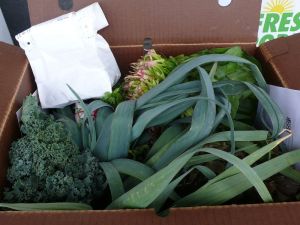
RFC Crop Box

Crop Box from Riverside Food Cooperative

Where can you find plants in the city?

Why in the fridge, of course. Open your refrigerator and you will find a selection of fruit, vegetables and plant-based food items such as tomato ketchup and mustard.

I am thrilled to launch this column by introducing you to an organization whose focus is to bring fresh, healthful food into the homes of Riverside residents.

The Riverside Food Cooperative (RFC) is a not-for-profit organization born out of the Occupy Movement. Founder William Cobb participated in Occupy Riverside and began the food cooperative because he wanted to establish a source of organic food available in bulk for local residents.

The Cooperative’s objective is to open a grocery store between Riverside’s historic downtown area and the University of California Riverside campus. The Cooperative is currently raising money to establish their store. The money to pay for the building, refrigerators and other construction expenses is being raised by selling lifetime memberships.

The Riverside Food Cooperative began as an idea and it was this idea I encountered when I visited their booth at the 2012 Riverside Neighborhood Conference in downtown Riverside. They weren’t selling memberships back then, they were only promoting their idea. Since this conference, they incorporated and became a not-for-profit organization in Spring 2013. Membership in the cooperative is a one-time fee of $300 that can be paid in installments of $10 per month. Currently the cooperative has 43 members. The RFC Board says they need 700-1000 memberships to move forward with the grocery store.

Because membership fees are dedicated to the establishment of the grocery store, the cooperative pays for its operational expenses in another way. They pay for these expenses by selling Crop Boxes to members.

For only $27 per month, members have the option of receiving a Crop Box filled with fresh locally grown fruit and vegetables. Each month the Crop Box contains 12-15 items. The day I visited the pick-up location, members were

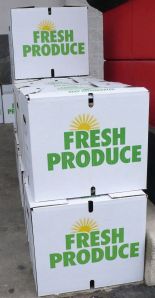
Crop Boxes ready for pick-up.

Crop Boxes

being treated to sunflower sprouts, mandarin oranges, a Meyer lemon, a Zutano avocado, leeks, spinach, broccoli, garlic, red leaf lettuce, kale, radishes, cilantro, snap peas, Etta Mae Gourmet artisan jam and Whole Chinese 5-spice ingredients.

As I watched members come and go, I noticed that they arrived with a smile and were eager to trade the now-empty cardboard Crop Box they received last month for a new box filled with nutritious food.

The Riverside Food Cooperative sources their produce from local farmers. They try to get the best of local produce and aim to include 12 items in each box. The selection of produce changes with the seasons and the balance of the items comes from whatever crop is available.

I spoke with Treasurer Sue Struthers the day I visited the pick-up location. Sue is not only the Treasurer, she is also the author of the recipe booklet included in each Crop Box. She writes a new booklet each month. Sue says that eventually the cooperative plans to host cooking classes so they can teach people how to eat healthfully, inexpensively and creatively using the food they receive from local growers.

To encourage the recruitment of new members, the co-op offers special member promotions. This month Riverside Co-op members can receive a free crop box for every new member they bring to the co-op at the $100 or full membership level by February 16. Members can enjoy the crop box they receive, share it with a friend or donate it through the Riverside Food Co-op to Operation Safehouse.

Learn more about the Riverside Food Cooperative on their website and on Facebook. You can also speak with them in-person at the Grow Riverside conference, a conference for local businesses and residents exploring the economic feasibility of urban agriculture. This conference will be held at the Riverside Convention Center March 19-20, 2014.


Related Resources

Read Full Post »

« Newer Posts - Older Posts »