Feeds:
Posts
Comments

Archive for the ‘History’ Category

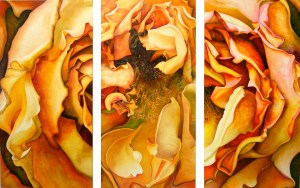
Centering © 2012 by Neena Birch. All Rights Reserved. Oil on canvas, Triptych, 48 x 24 inches, each panel.

Inspired by artists’ use of plants as symbols across cultures and throughout history, the botanical artists of Studio 155 have created an exhibition dedicated to symbolic subjects in nature. The exhibition Beyond Words: The Symbolic Language of Plants includes works in watercolor, oil, tempera, and colored pencil. This exhibition opens Saturday at the Delaware Art Museum in Wilmington, Delaware.

In the ancient world, Roman artists used roses to represent Venus, the goddess of love; Egyptian art connected the lily to Isis, the goddess of fertility; and Asian art included lotus flowers to convey beauty. Plant symbolism reached a high point in Medieval Christian art when religious craftsmen and artists used plants to explain the meaning of church parables and doctrine to a largely illiterate population.

In keeping with this tradition, the seventeen artists of Studio 155 created drawings and paintings that bring attention to symbolic themes represented by flowers, trees, fruit, vegetables, herbs and vines. For example, museum visitors will see the whimsical watercolor painting by Wendy Cortesi of a pumpkin that recalls Dia de los Muertos, the Hispanic tradition “Day of the Dead”. They will also see Neena Birch’s rose painting symbolizing ancient spiritual contemplation and centering, as well as Michael Rawson’s painting of a white oak representing strength and endurance.

The artists of Studio 155 have also published a fold-out book called Small Works. This handmade book created by Elizabeth W. Carter features 4″ x 4″ plant idioms painted by each artist. Idioms include “Shrinking Violet” and “Apple of His Eye.” When viewing Beyond Words, museum visitors will be encouraged to match the idioms on the gallery’s list to a corresponding painting in the exhibition.

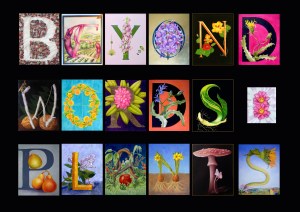
Studio 155 created the fun exhibition postcard at right by painting 10″ x 8″ letters in oil, watercolor or colored pencil and then mounting the letters on a panel. Learn more about the artists behind these letters on the Beyond Words website. The Small Works book is also available for viewing on this site, so be sure to visit and try your hand at matching idioms to their paintings!


Beyond Words: The Symbolic Language of Plants

Delaware Art Museum
Wilmington, DE
February 4 – April 8, 2012


Related

Read Full Post »

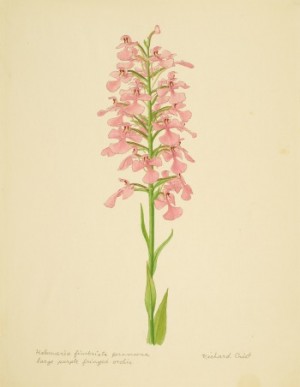
Habenaria fimbriata peramoena, Large purple fringed sic orchis Platanthera peramoena (A. Gray) A. Gray, purple fringeless orchid, Orchidaceae (orchid family), watercolor on paper by Richard Crist (1909–1985), HI Art accession no. 6615.309. © 2012 Richard Crist Estate. All Rights Reserved


Native Pennsylvania,
A Wildflower Walk

Hunt Institute
Carnegie Mellon University
March 2 – June 29, 2012

The Hunt Institute for Botanical Documentation and the Botany department at Carnegie Museum of Natural History will celebrate the native wildflowers of Pennsylvania in a collaborative exhibition opening in March.

Native Pennsylvania, A Wildflower Walk allows visitors to take a virtual walk through a southwestern Pennsylvania growing season and become more familiar with some of the native wildflowers that are integral to so many relationships. Information about Pennyslvania’s many parks, woodlands and wetlands is provided throughout the exhibition. Visitors are encouraged to follow their visual walk with a physical one in many of the state’s wildflower habitats.

Thirty-six wildflower watercolors by Richard Crist (1909–1985) from the Institute’s collection illustrating the simplicity and beauty of Pennsylvania’s native species will be on view. Coupled with Carnegie’s significant herbarium specimens, these pieces combine to create a visual wildflower walk through Pennsylvania’s blooming seasons with a focus on endangered, rare and threatened species within Pennsylvania. Additional watercolors by artists Lyn Hayden and Andrey Avinoff (1884–1949) also underscore the exhibition’s emphasis on the importance of herbaria and their contributions toward research, education and conservation.

Thoughout spring and early summer, visitors can learn more about Pennsylvania’s native plants through a series of public talks that will occur at the Hunt Institute on Sunday afternoons. All talks are free and begin at 2 PM. Plan ahead to attend the presentations below:

  • Why Do Plants Bloom When They Do? Spring Ephemerals and Other Seasonal Flowering Patterns – March 18; Steve Grund, botanist
  • Pressing and Mounting Specimens for a Personal Herbarium – March 25; Jeanne Poremski, landscape designer/botanist
  • Wildflowers of Pennsylvania – April 15; Dr. Mary Joy Haywood, botanist and plant pathologist
  • Wildflowers in the Home Garden – April 22 (Earth Day); John Totten, landscape architect
  • Gallery tour of Native Pennsylvania, A Wildflower Walk (in conjunction with Carnegie Mellon commencement ceremonies), May 20
  • Rare Plants of Pennsylvania – June 24; Bonnie Issac, collections manager at Carnegie Museum of Natural History and exhibition co-curator. This presentation will be held in conjunction with the Hunt Institute’s Open House.
  • Early Pennsylvania in Writing and Images – June 25; Angela Todd, Hunt Institute Archivist. This presentation will be held in conjunction with the Hunt Institute’s Open House.

The exhibition will be on display on the 5th floor of the Hunt Library building at Carnegie Mellon University and will be open to the public free of charge.

Hours: Monday–Friday, 9 a.m.–noon and 1–5 p.m.; Sunday, 1–4 p.m. (except 11 March, 6–8 April, 6 and 27–28 May). The library’s hours of operation are occasionally subject to change, please call or email before your visit to confirm their hours. For further information, contact the Hunt Institute at 412-268-2434.


About the Hunt Institute

The Hunt Institute for Botanical Documentation, a research division of Carnegie Mellon University, specializes in the history of botany and all aspects of plant science and serves the international scientific community through research and documentation. To this end, the Institute acquires and maintains authoritative collections of books, plant images, manuscripts, portraits and data files, and provides publications and other modes of information service. The Institute meets the reference needs of botanists, biologists, historians, conservationists, librarians, bibliographers and the public at large, especially those concerned with any aspect of the North American flora.

Read Full Post »
This month the National Tropical Botanical Garden offers two opportunities to learn about plant exploration.

At their garden campus in Miami, The Kampong, the National Tropical Botanical Garden is offering guided tours of the private home and garden of botanist and explorer, David Fairchild. Tours are given on Wednesdays and Saturdays through January. Tours begin at 10:30 AM. Reservations are required.
View Details/Register

Meanwhile, at their main garden in Kaua’i, the National Tropical Botanical Garden will host a viewing of Pearl of the Pacfic: Exploratory Botanist Steve Perlman on January 19 (5:30 – 7:00 PM). View Details/Register

To get a sense of what plant explorers do in the field to gain a better understanding of the plant world, watch this video of botanist Steve Perlman at work on the Hawaiian island of Moloka’i.

Read Full Post »

Arts & Archives Tour
with Mervi Hjelmroos-Koski
of Denver Botanic Gardens

March 22 – April 3, 2012

This 12-day tour includes visits to the Shirley Sherwood Gallery of Botanical Art at Kew Gardens, viewings of work by Maria Sibylla Merian, William Bartram, Mark Catesby and others. Also included are a tour of the British Library’s medieval illuminations and herbals collection, plus visits to the studio of botanical artist Ann Swan, the home of William Morris, a 150-year old art store, a pharmacy museum, the headquarters of Faber Castell, and so much more! Click on the image to download the itinerary and to read the irresistible details.

Read Full Post »

The coloring book, Colorful Edibles, was the brainstorm idea of botanical artist and organic farm owner, Wendy Hollender. Grounded in a desire to promote the work of the American Society of Botanical Artists (ASBA), a small committee was formed to raise awareness about the ASBA through the development and sale of products created by its members. It took about one year for the first idea, a coloring book, to take shape. Botanical illustrator Bobbi Angell signed on as Co-Project Coordinator and Editor. Graphic artist and book designer, Charlotte Staub Thomas, also joined the project. Together they created a coloring book highlighting the contemporary botanical art of 26 ASBA members.

Editor, Bobbi Angell, says it was easy to get artists involved in this project. The project team made a specific request for pen-and-ink illustrations so that they could include as many ASBA artists as possible. They received 85 submissions from 38 artists. Because they wanted to keep the book inexpensive, only 36 illustrations were selected. The illustrations in Colorful Edibles showcase the strong and diverse line work of ASBA members, and includes work from new artists along side work by more established artists, things Angell said the project team was hoping to accomplish.

Most pages of the coloring book feature a full-page illustration. Informative passages about each fruit and vegetable are included on each page. Angell wrote the passages with young readers in mind. Through her writing, Angell makes reference to the origin and domestication of each fruit and vegetable so that readers learn about the history of their food. She also includes comments from contributing artists.

Colorful Edibles is truly a coloring book for all ages. Garden teachers will find this activity book to be a helpful teaching tool because it not only explains where familiar fruit and vegetables come from, it touches upon the subjects of botany, history, agriculture and nutrition.

The project team hopes to expand the coloring book format to other books about native plants and wildflowers.

Colorful Edibles can be purchased on the ASBA website.

Read Full Post »

Kelly Houle at work in her studio.

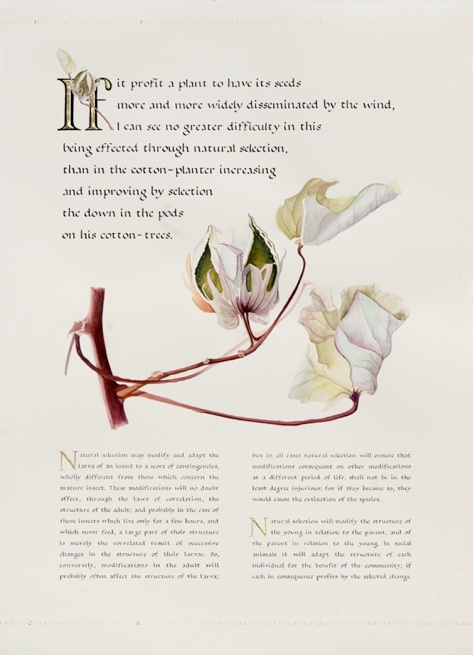
Natural history artist, calligrapher and science educator, Kelly Houle, is creating a large-scale illuminated manuscript based on Charles Darwin’s The Origin of Species. Each page will be designed as a work of art. All text will be written by hand and natural history illustrations will be illuminated with iridescent watercolors and 23-karat gold. The completed manuscript will be 22 x 30 inches and is expected to have 300 pages and over 500 illuminations.

Kelly has established working relationships with biologists and evolution experts from all over the world who will advise her during this project (see timeline). Kelly’s goal is to enhance public understanding of Darwin’s text. She explains:

I believe that the main barrier to understanding The Origin of Species is the perceived difficulty of the writing. The concepts themselves are simple, yet profound. I hope to improve understanding of The Origin by integrating poetic arrangements of Darwin’s words with visually striking presentations of the evidence. I will use elements of poetry, traditional realism, lettering art, graphic design, and fine art illustration in the service of communicating one of the most important ideas in science. 

Kelly has been raising funds on the funding website Kickstarter. Donors donating $10 or more will receive gifts of art related to The Illuminated Origin of Species. All donors will have their names written in a special section of the illuminated manuscript. In addition to individual donations, Kelly is looking for an institutional donor to fund the entire Illuminated Origin of Species project in exchange for the completed manuscript.

To read more about this project, watch a short video and to make a donation, visit the The Illuminated Origin of Species.


Related


Read Full Post »

Inspiration for the Holidays

It is the diaries that speak the loudest in the empty library at night.

— Susan Snyder

Diarist, Susan Snyder, has compiled a moving and engrossing collection of diaries in Beyond Words: 200 Years of Illustrated Diaries. The featured diarists recorded their thoughts, secret wishes, To Do lists and illustrations in diaries they referred to as their “journals”, “field notes” and “logs”. The unknown writers provide an insider’s perspective of significant world events and invaluable insight into what nature looked like during their lifetimes.

Most of the diaries in this book are from the Bancroft Library at the University of California, Berkeley where Snyder works as a librarian and researcher. The diaries in this book are not all by famous people, although you may recognize the products they created and the organizations they established. The featured diarists were (and are) travelers, mothers, inventors, explorers, naturalists, children, poets and soldiers — including a 16 year-old soldier of the Mexican-American War whose interest in botany was greater than his interest in fighting.

In Beyond Words, you will find journals written between 1776 and 1981. With each turn of the page, years pass, journal pages become less fragile, penmanship becomes more modern, and advances in technology (think typewriter) and advances in photography become evident.

Each 24″-wide, two-page spread allows the reader to view each diarists’ words and illustration up close. These visual treats and the warm colors, eye-pleasing fonts and clean layout of each page create a soothing reading experience for readers.

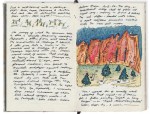
Heyday Books has provided us an opportunity to view pages inside this wonderful new book. Click on the image to peek into the diaries of John Muir and others.


Beyond Words: 200 Years of Illustrated Diaries

Order this book online from your local independent bookstore.

Read Full Post »

« Newer Posts - Older Posts »