Feeds:
Posts
Comments

Archive for the ‘History’ Category

ArtPlantae: In reviewing the literature about dioramas, I noticed that the educational value of dioramas is a topic that comes up often. In your article, Saved From the Trash, you state that dioramas are in danger of disappearing because they are considered to be “outdated displays.” How do you defend the value of dioramas when others want to replace them with, say, something more interactive?


Gary
: There is a stark difference between an interactive exhibit and a diorama. Certainly interactive exhibits fit well with our cybernetic lifestyle. Dioramas do not, and that makes the diorama even more unique in today’s world. The “time freeze” in such an exhibit does not mean that the diorama is a contemplative and therefore outdated exhibit model. If done well, a diorama can evoke a powerful potential energy. Muscles straining on a tiger crouched in the grass or a ruffed grouse ready to bolt from cover can awaken something primal if we are willing to stop and really look. Publishers assumed that a child’s attention span was too narrow to read a book of over a hundred pages until J.K. Rowling blew that theory out of the water. The same is true of a diorama. I have seen young children, and adults too, thrill to that type of exhibit.

I have nothing against interactive exhibits. I actually think certain types of interactive exhibits keyed to elements within a diorama…
Read More

Read Full Post »

What’s the difference? Let’s ask…


ArtPlantae
:
While reading about the history of pop-ups, I learned there are different types of formats. The two general labels, though, appear to be “pop-up” or “moveable book”. Do designers of these interactive books prefer one label over the other?


Shawn
: This one is sticky. Technically, “pop-up” structures are those that actuate at the turning of the page, and “movable” structures are those that actuate after the page is turned and require the turning of a wheel or pulling of a tab. Since there is limited academic treatment of the form…

Read More

Read Full Post »

Do you use an electric sharpener?

A wall sharpener?

A pocket knife?

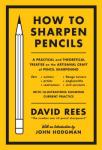
I know of one person who believes strongly that wooden pencils should only be sharpened by hand. For this reason, and because I like pencils myself, I could not resist reading the book How to Sharpen Pencils by David Rees.

Part humor and part reference,
How to Sharpen Pencils is an informative little book about the #2 pencil. Rees reviews the anatomy of a pencil, discusses different types of pencil sharpeners, and shows how to carve four different pencil points with a pocket knife. For the pencil enthusiast, Rees lists various pencil-related resources in the appendix of his book. One resource is his website, www.artisanalpencilsharpening.com. The other resources are about vintage pencils, antique pencils, pencil industry news and blogs written by pencil enthusiasts.

Because I have a thing for pencils (yes, those are my pencil boxes), I did not hesitate to ask David to sharpen an ArtPlantae pencil. I sent David one of my beautiful natural wood, unpainted pencils and a check for $15 so that my pencil could be sharpened with his pocket knife and so that I could include a photo with this post (David takes orders online).

Not too long afterwards, I received…

Pencil sharpened by David Rees.

… a note, a Certificate of Sharpening, the shavings from my pencil and a very sharp ArtPlantae pencil encased in a tube.

All now have a special place in my library.

Do you need your pencil sharpened?


How to Sharpen Pencils is available at ArtPlantae Books. Save 20% ($3.99)
Read Full Post »

Scholar Alain Touwaide, co-founder of the Institute for the Preservation of Medical Traditions and expert about medicinal plants found in Renaissance herbals, will present Ancient Roman Gardens as Urban Pharmacopeia on July 18. This presentation is one of many special learning opportunities provided by The Smithsonian Associates. In his presentation, Alain will discuss how the population boom in ancient Rome created a shortage of medicinal plants.

For a complete description of Alain’s presentation, and to purchase tickets, click here.

Read Full Post »

Rubus idaeus (Raspberries) by Denise Walser-Kolar

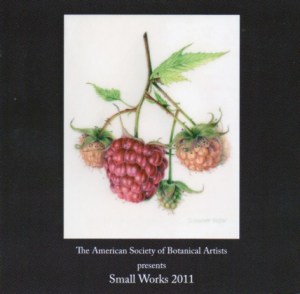
The success of the Small Works exhibition at the 2008 conference of the American Society of Botanical Artists in Pasadena, CA, inspired the inclusion of a similar exhibition at the 2011 conference held in Boston this past Fall. This non-juried exhibition of artwork small enough to fit in carry-on luggage, was organized by the New England Society of Botanical Artists (NESBA), hosts of the 2011 meeting. A color catalog about the exhibition has been created by NESBA and the American Society of Botanical Artists and can be previewed online.

Small Works 2011 is a 118-page collection of drawings and paintings by ASBA members. This self-published special collection can be purchased at Blurb.com for $29.95 (plus S&H).

Read Full Post »

The Gardens at Heather Farm in northern California has added two new events to their Winter schedule.

Professional appraisers will donate their time at the Antique and Collectibles Appraisal Event on Saturday, March 11, 2012 (12-5 PM). This event will have a format similar to the popular show Antiques Roadshow. Rare books, antiques, jewelry, toys, clocks, watches, stamps, coins and other items will be appraised. A $15 fee includes the entry fee and the appraisal of the first 3 items. Additional appraisals will cost $5 each.

The Gardens at Heather Farms has also announced details about their annual Spring Plant Sale that will be held on Saturday, April 14, 2012 from 9 AM to 12 PM. Come early for the best selection. Plan ahead by previewing the plant list before you arrive. A list of the plants available for purchase at the plant sale will be posted on the Garden’s website after March 15, 2012.

View more classes at the Gardens at Heather Farm at
Classes Near You > Northern California.

Read Full Post »

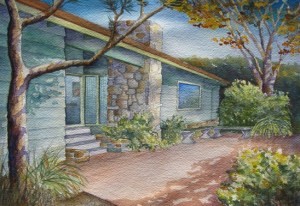
Theodore Payne Foundation, watercolor. © Ron Maben. All Rights Reserved


Inspired: Interpretations of California Native Flora, Fauna and the Natural Landscape of Theodore Payne Foundation

Feb. 1 – Mar. 24, 2012
theodorepayne.org

Paintings, poems and photographs. Baskets, gourds, ceramics and drawings. Watercolors.  
These are a few of the many works in a large group exhibition of artists who are inspired by the native flora, fauna and the natural landscape found at Theodore Payne Foundation for Wild Flowers and Native Plants. Over 25 artists responded to the call for entries, submitting their personal interpretations of California’s native landscape. 

Hung salon-style, this exhibition is one of extraordinary creativity and a survey of the varied styles and mediums in which artists are working today. 

This exhibition is sponsored by the Theodore Payne Arts Council.  The Theodore Payne Foundation for Wild Flowers and Native Plants, Inc., is a non-profit organization dedicated to helping others discover the beauty of California native plants.

The Theodore Payne Foundation is located north of Los Angeles in Sun Valley, CA. Map

Read Full Post »

« Newer Posts - Older Posts »