Feeds:
Posts
Comments

Archive for the ‘environmental education’ Category

The Lake Oswego Festival of the Arts in Lake Oswego, Oregon invites you to participate in Beyond the Point: The Fine Art of Colored Pencil and Graphite.

Colored pencil and graphite artists are invited to submit work showing how they apply colored pencil &/or graphite to a variety of surfaces including, but not limited to paper, wood, stone and board. Work may be 2D or 3D. Both colored and graphite, dry and water-soluble pencils may be used. This special exhibition will feature local and national artists such as Mary McCarty, Pat Averill, and Tracy Frein.

Beyond the Point is one of three juried exhibitions planned for the 54th Annual Lake Oswego Festival of the Arts (June 23-25, 2017). Below is an overview of all exhibiting opportunities:

    Beyond the Point: The Fine Art of Colored Pencil and Graphite
    Special exhibition featuring works in colored pencil and graphite.


    The Artist’s Vision: The Skies Opened

    The Artist’s Vision juried exhibition is a popular venue for both emerging and established artists in the 2D and 3D arts.


    Craft in the Park: Fine Art and Craft

    This is an outdoor booth show located in Lake Oswego’s George Rogers Park showcasing original handcrafted fine art and craft in fifteen categories.

View Exhibition Info / Deadlines


About the Lake Oswego Festival of the Arts

The Festival, an event created by Lakewood Center for the Arts, is a major regional arts event located in Lake Oswego, Oregon. Lake Oswego is located 9 miles south of Portland, Oregon. The Festival presents the creative endeavors of recognized and emerging artists and enjoys an outstanding reputation for bringing special exhibits of quality and diversity to a weekend that is accessible to everyone. Attracting some 25,000 visitors during the three day event, the Festival includes several art exhibits, food booths, music, and fine art crafts. The Festival is held in the Lakewood Center for the Arts in Lake Oswego and George Rogers Park. It features multiple art exhibits, music, dance and demonstrations. The special exhibit is housed at Lakewood Center. Other art exhibits (Open Show, Lake Oswego Chronicle, Artist’s Vision and Student Exhibits) are also located at Lakewood Center. Craft in the Park, with more than 110 artists, is located at George Rogers Park across the street from Lakewood Center.

Read Full Post »

New York Botanical Garden
www.nybg.org
The New York Botanical Garden is home to one of the longest-running botanical art certificate programs in the country. View their current schedule online. Don’t miss what’s coming up this holiday season!

    Flower Grouping
    Thursdays, 11/3/16 – 11/24/16
    11:00am – 04:00pm
    Midtown Center, Room C
    Instructor: Adele Rossetti 
    Bring a heightened reality to your painting. Learn to gracefully arrange botanical subjects in your compositions and use color, value, and focus to create convincing three-dimensional images. Add depth to a single stem with many flowers, or a group of different flowers combined in one image. Prerequisite: Botanical Watercolor. 
    Register
    © Adele Rossetti, All rights reserved

    © Adele Rossetti, All rights reserved


    Oriental Lilies in Color

    Wednesdays, 11/30/16 – 12/14/16
    06:00pm – 09:00pm
    Midtown Center, Room C
    Instructor: Rose Marie James
    These bold, exotic flowers make striking paintings. Learn the basic botany of the lily family while developing skills in painting the lovely, graded pinks of the “Stargazer” lily. Learn to make fluid color changes, as well as capture the textures of the flowers and the linear structure of the foliage. Prerequisite: Color Pencil I or Botanical Watercolor.
    Register

    © Rose James, All rights reserved

    © Rose James, All rights reserved


    Botanical Drawing I: Methods and Materials

    Wednesdays, 01/11/17 – 02/15/17
    10:00am – 01:00pm
    NYBG, Watson Room 312
    Instructor: Linda M. Nemergut 
    Accurate observation translates into sensitive, realistic drawings and is an essential skill for botanical artists. Using basic shapes, fruit, and leaves, learn contour drawing with an emphasis on proportion, and explore techniques such as foreshortening, perspective, and line weight. 
    Courtesy: New York Botanical Garden

    Courtesy: New York Botanical Garden


    Botanical Drawing I: Methods and Materials

    Wednesdays, 01/11/17 – 02/15/17
    06:00pm – 09:00pm
    Midtown Center, Room C
    Instructor: Laura Vogel 
    Accurate observation translates into sensitive, realistic drawings and is an essential skill for botanical artists. Using basic shapes, fruit, and leaves, learn contour drawing with an emphasis on proportion, and explore techniques such as foreshortening, perspective, and line weight. 
    Register

    Courtesy: New York Botanical Garden

    Courtesy: New York Botanical Garden


    Eastern Woodland Habitat
    Fridays, 02/10/17 – 03/03/17
    10:00am – 01:00pm
    NYBG, Watson Room 312
    Instructor: Patricia Wynne
    The oak/hickory woodland of North American once stretched unbroken from New England to the Ozarks and the Atlantic Ocean to the Mississippi River. It was the most diverse temperate forest ecosystem in the world. We will study the habitat, past, present, and future focusing on the many small animals and plants that inhabit it. This class will stress research, composition, and narrative. We will discuss the history of scientific illustration and professional assignments, with an emphasis on clarity. Includes a special session at the American Museum of Natural History and a walk in The New York Botanical Garden’s own oak/hickory habitat. Prerequisite: Botanical Drawing I 
    Register
    © Patricia Wynne, All rights reserved

    © Patricia Wynne, All rights reserved


This information has also been added to Classes Near You > New York.

Read Full Post »

Friends of Wellesley College Botanic Gardens Certificate Program in Botanical Art and Illustration
http://www.wellesley.edu/wcbgfriends
Our program offers several weekly and one- to three-day classes on botanical art with lead instructor and Education Director Sarah Roche as well as Carrie Megan, Carol Ann Morley, Esther Klahne, and many other visiting instructors from near and far. The courses offered through this program cover all aspects of botanical art. Along with Sarah’s twice-yearly offerings, Foundations of Botanical Drawing and Painting and the more advanced Techniques of Botanical Drawing and Painting, here is a brief overview of the 2016-2017 course offerings:

  • Carrie Megan’s Drawing Pine Cones; Assorted Vegetables & Herbs: Library Page; and Spring Flowers Decomposed
  • Liz Haywood-Sullivan’s smART Business: Creative Management Techniques for Artists
  • Carol Ann Morley’s Drawing in the Greenhouses: From Root to Tip and Colored Pencil Review
  • Jeanne Kunze’s Introduction to Watercolor: Three Colors and Mark Making Techniques: Your Inner Doodle
  • Hillary Parker’s Expressing Your Artistic Voice Through Composition and Mastering Washes
  • Esther Klahne’s Floral Collage: In the Style of Mrs. Delany
  • Ellen Duarte’s Introduction to Scientific Pen Techniques
  • Susan Fisher’s Color Mixing for Artists and Study the Masters
  • Ann Swan’s Pushing the Boundaries: Composition with Colored Pencil and Vibrant Colors and Tactile Textures with Colored Pencil
  • Sarah Roche’s beginner class, Drawing and Painting for the Petrified


Learn more about Wellesley’s certificate program


View current Programs, Courses, & Travel schedule


This information has also been posted to Classes Near You > Massachusetts

Read Full Post »

The University of Newcastle Australia is offering a six-week course about natural history illustration on edX, an online platform founded by Harvard University and the Massachusetts Institute of Technology.

Drawing Nature, Science and Culture: Natural History Illustration is for aspiring scientific illustrators or anyone who enjoys drawing nature. Participants will learn observation skills and drawing techniques. They will also learn about composition and will study the morphology of mammals, birds and plants.

Participants should plan for up to six hours of homework per week. While this online course is free, a verified certificate of completion is available for a fee.

The instructors for this course are Dr. Andrew Howells and Dr. Bernadette Drabsch, both of the Natural History Illustration program at the University of Newcastle.

Learn more about this free learning opportunity by watching this short video and by reviewing the syllabus online. This course begins on October 26, 2016.


More about “Drawing Nature, Science and Culture”

Read Full Post »

The TAG Gallery in Santa Monica will host an artists talk this weekend that includes Sally Jacobs, an L.A. botanical artist whose work is featured in the exhibition Larger Than Life. If you live in southern California and are a fan of botanical art, this is a wonderful opportunity to learn more about this genre.

Recently Los Angeles Times writer Lisa Boone called Sally’s work “captivating”. She also marveled how farmer’s market produce can “inspire more than just cooking“.

This weekend’s artists panel will also feature artists Ernie Marjoram and Jane Peterson. Visit TAG Gallery to learn more.

The TAG Gallery is located in Bergamot Station Arts Center. The panel discussion begins at 3 p.m. on Saturday, October 8, 2016.

Click image to learn more

Click image to learn more


Related

Farmer’s market fare becomes larger than life

Read Full Post »

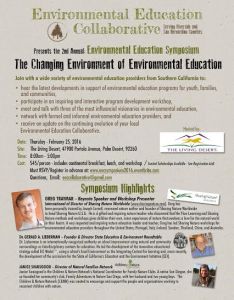
EEC Symposium 2016 Flyer Next month the Environmental Education Collaborative (EEC) of the Inland Empire will host its second annual symposium at The Living Desert in Palm Desert, CA.

The EEC formed in February 2015 when over 125 organizations participated in a strategic planning meeting near downtown Riverside. Quite a bit was accomplished during this one-day meeting and the Environmental Education Collaborative has grown steadily during its first year.

The EEC is lead by co-chairs Dave Ficke, Region 10 Coordinator of the California Regional Environmental Education Community, and Ginger Greaves, Executive Director of the Santa Rosa Plateau Nature Education Foundation. The purpose of the Collaborative is to:

  • Bring funding to the Inland Empire to increase environmental literacy in San Bernardino and Riverside counties.
  • Develop a network of environmental education resources.
  • Promote the programs of environmental education providers in the Inland Empire.
  • Monitor and influence environmental education policy in San Bernardino and Riverside counties.

Would you like to learn more about the EEC and support environmental education in the Inland Empire?

The Collaborative is seeking sponsors for their second annual meeting. All sponsorship packages include tickets to the symposium. To learn more about keynote speakers and to view the itinerary, click on the image above to download the event flyer.

To view sponsorship opportunities and benefits, download the Sponsorship package.

Read Full Post »

Plants, Life, Riverside is an ongoing interpretive project about plants in an urban setting, continuing ArtPlantae’s mission of encouraging an interest in plants and addressing the subject of “plant blindness”. Where do plants reside in this city of concrete, asphalt and stucco? Let’s find out.


CN_inrectangle.wseal.tag The Inland Empire region of southern California is home to many native species of plants and animals. It is also home to many invasive species that threaten local plant communities and animal populations. The Inland Empire is a two-county area east of Los Angeles composed of San Bernardino and Riverside counties. In terms of mileage, the Inland Empire (or “IE”) is generally 60 miles from Los Angeles. In terms of drive time…well, the 80-mile commute to west Los Angeles from Riverside can take 3.5 hours during peak commuting hours. 

Nestled below the San Bernardino Mountains, is the Santa Ana Watershed. The watershed is an area of land through which water flows from the mountains to a single outlet at the Pacific Ocean. Water flowing from the mountains travels through four counties on its way to the ocean. These counties are San Bernardino, Riverside, Los Angeles and Orange County. The Santa Ana watershed, its plant and animal communities and its namesake river are monitored by many resource conservation districts whose objectives are to promote the care of natural resources within the watershed.

The Santa Ana Watershed Association (SAWA) SAWAlogoTR2-2 began as a collaborative of local Resource Conservation Districts and the Orange County Water District. Formed in 1996, the purpose of the new association was to eradicate Giant Reed (Arundo donax) and other invasive species that had established themselves in the Santa Ana River. The Association became a nonprofit organization in 2000.
While earlier efforts focused primarily on field work, biological monitoring and habitat restoration, SAWA realized there was a need to educate the public about watershed issues. The Education and Public Outreach Department was formed in 2008 and in five short years, the three-person department has established itself as a major player in environmental education. The educators at SAWA participate in 30 outreach events per year, host four to eight educational events of their own and host four volunteer days (e.g., “clean up” events) at different locations in the Inland Empire. The Education Department connects with 12,000 people per year through its workshops, field trips and events, operates an interpretive center at Chino Creek Wetlands and Educational Park and is responsible for establishing the California Naturalist program in the Inland Empire.

You may already be familiar with the Master Gardener program and its requirement of 40 class hours and volunteer time. The California Naturalist program is similar in that it also requires 40 class hours. It differs from the gardening program in that it does not currently have the volunteer requirement. Participants are instead required to complete a capstone project to earn certification. Capstone projects must be a citizen science project, an educational or interpretive project, or be a work effort benefiting a local environmental organization.

river-2The California Naturalist program was created by UC Davis as a way to promote environmental literacy and engage California residents in the stewardship of California’s natural resources. This program exists in the Inland Empire because of the tireless efforts of Carrie Raleigh, SAWA’s Education and Public Outreach Manager. Carrie was already familiar with naturalist programs for the public because she herself had completed Florida’s Master Naturalist program in 2006. She returned to California, began work with SAWA and in 2011 began looking for a comparable program in California. She learned about the California Naturalist program through the UC Cooperative Extension. One of the first adopters of the program in inland southern California, Carrie worked on the program with her staff for two years and launched the Inland Empire California Naturalist program in
Fall 2013. 

Subject areas covered in the 40-hour program include: native plants, nature journaling, geology, climate, water resources, wildlife, forest and woodland resources, interpretation, communication, citizen science, and global environmental issues.

Thirty-six states have a Master Naturalist program. If you are interested in becoming a certified naturalist in your area, look for Master Naturalist programs near you.

If you live in the IE and want to learn more about the local California Naturalist program, see California Naturalist in the Inland Empire. To inquire about upcoming sessions, contact Carrie Raleigh.

UPDATE
On May 29, 2014, the Santa Ana Watershed Association closed its Education department. To inquire about future programming in the Inland Empire for the California Naturalist Program, please click on the link below.


Related Resources

Read Full Post »

« Newer Posts - Older Posts »