Feeds:
Posts
Comments

Archive for the ‘Education’ Category

© 2005 ArtPlantae Artist's Herbarium, Hippeastrum flower

© 2005 ArtPlantae Artist’s Herbarium, Hippeastrum flower

Here is a wonderful idea that can be used at schools that do not have the room or the funds to create a garden.

In 2004, undergraduate student Stefanie Lawniczak and professors D. Timothy Gerber and Judy Beck pilot tested a program enabling teachers and students to have direct access to plants at their schools. This program was created around three of the twelve principles of plant biology established by the American Society of Plant Biologists (#4, #7, #12) (learn more, get bookmarks).

Lawniczak et al. applied the National Science Education Standards to these principles and created five themed plant displays. The themes they chose to address were: Environment, Plant Families, Plant Organs, Growth & Reproduction and Plant Origins. Displays were placed in the media centers at three elementary schools and were left in place for 10 weeks. The theme of each display changed every two weeks. Teachers were invited to use display plants as subjects for their classroom studies and students were invited to drop questions in an “Ask a Botanist” box. At the end of the 10-week program, teachers received surveys and were asked to share their thoughts and experiences. Lawniczak et al. received positive feedback from teachers, as well as helpful recommendations about how to improve their displays.

Learn how each themed display was created and get a list of the easy-to-find plants (e.g., orchids, geranium, Hippeastrum) used in each theme.

Order a copy of Plants on Display at the NSTA Store for 99¢.


Literature Cited

Lawniczak, Stefanie and D. Timothy Gerber, Judy Beck. 2004. Plants on Display. Science and Children. 41(9): 24-29

Read Full Post »

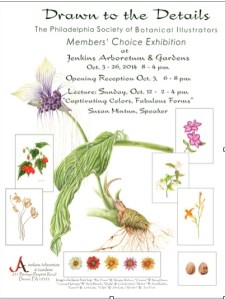
Susan Minton, horticulturalist, retired professor and member of the Philadelphia Society of Botanical Illustrators, will give a gallery talk at Drawn to the Details, the botanical art exhibition at Jenkins Arboretum & Gardens. Susan will explore some of the fascinating characteristics of plants that inspire both artists and horticulturalists.

Here is a sneak peek at Susan’s presentation Captivating Colors, Fabulous Forms:

A common thread that binds gardeners and botanical artists is a fascination with plants: how they look, how they grow, what makes each species unique. For all of us, but perhaps especially for artists, it is often easy to be so entranced with their colors and shapes and textures, that we forget how amazing they are from a botanist’s perspective. Scientists are continually uncovering new and wondrous details about how plants function, what purposes their particular (and often peculiar!) characteristics serve, and the many ways they interact with their environment.

Plants have inspired artists and gardeners for centuries. Learning about them will enhance your work and enrich your experience, both in the studio and in the garden.

You are invited to attend this special presentation.


Captivating Colors, Fabulous Forms

Jenkins Arboretum & Gardens
October 12, 2014
2-4 PM

Get Directions

Read Full Post »

invite_

In 2012 California artist and educator Estelle De Ridder was awarded an education grant from the American Society of Botanical Artists to create plant identification cards about the plants at the Madrona Marsh Preserve
in Torrance, CA. This project is now complete and will be presented in conjunction with an exhibition of Estelle’s original paintings.

The Madrona Marsh Preserve, in collaboration with the American Society of Botanical Artists, invites you to The Flora of the Madrona Marsh, an exhibition of botanical art by Estelle DeRidder, November 18, 2014 – January 9, 2015.
An opening reception will be held on Sunday, December 7, 2014 from 2-5 pm.

During the month of December, visitors to Madrona Marsh will have three opportunities to meet Estelle and to learn about the role botanical illustration plays in our understanding of plants.

Residents of inland southern California will have the opportunity to view this exhibition when it travels to the La Crescenta Public Library in La Crescenta, CA (January 24 – February 28, 2015).

Visit the Madrona Marsh Preserve

Read Full Post »

Lightbulbs. Cereal. Sandwiches.

This is what some kindergarten students cited as factors necessary for plant growth.

This and other interesting insights into what young students think about plants are revealed in Understanding Early Elementary Children’s Conceptual Knowledge of Plant Structure and Function through Drawings by Janice L. Anderson, Jane P. Ellis and Alan M. Jones.

Anderson et al. (2014) chose to investigate the conceptual knowledge of plants of K-1 students because, at this age, children are busily constructing explanations about what they see. The authors chose to analyze students’ drawings of plants for three reasons: 1) drawings enable young children to express what they cannot articulate verbally, 2) drawings offer insight into what children think, and
3) drawings offer insight into children’s stage of development with respect to conceptual thinking (Anderson et al., 2014).

The research team investigated student knowledge of plant structure and function specifically. They did this by creating a three-stage investigation. The data-collecting tools they used were a Draw-A-Plant instrument (based on the Draw-A-Scientist instrument), a plant survey, and interviews (Anderson et al., 2014). Study participants were K-1 students (n=182) from an elementary school in the southeastern United States.

Anderson et al. (2014) explain their research methods in detail, including how they coded student drawings. You can read about these methods in their paper. Today I provide only general insight into their findings.

Anderson et al. (2014) observed that:

  • Young students have some basic understanding of plant structure and function.
  • Young students have misconceptions about plants.
  • Some teachers spend more time discussing plants with students than others.
  • Some students learn about plants outside of the classroom.
  • Flowers and flowering plants are drawn most often.
  • Young students can identify the simple needs of plants.
  • Young students often exclude soil from their drawings.
  • Students sometimes demonstrate more plant knowledge in conversation than through drawing.
  • There is a lack of advanced conceptual knowledge about plant structure and function in young students.
  • Student interviews help researchers interpret their findings.
  • Students drawings provide insight into students’ life experiences.
  • There is a need to involve students in more inquiry-based activities about plant structure and function.

The paper by Anderson et al. (2014) is available for free through an Attribution-Noncommercial-Share Alike 3.0 Unported Creative Commons License. Click on the link below to download a PDF copy of the article that includes supplementary materials used in this project.


Literature Cited

Anderson, Janice L. and Jane P. Ellis, Alan M. Jones. 2014. Understanding Early Elementary Children’s Conceptual Knowledge of Plant Structure and Function through Drawings. CBE – Life Sciences Education. 13(3): 375-386. Retrieved from http://www.lifescied.org/content/13/3/375.full.pdf+html?with-ds=yes

Read Full Post »

By Philadelphia Society of Botanical Illustrators

The public is invited to Drawn to the Details (October 3-26, 2014) the Philadelphia Society of Botanical Illustrators (PSBI) exhibition at Jenkins Arboretum & Gardens. Admission to both the exhibition and the gardens is free. Gallery hours are 9 am – 4 pm. psbi_flyer_DrawnToDetails

Viewers of the exhibit will be “drawn to the details” in each of the paintings. The carefully executed work appeals to all ages. In the last PSBI exhibition at Jenkins Arboretum & Gardens, the comments of visitors ranged from “The detail is amazing“ and “Incredible detail! [It] shows that in nature, beauty exists” to “I loved seeing the root system as well as flowers. Just beautiful!”

The artwork has been executed by the over 75 members of PSBI, a Philadelphia organization. Its purpose is “to educate, to celebrate the artistic development of our members, to provide an opportunity to exhibit together, and to bring Botanical Illustration to the attention of many audiences.”

To that end, PSBI provides free art classes for Philadelphia public school children as well as sponsoring many exhibits of botanical art, including one at the Philadelphia Flower Show. This is the second year that PSBI has exhibited at Jenkins.

Jenkins Arboretum & Gardens prides itself on providing “a tranquil, natural setting in a densely populated residential and commercial area.” It has over a mile of paved walkways that meander through native woodlands with labeled trees, shrubs and herbaceous plants. It is indeed an oasis in a busy world and an inspiration to botanical artists.

For more information, contact Sarah Maxwell at the PSBI (267-639-6053) or Janet Bauman at Jenkins Arboretum & Gardens (610-647-8870 ext. 152). 

Read Full Post »

Click to view itinerary at Quench Travel.

Click to view itinerary at Quench Travel.

Travel to Puglia, Italy!

Award-winning botanical artist Margaret Best will teach in southern Italy next Spring. Join Margaret to spend eight luxurious days exploring the “heel” of Italy’s boot.

Travel highlights include visits to botanical gardens, local markets and historic UNESCO villages. Traveling artists will also participate in a cooking class and will have exclusive use of a large garden studio overlooking the Adriatic Sea.

Travel dates are April 12-20, 2015. Starting costs are €3555 per person. Actual cost varies, depending upon the accommodations selected. Register before October 10, 2014 and receive a discount of €125. Here is a currency converter to help you plan.

Reserve your spot in the garden studio at Masseria Montenapoleone today!

Contact Quench Travel


Related

Read Full Post »

A new ten-week class has been added to Classes Near You > England!


Lewisham Arthouse, London

www.lewishamarthouse.co.uk
The Lewisham Arthouse once served as the central library of Deptford. Designed by architect Sir Alfred Brumwell Thomas (1868-1948) and funded by Andrew Carnegie (1835-1919), this former library is now a public gallery and studio space for professional artists. Artist studios are open to the public once per year. Exhibitions in the gallery are open to the public year-round, free of charge. Botanical illustration classes are taught by Alison Day.

    Drawing from Plant Life
    September 29 – December 8, 2014
    Mondays, 1:00 – 2:30 PM

    This introductory ten-week course aims to provide an opportunity to explore the art and science of botanical Illustration. Students will have the opportunity to explore both drawing and painting plants while learning a range of graphic techniques used to represent plant material. Some basic theory is taught and, where relevant, historical and contemporary practice is referenced. The course is taught by a practicing artist who has a background in the science of botany and the practice of fine art.

    Students are asked to bring their own ideas and specimens to the course as well as drawing plants provided. Basic materials are provided, together with reference literature, students must provide their own sketch book pencils and colors. All are welcome, no experience needed. This is a small class and provides and supportive and relaxed environment in which to draw. Places are limited so booking is required.

    Cost: £95/90 concessions

    To register, contact Alison Day at Lewisham Arthouse.

    Transport :
    BR/Overground New Cross/New Cross Gate
    Bus 136, 21, 436, 321
    Disabled access

Read Full Post »

« Newer Posts - Older Posts »