
Valerie Littlewood created the traveling exhibition, BUZZ… A Celebration of British Bees & Their Flowers, to bring her message to the public. Her exhibition has been on view at wonderful venues.
Today Valerie talks about her outreach efforts.
Posted in botanical art, Education, general botany, Learning Opportunities, Special Announcements, Special Events on June 19, 2012|
Valerie Littlewood created the traveling exhibition, BUZZ… A Celebration of British Bees & Their Flowers, to bring her message to the public. Her exhibition has been on view at wonderful venues.
Today Valerie talks about her outreach efforts.
Posted in botanical art, Education, general botany, Learning Opportunities, Sketching & Journaling on June 19, 2012|
Click to enlarge image
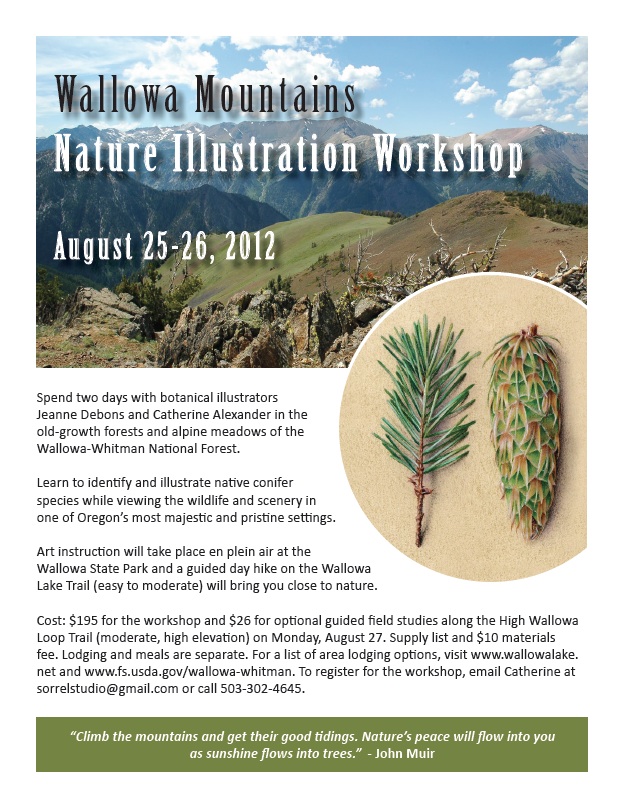
Botanical illustrators Jeanne Debons and Catherine Alexander will lead this two-day workshop in the
Wallowa-Whitman National Forest in Oregon. Immerse yourself in Oregon’s beautiful landscape in this special workshop. Includes a guided day hike. Lodging and meals are separate.
Cost: $195
Optional: Field Studies Day, August 27; $26 per person (see details)
Download Information:
Color flyer
Wallowa Registration Form
Wallowa Itinerary
About Jeanne Debons Studio
www.jeannedebons.com
Botanist and botanical illustrator, Jeanne Debons, teaches small student-focused painting workshops at her Oregon studio. Dr. Debons received her Ph.D. in the Department of Botany and Plant Pathology at Oregon State University. She graduated from the diploma course in Botanical Painting at the English Gardening School in 2005. Dr. Debons invites you to join her painting workshops this summer.
This information can also be found at Classes Near You > Oregon.
Posted in botanical art, Education, general botany, Learning Opportunities, Special Announcements, Special Events on June 18, 2012| 10 Comments »
Click to find a Pollinator Week event near you.
This week featured guest
Valerie Littlewood will discuss her work documenting wild British bees and how she teaches the public about the bees and their plants.
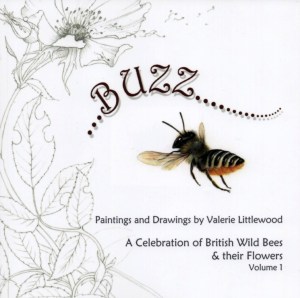
As you know, one way Valerie informs the public about plants and pollinators is through her book series, BUZZ. In Volume I of this series, Valerie pairs exquisite drawings and paintings with information about 14 bee species. Each two-page spread features a detailed painting of a bee and a graceful pencil drawing of a plant the featured bee pollinates. In her description of each species, Valerie includes interesting information about a bee’s identifying characteristics, its behavior, and its conservation status. She includes with her text thumbnail sketches of work-in-progress revealing how her finished drawings were completed.
Volume II of BUZZ is in preparation and will highlight 14 additional species of British bees. Overall, there are over 250 species of bees in Britain.
Thank you again for joining us Pollinator Week. You are invited to ask Valerie questions or post comments as our conversation progresses. Simply post your question in the Comment box below.
Posted in botany, Education, general botany, Learning Opportunities, Reference on June 15, 2012|
Ask and they will see.
In What Do You See?, professors Julianne Maner Coleman and M. Jenice “Dee” Goldston explain how to implement questioning strategies to enhance visual literacy in students.
What is visual literacy?
Visual literacy has to do with the ability to interpret the diagrams, charts, tables and illustrations that accompany text. Science textbooks contain many photographs, graphics and scientific illustrations. But do readers really understand them? Do they even look at them? Do teachers spend time discussing them?
After reviewing the teacher’s guide to a popular K-6 science textbook series, Coleman and Goldston (2011) concluded that teachers were probably not spending much time discussing the diagrams in their science textbooks. During their review, they found that the teacher’s guide provided little instruction about how to incorporate textbook diagrams into conversations about content. In their paper, Coleman and Goldston (2011) offer a solution to this problem and show how teachers can use “purposeful questions” (Coleman and Goldston, 2011) to enhance visual literacy and student learning.
The authors present their solution in a vignette in which a 4th grade teacher guides her student’s review of a plant cell diagram. The diagram students analyze is a cutaway diagram showing the structure of a plant cell and its contents. In the vignette presented by Coleman and Goldston (2011), the teacher guides her students’ review of the cell by asking questions such as:
These questions spark much discussion about what the students see in the cutaway diagram. It becomes clear that students understand the authors of their textbook included this particular diagram because they wanted students to learn what plant cells look like and what’s inside of them.
Because of their teacher’s thoughtful questioning, students make insightful observations about how the artist used a line to mark the cell’s edges and used different colors to make it look three dimensional. The teacher supports her students’ observations by explaining how artists use shading, lines and other techniques to present information that is otherwise not easy to see (Coleman & Goldston, 2011).
In the vignette, this conversation is followed by an activity in which students use microscopes to observe onion cells, Elodea cells, and then compare these live cells to the diagram in their book.
In What Do You See?, the dialogue between the teacher and her students is written out in detail and clearly demonstrates how purposeful questioning can support student understanding of diagrams and other graphics used in science textbooks.
In their paper, Coleman and Goldston (2011) provide three tools teachers can use to enhance the visual literacy of their students. These tools are:
What Do You See? is recommended reading for anyone with an interest in visual literacy and the role images play in science education.
This paper can be purchased online (99¢) from the National Science Teachers Association. Alternatively, you can search for a copy of this article at your local college library.
Literature Cited
Coleman, Julianne Maner and M. Jenice “Dee” Goldston. 2011. What do you see? Science and Children. 49(1): 42-47.
Related
Posted in botanical art, botanical art books, Education, general botany, Learning Opportunities on June 13, 2012|
The Los Angeles County Arboretum and Botanic Garden has put selected treasures from its rare book room online and has created a new experience for Arboretum visitors. Now visitors to this popular southern California landmark can compare 19th-century botanical illustrations to living plants in the Arboretum’s collection.
The Arboretum Library has about 500 books in its Rare Book Room. The plants featured in the new Rare Book Walk are plants native to Mediterranean climates. Using a smartphone, visitors can click on markers posted on a Google map that reveals a plant’s location in the Arboretum. Accompanying each marker is a brief description of the plant and an illustration from one of the historic botany or horticultural books in the Arboretum’s library.
To see how the Rare Book Walk works with Google Maps, click here.
Learn more about this special project on the Arboretum’s website.
About the Arboretum
The Los Angeles County Arboretum & Botanic Garden is a 127-acre botanical garden and historic site. It serves as the site for many garden-related events, including GROW! A Garden Festival. The Arboretum is a popular filming location and has served as a backdrop to many films, television shows and commercials. It is also home to the botanical illustration program founded by Olga Eysymontt. To view the current schedule of botanical art classes, visit the Arboretum’s listing at Classes Near You > Southern California.
Posted in Education, Learning Opportunities, Special Announcements, Special Events on June 13, 2012|
 Pollinator Week is an annual event hosted by the Pollinator Partnership, a nonprofit organization in San Francisco whose mission is to “protect pollinators, critical to food and ecosystems, through conservation, education, and research.”
Pollinator Week begins on Monday, June 18 and continues through Sunday, June 24. This year we have the wonderful opportunity to learn from artist and author, Valerie Littlewood. Valerie brings attention to the status of wild bees in Britain through her art, exhibitions and books. Valerie will discuss her work and take questions from readers next week.
Join us as we turn our attention to pollinators and a special week-long conversation with Valerie Underwood.
Please share this information with friends, fans and followers!
Posted in botanical art, Education, general botany, Learning Opportunities, Special Announcements, Special Events on June 11, 2012|
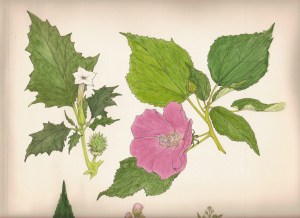
Swamp Mallow, courtesy of the Arnold Arboretum
From Newcomb’s Wildflower Guide to The Curious Naturalist magazine, from the Garden in the Woods in Framingham to the Missouri Botanical Gardens tropical rainforest exhibit,
Gordon Morrison has illuminated the natural world for over four decades. A retrospective of his work is now on view at the Arnold Arboretum in Boston.
A Natural Curiosity: A Retrospective of Images by Gordon Morrison is a look at his botanical work, highlighting the best of the thousands of illustrations he has created for education and conservation organizations.
This exhibition includes illustrations from Newcomb’s Wildflower Guide (1977), a book that is still in use and praised by many experts. Morrison’s illustrations, combined with a novel key system, made identifying wildflowers in the eastern United States simpler than ever before.
Original plates from the Peterson Field Guide to Forests series, Gordon’s own children’s book series; the Birds In The Garden series and the Native American series, both for Horticulture magazine, as well as interpretive panels completed for the New England Wildflower Society and the Missouri Botanical Gardens will also be on view.
Morrison’s work appears regularly in Mass Audubon’s Sanctuary magazine and in a variety of field guides and other natural history publications.
A Natural Curiosity: A Retrospective of Images by Gordon Morrison will be on view at the Arnold Arboretum Hunnewell Visitor Center through July 1, 2012. Visitor center hours are Monday-Friday (9 AM – 4 PM), Saturday (10 AM – 4 PM) and Sunday (12-4 PM).
You’re Invited!
You are invited to take part in a conversation
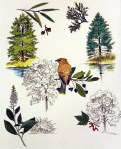
Trees for Nell, courtesy of the Arnold Arboretum
You may also enjoy:


Botanists and illustrators strive to document conifers around the world.
 ArtPlantae Today