Feeds:
Posts
Comments

Archive for the ‘Learning Opportunities’ Category

© Amie Potsic, All rights reserved. Image courtesy Schuylkill Center.

© Amie Potsic, All rights reserved. Image courtesy Schuylkill Center.

Frost
Schuylkill Center
Philadelphia, PA
February 15 – April 18, 2014

Philadelphia artists Amie Potsic and Nancy Agati explore the meaning of winter through photography and mixed media at the Schuylkill Center for Environmental Education.

In winter, patterns emerge from the harsh relief of cold temperatures and heavy snow that illuminate the relationship between us and the changing environment in which we live. Photographer Amie Potsic explains, “I find winter to be particularly seductive as it simultaneously highlights the stark beauty of our environment’s dormant cycle while hinting at the potential growth of spring.” Nancy Agati’s mixed media work, explores the ephemeral through use of natural materials and emphasizes the cyclical patterns of the natural world. Agati writes eloquently about the details that are highlighted by winter: “Working in the studio while the snow falls – again. Linear patterns are further defined as I notice the stark contrast of branches against a pallid backdrop.”

Agati and Potsic draw elements of nature into their work, giving voice to the natural world and putting it in dialogue with both the viewers and the artists themselves. Potsic’s photographs and installations focus on the intersection of the physical, socio-political, and natural worlds, highlighting the change of seasons as indicators of ecological wellbeing.
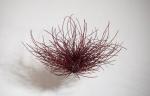
©Nancy Agati, All rights reserved. Image courtesy Schuylkill Center.

©Nancy Agati, All rights reserved. Image courtesy Schuylkill Center.

Agati’s sculptural installations use natural materials to create forms which resonate with the patterns, shapes, and complex structures of the natural world. Whether it is Agati’s striking sculptures or Potsic’s photography that transports you, Frost creates a world that is both uniquely its own and deeply connected to its inspiration: our natural world.

The public is invited to view the exhibition and meet the artists this weekend during the opening reception. The reception will be held on Saturday, March 1, 2014 at 4:00 pm.

Learn more about the Schuylkill Center for Environmental Education on their website at www.schuylkillcenter.org.
Read Full Post »

By Philadelphia Society of Botanical Illustrators

Every year the Philadelphia Society of Botanical Illustrators is given the opportunity by the Pennsylvania Horticultural Society to demonstrate our skills at the Philadelphia Flower Show. This is a wonderful chance for our organization to explain the fascination of botanical art to the world at large.

Some of the artists think this is great fun. But some do not. It is certainly different from the peace and quiet most of us experience when painting. People crowd around us. Small children want to see what we’re doing – up close. School groups ask endless good questions. It can be stressful.

It’s all a matter of attitude. The “best” attitude is that of a teacher who thinks that botanical art is the most fascinating subject in the world (which, of course, it is). You have to accept the obvious that there is no way that you’ll have the time to paint an entire watercolor. Maybe you can do a little work on one to show how laboriously slow it is. But do not expect to finish it. It is better to bring examples of your sketches, notes, drawings, tracings — whatever led up to the final artwork (which is shown on the wall behind us).

Instead of painting, your time will be taken up with talking to people: explaining how important it is to really “see” the plant, to understand how it grows and reproduces, to show aspects of the plant that photography cannot capture. You can possibly show how artists create form, a feeling of three dimensions. You might briefly touch on the long history of botanical art going back to the Egyptians. You must, however, talk in “sound bites.” Every sentence has to be a headline. And don’t be riled if your audience drifts away. Don’t expect to hold their attention.

You are there to rouse interest that might find an outlet at another time. Who knows? Your audience might someday take a botanical art class. They might become avid painters of wild flowers. They might even buy one of your botanical watercolors. But it’s not going to happen during the demonstration. So relax. Enjoy yourself. Stay calm and carry on.

Read Full Post »

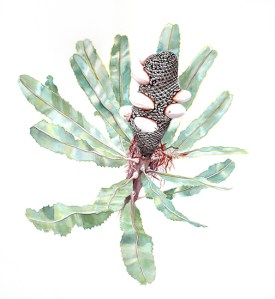
Raspberry Frost Banksia (Banskia menziesii), watercolor, 22x30". © Sharon Birzer, all rights reserved.

Raspberry Frost Banksia (Banskia menziesii), watercolor, 22×30″. © Sharon Birzer, all rights reserved.

Sharon Birzer
www.sharonbirzer.com
Scientific illustrator Sharon Birzer is a teaching artist at Seattle Pacific University and Frye Art Museum, and has completed illustrations for the Burke Museum of Natural History and Culture at the University of Washington. Sharon shows her work at Shift Collaborative Studio in Seattle, Washington.

Her work is currently on view in the exhibition Drawing on Nature: Flora and Fauna at the Washington State Convention Center in Seattle (January 15 – April 1, 2014). This exhibition features the work of members from the Northwest Chapter of the Guild of Natural Science Illustrators and The Pacific Northwest Botanical Artists’.

    Art in the Garden: One-Day Botanical Illustration Workshop
    Sunday, March 2, 2014
    9 AM – 3 PM

    The National Tropical Botanical Garden is offering a one-day botanical illustration workshop with natural science illustrator Sharon Birzer. For beginning and intermediate artists, ages 15 and up. Students will work in watercolor. This workshop will be taught at the Harrison Chandler Education Center, National Tropical Botanical Garden Headquarters Campus at 3530 Papalina Road, Kalāheo.
    View Details/Register

Read Full Post »

Looking for inspiration and adventure?

Artist Andie Thrams has announced her teaching schedule for 2014. Take a look!


Andie Thrams

www.andiethrams.com
Andie is a painter and book artist devoted to creative work in wild places. She teaches in California, Oregon, Alaska and Hawaii. Her work is widely exhibited and honored, and is held in many private and public collections. Get the latest news about Andie’s popular classes on her website. Here is what’s coming up in 2014:

  • Wild Yoga, Wild Art & Ecology on the Big Island of Hawaii – March 9-15
  • Individual Artist Mentoring & Creativity Coaching – March 31 – June 2
  • Field Journal Studies: San Francisco Botanical Garden – April & May
  • Field Journal Studies: UC Berkeley Botanical Garden – May 12
  • Color Mixing Intensive: Spring Wildflowers – May 23-25
  • Watercolors in the Wild: Sierra Flora – June 14-19
  • Botanical Explorations: Papermaking & The Artist’s Book – August 25-29
  • Watercolor Intensive: Methods, Materials & Magic – Sept. 2-5
  • Wild Forest Wild Art – October 3-5

This information has been added to Classes Near You > Northern California.

Read Full Post »

Botanical Illustration of Desert Flora
Desert Studies Center, Zzyzx, CA in the Mojave National Preserve
Apr 11-13, 2014 (Friday night to Sun afternoon)

Learn how to draw artistic and realistic flowering plants in a way designed to understand the form, function, and identification of native plants. Exciting
hands-on experience both in the lab and in the field amid native flora habitats. Techniques in pencil, pen, and watercolor. Learn how to:

  • Focus on comprehensive line drawing stressing contour, volume and perspective.
  • Make drawings of minute structures to full-scale renditions of plants.
  • Understand how artistic and scientific skills work together.

This 1-unit field study course is based at the Desert Studies Center (of California State University) located within the Preserve at Soda Springs (Zzyzx), about an hour outside Las Vegas, about a three-hour drive from Riverside. The course fee includes two nights’ lodging at the Center (dormitory rooms & some couples rooms), and fresh cooked breakfast and dinners; bag lunches and tapas on Friday night. Participants will be sent information via email about the Center and what to bring with them. NO VEHICLE REQUIRED ONCE YOU ARRIVE, so great for car share to and from this special location. Cost: $325

Instructor Donald Davidson is an artist with over 500 pieces of art featured in the Traveling Artist Wildflower Project with the National Park Service.


Course Schedule
:
Friday, April 12: 8-10 p.m.
Saturday, April 13: 8 a.m.-5 p.m.
Sunday, April 14: 8 a.m.- 2 p.m.


Registration Deadline
:
Register by March 28, 2014. Cite registration # 124−CPF−F61

View Details/Register


This information can also be found at Classes Near You > Southern California.

Read Full Post »

An exciting new learning opportunity at Classes Near You > Mississippi:


The Illustrated Garden, A Studio Blog

www.valwebb.com
See Val Webb’s online tutorial, Botanical Drawing with Pencil and Watercolor. Connect with The Illustrated Garden on Facebook. For more information about the class below, email Val Webb.

    Artist-Naturalist Workshop: An Introduction to Botanical Art
    Grand Bay National Estuarine Research Reserve (NERR)
    In conjunction with the Walter Anderson Museum of Art (WAMA)
    Moss Point, MS
    May 9-10, 2014

    Join illustrator Val Webb, coastal ecologist Jen Buchanan and WAMA education director Melissa Johnson at the Grand Bay National Estuarine Research Reserve to learn about freshwater habitats, saltwater habitats and plant anatomy while learning how to draw the plant life at the Reserve.

    This two-day adventure includes an overnight stay at the NERR dormitory and two meals. Cost: $95 Non-WAMA Members; $85 WAMA Members.

    View Photos & Itinerary

Read Full Post »

If you like to tell stories about plants but come up against students who are indifferent towards botanical subjects, consider the strategies suggested by professor Rob Reinsvold in Why Study Plants? Why Not?.

In his short 2.5-page editorial, Reinsvold (1999) provides an overview of how students learn about plants in elementary school, middle school and high school and how what they learn contributes to their thinking that biology is primarily about humans and animals.

To make plants more interesting to students, Reinsvold (1999) suggests educators try the following:

  • Take advantage of society’s obsession with “the biggest and the best”
    (p. 3). Introduce students to the largest known creosote bush, the oldest living tree, the largest living organism, etc. and relate them to comparable examples in the animal world. Reinsvold talks about hosting an Organismal Olympics. You can learn more about this in his paper.
  • Show students that plants are active using time-lapse photography.
  • Explain how people use plants.
  • Talk about money. Discuss plant products as traded commodities.
  • Discuss how plant research has contributed to our knowledge about genetics, growth, development, biodiversity and climate change.

Reinsvold (1999) includes in his editorial a list of principles proposed by the American Society of Plant Physiologists. These principles address what the Society thinks every student and citizen should know about plants. An updated version of this list is available on the website of the American Society of Plant Biologists (ASPB). (Note: The Society changed its name since Reinvold’s editorial was published).

The principles proposed by the ASPB have been aligned with the National Research Council’s Life Science Standards. Educators may be especially interested in the bookmarks the Society created around these twelve principles. These double-sided bookmarks are available for free in limited quantities each month. Go to the Society’s Education page to learn more about the bookmarks, the Standards and the Principles of Plant Biology.

Reinsvold (1999) can be purchased online for $39. You can also search for back issues of this journal at your local college library.


Literature Cited

Reinsvold, R. 1999. Why study plants? Why not? Science Activities. 36: 3-5


Also See


Remembering Dr. James Wandersee

Dr. James Wandersee was a professor of biology education and one of the researchers to coin the term “plant blindness”. In 2009 I had the opportunity to communicate with Dr. Wandersee via email. I told him about ArtPlantae and we discussed some of my ideas. He was very encouraging and supportive. This weekend I was saddened to learn of Dr. Wandersee’s passing. I can’t read or write the phrase “plant blindness” without thinking of our email exchanges and his encouraging words. Dr. Wandersee was 67.


Read Full Post »

« Newer Posts - Older Posts »