Feeds:
Posts
Comments

Archive for the ‘botany’ Category

Update at Classes Near You > England:


The Beth Chatto Gardens

Elmstead Market, Colchester, Essex
www.bethchatto.co.uk
A former overgrown wasteland that has been transformed into an informal garden in the countryside. The garden’s Tea Room offers light lunches, sweet treats, tea, and coffee.

  • Learn How to Identify Plants & The Use of Botanical Latin – September 18, 2010; 11:00 AM – 3:00 PM. Study the morphological differences of several species of plants. Also learn the Latin names of plants and how these names are used.
  • Drawing, Painting and Design in Line w/Watercolor
    November 6, 2010; 10:30 AM – 3:00 PM. Capture the colors of autumn using pencils, pens, and watercolor. Participants will have the option of incorporating their drawings into a design of a simple Christmas card.

Read Full Post »

What’s the value of an image?

Is a picture really worth a thousand words?

Today we value the use of illustrations to convey scientific information. But in early 19th-century Britain, the use of pictures in science education was a hot topic of debate. In her article Botany on a Plate: Pleasure and the Power of Pictures in Promoting Early Nineteenth-Century Scientific Knowledge, Anne Secord reviews the debate in detail. Secord’s research focused on botanists specifically and their use of illustrations because early botanists recognized the importance of providing pleasure (appealing imagery) to their audience while imparting scientific knowledge. Secord’s research brings attention to “the role of pleasure in intellectual pursuits.”

In the 1800s, the “Diffusers of Knowledge” (i.e., experts in any given field) networked with only one objective in mind — to encourage people with an interest in nature to begin formalized study so they can become experts. The recruiters for botany took advantage of the public’s interest in color botanical plates to establish their own following of “admirers.” Botanists knew that to be successful at turning admirers into future botanists, they needed to maintain a balance between making botany an attractive science and keeping it a serious discipline. As a naturalist in 1838 proclaimed:

I conceive that the presentation of an allurement to the study of any science, is both a justifiable and a legitimate mode of procedure.

The use of illustrations as a teaching tool was a controversial topic back then because there were two schools of thought. One school felt it was perfectly legitimate to use illustrations that appealed to their audience. They recognized the need to engage their audience in conversation and the need to form a relationship with their audience. The other school, however, disagreed with this approach. They felt that by using illustrations and paintings to appeal to amateur naturalists, botanists were not really addressing the discipline of botany. According to the botanists in this second group, botany is best learned by studying written descriptions of plants and by studying actual specimens, not by looking at pictures. They felt color plates were “harmful” and merely provided “easy access” to the discipline instead of “sound knowledge” and “rational instruction.”

Let’s revisit the 1838 debate about the use of illustrations to teach natural history. Here’s a question for you…

Do color plates encourage beginners to study botany or do color plates encourage a superficial appreciation of nature?


Literature Cited
:

    Secord, Anne. 2002. Botany on a plate: Pleasure and the power of pictures in promoting early nineteenth-century scientific knowledge. ISIS. 93:28-57


Related
:

Read Full Post »

ArtPlantae brings botany and botanical art education to the largest women’s conference in the nation. Visit us at Booth #1915.

We may only have 100 square feet, but look at what you can do!

  • Learn about ArtPlantae’s research to improve botanical literacy.
  • Discover what there is to learn at ArtPlantaeToday.com.
  • Discover instructional books about drawing and painting plants.
  • Learn about plant books used by botanical illustrators.
  • Be inspired by the contemporary botanical art collection of Dr. Shirley Sherwood.
  • Delight in viewing a baby elephant display copy of Botanical Magnifica
  • Turn your inspiration into art! Moleskine® sketchbooks and watercolor notebooks available for purchase.
  • Discover clever interchangeable notebooks from StartHereNY®.
  • See the revealing paper in Whitelines® notebooks.
  • See sketchbooks and art supplies for children.
  • Buy botanical art prints, cards, notepads, or bookmarks for the gardener in your life.
  • Learn about California’s two botanical art groups and the only botanical art certificate program in California.

Don’t forget to doodle in our Guest Sketchbook!


Related Items:

Posters
A free Botanica Magnifica poster for teachers, nature centers, or libraries. Limited supply. While supplies last.

Watch the Women’s Conference Live

Go to www.womensconference.org to watch the LIVE WEBCAST on October 27th beginning at 8:00 AM PDT.

Follow Us on Twitter

We’ll do our best to tweet from the floor of The Village. Go to @artplantae or check the feed in the column to your right. The feed box has been expanded for this event.

Visit ArtPlantae Books

A companion resource specializing in books about botanical art history, botanical art instruction, botany, plant identification, economic botany, and natural history.

Read Full Post »

Lessons For A Young Botanist

This article was published in the December 2006 issue of Artists’ Botany.

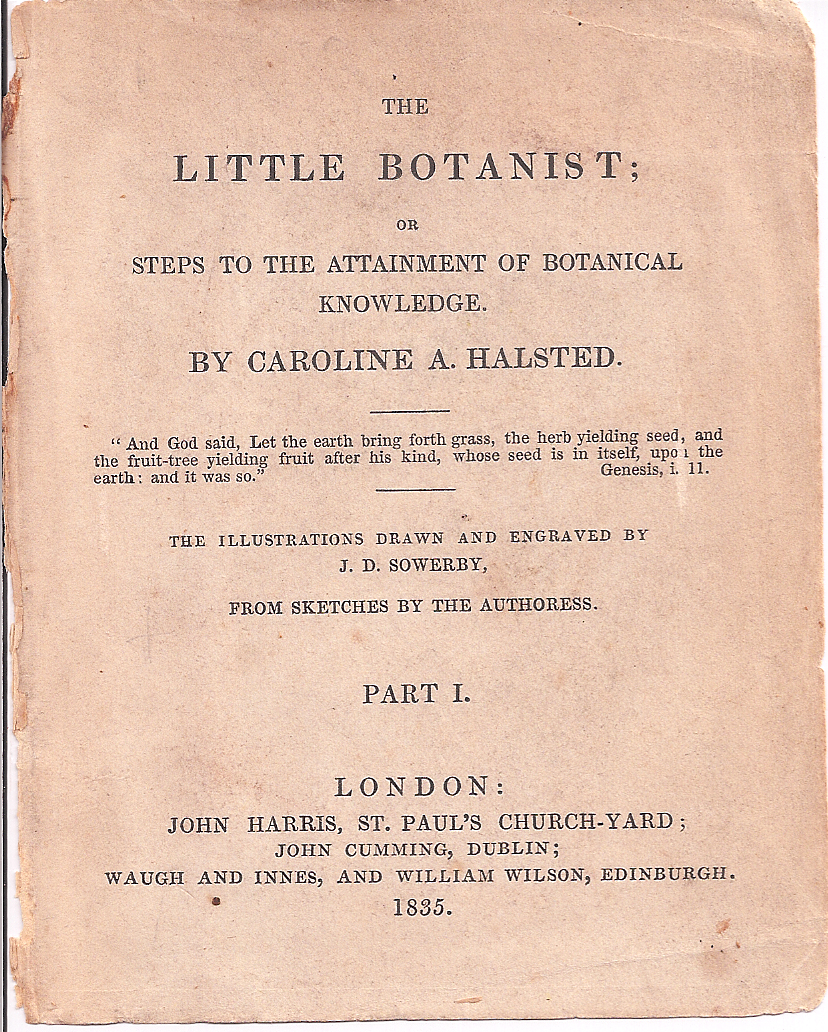
coverTheLittleBotanistOne of the true treasures in our collection is an introductory botany book that was published in 1835. This book is not a college text, but instead an introductory botany book for children. The botany lessons in this book are presented as a conversation between a mother and a young child. These conversations are modeled after actual conversations the author had with a nine-year old family friend.

This book is titled, The Little Botanist or Steps to the Attainment of Botanical Knowledge. The title alone makes us giddy. The fourteen illustrations included in this book were drawn and engraved by J.D. Sowerby and were based on sketches created by the author, Caroline A. Halsted.

The conversations between mother and child are so sweet and so engaging, it is not possible to describe them well enough in this little space. Throughout the book, the young girl’s mother patiently and lovingly discusses the following
topics with her daughter: the definition of botany, flower structure, artificial and natural classification systems, Greek and Latin terms, and the morphological features of several types of plants. During a conversation about flower parts, the young mother teaches her daughter how to remember the arrangement of parts in a flower. She asks her daughter to stretch out her hand and to lift her fingers so as to form a cup. She then explains:

…call the thumb the calyx, the first finger the corolla, the second the stamens, the third the pistil, the fourth the pericarp, and the entire of the hand the receptacle…..for the calyx, like the thumb, stands apart from the next four parts of a flower, which, like the fingers, are more immediately connected with each other; and they all spring from the receptacle, which is the bottom part of a flower, and on which, generally speaking, all the other parts rest.

The conversations recorded in this book are precious. The botany lessons in this 171-year old book are as well because they offer a glimpse into how botanists made meaning so many years ago.


Updated 9/26/09

This book can be viewed online and is available as a PDF at Google Book Search.

Read Full Post »
Enhance your ability to key out those plants that can ruin your day! Attend the 34th Annual Symposium of the Southern California Botanists this Saturday (Oct. 18th) at the Ruby Gerentology Center at CSU Fullerton.

Tackle grasses with Dr. J. Travis Columbus, delphiniums with Dr. Jason Koontz, the Polemoniaceae with Dr. Leigh Johnson and Mark Porter, oaks with Fred M. Roberts, Jr., Cryptantha with Dr. Michael Simpson, Camissonia with Dr. Warren Wagner, and Ceanothus with Dr. Dieter Wilken.

For more information about this symposium, visit the website of the Southern California Botanists.

Read Full Post »

Darwin’s Garden

You are invited to discover the untold story of Charles Darwin’s lifelong fascination and work with plants. Darwin’s Garden: An Evolutionary Adventure at The New York Botanical Garden showcases Darwin’s botanical influences, research, and contributions in these venues:

Darwin’s Own Gardens: A re-creation of Darwin’s gardens at his home Down House in England features his important work, in the Enid A. Haupt Conservatory April 25 – June 15.

Darwin’s Botany in His Own Words: Original historical documents explore Darwin’s deep, personal relationship with plants, in the LuEsther T. Mertz Library’s William D. Rondina and Giovanni Foroni LoFaro Gallery April 25 – July 20.

Children’s Adventures with Darwin: Hands-on activities, a replica of Darwin’s ship, and a display of carnivorous and other plants he studied teach about Darwin’s groundbreaking findings, in the Everett Children’s Adventure Garden, April 25 – June 29.

Evolutionary Tour: A walking tour through some of the Garden’s living collections illustrates Darwin’s concept of a tree of life, April 25 – June 15.

An additional highlight of the exhibition is a two-day symposium, on May 6 and 8, hosted by the Botanical Garden and the American Museum of Natural History. Darwin: 21st-Century Perspectives will feature presentations by some of the world’s leading Darwin experts who will discuss the far-reaching legacy of Charles Darwin and the implications of his thinking for science and society today. See the enclosed flyer for more information.

Darwin’s Garden: An Evolutionary Adventure will be on view April 25 – June 15, 2008.

Read Full Post »

« Newer Posts