Feeds:
Posts
Comments

Archive for the ‘botanical art’ Category

During the food-filled Thanksgiving weekend, a few changes were implemented at the store. The search function operates a bit more smoothly and a new category system was created. All of this in response to customer feedback (thank you for your comments).

Now when you go to ArtPlantae Books, you will see a new section in the right-hand column called Discover More. This section contains links to titles in the following categories:

  • Drawing
  • Pen & Ink
  • Watercolor
  • Colored Pencil
  • Plants & You
  • Botany
  • Botanical Terminology
  • Natural History Art

These categories have been created to connect you to what you’re looking for in a fraction of the time. The titles in each category are only a sample of what is available, so I encourage you to use the search field to look for related titles. I will do my best to keep fresh titles circulating through this new section.

Visit the new Discover More section and tell me what you think.


CyberMonday (& Tuesday) Specials

Save 20% off select books, gift items, DVDs and CDs storewide. Also receive free shipping on orders over $50.

Sale prices good through Tuesday, November 29, 2011.

Read Full Post »

The coloring book, Colorful Edibles, was the brainstorm idea of botanical artist and organic farm owner, Wendy Hollender. Grounded in a desire to promote the work of the American Society of Botanical Artists (ASBA), a small committee was formed to raise awareness about the ASBA through the development and sale of products created by its members. It took about one year for the first idea, a coloring book, to take shape. Botanical illustrator Bobbi Angell signed on as Co-Project Coordinator and Editor. Graphic artist and book designer, Charlotte Staub Thomas, also joined the project. Together they created a coloring book highlighting the contemporary botanical art of 26 ASBA members.

Editor, Bobbi Angell, says it was easy to get artists involved in this project. The project team made a specific request for pen-and-ink illustrations so that they could include as many ASBA artists as possible. They received 85 submissions from 38 artists. Because they wanted to keep the book inexpensive, only 36 illustrations were selected. The illustrations in Colorful Edibles showcase the strong and diverse line work of ASBA members, and includes work from new artists along side work by more established artists, things Angell said the project team was hoping to accomplish.

Most pages of the coloring book feature a full-page illustration. Informative passages about each fruit and vegetable are included on each page. Angell wrote the passages with young readers in mind. Through her writing, Angell makes reference to the origin and domestication of each fruit and vegetable so that readers learn about the history of their food. She also includes comments from contributing artists.

Colorful Edibles is truly a coloring book for all ages. Garden teachers will find this activity book to be a helpful teaching tool because it not only explains where familiar fruit and vegetables come from, it touches upon the subjects of botany, history, agriculture and nutrition.

The project team hopes to expand the coloring book format to other books about native plants and wildflowers.

Colorful Edibles can be purchased on the ASBA website.

Read Full Post »

Learn about books that move, fold and pop up. Then learn introductory bookbinding techniques you can use to create your own art journals.

New at the Morton Arboretum…


The Morton Arboretum Botanical Art & Illustration and Master’s Studio Certificate Program

http://www.mortonarb.org/
The Morton Arboretum is located in Lisle, Illinois and is dedicated to the conservation of trees. Its 1,700-acre garden has 4,000 kinds of trees, shrubs, and plants. Individuals interested in earning a certificate in botanical art & illustration &/or an advanced master’s certification in this discipline, should visit the program’s webpage for more information. In addition to completing required coursework, certificate students explore related topics and disciplines in elective courses such as:

    Creative Pop-up Books – Saturdays, March 3 & 10, 2012; 1-4 PM. Artist, Kathleen Garness, will teach basic bookbinding through a variety of book structures, including some that move, pop up, fold and display original artwork in unique ways. Explore the third dimension and the book arts and learn how to make an artist’s journal. Each book created will be unique to a student’s interests. Nature themes will be the focus of this two-day workshop. Cost: $75 member, $89 non-member. Prerequisite: Botanical Art & Illustration Pencil (A110), Begin to Draw (A000), or some art background. This course qualifies as an art certificate elective.
    Register Online

This information can also be viewed at Classes Near You > Illinois.

Read Full Post »

Hazel West-Sherring appreciates your questions and has replied to your questions and comments.

Thank you to readers who participate in the learning opportunities presented each month with featured guests. These opportunities exist so that you can ask our guests questions directly and so you can connect with each other. Remember that your participation is always welcome. Simply join in the conversation by using the comment box below.

I would like to thank Hazel for her thoughtful replies and wonderful instruction. Hazel has spoiled us with step-by-step instructions for painting stems.

Let’s get right to it!


Reader 1
: Hello Hazel. I have been unable to find courses in botanical art without having to travel thousands of miles and having to spend thousands of dollars. I am unclear where you live, but feel sure that the ASBA (American Society of Botanical Artists), would be able to locate classes locally, since their membership is widespread as well as international. Meeting like-minded people to paint with will save lots of money and is really enjoyable. I have all of the “how to” books on learning botanical art, but seem to have lost the passion or zest or desire to do anymore painting. And doing it on my own just isn’t any fun, at all. It has now been over a year since I have done any painting of any subject (in watercolours or graphite). I think that because there is no support, no teachers, no interest from anyone, that I have lost my interest also.

Hazel: You haven’t lost your interest fully or you wouldn’t be writing! I do agree that botanical art can become a rather lonely occupation. It is hugely helpful therefore to meet others, to view their work, and receive feedback on your own work too. Initially when I first became professional in botanical art, I met with a small group of other amateur and professional painters once a month, over a period of 2 years. We didn’t do much painting, but we inspired and encouraged each other, and discussed exhibitions.


Reader 1
: I hate to give this up because I have invested a small fortune in books, painting supplies, time and talent. I feel absolutely lost. How do I find some interest in this again, or some fellow botanical artists for mutual support? Is there anyone else who has given up?

Hazel: For me, when feeling uninspired to paint, gardening or a visit to a good plant nursery often helps. Visiting galleries and exhibitions is sometimes a welcome relief when feeling confused about direction. Looking through bulb or seed catalogues is inspiring, and (perhaps) allows planning for a series of paintings?!

Start simple with a subject whose colour, texture or shape you absolutely love, and want to ‘capture’…..an apple or pear, a pretty leaf, or perhaps a single flower stem. To bring some fun into your projects, challenge composition and the way that you crop the image, or concentrate on red flowers or just yellow.


Reader 1
: Any suggestions, please?

Hazel: Get those paints out and ‘play’ with colour! Form a wish list of favourite plants, fruits or vegetables, and have a go at drawing and painting what you are inspired to portray.


Reader 2
:
You mentioned opera rose as an unexpected underwash. What are some of your other favorite colors to use as an underwash. I need to get out of my blue or yellow underwash state of mind.

Hazel: Yellows and blues are always useful as single pigment underwashes! A wash of cerulean or cobalt blue is fantastic on deep green shiny leaves, and raw sienna or gamboges works well for more olive tones. If looking for a startling bright red, an underwash of transparent orange or winsor yellow works well, identifying the underlying tones of the final red.


Reader 3
: The Auricula Collection in your gallery has a peaceful antique look to it. Did you paint your specimens on colored paper or did you paint the background? Did you use gouache or transparent watercolor to paint the deep colors in this collection?

Hazel: The Auricula Collection was painted in watercolour on Arches hot-pressed paper. Depth of colour is built up with subsequent layers of colour wash (i.e not watery but full of pigment), or by using very dry brush and small ‘feathered’ strokes. This collection has no painted background, but occasionally I am asked to paint a weak tea-coloured background in order to promote an antique feel, as in the gooseberries and currants. This was achieved by mixing up a quantity of much diluted burnt umber, applied liberally with a very large sable brush. Once dry, it can be modified if there are areas that are too dark and need lifting.


Reader 4
: What are common mistakes students make when learning how to draw, shade, color, or paint stems? I am hoping you say something that will make me realize what I am doing to make not-so-graceful, not-quite-realistic stems.

Hazel: What a good question! I think that there is much fear in painting stems, with many people fearful of wiggly edges and a thickening of the stem in the wrong places. The plant’s posture and character rely on the stem structure. It will often determine your composition, so the drawing (with good observation of how the stem behaves), must capture this character. Where does it thicken, bend or curve? How do leaf junctions work? What is the cross section? Is there colour interchange or transition of green to magenta for example, as it nears a leaf junction, flower, or roots? What is the texture, and are there additional features such as hairs, prickles or thorns?

Shading is about applying necessary light and shade, to promote 3-dimensional qualities. In general terms, if you think of the stem as a geometric tube or cylinder, and applying the light source from top left for example, break the length of the cylinder into thirds. Tonally, the left light, the center medium and the right dark.

To paint:

  • Taking care to create clean edges, underwash with a light lime green or yellow wash, allow to dry. (This first wash determines the boundaries for the subsequent paint layers to flow within…..try not to paint outside these clean edges.)
  • Paint two-thirds (the centre and right-hand side) in a darker medium tone, allow to dry.
  • With a darker tone still, then paint down the right hand side giving the stem three tones. It will look striped, so carefully blend the edges working the paint from the darker tone into the lighter tone with a damp rounded or flat brush. Where you see possibility of a highlight, use a flat brush to take away a thin area of the first light wash.
  • Use a very dark shadowy tone on the extreme right-hand edge of the stem and up and under the leaf or flower.
  • Most stems will carry colour that will be found in the flower or fruit, often magenta. Carefully observe the texture, spots or flecks, and apply.
  • Finally, use a final dilute green wash to blend it all together!


Reader 5
: When you paint on colored ground, do you paint your subject in white to establish a footprint for your painting or do you paint directly over the colored paper?

Hazel: I don’t work with coloured grounds, although I adore the work done by Mrs. Delaney on her deep black painted ground. The idea of establishing a white footprint is ideal when working with gouache, and results are delightful. A weak watercolour tea wash is about my limit!


Readers, do you have any questions or comments?

Read Full Post »


A Botanical Painting Holiday with Elaine Searle

Hotel Il Collaccio
Umbria, Italy
May 2-9, 2012
Cost: Euro 960 (convert currency)

Artists of all ability levels are invited to paint the orchids and Spring flowers of Umbria with botanical artist and teacher, Elaine Searle. This 7-day trip includes five days of instruction, plus a full day trip that includes a visit to a national park, shopping at a market in a medieval town, and lunch at the gastronomy capital of the region. Non-painting companions are also welcome. There is plenty to see and do in this region of Italy.

Click on the image above to download a color brochure containing a complete itinerary, photos of the 2011 trip, and a helpful FAQ section.

This botanical art holiday has also been listed in Classes Near You > Italy.


Related

Elaine Searle Shares Her Passion for Botanical Art, Discusses How Students Learn Best

Read Full Post »

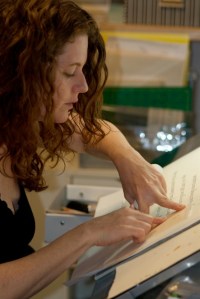
Kelly Houle at work in her studio.

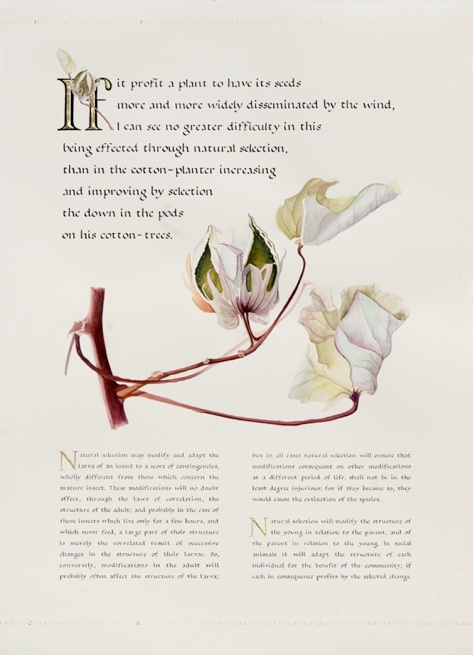
Natural history artist, calligrapher and science educator, Kelly Houle, is creating a large-scale illuminated manuscript based on Charles Darwin’s The Origin of Species. Each page will be designed as a work of art. All text will be written by hand and natural history illustrations will be illuminated with iridescent watercolors and 23-karat gold. The completed manuscript will be 22 x 30 inches and is expected to have 300 pages and over 500 illuminations.

Kelly has established working relationships with biologists and evolution experts from all over the world who will advise her during this project (see timeline). Kelly’s goal is to enhance public understanding of Darwin’s text. She explains:

I believe that the main barrier to understanding The Origin of Species is the perceived difficulty of the writing. The concepts themselves are simple, yet profound. I hope to improve understanding of The Origin by integrating poetic arrangements of Darwin’s words with visually striking presentations of the evidence. I will use elements of poetry, traditional realism, lettering art, graphic design, and fine art illustration in the service of communicating one of the most important ideas in science. 

Kelly has been raising funds on the funding website Kickstarter. Donors donating $10 or more will receive gifts of art related to The Illuminated Origin of Species. All donors will have their names written in a special section of the illuminated manuscript. In addition to individual donations, Kelly is looking for an institutional donor to fund the entire Illuminated Origin of Species project in exchange for the completed manuscript.

To read more about this project, watch a short video and to make a donation, visit the The Illuminated Origin of Species.


Related


Read Full Post »

Botanical artist, Heeyoung Kim, will begin teaching a 10-week class in botanical painting in January 2012. Do you live in the Chicago area?

Don’t miss this class by Heeyoung Kim!


Lillstreet Art Center

http://lillstreet.com
The Lillstreet Art Center offers adult classes in painting and drawing, ceramics, metalsmithing and jewelry, printmaking, textiles, glass, photography and the digital arts. View a schedule of their classes for first-time artists and for children ages 2 and up here.

    Introduction to Botanical Art & Illustration I
    Mondays, January 9 – March 12, 2012; 10 AM – 1 PM. This class is designed for beginners/advanced beginners. Fundamental watercolor techniques will be introduced, along with an introduction to botanical art history. In this ten-week class, students will also learn basic botany, which is essential for botanical artists to make their work botanically accurate. Two independent projects will be completed by each student.

    For more information, contact instructor and botanical artist Heeyoung Kim at info@PrairiePlantArt.com. Learn more about Heeyoung and view her online gallery at www.PrairiePlantArt.com. To register for this class, contact the Lillstreet Art Center at (773) 769-4226 or register online. Cost: $320 members, $330 nonmembers

This information has also been posted to Classes Near You > Chicago.

Read Full Post »

« Newer Posts - Older Posts »