Feeds:
Posts
Comments

Archive for the ‘botanical art’ Category

Here is the latest news at Classes Near You > New York:


Wendy Hollender at Hollengold Farm

www.drawingincolor.com
Wendy Hollender is an illustrator, author, and teacher. She teaches at the New York Botanical Garden and at Hollengold Farm, her organic vegetable farm. Wendy is the author of Botanical Drawing in Color. A new exciting schedule of classes for 2012 has been announced, as well as two new instructors:

    Botanical Drawing Basics – Fridays, twice per month (8 sessions); 2-5 PM. Could there be a nicer way to spend a summer afternoon? Botanical artists Wendy Hollender and Carol Woodin will teach this introductory course to botanical illustration throughout the summer at Hollengold Farm. Cost: $440. The dates for this class are as follows:

    June 1 – Wendy
    June 22 – Carol
    July 13 – Wendy
    July 27 – Wendy
    August 10 – Carol
    August 24 – Wendy
    Sept 7 – Carol
    Sept 28 – Wendy

    For more information, visit the webpage for Botanical Drawing Basics.


    Saturday Workshops at Hollengold Farm
    – Saturdays. Workshops are held 10:00 AM – 4:30 PM. Six one-day workshops are planned through October 2012. Workshops will be taught by Paul Harwood, Carol Woodin and Wendy Hollender. Each workshop will focus on a specific topic. Topics include botanical field sketching, drawing trees in charcoal and chalk, drawing fresh produce, drawing still lifes, heirloom fruits in watercolor, and drawing dahlias.
    Cost per workshop: $105, includes a farm-fresh lunch.
    View complete workshop schedule

Read Full Post »

Observe and draw local flora while learning plant classification and identification. See what’s new in the Classes Near You sections for Washington, Oregon and Colorado.


Quinn Fitzpatrick

www.quinnfitzpatrick.com
Quinn is an artist, a musician, and a graduate of the Natural Science Illustration Program at the University of Washington. His specialties include wild cats, raptors, wild edible plants, and medicinal plants. His chosen media are graphite, watercolor, gouache, colored pencil, and photography. He teaches workshops in botanical illustration in Washington, Oregon and Colorado.

  • Introduction to Botanical Illustration
    Tuesdays, April 10 – June 5, 2012; 5:30 – 7:30 PM. This workshop introduces students to the practices of botanical illustration from a natural science perspective. We will be primarily working with black & white mediums using graphite and pen & ink. Some color theory and mediums (i.e., colored pencil) will be introduced. Draw northwest flora while learning classification and identification. Some drawing experience is helpful and this course is open to all skill levels. Location: North Seattle Community College, Seattle, WA. Details/Register
  • Introduction to Botanical Illustration – April 30, 2012; 6-9 PM. This workshop introduces students to the practices of botanical illustration from a natural science perspective. We will be primarily working with black & white mediums using graphite and pen & ink. Some color theory and mediums (i.e., colored pencil) will be introduced. Draw northwest flora while learning classification and identification. Some drawing experience is helpful and this course is open to all skill levels. Location: Rossehill Community Center, Mukilteo, WA. Details/Register
  • Introduction to Botanical Illustration – May 3, 2012; 6-9 PM. This workshop introduces students to the practices of botanical illustration from a natural science perspective. We will be primarily working with black & white mediums using graphite and pen & ink. Some color theory and mediums (i.e., colored pencil) will be introduced. Draw southwest flora while learning classification and identification. Some drawing experience is helpful and this course is open to all skill levels. Location: Frontrange Community College, Boulder, CO. Cost: $59. Details/Register
  • Introduction to Botanical Illustration
    May 5, 2012; 9:30 AM – 12:30 PM. This workshop introduces students to the practices of botanical illustration from a natural science perspective. We will be primarily working with black & white mediums using graphite and pen & ink. Some color theory and mediums (i.e., colored pencil) will be introduced. Draw southwest flora while learning classification and identification. Some drawing experience is helpful and this course is open to all skill levels. Location: Frontrange Community College, Westminster, CO. Cost: $59. Details/Register
  • Introduction to Botanical Illustration
    May 7, 2012; 4:30 – 7:30 PM. This workshop introduces students to the practices of botanical illustration from a natural science perspective. We will be primarily working with black & white mediums using graphite and pen & ink. Some color theory and mediums (i.e., colored pencil) will be introduced. Draw southwest flora while learning classification and identification. Some drawing experience is helpful and this course is open to all skill levels. Location: Frontrange Community College, Fort Collins, CO. Cost: $59. Details/Register
  • Introduction to Botanical Illustration
    May 20, 2012; 4:30 – 7:30 PM. This workshop introduces students to the practices of botanical illustration from a natural science perspective. We will be primarily working with black & white mediums using graphite and pen & ink. Some color theory and mediums (i.e., colored pencil) will be introduced. Draw southwest flora while learning classification and identification. Some drawing experience is helpful and this course is open to all skill levels. Location: South Whidbey Parks & Recreation, Whidbey Island, WA. Details/Register
  • Botanical Illustration Weekend Workshop
    June 15-17, 2012. Review plant anatomy, ecological adaptations and develop drawing skills while exploring the flora on the east side of the Cascades with Quinn Fitzpatrick. Cost: $280 for shared room includes 2 nights, 5 meals, instruction and field trips; $295 private room; $175 no lodging. Details/Register
  • Introduction to Botanical Illustration – July 11, 2012. This workshop introduces students to the practices of botanical illustration from a natural science perspective. We will be primarily working with black & white mediums using graphite and pen & ink. Some color theory and mediums (i.e., colored pencil) will be introduced. Draw northwest flora while learning classification and identification. Some drawing experience is helpful and this course is open to all skill levels.
    Location: Portland Community College, Portland, OR. Details/Register

Read Full Post »

On Monday, the Reeves-Reed Arboretum in Summit, NJ revealed
The Magnified Eye: Contemporary Botanical Portraiture in collaboration with Susan Frei Nathan Fine Works on Paper, LLC. This new exhibition features the work of fifteen international artists who have used various techniques and media to create their drawings and paintings of plants. Visitors can study each artist’s technique up close by using the magnifying glasses that will be on hand.

Artists participating in The Magnified Eye are:

Additional information, including an exhibition flyer, are available here. This exhibition will be on view in the Wisner House through June 15, 2012.

The Reeves-Reed Arboretum is an estate garden listed on the National and State Registers of Historic Places. The arboretum hosts programs for families, children, school groups and adults. Readers of this website might be particularly interested in the workshop Tree ID for Beginners scheduled for April 19, 2012.


Related

Martin J. Allen Discusses the Power of Seeing

Read Full Post »

By Heeyoung Kim


Heeyoung Kim
, a botanical artist from Illinois, has been awarded a gold medal from the Royal Horticultural Society (RHS) at the 2012 RHS Botanical Art Exhibition in London.

Twenty-five botanical artists from six countries (Australia, England, Japan, Scotland, Turkey, and USA) were selected by the RHS exhibition committee. Artwork is judged as a group of drawings or paintings making up a complete exhibit. If one or two works in a group are of a lower standard than the others, this affects the way the entire exhibit is judged. Particular credit is given for botanical accuracy, exact color reproduction and attention to detail. Higher awards tend to be given to exhibits illustrating a particular theme or plant family. Gold medals are awarded only to exhibits of outstanding and consistent excellence. Seven gold medals were awarded this year.

Heeyoung’s collection of paintings focused on the common, rare and endangered plants of the American prairie. Since the late 1800s, the fertile tallgrass prairie has been converted into an intensive crop producing area. This region of the US is called America’s “breadbasket” or “corn belt”. What was once the largest ecosystem of the American continent with a biodiversity rivaling the richest rainforests, has yielded to commercial agriculture leaving its flora and fauna in peril. Heeyoung is devoted to documenting these rapidly disappearing plants. She draws public attention to this environmental issue by exhibiting her paintings both locally and internationally.

In this year’s RHS show, Heeyoung exhibited six watercolor paintings and two mixed media paintings featuring watercolor and graphite. Each were drawn and color recorded in situ and finished in the studio after extensive research and observation. Sometimes it took years to follow up on the full life cycles of a plant. Other times it took years of waiting for rare plants to grow and to bloom. Heeyoung says, “It was a great joy to be able to paint the unearthly beauty of Fringed Gentian (Gentianopsis crinita) and the two iconic yellow flowers of the prairie, Prairie Dock (Silphium terebinthinaceum) and Compass Plant (Silphium laciniatum).”

“Well done!”
This was the reaction visitors had to Heeyoung’s paintings at the RHS show. Visitors understood what a gold medal represented and repeatedly expressed enthusiasm and appreciation for the story Heeyoung was telling and how she told it through her paintings. For two full days, Lindley Hall was filled with the joy and the excitement of botanical artists, art lovers and plant lovers in attendance.

Heeyoung says the RHS exhibition was a great learning experience through which she gained confidence as a professional botanical artist.

Heeyoung teaches botanical art in the Chicago area at Noyes Cultural Arts Center, in Evanston, Illinois. Eager to be involved in any kind of activity involving plants and art, whether it be speaking with other artists and plant enthusiasts, sharing her work with garden clubs, or conducting technique demonstrations to art groups, Heeyoung believes showing her artwork and sharing her enthusiasm in every possible way helps make people more aware of the current crisis facing native plants.

View Heeyoung’s paintings of America’s prairie plants at www.PrairiePlantArt.com.


Related

Exhibiting botanical art at an RHS show

Read Full Post »
Georg Eberhard Rumpf was born in Germany to August Rumph and Anna Elisabeth Keller in 1627. The eldest of three children, he would grow up to create the first herbal of Indonesian plants and of Wallacea, an island region in eastern Indonesia that includes the Spice Islands.

The story behind the Ambonese Herbal is a long one and includes tales of many unfortunate events. The only reason we are fortunate enough to know about it today is because of the actions a few key people took many centuries ago and because of the incredible research by E.M. Beekman (1938-2008), a scholar of Dutch colonial literature at the University of Massachusetts, Amherst who translated the Ambonese Herbal into English from its original Dutch and Latin text. It is from Beekman’s English translation and other resources that we will come to understand Rumphius’ life and contributions.

When we think about Georgius Everhardus Rumphius (1627-1702), this is the Latinized version of his name, we need to think of him as a soldier first and a naturalist second because he was really a botanist trapped in a soldier’s body. Born in a region of Germany devastated by the Thirty Years’ War, Rumphius knew war all of this life. To escape the devastation, he exercised the only option he had to get away from home — he joined the military to see the world. During his lifetime, Rumphius experienced three wars: the Thirty Years’ War, the Portuguese-Spanish War and the Ambonese War. He spent his military service fighting for Portugal and the Dutch East Indies Company. Rumphius’ military contract with the Dutch East Indies Company ended in 1657. At this time, he applied to work for the civil branch of the same company. Fluent in many languages (Dutch, German, Malay, Portuguese, the local Ambonese dialect plus a working knowledge of many other languages), Rumphius was an invaluable asset. Rumphius was assigned to the island of Ambon in 1657 and it was during this time that he began to write about the flora and fauna of this island.

Insights into Rumphius’ story will be shared this month here on this website, for he is our Feature Botanist for April. Welcome Rumphius!

For the first time, our featured guest is not living. I hope to bring him to life this month so that he becomes more than just one of those old names one encounters every so often when reading about natural history.

For an in-depth look at the Ambonese Herbal, you are invited to join me at the Southern California Spring Garden Show on April 27 (7-8 PM) where I will discuss Rumphius’ herbal and have all six volumes available for you to review.


Other Viewing Opportunities

The Ambonese Herbal can also be viewed at:

    26th Annual Avocado Festival, Fallbrook, CA
    Sunday, April 15, 2012
    Visit ArtPlantae on the “Avenue of the Arts” at the wildly popular Avocado Festival. The herbal will be available for you to view. Stop by to see this special collection, plus other resources related to plants and botanical art. And don’t forget about the unlimited supplies of guacamole and avocado ice cream! Festival Hours: 9 AM – 5 PM. Location: Alvarado Street between Main & Vine (map)

    GROW! A Garden Festival, Arcadia, CA
    May 4-6, 2012
    ArtPlantae will be in the Marketplace at this brand new venue. Stop by to say hello and to view The Ambonese Herbal in person. While at the festival, don’t miss the guest speakers, landscape designs, gardening activities for families and kids, plant sale, and many other activities planned for this fun weekend. Hours: 9:00 AM – 4:30 PM. (details)


UPDATE (5/1/12)

View All April Posts About Rumphius

Read Full Post »

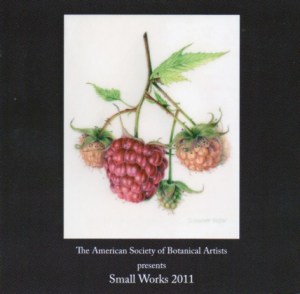
Rubus idaeus (Raspberries) by Denise Walser-Kolar

The success of the Small Works exhibition at the 2008 conference of the American Society of Botanical Artists in Pasadena, CA, inspired the inclusion of a similar exhibition at the 2011 conference held in Boston this past Fall. This non-juried exhibition of artwork small enough to fit in carry-on luggage, was organized by the New England Society of Botanical Artists (NESBA), hosts of the 2011 meeting. A color catalog about the exhibition has been created by NESBA and the American Society of Botanical Artists and can be previewed online.

Small Works 2011 is a 118-page collection of drawings and paintings by ASBA members. This self-published special collection can be purchased at Blurb.com for $29.95 (plus S&H).

Read Full Post »

Wave Hill Public Garden and Cultural Center is celebrating Mother Nature this year with a weekend full of learning opportunities for children and adults.

On Saturday, April 21, 2012, families can take part in the Family Art Project to hear stories honoring Earth’s trees. Families will then have the opportunity to create a tree tribute of their own. Also planned for Saturday are a kid-friendly Earth Day Garden Walk, a Wave Hill History Walk and a family tour of the exhibition in Glyndor Gallery that was inspired by Wave Hill’s Wild Garden.

On Sunday, April 22, 2012, families can go on a Garden & Conservatory Walk and attend Branch Dances at Wave Hill, a performance by award-winning choreographer Merian Soto and her dancers. A nature journaling class will also be held on this day. See details below:


Wave Hill: New York Public Garden and Cultural Center

www.wavehill.org
Wave Hill is a 28-acre public garden and cultural center in the Bronx. Their mission is to establish human connections with nature through horticulture, education and the arts. Visit their website to learn more about their gardens, special collections and art classes.

    Writing in Nature
    Thursdays, April 19, 26, May 3, 10, 17, 31, 2012 (1-4 PM)
    “To learn about a tree, go to a tree,” wrote famed Japanese poet Basho many centuries ago. Guided by his advice, writing coach and former New York Times editor, Joan Motyka, works with participants to more acutely observe and write about individual plants and trees, as well as the general impact of the landscape, including color, texture and design. Reading and discussing selected nature writers enhances the experience. Cost: $180 members, $210 nonmembers. Location: Ecology Building. Details/Register

    NEW! Earth Day Nature Journaling
    Earth Day Weekend at Wave Hill
    Sunday, April 22, 2012 (12:30 PM)
    Perkins Visitor Center
    View nature up close! Join naturalist Gabriel Willow on a journey through Wave Hill’s landscape, to observe and record the Garden’s plants, flowers and birds as you deepen your connection to nature. No drawing experience required; materials provided. Admission to Wave Hill on April 22, 2012 is FREE because it is Earth Day. Ages 8 and older welcome with an adult. $10 member/$18 nonmember. Details/Register

An updated listing for Wave Hill can also be viewed at
Classes Near You > New York.

Read Full Post »

« Newer Posts - Older Posts »