Feeds:
Posts
Comments

Archive for the ‘botanical art’ Category

The 4th Annual Arts and Archives Tour led by the Denver Botanic Gardens’ School of Botanical Art and Illustration will occur April 25 – May 10, 2014.
Travel to London, Geneva, Lyon and Paris. Explore the Lindley Library, the Kew Gardens’ Library and Archives, the Louvre, and the Natural History Museum in Paris where you will see the largest and oldest herbaria in the world. You’ll also visit the Palace of Versailles, a tapestry museum, the Shirley Sherwood Gallery of Botanical Art and attend the annual exhibition of the Society of Botanical Artists. This special tour also includes a visit to the manufacturing site of Caran d’Ache colored pencils.

There are only two spots available. Reserve your seat today!

View the tour itinerary on Botanical Illustration, the blog by Mervi Hjelmroos-Koski, Manager of the School of Botanical Art and Illustration at Denver Botanic Gardens.


Also See

Read Full Post »

As you know, then purpose of my Plants, Life, Riverside project is to make plants more visible in our increasingly busy world. It’s about telling the “plant story” of a suburban city and demonstrating we don’t need to travel to a designated natural area to see plants, animals and nature. Today I share with you an activity that not only supports this position, it also helps children and adults establish a sense of place about where they live.

I have always had an interest in maps. My interest in maps began when I saw an old globe (complete with sea monsters) at the Huntington Library when I was a young. Years later I was able to learn more about maps in a cartography class I took as an elective in college. I enjoyed the class very much. I got to sit still, draw, think and immerse myself in a subject in which I had a genuine interest.
The class was also respite from physics and organic chemistry!

It is my interest in maps that prompted me to investigate the article
Artistic Cartography by middle school art teacher, Miranda Nelken. In her article, Nelken (2012) explains how she uses topographic maps to connect students with the animals and natural areas in their area. Through a series of activities she describes in her article, Nelken teaches students how to merge animal drawing with geography, cartography and local history. She also introduces students to the work of Stuart Arnett, a Canadian artist who draws animals on topographic maps.

Applying the studio lesson presented in Nelken (2012) to botanical art will be easy to do. Nelken’s directions are very clear. What maybe isn’t so easy at first thought, is associating this lesson to the work of a contemporary botanical artist the way Nelken associates her classroom project with Arnett. Fortunately, I know of an artist who is the perfect match.

Allow me to introduce you to Susan Rubin, a botanical artist in Colorado whose work I have admired for many years. She blends maps with botanical art and I thought of Susan’s work the moment I came across Nelken’s article.

Susan has two cartography series in her portfolio. One series is about spice plants and their origins and the other is about houseplants and their origins. If you haven’t seen Susan’s cartographic images, I encourage you to take a look. They are exciting and make you think about more than just the plant and how you have come to know it.

To view Susan’s cartographic images, go to her online portfolio and click on Spice and Map. While you’re there, be sure to explore the series, Chlorophyll, a collection of colored pencil paintings about leaves.

Artistic Cartography is available online from SchoolArts magazine and can be downloaded for free.


Literature Cited

Nelken, Miranda. 2012. Artistic cartography. SchoolArts. April 2012. Retrieved from http://www.davisart.com/Portal/SchoolArts/articles/4_12_middle-school-studio-art-lesson-plan-artistic-cartography.pdf


Do you blend maps with natural history art?
Introduce us to your work below.


Read Full Post »

By Philadelphia Society of Botanical Illustrators

Every year the Philadelphia Society of Botanical Illustrators is given the opportunity by the Pennsylvania Horticultural Society to demonstrate our skills at the Philadelphia Flower Show. This is a wonderful chance for our organization to explain the fascination of botanical art to the world at large.

Some of the artists think this is great fun. But some do not. It is certainly different from the peace and quiet most of us experience when painting. People crowd around us. Small children want to see what we’re doing – up close. School groups ask endless good questions. It can be stressful.

It’s all a matter of attitude. The “best” attitude is that of a teacher who thinks that botanical art is the most fascinating subject in the world (which, of course, it is). You have to accept the obvious that there is no way that you’ll have the time to paint an entire watercolor. Maybe you can do a little work on one to show how laboriously slow it is. But do not expect to finish it. It is better to bring examples of your sketches, notes, drawings, tracings — whatever led up to the final artwork (which is shown on the wall behind us).

Instead of painting, your time will be taken up with talking to people: explaining how important it is to really “see” the plant, to understand how it grows and reproduces, to show aspects of the plant that photography cannot capture. You can possibly show how artists create form, a feeling of three dimensions. You might briefly touch on the long history of botanical art going back to the Egyptians. You must, however, talk in “sound bites.” Every sentence has to be a headline. And don’t be riled if your audience drifts away. Don’t expect to hold their attention.

You are there to rouse interest that might find an outlet at another time. Who knows? Your audience might someday take a botanical art class. They might become avid painters of wild flowers. They might even buy one of your botanical watercolors. But it’s not going to happen during the demonstration. So relax. Enjoy yourself. Stay calm and carry on.

Read Full Post »

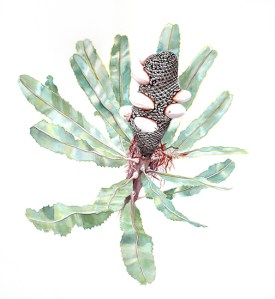
Raspberry Frost Banksia (Banskia menziesii), watercolor, 22x30". © Sharon Birzer, all rights reserved.

Raspberry Frost Banksia (Banskia menziesii), watercolor, 22×30″. © Sharon Birzer, all rights reserved.

Sharon Birzer
www.sharonbirzer.com
Scientific illustrator Sharon Birzer is a teaching artist at Seattle Pacific University and Frye Art Museum, and has completed illustrations for the Burke Museum of Natural History and Culture at the University of Washington. Sharon shows her work at Shift Collaborative Studio in Seattle, Washington.

Her work is currently on view in the exhibition Drawing on Nature: Flora and Fauna at the Washington State Convention Center in Seattle (January 15 – April 1, 2014). This exhibition features the work of members from the Northwest Chapter of the Guild of Natural Science Illustrators and The Pacific Northwest Botanical Artists’.

    Art in the Garden: One-Day Botanical Illustration Workshop
    Sunday, March 2, 2014
    9 AM – 3 PM

    The National Tropical Botanical Garden is offering a one-day botanical illustration workshop with natural science illustrator Sharon Birzer. For beginning and intermediate artists, ages 15 and up. Students will work in watercolor. This workshop will be taught at the Harrison Chandler Education Center, National Tropical Botanical Garden Headquarters Campus at 3530 Papalina Road, Kalāheo.
    View Details/Register

Read Full Post »

Looking for inspiration and adventure?

Artist Andie Thrams has announced her teaching schedule for 2014. Take a look!


Andie Thrams

www.andiethrams.com
Andie is a painter and book artist devoted to creative work in wild places. She teaches in California, Oregon, Alaska and Hawaii. Her work is widely exhibited and honored, and is held in many private and public collections. Get the latest news about Andie’s popular classes on her website. Here is what’s coming up in 2014:

  • Wild Yoga, Wild Art & Ecology on the Big Island of Hawaii – March 9-15
  • Individual Artist Mentoring & Creativity Coaching – March 31 – June 2
  • Field Journal Studies: San Francisco Botanical Garden – April & May
  • Field Journal Studies: UC Berkeley Botanical Garden – May 12
  • Color Mixing Intensive: Spring Wildflowers – May 23-25
  • Watercolors in the Wild: Sierra Flora – June 14-19
  • Botanical Explorations: Papermaking & The Artist’s Book – August 25-29
  • Watercolor Intensive: Methods, Materials & Magic – Sept. 2-5
  • Wild Forest Wild Art – October 3-5

This information has been added to Classes Near You > Northern California.

Read Full Post »

By Hunt Institute for Botanical Documentation

As part of a multi-year photography initiative at the Hunt Institute for Botanical Documentation, we are working to photograph our entire Art collection. These photos are primarily for in-house purposes, but we would like to add small, 100 dpi thumbnails of the artwork to our Catalogue of the Botanical Art Collection at the Hunt Institute database, which is accessible on our Web site. These thumbnails will be of low-resolution, unable to be reproduced and still protected by copyright where applicable. Adding thumbnails of the 29,470 works in our Art collection to our online database not only will provide helpful information for researchers but also will give potential visitors and scholars the opportunity to see amazing examples of botanical art by historical masters and leading contemporary artists. To date we have photographed and added thumbnails for several collections that are out of copyright or are otherwise in the public domain.

Because this is a use not covered in the original donation or purchase agreement prior to 2010, we would like to contact all living artists (or their heirs) who have work in our collection to request permission to include thumbnail images in our database. We ask that any artist who has participated in our International Exhibition of Botanical Art & Illustration series prior to the 13th International in 2010 and whose work is in our collection please contact:

    Carrie Roy
    Assistant Curator of Art
    Hunt Institute for Botanical Documentation
    5th Floor, Hunt Library
    4909 Frew Street
    Carnegie Mellon University
    Pittsburgh, PA 15213
    Telephone: 412-268-3035
    Fax: 412-268-5677
    Contact Carrie Roy

State either “Yes, I grant permission for a thumbnail of my artwork to be included on the Web site” or “No, I do not wish for my artwork to have a thumbnail on the Web site.” Be sure to include updated contact information so that we can include it in our private records and contact you should there be any request involving your work.

Feel free to contact us with any questions you have about this issue, and please note that this is a multi-year project involving both a Web site re-design and extensive photography. Photos will be uploaded to the Web site in stages, and we cannot give an exact date for when any single artwork will appear.


About the Institute

The Hunt Institute for Botanical Documentation, a research division of Carnegie Mellon University, specializes in the history of botany and all aspects of plant science and serves the international scientific community through research and documentation. To this end, the Institute acquires and maintains authoritative collections of books, plant images, manuscripts, portraits and data files, and provides publications and other modes of information service. The Institute meets the reference needs of botanists, biologists, historians, conservationists, librarians, bibliographers and the public at large, especially those concerned with any aspect of the North American flora.

Hunt Institute was dedicated in 1961 as the Rachel McMasters Miller Hunt Botanical Library, an international center for bibliographical research and service in the interests of botany and horticulture, as well as a center for the study of all aspects of the history of the plant sciences. By 1971 the Library’s activities had so diversified that the name was changed to Hunt Institute for Botanical Documentation. Growth in collections and research projects led to the establishment of four programmatic departments: Archives, Art, Bibliography and the Library. The current collections include approximately 30,150 book and serial titles; 29,000+ portraits; 29,470 watercolors, drawings and prints; 243,000+ data files; and 2,000 autograph letters and manuscripts. The Archives specializes in biographical information about, portraits of and handwriting samples from scientists, illustrators and all others in the plant sciences. The Archives is a repository of alternate resort and as such has collected over 300 institutional and individual archival collections that may not have otherwise found an easy fit at another institution. Including artworks dating from the Renaissance, the Art Department’s collection now focuses on contemporary botanical art and illustration, where the coverage is unmatched. The Art Department organizes and stages exhibitions, including the triennial International Exhibition of Botanical Art & Illustration. The Bibliography Department maintains comprehensive data files on the history and bibliography of botanical literature. Known for its collection of historical works on botany dating from the late 1400s to the present, the Library’s collection focuses on the development of botany as a science and also includes herbals (eight are incunabula), gardening manuals and florilegia, many of them pre-Linnaean. Modern taxonomic monographs, floristic works and serials as well as selected works in medical botany, economic botany, landscape architecture and a number of other plant-related topics are also represented.

Read Full Post »
The Botanical Art Society of the National Capital Region (BASNCR) is committed to education in the botanical arts. They provide a variety of educational opportunities through meetings, field trips and workshops to members and artists in the vicinity of Washington, D. C.

You are invited to visit their website at http://www.basncr.org for information about joining and for updates about member workshops and educational opportunities.

The National Capital Region encompasses the following states: Virginia, Maryland, District of Colombia and Delaware.

Read Full Post »

« Newer Posts - Older Posts »