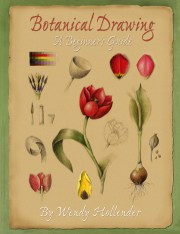
 Congratulations on the publication of your new workbook! It contains just the right amount of information for beginners who are studying botanical illustration on their own. Budding botanical artists will no doubt appreciate the easily digestible bite-sized pieces of information you provide for them. Alternating pages of written and visual instruction with pages of drawing paper differentiates your book from other botanical art books. How did you decide upon this format?
I have often found art instruction books difficult to use as a step-by-step guide. There is usually lots of helpful information and wonderful artwork, but these books seem overwhelming to use when trying to learn on your own. I want my workbook to be as easy to use as possible. I have included drawing paper right next to each lesson. Students can work on one lesson at a time, and not have to figure out what paper to use and where to buy it.
The first edition of your book was published in January 2008. This first edition contains Fabriano 140 lb hot-press paper in addition to Strathmore 400 Series drawing paper. You do not discuss painting in this book at all. Why did you include Fabriano watercolor paper in the first edition?
Fabriano hot pressed watercolor paper is excellent for using colored pencils with the techniques I teach in my workbook. I like to achieve intense rich colors with good contrast from light to dark. This paper helps to blend the colors and saturate the paper to create color that can often look like blended paint as well as drawn with pencil. For the more advanced student, using this paper allows for laying down layers of watercolor as well and makes the paper appropriate for exhibition. I offer refills of this paper if your customers are interested.
One of the strongest attributes of your workbook is that your instruction for blending colors in colored pencil is easy to understand. Students often become bored with creating tones in graphite and become anxious about adding color. In your book, you begin your conversation about color almost right away (on page 6). Was this out of necessity because of the book’s format or do you normally introduce color immediately after discussing how to create tonal values in graphite? In the classes you teach, how much time do your students spend working in graphite before they are introduced to working in color?
It is very important to understand tone first and color second when rendering three-dimensional forms. No matter how long students work in graphite on tonal scales and tonal drawings, they often forget the importance of tone when first starting to work in color. By introducing color techniques along with toning in graphite I am trying to emphasize the importance of the ability to see and draw tones regardless of the medium you are using. In other words, it is important to be thinking of tones in graphite and in color. My experience in teaching both advanced and beginner students showed me that students have this problem regardless of their experience. Everyone forgets about color having tonal value because they are all too often seduced by the beautiful colors.
Another plus about your workbook is that you include the transitional phases of a drawing, from line drawing to a drawing in full color. You even include the “ugly phase” – the phase during which one is most likely to think that their drawing is not going to become anything. In this phase, a drawing feels as much like a pencil drawing as it does a picture out of a coloring book. How do you assist students who are stumbling their way through the “ugly phase”?
I actually don’t feel there is necessarily an ugly phase in a drawing that is well drawn. By being well drawn, I mean that the drawing is progressing with purpose from a light sketch that is defining the shapes and perspective first, understanding the structure of the plant being drawn next, and then adding in light source to help define the tones. Finally, a good drawing understands the overlapping elements in a composition and strives to make these areas have dimension as well. The technique I teach in this workbook does not require the student to re-draw their work when beginning to turn the drawing into a work in color. Tracing and re-drawing often lead to this “ugly phase” in a drawing, one that looks like a hard over-simplified outline of forms. The color in this workbook goes right over the initial drawing, retaining the delicacy and subtleties that are all too often lost when transferring a drawing.
As a member of the Colored Pencil Society of America, you are aware of the lightfastness standards created by this organization. Are the colors in your colored pencil palette lightfast? Is lightfastness a concern of yours, regardless of the color medium in which you are working? Why or why not?
I initially learned to use colored pencil with Prismacolor pencils. I liked their smooth buttery laydown and intense colors. When I began to think about exhibiting my work, I became very interested in lightfast issues. Many of my favorite Prismacolor colors had extremely poor lightfast ratings. I was forced to try other brands and found that the Faber-Castell Polychrome pencils I use in this workbook have excellent properties in addition to having good lightfast ratings. They are a more stable pencil, do not create a lot of pigment crumbs on the paper, and work well for fine lines and details.
You have 20 years of experience in textile design. How has your experience in surface design enhanced the process you use to create botanical art?
I always loved drawing and painting flowers in my textile designs. I could copy an old botanical illustration, but I could not draw from nature directly. Exposure to old botanical documents in textile design gave me the desire to learn the techniques used by these talented artists over the centuries. Having been a professional textile designer helped me approach botanical art as a profession and not just a passion. I knew how to find a client and fulfill their needs, as well as satisfy my desire to create botanical art.
Consider these three titles: botanical artist, botanical illustrator, scientific illustrator. Which title best describes who you are? Why?
This is a great question. I am often not sure what to call myself and often each of these titles can describe what I do. My work varies, so that really sometimes I am illustrating for a commercial purpose such as a label design or for scientific use. I always consider myself an artist first, because the artistic side of a piece is always the most important for me, regardless of its end use.
Briefly describe what you do in your role as Coordinator of Botanical Art and Illustration at the New York Botanical Garden.
I work with the continuing education department at the garden on developing new classes, improving existing ones and eliminating those that are outdated. I work directly with students on their own personal needs and advise them on a program that will best serve their goals. I help students that need additional help, making sure they learn techniques that may be a struggle for them. Most importantly, I try to keep the garden current on the botanical world today and how we can continue to offer an exciting and sought-after program. I strive to increase the feeling of community among our students and the botanical world at large.
You teach classes both in a classroom setting at botanical gardens and on-location at exotic destinations. Describe the general format of the classes you teach currently in Trinidad, Block Island, and Hawaii.
I usually hold a class in one location that I think will not only provide inspiration in the form of plants and flowers to draw from but will be the kind of environment that students will want to stay in for 5 days at a time. These are not traveling workshops, where we drive somewhere each day touring, looking, and squeezing in time to draw. We are settled in one location that often provides not only lodging, but meals, and lots of trails to walk on to find specimens. I like to work in an outdoor environment but possibly with a roof so we can stay outside if it rains or if the sunlight is too bright. The daily schedule is typically like this:
- Breakfast as a group
- Three-hour drawing workshop in the morning, including a demonstration each day on a different technique
- Lunch as a group
- Three-hour afternoon workshop (sometimes a group critique where we share each other’s work)
- Free time, to swim, explore the area or stay and continue to draw unsupervised
- Sometimes we have a group afternoon excursion
- Dinner, usually as a group sometimes at a restaurant, or sometimes we cook together from the local produce available
- Free time, believe it or not, some students continue to draw, even by flashlight!
- Bedtime- lights out at 10 pm (just kidding!)
What do you hope to accomplish through the publication and distribution of your workbook?
My hope is to have provided a workbook that will actually be used by students and not end up sitting on a shelf after it is read. I want to take away some of the confusion in drawing by making it a step-by-step approach that builds and reinforces with each skill taught. I want a guide that students could use on their own and actually work in. The guide is for people who have studied with me, but also for those who have never taken a botanical drawing class or any drawing class. It is also a good refresher for the more advanced student.
What question about your art or artistic process have you never been asked? State this question and then answer it.
What do you think sets your work apart from the countless talented botanical artists throughout time?
My work is driven by my love of exploring nature close up and having the opportunity to study a plant’s detail. The drawing that I create just documents this process. It is the process that is most important to me. I am always amazed by nature’s perfection in the arrangement of color and form. I want my work to be an exploration of that and not a stiff depiction of a plant. The drawing has to convey my delight in the process.
Wendy’s new botanical art workbook for beginners can be purchased at ArtPlantae Books. Select Art, then Drawing.
Also See:
Wendy Hollender Answers Your Questions About Botanical Drawing
“Botanical Drawing in Color” is a Comprehensive Guide to Botanical Illustration
Read Full Post »
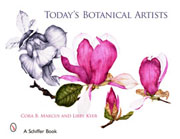 While several books have been published about contemporary botanical art, both how-to books and books about international collections, there has never been a book highlighting the work of North American artists until the publication of Today’s Botanical Artists earlier this year. Written by Cora B. Marcus and Libby Kyer, this book features 220 pieces of artwork by


 ArtPlantae Today