Feeds:
Posts
Comments

Archive for the ‘botanical art’ Category

Losing Paradise? Endangered Plants Here and Around the World opens at the Smithsonian National Museum of Natural History on Saturday August 14. Organized by the American Society of Botanical Artists, this traveling exhibition brings attention to plant diversity, the fragile state of endangered species, and the efforts by botanists and botanical artists to document and describe thousands of species of plants.

The Smithsonian will host many interactive learning opportunities during the exhibition. One opportunity to learn from botanists and illustrators is through the Ask The Expert forum. Submit your questions through the museum’s website and your questions will be answered and posted online on specific dates. The first installment of answers will be posted on September 13, 2010.

Museum visitors will have the opportunity to watch illustrators work as part of The Illustrator Is In program featuring scientific illustrators from the Washington D.C. area. Ten illustrators are participating in this demonstration series and they will discuss everything from traditional botanical art techniques to digital illustration techniques. View the calendar of events for this exhibition for details and to schedule email reminders so you don’t miss your opportunity to learn from this group of accomplished scientific illustrators.

If a you want to experience botanical illustration yourself, you may be interested in the following workshops:

  • The Art and Science of Botanical Illustration – Thursday, October 14;
    3:00 PM – 5:00 PM. Smithsonian botanist, Gary Krupnick, will teach you how herbarium specimens are used in conservation research. Botanical illustrator, Alice Tangerini, will give participants a behind-the-scenes look at how she works with botanists to document plants. Members $45 / General Admission $55
  • Introduction to Creating Botanical Art (3-sessions) – Sundays, October 17 – 31; 10:00 AM – 4:30 PM. introductory course in the techniques of botanical illustration. Participants will learn how to prepare a sketch for painting while receiving detailed step-by-step instruction from botanical artist, Doreen Bolnick. Members $215 / General Admission $261

The Losing Paradise website is a must-see. Visit the site and you will be able to…

  • Experience first-hand, the assessment technique used by the Plant Conservation Unit when determining the conservation status of plant species.
  • Learn how the Smithsonian’s botanical illustrator applies a four-step approach to creating botanical plates.
  • Study paintings of endangered plants and view herbarium specimens up-close. The zoom-in feature will get you a front row seat even though you are miles away!
  • Share your own botanical illustrations with others online.
  • Send a painting of an endangered plant to a friend via e-postcard.
  • Learn how you can become involved in plant conservation.
  • Browse the Smithsonian’s extensive collection of botanical illustrations.
  • Learn more about the Smithsonian’s Department of Botany.

The Losing Paradise? exhibition will be at the Smithsonian National Museum of Natural History August 14 – December 12, 2010. For visitor information, visit the museum’s website at http://www.mnh.si.edu.
Read Full Post »

New at Classes Near You > Washington:


Kathleen McKeehen, Scientific Illustrator

Kathleen is a teacher and freelance illustrator. Her work has appeared in Organic Gardening Magazine and The Herb Companion. View Kathleen’s artwork in the ASBA Members’ Gallery or at the Guild of Natural Science Illustrators’
Science-Art.com.


Gage Academy, Seattle

www.gageacademy.org

  • Painting Roses – August 14, 15 (weekend)
  • Basics of Botanical Watercolor – Fridays, August 6 – September 3;
    1:30 PM – 4:30 PM. An introduction to classic techniques in botanical illustration. Learn how to observe, measure, draw, and paint botanical specimens. Open to all levels of artist. Continuing students will work on new projects under supervision. Cost: $205
  • Botanical Watercolor: Autumn Cornucopia – Fridays,
    September 17 – November 19; 1:30 PM – 4:30 PM. Capture the colors, textures, and shapes of Fall. Learn watercolor techniques such as wet-on-wet and color-intensifying dry brush. All levels of artist are welcome. Cost: $420
  • Leaves of Autumn in Watercolor – October 9 – 10 (weekend);
    9:30 AM – 4:30 PM. Learn a variety of watercolor techniques while studying the colors and forms of autumn leaves. Beginners to botanical illustration will learn how to observe and measure leaves. All levels of artist are welcome. Cost: $195


Center for Urban Horticulture, University of Washington

http://depts.washington.edu/uwbg

  • Botanical Drawing I – Thursdays, September 30 – October 28,
    7:00 PM – 9:30 PM. Contact Jean Robins 206-685-8033 or jrobins@u.washington.edu


Poulsbo Parks & Recreation

www.cityofpoulsbo.com/parks/parks.htm

  • Botanical Drawing – Mondays, October 18 – November 29, 2010


Studio Classes

Botanical drawing and watercolor classes in Kathleen’s Indianola studio. Contact Kathleen for more information. (360) 297-8858

Read Full Post »

Now at Classes Near You > Connecticut:

Connecticut Natural Science Illustrators
In collaboration with the Yale Peabody Museum
www.ctnsi.com

Connecticut Natural Science Illustrators LLC is comprised of professional artists and scientists who have developed educational programs in natural science illustration. The members of CTNSI also provide illustrations, printed material, murals and exhibits addressing environmental and biological topics. The team at CTNSI works with environmental groups, nature centers, schools, and event managers. Download the CTNSI brochure for more information. All classes are taught at the Yale Peabody Museum Education Center/West Campus, 117 Frontage Road, Orange, CT 06477.
Register online at www.ctnsi.com or contact Susannah Graedel.

  • Fundamentals of Natural Science Illustration – Wednesdays, September 8 – October 27, 2010, 1-4 PM (eight weeks). All you need is a pencil. Learn to observe and render natural science subjects accurately by applying what you will learn about line, value, proportion, and perspective. Supply list provided. Cost: $275
  • Fundamentals of Natural Science Illustration – Saturdays, September 11 – October 30, 2010, 10 AM -1 PM (eight weeks). All you need is a pencil. Learn to observe and render natural science subjects accurately by applying what you will learn about line, value, proportion, and perspective. Supply list provided. Cost: $275
  • Botanical Watercolor – Wednesdays, September 8 – 29, 2010
    (4 weeks), 1-4 PM. Sketch, draw and paint fresh flowers and plants. Supply list provided or pay instructor a $35 material fee. Cost: $140
  • Botanical Watercolor – Wednesdays, October 6 – 27, 2010 (4 weeks), 1-4 PM. Sketch, draw and paint fresh flowers and plants. Supply list provided or pay instructor a $35 material fee. Cost: $140
  • Stipple Techniques in Pen and Ink – Saturdays,
    November 6 – December 4, 2010, 10 AM – 1 PM. Learn how to created subtle gradations of tone in black and white. Prerequisite: Fundamentals of Natural Science Illustration or proof of prior drawing experience approved by the instructor. Supply list provided. Cost: $140
  • Natural Science Drawing from Museum Specimens – Wednesdays, November 3 – December 15, 2010, 1 PM – 4 PM. Observe and draw fossils, mammals, birds, and insects from the Peabody Museum. Prerequisite: Fundamentals of Natural Science Illustration or proof of prior drawing experience approved by the instructor. Supply list provided. Cost: $210
  • Natural Science Drawing from Museum Specimens – Saturdays, November 6 – December 18, 2010, 10 AM – 1 PM. Observe and draw fossils, mammals, birds, and insects from the Peabody Museum. Prerequisite: Fundamentals of Natural Science Illustration or proof of prior drawing experience approved by the instructor. Supply list provided. Cost: $210

Download Fall 2010 Workshop Flyer

Read Full Post »

At Monash University in Australia, the interdisciplinary journal Colloquy was created to present new work in literary and cultural studies and to encourage discussion among postgraduates and others in the literary community. In 2003, Judy Dyson published an article in Colloquy about the cultural and sexual imagery observable in botanical illustrations. In Botanical Illustration or Flower Painting: Sexuality, Violence and Social Discourse, Dyson states that botanical illustrations contributed to “cultural concepts of aesthetics, religion, and society” before becoming scientific tools. In her article, Dyson calls for a more thorough analysis of botanical illustrations to identify the role botanical illustrations play in “social and medical discourses concerning sexuality, race, and psychology.” She argues that a critique of botanical illustrations has not occurred because of their use in plant classification. Dyson suggests that, as an art form, botanical illustration is not as cut-and-dried as it may seem. Dyson is certain there is more than data in these illustrations and that here is more to learn about those who obsess over their creation. In order for a thorough analysis to be completed, Dyson proposes ending the protective status botanical illustrations are provided “within the privileged discipline of science.”

The work of Carl Linnaeus, Ferdinand Bauer, Walter Hood Fitch, Pierre-Joseph Redouté, Celia Rosser, Stanley Kelly, Georgia O’Keefe, and others are discussed. Dyson also refers to Shirley Sherwood’s A Passion for Plants and Keith West’s How to Draw Plants: The Techniques of Botanical Illustration as she builds her case about the sensual and suggestive imagery of botanical illustrations.

What do you think?

Read Judy Dyson’s article online


Literature Cited
:
Dyson, Judy. 2003. Botanical illustration or flower painting: sexuality, violence, and social discourse. Colloquy. Issue Seven. Web. <http://colloquy.monash.edu.au/issue007/dyson.html>

Sherwood, Shirley. 2002. A Passion for Plants: Contemporary Botanical Masterworks from the Shirley Sherwood Collection. Weidenfeld & Nicolson. London.

West, Keith. 1996. How to Draw Plants: The Techniques of Botanical Illustration. Timber Press in association with The British Museum (Natural History). Portland, OR.


Both A Passion for Plants and How to Draw Plants are available at ArtPlantae Books.

Read Full Post »

Jane Pinheiro’s Watercolors:
A Collection Lost and Re-Found

Now through September 30, 2010
Thursday to Saturday
8:30am to 4:30pm
Directions


By John Wickham, President
The Theodore Payne Foundation

In the early ‘90s, the Foundation had to make some tough choices to keep the nursery open. One of the toughest was the decision to sell most of our collection of 100 botanical watercolors by Jane Pinheiro.

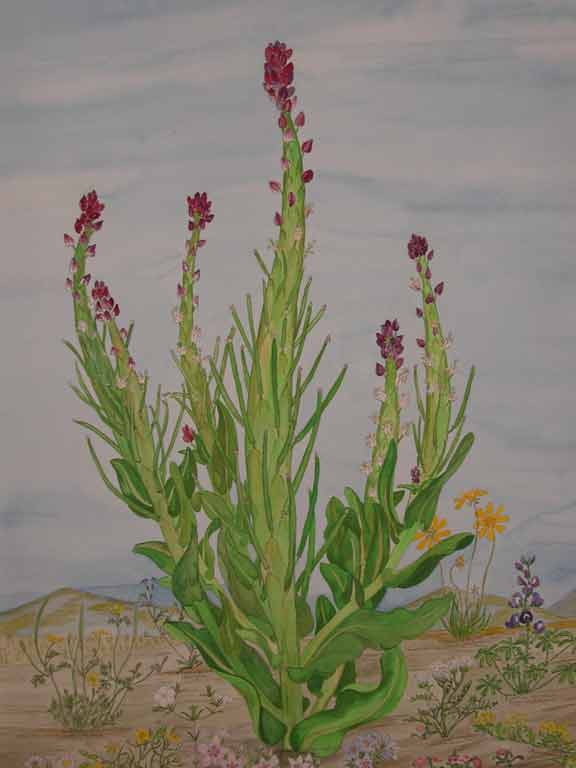
The collection came to us in 1960, shortly after the Foundation was formed, thanks to a donation arranged by Tasker and Beula Edmiston of the Nature Conservancy and Bonnie Templeton from the Natural History Museum of Los Angeles County. “The Poppy Lady,” as Pinheiro was called, was well known for her watercolors depicting the flora of the Antelope Valley. She was a self-taught artist and botanist who took great pride in the accuracy of her illustrations, and her work was collected widely.

Born Jane Seymour, Pinheiro was raised in Salt Lake City and lived in Pasadena for years, helping her mother run a boarding house. One of the guests was Joseph Pinheiro, a native of the Azores. He and Jane married in 1930. In 1940 they moved to the Antelope Valley, where Jane became enamored with the desert flora. She was deeply involved in the civic affairs of the Antelope Valley region and instrumental in establishing the California Poppy Reserve. Though she did not survive to see the opening of the visitor center at the Reserve, 163 of her paintings are displayed there each spring.

Upon her passing in 1982, Pinheiro’s family donated dozens of additional paintings to the Foundation, providing a rich body of work for our art program. The original 100 paintings and several of the later acquisitions were large paintings depicting species in a natural landscape setting. Most of her later works were smaller unfinished studies and drawings.

A decade later, financial woes at the Foundation forced us to sell about 70 of the initial 100 paintings. It was a difficult decision, and one not taken lightly.
The Foundation is in a much better place today, and we’ve been able to recover several of these paintings from generous individuals. In 2005, seven Pinheiro works from our original collection were offered at auction, and we placed the winning bid!

Enter our newest heroine, Helen Moore, who had purchased 34 of our Pinheiro paintings during our very lean times. Sadly, Helen passed away in 2009. In May of this year, her family chose to return those paintings to the Foundation. And so it was that this group of remarkable botanical illustrations made its way back to Sun Valley. Most are still in their original frames with the original, though slightly faded labels, on their glass.

This season the Theodore Payne Art Gallery once again is proud to share with you the unique watercolors of Jane Pinheiro—thanks to Helen Moore, whose purchase helped us through a trying period and whose donation now helps rebuild our wonderful art collection. The exhibit runs through September 30, 2010.

We are also proud to have a dedicated corps of volunteers, the Theodore Payne Arts Council, who are working to develop new exhibits that celebrate our extraordinary native flora. Your support for the Foundation and the Arts Council helps us bring you new and inspiring exhibits each quarter. Times have changed at the Foundation, and we are thriving like never before.

And remember! There are still many Pinheiro paintings waiting to make their way back to the Foundation. Please keep your eyes peeled!


For more information, contact info@theodorepayne.org or call (818) 768-1802. Visit the Theodore Payne Foundation online at www.theodorepayne.org.

Read Full Post »

©Eva-Maria Ruhl. All Rights Reserved

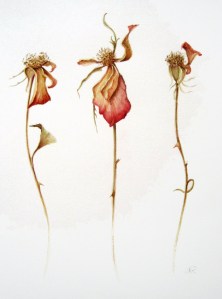
Eva-Maria Ruhl‘s solo exhibition, …plants in suspense…, closes today at the Orchard Art Gallery in Bethesda, MD. Last week the Montgomery County Gazette published a review of Eva’s exhibition that was written by Dr. Claudia Rousseau, an art history professor at The School of Art and Design at Montgomery College. Dr. Rousseau wrote an insightful and informative article about Ruhl’s work. She also provided interesting background information about botanical art. Dr. Rousseau’s article is available online and can be viewed here.

The Orchard Art Gallery is located at 7917 Norfolk Avenue, Bethesda, MD 20814. The gallery is open Monday – Saturday from 10:30 a.m. – 8:30 p.m. If you can’t make it to the gallery today, be sure to view the online exhibit featuring Eva’s drawings and paintings.


Also See…


Update 8/7/10
: Visit the Past Exhibits page to view Eva’s artwork.

Read Full Post »

New at Classes Near You > California:


University of California Botanical Garden at Berkeley

http://botanicalgarden.berkeley.edu/
This 34-acre garden was established in 1890 and is now a non-profit research garden and museum. The classes below are taught by Lee McCaffree and Catherine Watters . Download a detailed Fall schedule here.

  • Creating Botanical Art with Native Plants – August 26 & 27, 2010
  • Fall Leaves & Seed Pods – September 9 & 10, 2010
  • Orchids – October 28 & 29, 2010
  • Sketch in the Garden to Begin a Botanical Art Painting – November 13 & 14, 2010
  • Winter Botanicals as Paintings – December 10 & 11, 2010
  • Introduction to Botanical Art – January 29 & 30, 2011

Read Full Post »

« Newer Posts - Older Posts »