Feeds:
Posts
Comments

Archive for the ‘botanical art’ Category

New at Classes Near You > International > England:


The Wagon House

Lost Gardens of Heligan, Cornwall
www.thewagonhouse.com
A bed-and-breakfast in the English countryside where you can eat breakfast at a time that is convenient for you, visit the gardens in Cornwall, and take botanical art classes too!

  • Four-Day Botanical Painting Course – September 3-6, 2010. Classes are taught in a renovated, well-lit studio. The studio building itself is a 250-years old. Cost: £270.00, includes lunch each day.
  • Five-Day Botanical Painting Course – September 29 – October 3, 2010. Cost: £335.00 including lunch each day during the course. One day per week Termly Fees: £250.00 bring your own packed lunch.

Read Full Post »


Puget Sound Mycological Society 3rd Annual Art Exhibition

    Location: University of Washington Center for Urban Horticulture
    Show Dates: October 16 – 17, 2010
    Entries Due: September 30, 2010
    Contact: Doug Birkebak

Click on the poster above to view details and to download entry form.

Read Full Post »

Updates at Classes Near You > California:


Brenda Swenson
Swenson’s Art

www.swensonsart.net
Brenda Swenson, WW, NWWS is the author of Keeping a Watercolor Sketchbook and Steps to Success in Watercolor. She is a very popular, award-winning artist who teaches across the U.S. and abroad. Visit Brenda’s blog to read about her tips, techniques, and tools for artists.

  • Negative Painting with Watercolor, 2-Day Workshop – August 28-29, 2010. Palos Verdes Art Center, Rancho Palos Verdes, CA. Cost: $180.00 More Information: Email or (310) 541-2479
  • Sketching with Watercolor, 3-Day Workshop – September 13-15, 2010. Mountain Artists Guild, Prescott, AZ. Cost: $250.00. More Information: (928) 445-2510
  • Negative Painting with Watercolor, 2-Day Workshop – September 25-26, 2010. Schroeder Studio Gallery, Orange, CA. Cost: $170.00. More Information: Email or (714) 633-0653
  • Negative Painting with Watercolor (Session Code: Sa264) – Saturday, Oct. 23, 1:00 – 4:00 PM. Learning & Product EXPO, Pasadena, CA. Cost: $85.00 (before 10/15)
  • Keeping a Watercolor Sketchbook (Session Code: Su116) – Sunday, Oct. 24, 9:00 – 12:00 PM. Learning & Product EXPO, Pasadena, CA. Cost: $85.00 (before 10/15)
  • Watercolor Sketching Techniques (Session Code: Su255) – Sunday, Oct. 24, 1:00 – 4:00 PM. Learning & Product EXPO, Pasadena, CA. Cost: $85.00 (before 10/15)
  • Color Theory for Watercolorist, 2-Day Workshop – January 22-23, 2011, VIVA Art Center, Sherman Oaks, CA. Cost: $175.00
    VIVA Art Center, Sherman Oaks, CA. Contact Brenda Swenson for more information.

Read Full Post »

New at Classes Near You > California:


Fallbrook School of the Arts

www.fallbrookschoolofthearts.org
Located in downtown Fallbrook, the Fallbrook School of the Arts offers workshops and classes for adults and children in ceramics, printmaking, jewelry making, photography, drawing and painting, performing arts, literary arts, paper arts, life drawing and welding. They also rent or lease studio space to artists. Click on the link above to learn more about classes, lectures, demos, and special events.

  • The Illustrated Journal with Wicki Van De Veer – October 19, 21, 26, 28 (6:00 PM – 9:00 PM) and Saturday, October 30, 2010 (10:00 AM – 1:00 PM). Create your own travel journal, nature journal, or journal for daily reflection. Drawing skills and color theory will be taught. Cost: $75
  • Introduction to Botanical Illustration Using Colored Pencils with Wicki Van De Veer – October 23, 2010, 10:00 AM – 2:00 PM. Learn about fast sketching techniques, color mixing, form, composition, and design. Cost: $25

Read Full Post »

New at Classes Near You > England:


Royal Botanic Gardens, Kew

www.kew.org

  • Drop-in Art Workshop at the Shirley Sherwood Gallery
    Monday August 30 – 10 a.m. to 4 p.m. Create a collaborative piece of art with artist Stuart Simler and fellow artists. This workshop will be taught in conjunction with the exhibition, Bulbmania – Flowers from the Kew Collection (August 28, 2010 – January 3, 2011).
  • Distance and Detail: Drawing and Painting Plants
    September 6 – 10, 2010. Draw trees, shrubs, or flowers in this class emphasizing the basic techniques of botanical illustration (drawing and watercolor). Read More


More About Bulbmania
:
The beauty of bulbs is celebrated in a new exhibition at the Royal Botanic Gardens, Kew’s Shirley Sherwood Gallery of Botanical Art. Comprised of over seventy paintings, the exhibition focuses on the different forms of bulbs. From onions and asparagus to tulips and lilies, we eat bulbs, admire them, and use them for medicine (snowdrops, Galanthus species, are used in the treatment of Alzheimer’s), but rarely appreciate just how diverse and important they are.

Professor Stephen Hopper, Director of the Royal Botanic Gardens, Kew, says:

“This exhibition will allow visitors to see the splendor and richness of one of our most well loved plant groups. In the UN’s International Year of Biodiversity, Kew’s scientists, conservationists and horticulturists continue to combine forces to understand and conserve the remarkable diversity of bulbs and other plants.”

Accompanying Bulbmania will be an exhibition of the work of the Brooklyn Florilegium Society. In celebration of the 10th anniversary of the group, the exhibition will show some of the many paintings created by contemporary botanical artists to document the Brooklyn Botanic Garden’s living collections.

Visit Bulbmania – Flowers from the Kew Collection online!


VISITOR INFORMATION
:

  • Gallery Hours (until October 30, 2010): Monday – Friday:
    9:30 am – 5:30 pm / Weekends: 9:30 am – 5:30 pm
  • Gallery Hours (October 31, 2010 to January 3, 2011):
    Monday – Friday: 9:30 am – 3:45 pm / Weekends: 9:30 am – 3:45 pm
  • Admission: Adults £13.50, Concessions £11.50, FREE for children under 17 (accompanied by an adult). Admission includes free entry to all Galleries, Glasshouses, and the Rhizotron and Xstrata Treetop Walkway
  • Galleries, Glasshouses and Treetop Walkway all close an hour before the Gardens.

Read Full Post »

Update at Classes Near You > England:


The Beth Chatto Gardens

Elmstead Market, Colchester, Essex
www.bethchatto.co.uk
A former overgrown wasteland that has been transformed into an informal garden in the countryside. The garden’s Tea Room offers light lunches, sweet treats, tea, and coffee.

  • Learn How to Identify Plants & The Use of Botanical Latin – September 18, 2010; 11:00 AM – 3:00 PM. Study the morphological differences of several species of plants. Also learn the Latin names of plants and how these names are used.
  • Drawing, Painting and Design in Line w/Watercolor
    November 6, 2010; 10:30 AM – 3:00 PM. Capture the colors of autumn using pencils, pens, and watercolor. Participants will have the option of incorporating their drawings into a design of a simple Christmas card.

Read Full Post »

Colored pencil isn’t just a medium to use, it is also a learning tool. It allows you to teach drawing skills and teach about color at the same time.
— Wendy Hollender
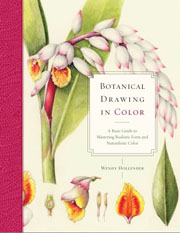
Just as her first book is an inspiring guide for botanical illustrators, Wendy Hollender’s Botanical Drawing in Color: A Basic Guide to Mastering Realistic Form and Naturalistic Color is equally inspiring, if not more.

In her new book, Wendy reveals the mystery behind botanical illustration by breaking each step of the process down to minute detail. No detail is too small. Even the seemingly obvious detail of sharpening a pencil is addressed. Experience has taught Hollender that something as innocent as a blunt pencil can become an obstacle if not monitored properly. The step-by-step instructions Hollender provides in Botanical Drawing do more than carefully guide artists through new exercises. Through carefully written text and supporting illustrations, Hollender instills confidence in novice illustrators bravely embarking on their first attempt in botanical art and instills confidence in artists who may be exploring colored pencil techniques for the first time.

What makes Botanical Drawing in Color a comprehensive guide to botanical illustration is Hollender’s careful arrangement of exercises, each exercise building upon the one before. This book is not a reading book. It’s a book that requires readers to take action. If the exercises are completed faithfully and in sequence, novice illustrators will find they are no longer beginners and colored pencil enthusiasts will be charged with their enhanced understanding of color theory and color harmony.

Here is a quick overview of the contents of this new book and how artists can benefit from Hollender’s thorough introduction to botanical illustration:

Chapter 1 – Overview

Chapter 2 – Art Supplies & Materials: Hollender introduces the materials she uses and explains the reasons behind her choice of graphite pencils, colored pencils, paper, and other supplies.

Chapter 3 – Tone and Form: Artists will learn how to look for changes in value on any surface, learn how to create many values in order to achieve 3-dimensional form, how to work with a light source, and how to create the natural forms found in nature.

Chapter 4 – Adding Color to a Toned Form: The essential skills of toning and burnishing in colored pencil are discussed. These skills are required if artists are to convincingly render form in color. Hollender demonstrates how to hang onto form while applying color.

Chapter 5 – Establishing Perspective: Creating a 3-dimensional form on a flat piece of paper is simply not possible without being able to see and draw in perspective. Artists will learn how to do both in this chapter.

Chapter 6 – Putting Value and Perspective Together: Applying the techniques learned in Chapter 5, Hollender demonstrates how line, tone, and perspective work together to create natural forms.

Chapter 7 – Understanding Color: Color theory, color mixing, and color harmony are the focus of this chapter. Carefully planned exercises enable artists to experience these concepts, not just read about them.

Chapter 8 – Depicting Overlapping Elements & Different Planes: Drawing an individual flower or leaf is fine, but plants don’t produce free-standing leaves and flowers. Plants have branches, clusters of flowers, and leaves of all shapes and sizes overlapping each other. How do you get all of this down on a piece of paper? This is what this chapter is about.

Chapter 9 – Understanding the Form & Function of Plants: Plant morphology, growth patterns, and working with a microscope are the focus of this chapter. Artists will learn how to design an herbarium page and a sketchbook page when studying plant specimens.

Chapter 10 – Mastering Advanced Drawing Techniques: In this chapter, artists will apply what they’ve learned about form, perspective, overlapping elements, and color to create a finished drawing.

Chapter 11 – Mastering Advanced Compositions & Techniques: Hollender describes how to plan and evaluate eye-pleasing compositions and how to use alternative backgrounds. She also demonstrates how to work with watercolor pencils, how to create a colored pencil painting of a white flower, and how to capture the intricate details of a flower’s reproductive parts so that the centers of your flowers are as alive as the rest of your drawing.

Botanical Drawing in Color: A Basic Guide to Mastering Realistic Form and Naturalistic Color is far from basic. This all-inclusive guide is sure to enhance the work of botanical artists and jump-start the career of beginners who have been wanting to explore botanical illustration, but were too intimidated by the process. Hollender’s approach to botanical drawing is doable and no-fuss. All one needs is paper, pencil, and colored pencils.


LEARN MORE


DID YOU KNOW…

  • Our April 2008 “Ask The Artist” with Wendy Hollender is the most read article to date at ArtPlantae Today?
  • Botanical Drawing in Color sky-rocketed to the #2 position on the Nielsen Bookscan Ratings during its first week?
  • Botanical Drawing in Color is already in its second printing?


Buy this book online from your local independent bookstore.

Read Full Post »

« Newer Posts - Older Posts »