Feeds:
Posts
Comments

Archive for the ‘botanical art’ Category

Artist Andie Thrams has updated her schedule for 2011. Classes filled to capacity have been removed and new classes have been announced for Fall. Take a look!


Andie Thrams, Coloma, CA

Andie is a painter and book artist devoted to creative work in wild places.
Her work is widely exhibited and honored, and is held in many private and public collections. She is currently at work on two series, IN FORESTS and FIELD STUDIES. View Andie’s 2011 IN FORESTS calendar on her Etsy page.

  • Printers Night with Andie Thrams (Free event) – May 12, 2011; 6-8 PM. San Francisco Center for the Book, San Francisco, CA.
    Go to SFCB website
  • Transformation: The Journal into Artist’s Book. May 14-15, 2011. San Francisco Center for the Book, San Francisco, CA.
    Go to SFCB website
  • A Sense of Place: Art and Hiking Retreat – June 10-12, 2011. Awaken your senses on this weekend camping trip in Yosemite! Balanced Rock Foundation, Yosemite National Park, CA. Cost: $450. View details
  • Finding Your Colors (Color Mixing Mysteries Solved!) – June 23-24, 2011. Focus on the Book Arts Conference, Pacific University, Forest Grove, OR. Conference website
  • Book Arts for Kids – July 2-3, 2011; 10 AM – 4 PM. Use ink, watercolor, sticks, feathers, stones, reeds, pen, brush, crayon, and other objects to create book structures. Ages: 8 & up. Cost: $107. Sitka Center for Art & Ecology, Cascade Head, OR. View details
  • Watercolors in the Wild– July 7-1, 2011. Learn to paint in wild places through the creation of a series of outdoor studies. Cost: $390. Ages: 12 & up. Sitka Center for Art & Ecology, Cascade Head, OR.
    View details
  • Field Studies: Sierra Flora & The Artist’s Book – July 20-24, 2011. Focused field study of plants and habitats in the Sierra Nevada. Supply lists, camping gear requirements are available online. Cost $370. San Francisco State University Field Camp, Sattley, CA. View course details
  • International Year of the Forest Celebration! Tongass Rainforest Festival – September 7-11, 2011. Petersburg, Alaska.
    Visit Tongass National Forest
  • Watercolor in the Wild – October 7-9, 2011. Yosemite Conservancy, Yosemite National Park, CA. www.yosemiteconservancy.org
  • Sitka Center for Art & Ecology Invitational Exhibition. World Forestry Center, Portland, OR. Dates for this Fall to be announced. www.sitkacenter.org
  • Ongoing: Private Art Instruction & Creativity Coaching
    Individually tailored instruction is available to a limited number of students. Lessons are conducted via email and/or in Andie’s studio or your workspace. Contact Andie Thrams.

This information has been added to Classes Near You > California.

Read Full Post »

Alana Lea is a Brazilian-American botanical artist and avid gardener who has become a forester. She is an environmental activist and mother who trusted her gut to lead her to a place even she did not know she was going.

Just over three years ago, Alana decided to gather her skills as a botanical illustrator and horticulturist and to put them to use in some way.

In 2009, Alana started the textile company Rainforest ECO to create awareness and to use as a vehicle to raise money to buy trees to renew the Atlantic Forest in Brazil. Alana soon realized, however, it was costing her dearly to create these textiles to raise money for trees. So she decided to raise money by whatever means possible and to have the textiles follow behind these other fund-raising efforts. Now her focus is fund-raising for trees first, art and textiles, second.

When Alana decided to put her skills as a botanical artist and horticulturist to good use, she went back to Brazil to search for a way to do this. She thought about focusing her efforts in a way that would benefit the Amazon Rainforest. While she was there, she learned she was born in Brazil’s most diverse and deforested rainforest, the Atlantic Forest. The people with whom she was visiting questioned why she wanted to focus on the Amazon when the Atlantic Forest needed just as much, if not more, attention. Her focus was on the Amazon only because she didn’t know about the Atlantic Forest. After she learned about this large deforested area, she changed her focus. Alana made it her business to learn about the Atlantic Forest. She spoke with NGOs (nongovernmental organizations) to learn about the people, the area and its needs. One of the things she learned was that 93% of the Atlantic Forest is gone. Alana has made it her life’s work to revegetate this biodiversity hotspot.

Alana credits her North American drive to help her get things done. One of the daunting tasks she had to complete early on was to create a team of people who could help her accomplish her objectives. This process involved a lot of trial-and-error. Eventually, she formed strong working relationships with individuals and organizations who understand her objectives and who are comfortable thinking “outside of the box.”

In her role as CEO (Cheerleading Enthusiastic Optimist), Alana facilitates relationships between growers of organic trees and the people who want trees, but who cannot afford them. She purchases the trees from growers at fair trade prices, then gives them to individuals or to NGOs.

While in Brazil, Alana focuses on forming partnerships and connecting people who share the goal of reforestation. She also leads Awakening the Dreamer Symposiums. While in the U.S., her role is as fundraiser and public speaker.

Earlier this year, while carpooling to an environmental event in San Diego, she caught the attention of a teacher from Los Angeles. This teacher arranged for Alana to speak to the group, Kids For Environmental & Social Action (KFESA). Inspired by Alana’s story, the youth of KFESA pooled their creative talents and held a benefit concert. The young doers raised enough money to purchase, and to plant, 2,000 trees (see video). Alana is currently raising the funds needed to support their gift with field maintenance.

Because of the impact made with small resources, Rainforest ECO has been taken in by WeForest and the GlobalWorks program at Agape International Spiritual Center in Los Angeles. An international non-profit and a U.S.-based non-profit, respectively, these organizations are helping Alana raise money to meet her goal of planting 22,000 trees by the end of 2011.

Rainforest ECO’s first gift to the people of the Atlantic Forest was a donation of 1,000 trees given to residents in a rural community. Alana began her gift-giving by asking a Brazilian acquaintance to help her find people who wanted trees. Once these people were identified, a drop-off location was established, signs were put up, and through word-of-mouth, local residents learned about trees that would be made available to them for free. A truck delivered the gift of 1,000 trees and residents were allowed to take as many trees as they wanted, on the condition they took more than one species of tree. Twenty tree species were represented in this first truckload. To preserve biodiversity in the area, residents were required to select one of each species.

The second gift made by Rainforest ECO was a gift of 2,000 trees, funded by the KFESA kids. These trees were given to a NGO who divided the trees between two cattle ranchers. The NGO will oversee planting and field maintenance for one to two years, while expanding their educational outreach in the community.


The Donation Cycle

Rainforest ECO currently raises funds through three channels – their website at RainforestEco.com and donations made through the non-profits WeForest and Agape. Donations to the non-profits are tax-deductible, but you must contact Alana for directions on how to contact each organization.

The recognition provided by their acceptance into the WeForest program is of great benefit to Rainforest ECO. However, because WeForest is based in Belgium, funds that are tax-deductible in the US can take months to reach the rainforest in Brazil. This time-consuming situation is simply an artifact of how the organization processes US donations.

Funds are received more quickly when they are raised through the GlobalWorks program at Agape because it is a U.S.-based organization and its office is located in Los Angeles. Alana has more direct contact with Agape because of its convenient location. Currently, the mechanism for processing donations when Alana is in Brazil is being established.

The most direct way Rainforest ECO receives funding for reforestation is through their website. When a donation is made at RainforestECO at www.rainforesteco.com, it goes directly into an account that is used to pay Brazilian growers with whom Alana works. These growers then send trees to specific project sites. Potential donors should note that donations made through the Rainforest ECO website are not tax-deductible. Fund-raising through the Rainforest ECO site is “crowd funding”. Crowd funding is a revenue stream created by people who get behind projects they want to support. There are many crowd funding websites on the Internet and each have their own way of connecting special projects with potential donors. You will find Rainforest ECO on the website ChangeAgents at www.changeagents.com/rainforesteco.

What happens when donations are received?

When enough donations have been collected to purchase 500 – 2,000 trees, money is sent to a grower in Brazil. The grower loads a truck with trees and delivers it to a delivery site designated by the organization who will then deliver the trees to their final destinations. Rainforest ECO pays the labor costs associated with the transportation and unloading of trees incurred by the receiving organization. Sometimes Rainforest ECO will pay for fencing to keep cows out of newly revegetated areas. During her next trip to Brazil, Alana will launch an experiment using living fences, some of which are thorny, to keep the cows away from planted saplings. Her idea to get around the need to purchase fencing is experiencing some resistance from locals because some “living fence” experiments have failed in the past. If she is successful in finding plants species that create viable living fences, she sees this as bringing more business to growers, while furthering the reforestation goal.


The Growers

Who grows the over 100 species of trees used in Alana’s reforestation project?

The answer is thirteen growers who, in 2009, each had the idea that growing rainforest plants would be a good thing. It is, as Alana says, as if the growers and she each “downloaded the same file from the Universe”. For there would be no Rainforest ECObank accomplishments without the association of growers with whom she works.

Rainforest ECO was founded in 2009 to fund the project Rainforest ECObank.

Thirteen growers began their nurseries in 2009.

The growers were not aware of each others’ existence.

When they found out about each other, they formed a rural Association, thus establishing a critical factor in the success of Rainforest ECObank — stock for 250,000 trees to draw from for reforestation.

Another critical factor in Rainforest ECObank’s success is the source of plants used by the growers — a seed collector whose life is completely, of the forest. He collects seeds in a sustainable manner and sells them to the nursery Association. The Association then distributes the seeds among the 13 growers.

The amount of time it takes for a tree species to go from seed to plantable seedling varies widely. In general, though, it takes about 1 year for a seed to become a viable transplant. Trees used for reforestation are usually planted when they are small. Although right now, members of Alana’s team are planting trees that are up to 5 feet tall. These are trees that have grown while waiting for buyers to purchase them.

So far, the growers’ biggest buyer has been Alana since the competition from nurseries funded by Dow Chemical company through The Nature Conservancy, is not something these small organic growers can compete against. Also, The Nature Conservancy’s executives have a background with Goldman Sachs that Alana cannot compete with either!

At the moment, Brazilian NGOs provide on-site monitoring for one-year. Monitoring is extended to the optimal two years as funding becomes available.

Rainforest ECO’s 2011 goal is to revegetate 42.5 acres of degraded land. This land is not one parcel, but a collection of many sites totaling 42.5 acres. Alana and her team are developing their own kind of “monitoring” system and have plans to tag the areas so the plots can be viewed on Google Earth.


The Textiles

The textile line Alana created to fund her reforestation project still exists. In fact, the prints featuring her botanical designs caught the eye of a large U.S. textile company who is considering licensing her designs. A well-known fashion designer in Brazil and a large Brazilian interior design company have also taken notice. Alana’s high-end fabric, made from fine organically grown cotton, hemp and silk, is sold to the trade only. But even with the attention she has received, the current U.S. economy has been quite the challenge and Alana is investigating what it will take to move her textile production to Brazil where the economy is experiencing positive growth.


What’s Next?

Alana will return to Brazil this month. Current funds will be used to purchase trees with the greatest need for transplanting so they can be repotted and given to an organization who will plant them in the Fall. The trees that will be purchased are two-year old trees that were not planted last season. There is concern that these trees will not survive the dry season in the plastic sleeves designed primarily for one-year old trees. Larger trees mean more labor for transportation and a need to dig larger holes. This increases Rainforest ECO’s operating expenses, so these trees need to be planted quickly. The rainy season in Brazil ends in April, so Alana and her team must scramble to repot 10,000 trees before the dry season takes hold of the area. The rainy season begins again in October and, if they survive, these repotted trees will be planted at this time.

While the repotting of 10,000 trees may appear to be an impossible task, it brings the local community together. However, recruiting the help of locals hasn’t been as easy as one would think. This part of the Atlantic Forest is cattle country and the locals hesitate to try anything new. Providing a stream of income to local communities has been a critical component of Rainforest ECO’s plans. Alana says they are looking for ways to provide incentives other than money, such as creating benefits and programs for local schools. They hope to demonstrate that Rainforest ECO can contribute to local economies in more than one way.


Alana wants to know…


Art for Trees

Alana has a small collection of original watercolors and limited edition prints, some of which were exhibited at the Smithsonian, and now live in bubble wrap while she travels. She would love to convert the art to cash for trees. Alana says,

Anyone who makes a purchase that can be shipped before I leave for Brazil on May 18, will receive the gratitude of hundreds of trees for their impeccable timing!

Contact Alana for more information.

Read Full Post »

Knowing Nature: Naturalist Illustration from Art to Science
University of Florida, Gainsville

www.harn.ufl.edu

Summer B Session
June 27 – August 5, 2011
Wednesdays, 12:30-3:15 PM

University of Florida (UF) students have the unique opportunity to study the collection of over 200 naturalist prints at the Harn Museum of Art. During this summer session, students will study prints from the 16th – 19th centuries featuring botanical, zoological, entomological and conchological subjects.

Seven faculty members will teach this course.Topics of discussion include:

  • Prints and Insects
  • Prints and Empire
  • Prints and Printmaking
  • Prints, Plants and Evolution
  • Prints, Gardens and Literature
  • Prints and Economics
  • Prints in the Museum

This summer course is for students who register through the University of Florida’s registrar’s office.

Non-UF students interested in auditing courses should read the University’s policies for auditing a class at http://www.registrar.ufl.edu/currents/audit.html.

Regular registration for this course begins June 24, 2011. The Drop/Add window for the Summer B session is June 27-28, 2011 (see academic dates)

Download flyer for Knowing Nature

This information has been posted at Classes Near You > Florida.

Read Full Post »

Ghost Ranch Conference Center, Abiquiu
The 21,000 acres that make up Ghost Ranch were part of a 1766 land grant to Pedro Martin Serrano from the King of Spain. Located in northwestern New Mexico, the Ranch is an education and retreat center and was the home of Georgia O’Keefe for many years.

    Field Sketching Ghost Ranch Flora and Fauna
    July 25-31, 2011
    Explore the ecosystems of Ghost Ranch, learn the art of field sketching and receive an introduction to botanical illustration. Work both in the field and in the classroom, and contribute to the creation of the Ghost Ranch nature guide. The nature guide project was started in 2009 by instructors Helen Byers (artist) and Dr. Janet Darrow (biologist). Helen has drawn and painted at Ghost Ranch since 1984 and has taught at the Ranch since 2005. Dr. Darrow is an award-winning filmmaker (Our Vanishing Desert) and has served as naturalist on trips to the Peruvian Amazon with the American Museum of Natural History. Artist of all levels are welcome. View a slide show of student work from past classes at Ghost Ranch.

    Cost: $300, plus housing and meals.
    Registration Information
    Download course flyer

This information has been posted at Classes Near You > New Mexico.

Read Full Post »

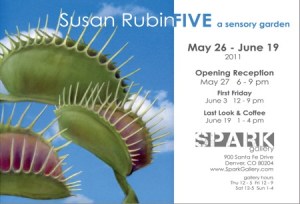
FIVE: a sensory garden
May 26 – June 19, 2011
SPARK gallery, Denver, CO

Botanical artist, Susan Rubin, will share her contemporary view of botanical art in an exhibition about plants, people, and the five senses.

As Susan explains in her statement for FIVE:

In an ongoing exploration of the relationship between people and plants, this group of drawings takes a closer look at the five senses and the way we experience our environment.

As babies, we touch and taste everything we see. As adults, we respond immediately to familiar sensations and make fast judgments based on past sensory experiences. Senses trigger one another. Just read the word “rose” and you can smell it. See a lemon and pucker up.

Smell is the sense most linked to memory. A whiff of Grandma’s perfume, the first Spring lilacs, or the charred scent of a campfire will snap you back in history faster than any photograph or story.

Beautiful, delicious, fragrant plants engage our senses, but it is not their job. It is coincidence that the sensory input of plants affects us at all. Their scents and colors and tastes are all geared toward one thing: species survival – theirs, not ours.

Textures and colors calibrate absorption of light and moisture; scent and markings attract pollinators; flavor and sound are related to ripening, decay and dehydration, which lead to dispersal of seeds and start the whole cycle again.

We are happy bystanders to botany, connected by our five senses.

View a gallery of Susan’s work online at Susan Rubin Studio.

Read Full Post »

New at Classes Near You > New York:


Cornell Plantations, Ithaca

www.cornellplantations.org
A collection of botanical resources comprised of Cornell’s arboretum, botanical garden, campus gardens, and natural areas. Cornell Plantations aims to preserve horticultural collections and natural areas for the public and for scientific research.

    The Joy of Botanical Illustration – Eight Thursdays, May 5, 12, 19, 26, June 2, 9, 16, 23, 2011; 6:00 – 9:00 PM.
    If you love botanical art but wonder if YOU could really do it yourself, this class is for you. Botanical artist Camille Doucet leads this introduction to painting the flora of the Plantations’ botanical garden. Participants will learn how to observe plants and how to draw them. They will also learn about perspective, composition and color mixing, and explore various media including pen and ink, colored pencil, and watercolor. A materials list is available upon request. Pre-registration is required. Cost: $288 nonmembers/$240 members (8 sessions). Individual sessions are $40 each for nonmembers and $35 each for members. This class will be held at the Brian C. Nevin Welcome Center.

    To register, please call (607) 254-7430 or email km274@cornell.edu.
    Additional Information

Read Full Post »

When Elaine Searle was enrolled in Anne-Marie Evans’ class by a friend, she did not know a thing about botanical art. That was in 2002.

Today in 2011, Elaine has work in the permanent collection at The Hunt Institute for Botanical Documentation and is a contributing artist to The Highgrove Florilegium, a collection of paintings documenting the plants grown in the Garden at Highgrove, the estate of HRH, The Prince of Wales.


How It All Began

Elaine received conventional art school training. After an initial year’s foundation program which included life drawing, ceramics, graphic design, etching and silkscreen printing, she chose graphics as a specialization before commencing a three-year Bachelor of Arts Degree. This decision shaped her first business career.

Graduating with an interest in Package Design, Elaine’s early career in the retail industry saw her build and manage teams of designers working on some of the most successful store concepts of the 1980-90’s. For the next 10 years, she ran a design partnership offering retail and print design to clients in the UK and Spain. This meant lots of business travel and a 24/7 schedule became the norm.

Elaine lived in an apartment in London during this time, with no garden and certainly no time to garden. Plants were not even a part of her life. Over time, Elaine became stressed with her business and a good friend told her she needed a hobby because all she did was work. The friend suggested that Elaine take a class in botanical art, something which she herself had recently done. Elaine’s reaction was, “What’s botanical art?”

Three months later, this concerned friend reserved a spot in Anne Marie Evans’ class for both of them. She told Elaine all she needed to do was show up.

Elaine showed up that first day. She returned on the second day too. However at the end of the second day, Elaine was strongly tempted not to continue.

Having used computers all of her professional life as a graphic designer, she had lost her drawing skills. She glanced rather than really looked and, in addition, didn’t even know the stamen in a flower were called stamen – referring to them as “the little bits in the middle.” She felt out of her depth. Coaxed by her very supportive husband, however, Elaine decided to return for Day Three.

That day proved to be a turning point. Anne-Marie’s teaching worked its magic and Elaine began to relax. During Days 3-5, Elaine’s experience with botanical art transformed from one of apprehension to intrigue to enthusiasm. She finished the five-day course in a much better place than when she started. After completing the course, Elaine returned to her full-time graphics business.

The experience of Anne-Marie’s class remained at the forefront of Elaine’s mind. She sought out botanical art books, traveled to exhibitions, and enrolled in more short classes. Her new obsession took on a life of its own. She contemplated joining the diploma program at the English Gardening School at Chelsea, where Anne-Marie was course director, and talked it over with her husband. Was it feasible that she could continue to run her design business, attend classes and keep up with the heavy schedule of homework? Well, her heart won over her head and she decided to enroll, financing the program with a bank loan. She structured her life so she could keep up with both her graphics business and the diploma course. Wherever possible, she made pragmatic choices – such as selecting specimens for her final project that did not move or change too much (succulents). After a hectic but very enjoyable two years, she graduated with a Distinction. Botanical art had become her passion, but financial realities meant that Elaine needed to resume her graphics business full-time.

Botanical art continued to lure Elaine. Whenever she met Anne Marie, her teacher would encourage Elaine to take her art further. Anne-Marie suggested she set her sights on the juried exhibitions hosted by the Royal Horticultural Society (RHS) in London.

Artists submitting work to the RHS exhibition are required to submit eight drawings or paintings related by a theme. Not having time to create a collection of new work, Elaine used the six succulent paintings which had formed her final project for the diploma course, painted two more, exhibited her work in January 2008, and was awarded a Silver gilt medal.

Then Anne-Marie suggested she submit work to The Hunt Institute for Botanical Documentation. Lacking the time to begin a project from scratch, Elaine sent two of those same succulents to The Hunt for their 12th Annual Exhibition, and now one of them is in the permanent collection. The exhibition gave Elaine her chance to attend her first American Society of Botanical Artists conference (which, incidentally, was also her first visit to the USA).

Elaine was surprised and honored by an invitation to paint for The Highgrove Florilegium. Elaine’s painting of Crocosmia ‘Emily McKenzie’ was accepted for inclusion in Volume I of the historic work. You can view this painting here on Elaine’s website.

While working on the Highgrove project, Elaine began to entertain the idea of teaching botanical art. She began by holding small classes locally. Wanting to see how things would go, she kept this new project low-key until she was more sure that it worked for her and her students. When she was given the opportunity to become a visiting instructor for the very diploma program she had attended in Chelsea, she gained additional and invaluable experience.

Well, word got out that Elaine was teaching, and she was invited to demonstrate at the 2008 ASBA conference and to teach at the 2009 conference. Elaine will teach again at the 2011 conference in Boston this Fall.

Elaine teaches in the UK, USA and Europe and plans and leads experiences in botanical art at vacation destinations such as Portugal and Italy. She recently launched a thoughtful and well-structured distance learning program for both beginning and experienced botanical artists.


A Conversation with Elaine Searle

ARTPLANTAE: Your paintings are not simple plant portraits. They have a presence on the paper. How do you decide on the statement your plant will make on the paper? What type of factors come into play — A plant’s physical features? Your first impression? Your past experiences with that type of plant? All of the above?

ELAINE SEARLE: Each plant has a personality. Sometimes It isn’t what you would first think of. For example, I recently painted a blue hydrangea. With its enormous “mop head” blooms and strong leaves I saw it as a “thug” in the garden. It demands your attention not because it is beautiful or brightly colored, but because of its architectural strength. I am drawn to plants that demand attention. I rarely paint herbs or wildflowers. Perhaps it’s time I did! I should find a way to give voice to their understated beauty.


AP
: What is your teaching philosophy?

ES: I believe people learn best in a safe and supportive environment. I try to take the fear out of the room. I want people to relax and to open their minds to what personally they might achieve. I like to share some of the mistakes I’ve made along the way. My teaching demonstrates that botanical art is a series of steps, which when broken down, are not difficult to learn. I don’t want to get too intense. The basic skills of watercolor painting are not complex, but to master them requires focus, determination and lots of practice. I always try to establish realistic expectations of what can be achieved within a short class. I think we often learn by making mistakes, and I think my teaching style is nurturing. I try to build confidence and discourage competitiveness.


AP
: How do you think students new to botanical art learn drawing best?

ES: I think they learn drawing with the fundamentals. By first learning to look, then to analyze, and then achieve sufficient control of the medium to be able to explain what they see. If they learn an approach based on breaking complex botanical forms down into simpler shapes and then build their drawings adding layers of refinement and detail, it reduces fear.


AP
: How do you think students new to botanical art learn painting best?

ES: By initially being introduced to a series of exercises that are not about painting botanical forms. They should be taught the correct brush hold and how to paint simple flat and graded washes. You can’t really tell someone the ratio of pigment-to-water they need. They need to practice making the paint do what they want it to do before they think about making flower or leaf shapes. Even now I still make squares of practice washes to loosen up or to try new pigments.


AP
: How do you think students with experience in botanical art learn best?

ES: They need to critique and to be critiqued without taking it personally. Learning how to critique is a valuable tool. The more experienced student needs to seek feedback from other more experienced artists whose work they admire and whose professional opinion they trust. Once they gain insight to where their strengths and weaknesses may lie, they can seek the specific tuition they need. Generally, the botanical community is a supportive one, so there are people willing to help them and share their knowledge either in the context of a masterclass or informally through discussion at an exhibition or conference. The more they are prepared to study the work of both historical and contemporary botanical masters, the more they will grow as artists.


AP
: You have developed a thoughtful and interactive distance learning program. Tell us about it.

ES: The idea for this program came out of a number of direct requests. To develop and launch such a program was not an easy decision. My own very positive experience of excellent classroom tuition made me aware that it’s very difficult for a distance learning program to match a classroom’s environment and benefits. Yet, there were clearly those who sought botanical art tuition, but were prevented from pursuing traditional routes to learning, and I wanted to develop a program that would work for those people. And, perhaps to act as an additional resource for those already taking periodic classes seeking a more structured and self-paced approach.

Researching other botanical art distance learning programs, I saw that there were basically two types. First, those which are small and very focused on a particular artist’s approach/techniques; or, second, those which were large, rather impersonal, and structured around “How to” manuals. I didn’t find that either embraced the capacity of the emerging technology of interactive learning via the Web in order to offer a more personal and nurturing environment.

Many questions arose. How could I translate the best of the classroom experience into home learning? How could I offer a structure, yet still tailor the program to some extent, to allow for differing starting levels of experience? How would I ensure that students felt motivated and supported throughout so that “distance” learning felt “up close and personal”?

The program launched in January 2011 is comprised of six modules introducing the student to the basics of observation, drawing and watercolor painting of botanical subjects. The later modules cover perceived problem colors, composition, creating textures, detail and depth.

A small group of students in the UK, USA and Japan have so far enrolled. Some are absolute beginners, others already take classes but like the idea of supplementing these with online learning. This is an evolving project and I have plans to add improved levels of interactivity, utilize video conferencing, etc. Watch my website – www.paintbotanical.com – for more news.


Office Hours with Elaine Searle

Now is your chance to ask Elaine questions about botanical art, her classes, and her new distance learning program. Elaine will hold office hours through the month of May. You are invited to submit questions to Elaine through the Comment form. Elaine will watch for your questions and will respond to all questions below.

Read Full Post »

« Newer Posts - Older Posts »